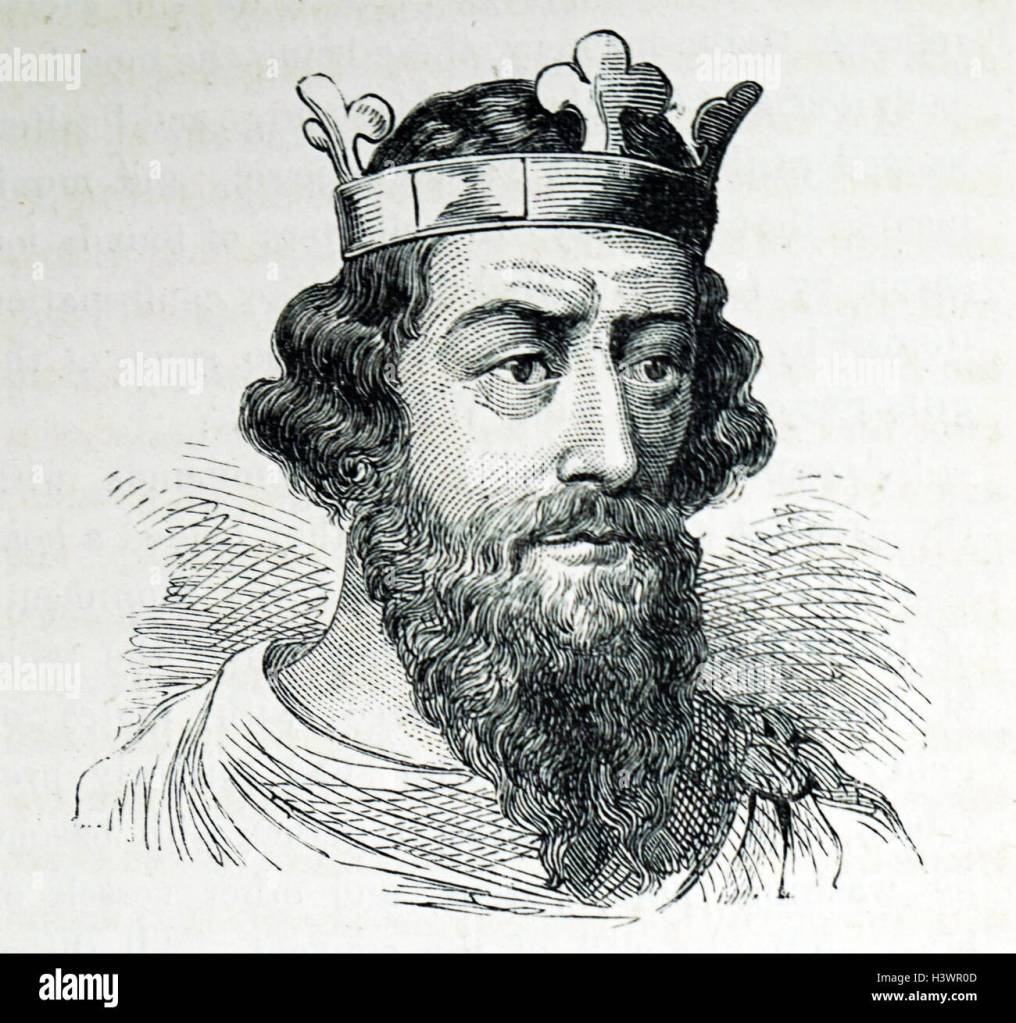
Chapter 27: From Tribes to Nations, by Kenneth Harper Finton
ALFRED THE GREAT
Alfred, the fifth son of his father, Æthelwulf, was a child of unusual talent and bearing. He was a handsome lad, prematurely an adult from his earliest days. At the age of five, Alfred was sent off to Rome . There, Leo IV confirmed him and hallowed him as “king”. This was most unusual, since at the time Alfred had three living brothers older than he in line for succession.
At age fourteen, the lovely Judith became the second wife of Alfred’s father, Æthelwulf. When he died two years later, she shocked the country by marrying her stepson, Æthelbald, who was Alfred’s brother. Upon his death, after a very short reign, she returned to France.and, in 862, married Baldwin I [Iron Arm], Count of Flanders.
During this time with hid mother in France, Alfred’s playmates were Charles, the boy king of Aquitaine, and his sister Judith, both children of Charles the Bald, Holy Roman Emperor and grandson of Charlemagne.
Again in 855 Alfred went to Rome with his father, possibly to secure some titles that were to be bestowed upon him. Two years later, his father died. Alfred’s older brother Æthelbald took the throne, followed shortly thereafter by Æthelbert who ruled until 866. Alfred the Great married Elsywyth of Mercia in 868. Elsywyth was born in 848 in Wantage, Berkshire, the daughter of Æthelred Mucil, who died on the 22nd of October of 899.
The Danes had occupied London and their army had been fortified at Reading. London was not the capital and bustling city of later years, but a town in the Kingdom of Mercia. From these points, the Danes moved forward and met the West Saxons on the Berkshire downs in January of 871. Here was fought the important Battle of Ashdown.
Though he was warned that the battle must be joined, Alfred’s brother Æthelred, the King, tarried for hours in his prayers. According to Bishop Asser, who left an account of Alfred’s life: “seeing the heathen had come quickly on the field and were ready for battle… [Alfred] could bear the attacks of the enemy no longer, and he had to choose between withdrawing altogether or beginning the battle without waiting for his brother. At last, like a wild boar, he led the Christian forces boldly against the army of the enemy… in spite of the fact that the King had not yet arrived.”
The battle lasted through the day. The King finally joined Alfred in the field. At last the Danes gave way and retreated, pursued by the Saxon forces until the whole length and breadth of the Berkshire downs [Ashdown] was filled with their corpses. One of the Viking kings and five of his jarls were found among the slain.
Though this battle did not break the back of the Danes, it takes its place in history for the significance of the issue. Had the West Saxons lost, all England would have fallen before the Danes. The victory restored the confidence of the West Saxons and gave Alfred the fame and support necessary to continue his resistance. When brother Æthelred died later that year, there was no debate as to whom his successor would be. At twenty-four, Alfred was King.
The Danes were strongly reinforced from overseas. Six or seven battles were fought and the Danes held their ground. The “summer armies” were difficult to beat and Alfred’s forces were whittled down through desertion and death. Alfred decided to come to terms while he still had an army left.
A treaty was signed whereby the Danes would make peace if the Saxons retreated and paid tribute. Alfred did so and enjoyed five years to consolidate his defenses and power. What led the Danes to make such a treaty is unknown, but a change had come over the Northmen. Those who had for centuries invaded and plundered had begun to take up the land. The sailors had turned soldier, the soldier turned yeoman. It was not that they wanted peace. They still desired all of England, but Alfred’s stubborn group had taken its toll. For now, they were content to settle the lands they already held.
Five years later Alfred’s truce ended. The Danes, under Guthrum, had developed a plan to take Wessex. Alfred sought peace and offered to pay a tribute for it. The Danes took the gold and swore they would keep the peace, but suddenly they seized Exeter.
Alfred and his troops were after them, but found them in a fortress where they could not be touched awaiting reinforcement. They lay siege for a month as the fortress ran low on supplies. The Danes finally decided to break away from the fortress by sea and sent more than a hundred longships to their rescue.
In those days, people believed that the weather was ruled by God and Alfred was fortunate to have God on his side. A dense fog followed by a frightening storm came over the sea. A hundred and twenty Viking ships were sunk and more than five thousand of the perjured Danes died before the storm’s onslaught. Alfred, watching safely from the shore, found the Danes in the mood for another treaty. This, they kept for five months.
In January of 878, Alfred’s fortunes reversed. While his army celebrated the Twelfth Night, the Danes swooped down on them in the dark, killing many. Most of his army fled to their individual homes and Alfred was left with a handful of officers and personal attendants, forced to take refuge in the swamps and forests of Somerset.
For some months he lived as did Robin Hood many centuries later. Here, Alfred found security in his wilderness retreat.
One day it was so cold that the waters were frozen underfoot. Alfred’s attendant shad gone out to find food enough to feed them for the day while Alfred stayed alone in the royal hut with his mother-in-law, Eadburga. The King always carried a writing tablet along with the Book of Psalms by David.
A poor man appeared suddenly at the door begging for bread. Alfred, in his usual manner, received the stranger as a brother and called upon Eadburga to give him food. She replied that there was only one loaf of bread and a little wine left in the pitcher, but Alfred insisted that he be given what was left. Alfred then fell asleep while reading. He dreamed that St. Cuthbert stood before him and said he had taken the form of the beggar. He told Alfred that God had noted his afflictions and assured him that his fortune was about to change.
When Alfred awoke, the beggar was not to be seen. The loaf of bread remained whole and the pitcher of wine was filled to the brim. Alfred recounted his dream to his mother-in-law. She said that she too had fallen asleep and had the same dream. While they still talked of the amazing event, the attendants returned with enough fish and fowl to feed an army.
Toward the end of Lent, the Danes attacked one of Alfred’s strongholds on Exmoor. According to Hodgson: “…in besetting it they thought the King’s thanes would soon give way to hunger and thirst… since the fortress had no supply of water. The Christians, before they endured any such distress, by the inspiration of heaven judged itto be better either to suffer death or to gain the victory. Accordingly at day-break they suddenly rushed forth against the heathen, and in the first attack they laid low most of the enemy, including their king. A few only escaped by flight to their ships.”
Eight hundred Danes were killed that day. Among the spoils of victory, the Saxons captured the sacred flag of the Vikings called “The Raven”. This enchanted banner whose lifelike bird fluttered in the wind was said to have been woven in one day by three daughters of Ragnar Lodbrok. According to Hodgkin: “…in every battle in which that banner went before them the raven in the middle of the design seemed to flutter as though it were alive if they were to have the victory.”
On this day, the wind did not blow and the raven hung lifelessly in its silken folds. News of this defeat was quick to spread. When Alfred heard of it he left his hideout and once again raised a call for arms. News that he was alive and well excited the masses and the warriors returned in great number. Soon, Alfred was again marching in front of a grand army.
They met the Danes on the downs at Æthandun, now called Eddington, and fought the culminating battle of all Alfred’s wars. Everything was at stake. Both sides dismounted their horses. The shield walls formed and the two armies clashed for hours with sword and axe. The Danes were routed and Guthrum found himself entrapped in his own camp. Desperate, he begged for peace, offering to give Alfred as many hostages as he desired if he would let him leave these lands forever.
Alfred, however, had other designs with a more farsighted point of view. He meant to make a lasting peace with the Danish king. They were in his power. He could have starved or slaughtered them to a man. Instead, he received Guthrum into his camp, entertained him for twelve days, convinced him to be baptized to the Christian faith, and called him his on. Realizing that East Anglia (a small territory north of London) was a Danish province, Alfred offered to divide the land with him so that both could share in the glory of the new nation.
“The sublime power to rise above the whole force of circumstances, to remain unbiased by the extremes of victory or defeat, to persevere in the teeth of disaster, to greet returning fortune with a cool eye, to have faith in men after repeated betrayals, raises Alfred far above the turmoil of barbaric wars to his pinnacle of deathless glory.” -Winston Churchill
Fourteen years of peace were to follow. Alfred began the gargantuan task of reorganizing his lands and brought culture back to his island nation. He restored London, rebuilt the walls and started the town on the road toward becoming the capital city. He reorganized the “fyrd”, dividing the peasantry into two classes which rotated service in forty day increments. Now the soldiers would not desert on long campaigns, knowing that someone was there to care for his lands and that he could return home and do the same shortly.
Next, Alfred’s attention turned toward the sea. He made great departures from the norms in ship design, building much larger vessels that rode higher and steadier than the others. His work was premature only due to the fact that the big ships were beyond the skill of the inexperienced seamen to handle.
He founded schools and universities and caused translations of great works to be made in the English language. Until his time the English had only written songs and epic poems. Alfred began the Anglo-Saxon Chronicle to compile the history of the land, and English prose was born.
The Laws of Alfred, continually added to by his successors, eventually grew into the English Common Law. Alfred’s Book of Laws or Dooms attempted to blend the Mosaic code with Christian ethics and Old Germanic principles. “Do unto others as you would that they should do unto you”, became in Alfred’s words: “What ye will that other men should not do to you, that do ye not to other men. By bearing this precept in mind a judge can do justice to all men. He needs no other law books. Let him think of himself as the plaintiff and consider what judgment would satisfy him.”
He gathered scholars about him. He used every spare hour he could to read. He also listened to books read by others. He carried with him a little handbook, constantly pausing to write down thoughts as they occurred to him. The singers in the court found Alfred to be a fellow troubadour. He loved to gather the old songs of his people. He taught these songs to his children. The children that he raised proved to be the most able leaders of their time.
Alfred drew up plans for buildings. He took care of the affairs of his court. Alfred instructed craftsmen in their workings with gold. He would pause in his travels to converse with strangers. He taught even the falconers and dog breeders new things about their business. It seemed there was little in the world of ideas with which he was not more than adequately familiar.
He spent many an hour soothing his depressions with the music of the Psalms. He wrote: “Desirest thou power? Thou shalt never obtain it without sorrows–sorrows from strange folk, and yet keener sorrows from thine own kindred… hardship and sorrow, not a king but would wish to be without these if he could. But I know that he cannot.”
Alfred took the time to translate books into English himself. Yet, he was more than just a translator. He was an editor for his people, omitting this, expanding upon that, changing the whole design of English literature.
One final war was Alfred’s lot. The Vikings had invaded France, sailing up and down the rivers with every device of war known to man. They laid siege on Paris; they invaded Germany. The Danes seemed to fan out in all directions. However, they faced resistance on too many fronts. It was more than they could handle. Once again Viking ships looked toward England. Guthrum died in 891, keeping peace with Alfred to his last breath, but with his death, Guthrum’s Peace ended. The next year, a hostile armada of two hundred and fifty Viking ships arrived. They landed at the edge of the forests near Appledore. A second force of eighty ships sailed up the Thames. Kent was to be attacked from two sides.
Alfred had prepared the country well. Food and wealth had been gathered again. Additionally, Alfred’s twenty-two year old son, Edward, had become an able commander. He could lead his father’s forces in the field. Alfred avoided war for several years. He preferred to pay some Danegeld to Haesten, the Viking king. This payment was for promises of peace. Alfred also convinced Haesten to have both his sons baptized as Christians.
In 893, a third force arrived and attacked Exeter. Young Prince Edward routed the raiders. He sent them swimming up the Thames for their lives. The Danes had fortified themselves below London. Edward and his brother-in-law, Æthelred, raised a strong army in London, then fell upon the Danes at Benfleet. According to the Anglo-Saxon Chronicle: they “put the army to flight, stormed the fort, and took all that was therewithin, goods as wells as women and children, and brought them all to London.”
Among the hostages were the Danish leader’s wife and two sons. Alfred sent Haesten’s wife back to him on humanitarian principles, an act unheard of and highly criticized for many years.
“As for the two sons, they had been baptized; he [Alfred] was Godfather to one of them, and Æthelred of Mercia to the other. They were therefore Christian brethren, and the King protected them from the consequences of their father’s wrongful war. People in the ninth century found it very hard to understand this behavior. During that time, the kingdom was fighting desperately against brutal marauders. However, this is one of the reasons why in the after-time the King is called ‘Alfred the Great’. The war went on, but so far as the records show Haesten never fought again. It may be that mercy and chivalry were not in vain.” -Winston Churchill
“So long as I have lived,” Alfred said, as death closed in upon him, “I have striven to live worthily.”

 Kenneth Harper Finton