Dimensions: Building Blocks of the Universe

Einstein recognized four dimensions, length, width, height and space-time. Since our eyes only see three in three dimensions (they cannot see space and time) comprehending the additional dimensions is both difficult and theoretical. Modern scientific theories call for at least ten dimensions, possibly as many as twenty-six or even an infinite number of dimensions. Though there is little agreement among scientists as to the natures of the additional dimensions, they are confident that there are more than four. Ancient Vedic texts speak of sixty-four dimensions long before modern science and mathematics was envisioned.


In zero dimension there are no measurements, but the zero also contains the point or the dot. It is the zero  point. No numbers are needed to identify its position. The point is infinite in that it is present everywhere at once with no time, spacial measurements or observation needed. Zero dimension is thus infinite, as is the first dimension of the point.

Whywecannotseegod0.png

The first dimension gives birth to the line. The line contains an infinite number of points. The line is symbolic of the future. The awareness inherent in the zero dimension creates a symbolic future, that forms a trajectory. Two dots are needed to define a line. Any other of the infinite dots on that line can be located on that line using one number. We can observe the distance to the second dot to the zero dot by using the distance between them as a unit of measurement. On a ruler, the first dots can be at 0 and the second dot is at some measurable length from the 0.

The second dimension is the plane. It contains an infinite number of straight lines. The second dimension represents the present or the now. We need two numbers to identify a point on a plane. Mathematicians call these the ‘x’ and the ‘y’ axis. The illustration represents four dots connected on a plane.

6-dimensions-of-user-interface-design-1st-dimension-a-line-length

The third dimension is where energy observes itself and congeals into matter. This is the plane where thought and mind comes into play. To understand this, we need to realize that thought and mind are universal entities, not simply products of organic nervous systems. We need to understand that awareness and the unconscious mental processes are essential to the manifestation of actuality itself.

The third dimension is the plane where awareness observes the flatness of the first two dimensions and projects it into objects and events. In the third dimension, three numbers determine the distance of an object in space. These are usually called ‘x,’ ‘y’ and’ z’. The third dimension is observed from above the plane. The operating word here is ‘observed’. Without the unconscious awareness observing an object from above, there can be no third dimension and no object to observe.

3 dimension

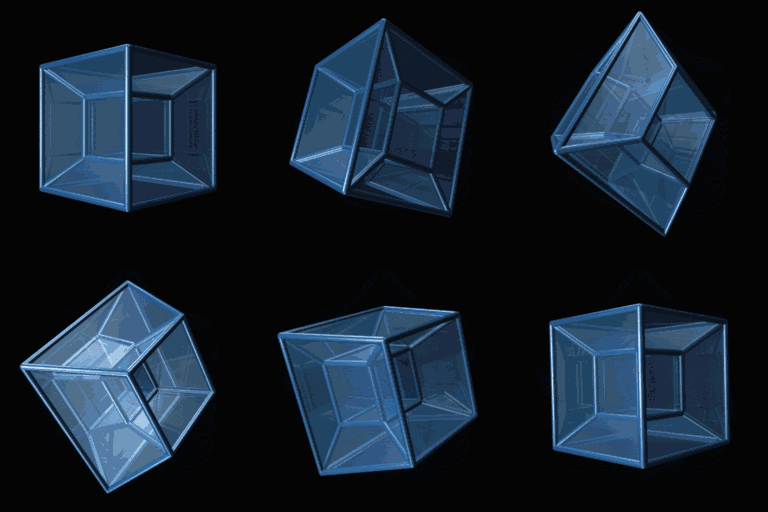
The fourth dimension is space-time. This is the dimension that we live within. Four numbers are needed to place an object in space-time. Three of these numbers set the position in space, and one of the numbers give duration for setting the time. We live in a four dimensional world. The fourth dimension is the gateway to universal formation. Space-time is the unification of time and space as a four-dimensional continuum as in Minkowski space, the mathematical setting for special relativity.

Simple4C

The fifth dimension is where possibility begins. The fifth dimension begins the building of universal imagination. Images-in-action appear in this dimension, as unconscious awareness begins to imagine other possibilities and other possible events and different potential worlds.

A five-dimensional space is a space with five dimensions. If interpreted physically, that is one more than the usual three spatial dimensions and the fourth dimension of time used in relativitistic physics. It is an abstract which occurs frequently in mathematics, where it is a  legitimate construct. In physics and mathematics, a sequence of N numbers can be understood to represent a location in an N-dimensional space.  The geometry of the fifth dimension studies the invariant properties of such space-time, as we move within it, expressed in formal equations.

See: http://www.huffingtonpost.co.uk/henryk-frystacki-phd/discovery-of-the-fifth-dimension_b_2858709.html

Mixed_by_La_Truffe_-_4th_Dimension.gif

Six-dimensional space is any space that has six dimensions, that is, six degrees of freedom, and that needs six pieces of data, or coordinates, to specify a location in this space. There are an infinite number of  these, but those of most interest are simpler ones that model some aspect of the environment. Of particular interest is six-dimensional Euclidean space, in which 6-polytopes and the 5-sphere are constructed. Six-dimensional elliptical space and hyperbolic spaces are also studied, with constant positive and negative curvature.

See: https://en.wikipedia.org/wiki/Six-dimensional_space

6Cube-QuasiCrystal

Beyond the fifth dimension, dimensions are imperceptible to our senses. They are highly theoretical, mathematical in nature.  That is to say, equations can describe them but we cannot see them.

The existence of extra dimensions is explained using the Calabi-Yau manifold, in which all the intrinsic properties of elementary particles are hidden. If the extra dimensions are compacted, then the extra six dimensions must be in the form of a Calabi–Yau manifold (shown below). While imperceptible as far as our senses are concerned, they would have governed the formation of the universe from the very beginning. Hence why scientists believe that peering back through time, using telescopes to spot light from the early universe (i.e., billions of years ago), they might be able to see how the existence of these additional dimensions could have influenced the evolution of the cosmos.

CalabiYau5

Seven-dimensional space in mathematics, is a sequence of n real numbers can be understood as a location in ndimensional space. When n = 7, the set of all such locations is called 7-dimensional space. Often such a space is studied as a vector space, without any notion of distance. Seven-dimensional Euclidean space is seven-dimensional space equipped with a Euclidean metric, which is defined by the dot product.

More generally, the term may refer to a seven-dimensional vector space over any field, such as a seven-dimensional complex vector space, which has 14 real dimensions. It may also refer to a seven-dimensional manifold such as a 7-sphere, or a variety of other geometric constructions.

Seven-dimensional spaces have a number of special properties, many of them related to the octonions. An especially distinctive property is that a cross product can be defined only in three or seven dimensions. This is related to Hurwitz’s theorem, which prohibits the existence of algebraic structures like the quaternions and octonions in dimensions other than 2, 4, and 8. The first exotic spheres ever discovered were seven-dimensional.

See: https://en.wikipedia.org/wiki/Seven-dimensional_space

Another theory about the seventh dimension is that it grants access to the possible planes that start with different initial conditions and other points in space-time than our own. A point in the seventh dimension consists of all the possible worlds that start with the different initial conditions from our own space-time and leads to all the possible endings to which such an initial condition can possibly go. In the fifth and sixth dimensions, the initial conditions were the same as our own space-time and subsequent actions and events were different. In the seventh dimension everything is different from the very beginning of time.

See: http://www.universetoday.com/48619/a-universe-of-10-dimensions/

Eight dimensional space, in mathematics, is a sequence of n real numbers can be understood as a location in ndimensional space. When n = 8,  the set of all such locations is called 8-dimensional space.

Often such spaces are studied as vector spaces, without any notion of distance. Eight-dimensional Euclidean space is eight-dimensional space equipped with a Euclidean metric, which is defined by the dot product.

Generally the term may refer to an eight-dimensional vector space over any field, such as an eight-dimensional complex vector space, which has 16 real dimensions. It may also refer to an eight-dimensional manifold such as an 8-sphere, or a variety of other geometric constructions. See: https://en.wikipedia.org/wiki/Eight-dimensional_space

The ninth dimension contains all the possible universes and histories whether or not they shared the same starting point in space-time. The ninth dimension includes all the possible laws of physics and initial conditions.

The tenth dimension is the point in which everything possible and imaginable is contained. It contains the history and records of all that has ever existed.

See: http://www.universetoday.com/48619/a-universe-of-10-dimensions/


THIS BOOK IS FREE  FROM AMAZON

The above is a sample chapter from the book Nothing Is Real: A metaphor for greater ideas. Not all the chapters are this complex and obtuse. The majority of the essays and articles are written in easy to understand prose. Free samples available and no cost review copies are available upon request from the author.

NOTHING COVER

Infinity precipitates all things. Nothing  becomes real, though nothing is real. Once experience begins there is no stopping it. Once movement defines space and contains enough duration to be felt, an entire universe is born.

http://www.amazon.com/dp/B01AU3C3CY

http://www.amazon.co.uk/Nothing-Real-metaphor-greater-ideas-ebook/dp/B01AU3C3CY/ref=sr_1_1?s=digital-text&ie=UTF8&qid=1454095060&sr=1-1&keywords=nothing+is+real

http://www.smashwords.com/books/view/609430

https://itunes.apple.com/us/book/nothing-is-real/id1076006346?mt=11

CLAUS VS. CORPORATE PERSONHOOD

Santa Claus

Claus checked his ledgers in Quickbooks. It was not a task he enjoyed.

He fondly remembered the days when the smoke encircled his head like a wreath. He quit smoking a pipe a decade or two ago, but he still missed the pungent aroma of his tobacco. What he did not miss was the sore tongue and hacking cough he would often get.

When Christmas was taken over by the corporate gift manufacturers he had shaken his head and withdrawn in total disbelief.  “How could they corner the market on gifts so quickly,” Claus remembered saying.

He had long since had to retire much of his elf force. The elves just could not compete with the prices the corporations charged for general gifts of all shapes and sizes. Soon metal toys replaced his home-made-by-elfen-hands wooden toys.

As if that were not bad enough, the metal toys makers cut back on production and the plastic toy makers flooded the market with every size and shape of plastic toys that were conceivable. The oil cartel would not sell the oils for making plastics to the North Pole Charitable Organization, St. Nicholas, Proprietor.

For Claus, these were perilous times.

One day a group of corporate lawyers met with Claus to discuss the possibility of his contracting for delivery for their orders.

“We will allow you to charge a delivery fee,” they proposed. “It could be a very big deal for you. Remember, you are not getting any younger. Long term care is expensive and we can sell you insurance for that out of the money you charge for delivery of our goods.”

Claus had to think about that: a delivery fee for Santa. Extraordinary, to be sure, but in step with the times. Tradition breaking.  But these are times to try a person’s pocket book.

When he examined his ledger on Quickbooks, he could easily see that he had been running at a loss for almost five hundred years.  “Why, then,” he thought, “would I need long-term care insurance? These men must think me to be a sucker.”

“If they keep it up, the way it is going,” Claus thought, “then I may as well retire. They do not understand that the gifts were not what I delivered. I delivered the love that made the gifts, not the gifts themselves. It has always been so, as long as my spirit has been around. If love no longer makes the gifts, then my delivery is in vain.”

The corporate lawyers did not agree with Claus. “Love” they said, “was a personal thing and the corporations are personal, therefore what they made was made with love, as Clause has admitted that love is what he delivered to persons like the corporations.”

Clause could not quite follow their logic.

Of course, the debate ended up in court.

The parties were forced to define some kind of argument for a favorable judgment. Who had been injured? Who had been financially cheated? What was the duty, if any, for Claus?”

Claus argued that because he had been working gratis of his own free will, there was no loss at all.

The corporations argued that Claus could not have a monopoly on love giving, that they were entitled to give love as well and could do it better than an old white guy that does not appeal to the Muslim and the Buddhist nor the Hindu faiths, among many others. We, they claimed, have a far better market share in love giving that is good for the world economy as a whole.

The court ruled that corporations were better fitted to distribute love than The North Pole Charitable Organization, St. Nicholas, Proprietor.

Claus retired, forced out by world non-opinion and legal issues.

Due to his eternal nature, he still distributed his love where it is most needed.

Let us hope he is not ordered to cease and desist.

THE MISCARRIAGE

by Kenneth Harper Finton ©2015

songs1Cassie’s seventeen-year-old son, Rob, left home with his dog Ozzie more than three weeks ago. The dog was picked up by the dog catcher and taken to the pound. Rob had not said a word about it. When Rob finally called the pound, he found that the dog had been terminated.

Cassie was very upset, blaming Mark at first for letting Rob take the dog away. Mark was not happy either. It made him very sad, especially as Cassie said, “That should not have happened. That situation should not have been allowed to exist.”

In principle, Mark agreed with her sentiments. Life was at stake, yet something more as well. Rob made no effort to talk with his parents about the dog. He had failed to make arrangements for a possible home for the dog. Rob had quit several jobs and had not worked more than a day since he’d been back. He spent his time dreaming of making it quickly in the world without preliminaries, hanging out with his friends and drinking.

It was his dog and it was his decision. It was not a decision his parents could control. In fact, they had very little, if any, influence on Rob since he had been back. The past few months had been filled with stress and worry about whether or not they were doing all they could to help straighten out Rob’s life. They truly wanted things to work out for the best, but the stress told heavily on both of them–showing up as bowel trouble in Mark, a lack of ability to sleep in Cassie, and trouble keeping their minds on their tasks. There was an unaccustomed tiredness in their steps and an inability to enjoy their time and work.

Mark felt very bad about the dog. He wished there had been another alternative. He wished he had interfered and found another home for the dog. Yet, wishing changes little, and he doubted that much would have changed had he been able to live the past month over again.

They arose that morning with Cassie feeling quite ill. She threw up before noon. They were to have left for the mountains by four o’clock yesterday but were delayed with the news Ozzie the dog’s death. Instead, they talked to Rob for a while and went to check the pound in case an error was made, but the pound was closed.

While getting supplies for the trip, Cassie picked up a pregnancy test. When they returned home, the results were positive. Both of them were flabbergasted. They had not used birth control for more than ten years. They talked about having a baby four or five years ago, but since they thought it was not possible, they never took it further. Suddenly, a new, life-changing reality knocked on the door.

The weekend was spent getting used to the shock that they were to have a new family member. They were invited to a hot springs resort by Roy Frank and his wife Nancy when they stopped over at their home in Coal Creek Canyon to give them some copies of the wedding videos that Adam had made early last month. Roy is a chiropractor, Nancy a nurse. Roy plays bass, harp, guitar, and drums. Mark had been getting together with Roy to play music for the parties that he has been throwing.

They finally rolled out of town about four P.M. and drove down to the mineral hot springs just north of Alamosa in the San Luis Valley.

The hot springs are only open to the general public during the week. They sell memberships, limited to around five hundred yearly. Members can have guests on the weekends. Roy had been a member for a number of years and was often raving about the place, so Mark and Cassie decided to check it out. Though their minds were not entirely on relaxing that weekend, they managed to do so anyway.

It was cold and snowing Friday when they left. A bit of the chill had filtered far south, but the temperature was moderate and quite a few people were at the resort despite the chill. Mark and Cassie soaked in the main pool that first night for several hours. It was the closest of the two hot pools, the other being a twenty-minute walk up a steep mountain trail to the spring headwaters. The upper pool is generally warmer than the lower pools. The resort had accommodations, some of them free with admittance fees, others available at a small charge of $10 per night. There were also camping facilities spread in secluded spots about the mountainside. There was a hostel with a common gathering room, an Olympic-size pool with hot spring water and a fine sauna that had a cool brook running through it pool for dipping when the heat got too hot to bear. Bathing suits are optional, as there were no changing rooms at the hillside pools. Most of the members opted for that privilege, though it was not a nudist colony. Most of the members were old hippies who had become successful or affluent enough to afford the dues. They gathered often and partied like the old days.

Mark and Cassie stayed Friday through Monday. Perhaps they were not quite the enjoyable company they might have been, but they still had a good time. Much of the time their thoughts centered on the pregnancy and what they should do differently. They were unprepared. They had no insurance, little savings, and a lot of doubts about their ability to begin another round of child raising after all this time.

By Christmas, Cassie was four months pregnant. Right after Christmas, they went to the hospital for an ultrasound. The baby could be seen swimming around, moving quite a bit. It looked rather alien in the video monitor, skeletal features, strange colors, and a visible heart. “We’ll call her Demi if she is a girl and Frank if he is a boy,” Cassie said, her eyes a-twinkle. “We’ll name it after your grandparents.”

Two weeks later, on a clear, cool day with Colorado blue hanging in the heavens, they felt productive and well. Cassie had a routine appointment for a prenatal exam. Mark was writing as Cassie came in the door. The sun was seating itself behind the mountains. Outside, the air grew chill.

“Well, how’d it go?” Mark asked.

“Not well,” she spoke. She had a cry in her voice. Her mascara was smeared around her eyes. “They can’t hear the baby’s heartbeat.”

“What!”  Mark lunged forward. “Oh, nooooooo.”

Quickly, they dashed to the emergency room. Suddenly, the day turned cold, the night descended and hideous terrors lurked in the shadows. A nurse ran another heartbeat test, amplified for all to hear. Cassie lay awkwardly on the table, the stethoscope grinding out noises like an amateur disc jockey trying to find the groove. Between the grinds, Mark listened carefully for the pump-pump-pump thump of a living heart. He wanted to hear the sounds of life, but his ears were rewarded only with the cold sounds of silence.

Mark felt like a soldier in a foxhole. Part of him wanted to say, “Prime Mover, if you’ve got anything on the ball at all, you’ll let me hear something but this silence.” Like the soldier in the foxhole, he heard only the sounds of battle as the microphone head scraped against cloth.

A portable ultrasound was wheeled in the room. It soon confirmed the silence of the heartbeat. The only movement was Cassie’s. The baby was dead. It had been dead for a week. Mark could see it in the monitor. It was so strange––this moving, big-headed life form he had seen in negative just two weeks ago lay motionless. The heart that had pulsed so strong was stilled.

Suddenly, new ghouls appeared on the horizon. The baby had to come out. Cassie was carrying death within her. That bastard was much to close. Could more be lost to this hopeless battle? Could it be that Mark alone could return from this quick journey, return to a life changed, a self in pain and transition?

Shudder that thought and chill the moment.

But the moment recurs.

The mind–left to itself–thinks of itself, fantasizes the worst while hoping for the best, searches for expert opinion, and, in finding it, mistrusts it once again to hoe those fields of sorrow and despair. Like a bad dream, a nightmare waking, you need to shake it from you like dust from the rug. Rise up you blackened thoughts. Come quickly and rise to a positive acceptance, even while knowing the inevitable is always nigh.

Powerful drugs were administered to induce labor. Cassie began to shake like the leaves of an aspen, every muscle trembling without ceasing.

It went on.

The vomiting began. The pain in the stomach was not really tolerable, but tolerate she must. Her body heaved a sheet of pain––an electric, hurting spasm.

Adam’s throat hurt. His senses numbed.

In a close room, a woman screamed and moaned awfully. The remoteness of her pain, her unseen face, made tolerable the noise. Then the screaming ceased, she cried, “My God, he’s born.”  And moments later, a baby’s wailing cry.

Somehow it seemed right–in this specter of death, new life announcing itself … and, yet, for Mark and Cassie, how strange and how sad.

An attendant shot Cassie with a painkiller. Her trembling slowly stopped as she fell into a restless sleep to fight the demons within her.

By three o’clock in the morning, her water broke.

Mark had slipped off into the night, lit the furnace in the camper and plopped fully clothed on the icy blankets, pulling a comfort over and succumbing to the exhaustion felt inside. Gwen, a close friend of Cassie’s, stood on bedside watch.

At 5:30 Mark was awakened by Gwen, out of breath, running, “Come quick! It’s over. The baby came out.”

It was quick. Feeling the need to urinate, Cassie had the nurse bring the bedpan and began the final contraction as Gwen ran for the truck.

A young, lithe woman doctor with long brown trusses who attended the delivery stated the facts:

1. It was a girl. 500 grams. Two pounds.

2. Said infant was well formed and pretty.

3. Said fetus had been dead a week.

4. Death occurred from the separation of the placenta from the uterus wall. (The umbilical cord, the lifeline to the mother’s womb, was loosed and scarred. Smooth on the end as a leather shoe).

5. That which caused this to happen is now and forever unknown.

Pictures were to be taken. Footprints were made. Certificates had to be filled. Arrangements were made.

And did they want to see her?

Yes.

They brought her to Mark and Cassie in a pink blanket. She was very small, perhaps seven inches long. Her skin was brownish blue and dark from the moist entombment in the black and bloody fluids.

Her face seemed covered partially by a veil, a beautiful woman’s face, well shaped and delicate, closed eyes that never saw the light of day.

“Oh, my,” Cassie said, “Oh, my.”

Visions of that face in negative, alive and kicking on the monitor of the ultrasound haunted Mark, came back to him in vivid color. This was the shape he had seen before, the colors reversed and not as brilliant.

Mark’s thoughts ran back to his grandmother, Demores, who was born smothered in a veil and went on to live a life of eighty years and bring much joy and creativity into this world. This Demi, her own namesake, was born only to the waters of the womb.

Be that as it is … was … perhaps will be again.

No pain upon this infant, no troubled thoughts nor learning. A mass of flesh and bone, sinew and nerve without experience?

Perhaps.

And yet a woman’s face was there, unfamiliar … strange, enchanted.

Mark and Cassie spoke of wasting a name on one that had no life. But there was little choice. This was little Demi.

She only had her name.

They could not take it from her.

After a few hours rest, Cassie responded as well as possible. She was up and walking soon. They moved her out of maternity to a private room with a lovely view of the city and the mountains. They had time then to rest their jangled nerves. Later they could make new plans.

The plan was to bury her homestead style in a crude pine box that Mark would make himself. They wanted to take her to a high mountain valley and place her down beneath the western sky.

Red tape got in the way. The hospital would only release the body to a funeral home. The funeral home had to provide the state with a certificate of burial. Instead, they chose cremation and the burial of the ashes at a sight of their choosing at some later date. Above the grave, a carved board would read:

Demores Walker, born 1992, died 1992.

Never had a fucking chance.


FOR MORE IN THIS SERIES SEE: https://kennethharperfinton.me/2014/10/10/from-whence-cometh-the-song-1/

https://soundcloud.com/khf333/moon-on-the-mountain

BITTERSWEET

by Kenneth Harper Finton

Bitteresweet


Maybe I am jaded now

or just too old to cry.

All the tears I’ve shed before

Have left my eyes quite dry.

Friends have come and friends have gone, 

how bittersweet is nature.

Work is really never done,

wars are really never won, 

lives are always left undone,

success is never measured.

Blisters used to pain my hands

’til callouses replaced them.

Caring always filled my days,

’til lack of it displaced it.

Friends have come and friends have gone, 

how bittersweet is nature.

Work is really never done,

wars are really never won, 

lives are always left undone,

success is never measured.

Living always pleasured me

and sorrow seldom ailed me,

but Father Time has dried me out

and left no room for wailing.

Friends have come and friends have gone, 

how bittersweet is nature.

Work is really never done,

wars are really never won, 

lives are always left undone,

success is never measured.

Anti-Islam Propaganda

12208604_980033425352897_7041136503211647923_n

It is not so much that Islam is a peaceful religion designed to co-exist with others, but outright misrepresentations such as the above are making their way around the world. Remember, Christians’ war against Christians and all religions that believe they are the only truth are false ideologies.

Verse by verse, you can see the result of the attempt to make was on Islam. See: http://corpus.quran.com/translation.jsp?chapter=3&verse=85

At the above site, you can read seven parallel translations of each verse and see the original Arabic in a word-by-word translation. This mistranslated propaganda is obviously created to provoke tension and war.

Verse (2:191) – English Translation

As above: “Slay the unbelievers wherever you find them.”

Shakir: And kill them wherever you find them, and drive them out from whence they drove you out, and persecution is severer than slaughter, and do not fight with them at the Sacred Mosque until they fight with you in it, but if they do fight you, then slay them; such is the recompense of the unbelievers.

Verse (3:28) – English Translation

As above: “Muslims must not take the infidels as friends.”

Shakir: Let not the believers take the unbelievers for friends rather than believers; and whoever does this, he shall have nothing of (the guardianship of) Allah, but you should guard yourselves against them, guarding carefully; and Allah makes you cautious of (retribution from) Himself; and to Allah is the eventual coming.

[Editorial note: Ir is quite common for sects to stay within their own congregations and ethnic populations to pocket in foreign areas.]

Verse (3:85) – English Translation

As above: “Any religion other that Islam is not acceptable.”

Shakir: And whoever desires a religion other than Islam, it shall not be accepted from him, and in the hereafter he shall be one of the losers.

Verse (8:12) – English Translation

As above: “Maim and crucify the infidels if they criticize Islam.

Shakir: When your Lord revealed to the angels: I am with you, therefore make firm those who believe. I will cast terror into the hearts of those who disbelieve. Therefore strike off their heads and strike off every fingertip of them.

Verse (8:60) – English Translation

As above: “Muslims must muster all weapons to terrorize the infidels.”

Shakir: And prepare against them what force you can and horses tied at the frontier, to frighten thereby the enemy of Allah and your enemy and others besides them, whom you do not know (but) Allah knows them; and whatever thing you will spend in Allah’s way, it will be paid back to you fully and you shall not be dealt with unjustly.

Verse (8:65) – English Translation

As above: “The unbelievers are stupid; urge the Muslims to fight them.”

Shakir: O Prophet! urge the believers to war; if there are twenty patient ones of you they shall overcome two hundred, and if there are a hundred of you they shall overcome a thousand of those who disbelieve, because they are a people who do not understand.

Verse (9:5) – English Translation

As above: “When opportunity arises kill the infidels wherever you find them.”

Shakir: So when the sacred months have passed away, then slay the idolaters wherever you find them, and take them captives and besiege them and lie in wait for them in every ambush, then if they repent and keep up prayer and pay the poor-rate, leave their way free to them; surely Allah is Forgiving, Merciful.

Verse (9:30) – English Translation

As above: “The Jews and Christians are perverts, fight them.”

Shakir: And the Jews say: Uzair is the son of Allah; and the Christians say: The Messiah is the son of Allah; these are the words of their mouths; they imitate the saying of those who disbelieved before; may Allah destroy them; how they are turned away!

Verse (9:123) – English Translation

As above: “Make war on the infidels living in your neighborhood.”

Shakir: O you who believe! fight those of the unbelievers who are near to you and let them find in you hardness; and know that Allah is with those who guard (against evil).

Verse (22:19) – English Translation

As above: “Punish the unbelievers with garments of fire, hooked iron rods, boiling water, melt their skin and bellies.”

Shakir: These are two adversaries who dispute about their Lord; then (as to) those who disbelieve, for them are cut out garments of fire, boiling water shall be poured over their heads.

Verse (47:4) – English Translation

As above: “Do not hanker for peace with the infidels; behead them when you catch them.”

Shakir: So when you meet in battle those who disbelieve, then smite the necks until when you have overcome them, then make (them) prisoners, and afterwards either set them free as a favor or let them ransom (themselves) until the war terminates. That (shall be so); and if Allah had pleased He would certainly have exacted what is due from them, but that He may try some of you by means of others; and (as for) those who are slain in the way of Allah, He will by no means allow their deeds to perish.

INSULTS

INSULTS

by Kenneth Harper Finton

The definition of a verbal insult is to disparage and speak with abuse and disrespect. People in the public eye are often insulted. You write song and you can be sure there will be those who doe not like it. You paint a picture and you can be sure some call it terrible. You write an article and someone calls you a hack. Receiving insults are part of being known by your peers. The adage is that we must develop ‘thick skin’ so that we remain unaffected by verbal and indirect defamations.

Unknown-1There are many ways to deal with insults and disparaging remarks. Some work better than others. Anger is probably the worst way to deal with an insulting person. It shows the insulter that we take them seriously and suggests that there is some truth to the insult.

When we are insulted, we are forced to judge the person doing the insulting. Do they have a valid point? Is their remark worth a retort? Is the insult really a statement of fact that we can learn from?

The first reaction to being insulted is to return it. This is the famous “put down” approach. The problem with this is that we must be very clever to do this. There is a problem with this approach in that is tends to raise the insulter to higher level and can add credence to the accusation. Very clever minds can come up with wonderful retorts. Winston Churchill, for example, said to a woman who called him a drunk said: “I may be drunk, Miss, but in the morning I will be sober and you will still be ugly.”

“Put down” reactions are best made with humor and among friends. Few of us have the ability to be so clever as this in an instant. Dorothy Parker was an exception. When a drunk told her that he could not bear fools, she replied:  “Apparently your mother could.”

As we can see, humor is possibly the most effective retort to an insult. It not only mitigates the seriousness of the situation, but mocks the insulter. If there is an audience, they are brought to  your side, not the side of the disparager.

Those who are not so quick might find that ignoring the insult might be the best imagesremedy. The down side there is that when someone throws mud at you, some of it is going to stick. Ignoring an insult is also likely to show that you are not in control any longer. This turning of the other cheek might me the Christian approach, but repeatedly ignoring a barrage of insults is harmful to your self-esteem. “Hear no evil, see no evil, speak no evil” does not rid the world or your persona of evil. It might be better to study a few clever retorts and have them at your fingertips.

Most people who bully and throw insults do so out of personal insecurity. They are trying to cover up their own inadequacies. Developing ways to point that out is a good defense. If someone calls you a fat pig, you can say, “I love pigs. Don’t you think bacon is the greatest.”

If you chose to say nothing at all, you can walk away freely and say, “You have crossed the line and I have nothing more to say.”

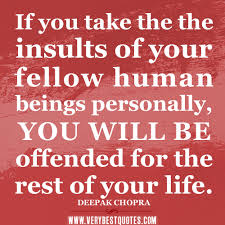
UnknownDeepak Chopra has it right. You cannot go through life and not be insulted. The pain caused by insults are symptoms of a more universal human condition. In the social hierarchy where people have the need to be among people, insults will surely result. Wolves and other predators fight to establish an order for their pack. Humans more often use words. As children we are taught that “sticks and stones may break my bones, but words can never hurt me.”

Unfortunately, that is not so. Words do hurt. We are naturally wired to seek social acceptance and we feel good when we get it. A jibe from a good friend might not hurt us, but we feel we lose status when strangers do the same.

It all comes down to not taking ourselves and the world so seriously. When we do, we feel bad and get depressed. It is better to listen, evaluate what we hear and see if there is any truth to the mud that is slung at is. Those who speak bullshit will always have a trace of it on their lips.

Antidepressant Studies Found Tainted by Pharma Company Influence

Docs and Big Pharma

BIG PHARMA CONTROLS THE RESULTS OF THEIR OWN STUDIES. THIS CONFLICT OF INTEREST NEEDS TO BE REGULATED.

“The medical profession is being bought by the pharmaceutical industry, not only in terms of the practice of medicine, but also in terms of teaching and research. The academic institutions of this country are allowing themselves to be the paid agents of the pharmaceutical industry. I think it’s disgraceful.”  – Arnold Seymour Relman (1923-2014), Harvard Professor of Medicine and Former Editor-in-Chief of the New England Medical Journal

“It is simply no longer possible to believe much of the clinical research that is published, or to rely on the judgment of trusted physicians or authoritative medical guidelines. I take no pleasure in this conclusion, which I reached slowly and reluctantly over my two decades as an editor of the New England Journal of Medicine” Dr. Marcia Angell, a physician and long time Editor in Chief of the New England Medical Journal (NEMJ) 

SEE ENTIRE ARTICLE HERE:

http://www.scientificamerican.com/article/many-antidepressant-studies-found-tainted-by-pharma-company-influence/

By Roni Jacobson | October 21, 2015

After many lawsuits and a 2012 U.S. Department of Justice settlement, last month an independent review found that antidepressant drug Paxil (paroxetine) is not safe for teenagers. The finding contradicts the conclusions of the initial 2001 drug trial, which the manufacturer GlaxoSmithKline had funded, then used its results to market Paxil as safe for adolescents.

The original trial, known as Study 329, is but one high-profile example of pharmaceutical industry influence known to pervade scientific research, including clinical trials the U.S. Food and Drug Administration requires pharma companies to fund in order to assess their products. For that reason, people who read scientific papers as part of their jobs have come to rely on meta-analyses, supposedly thorough reviews summarizing the evidence from multiple trials, rather than trust individual studies. But a new analysis casts doubt on that practice as well, finding that the vast majority of meta-analyses of antidepressants have some industry link, with a corresponding suppression of negative results.

The latest study, published in the Journal of Clinical Epidemiology, which evaluated 185 meta-analyses, found that one third of them were written by pharma industry employees. “We knew that the industry would fund studies to promote its products, but it’s very different to fund meta-analyses,” which “have traditionally been a bulwark of evidence-based medicine,” says John Ioannidis, an epidemiologist at Stanford University School of Medicine and co-author of the study. “It’s really amazing that there is such a massive influx of influence in this field.”

Almost 80 percent of meta-analyses in the review had some sort of industry tie, either through sponsorship, which the authors defined as direct industry funding of the study, or conflicts of interest, defined as any situation in which one or more authors were either industry employees or independent researchers receiving any type of industry support (including speaking fees and research grants). Especially troubling, the study showed about 7 percent of researchers had undisclosed conflicts of interest. “There’s a certain pecking order of papers,” says Erick Turner, a professor of psychiatry at Oregon Health & Science University who was not associated with the research. “Meta-analyses are at the top of the evidence pyramid.” Turner was “very concerned” by the results but did not find them surprising. “Industry influence is just massive. What’s really new is the level of attention people are now paying to it.”

DREAMS

DREAMSsleep-paralysis-lucid-dream-e1297199806299

I often wish that dreams were more useful. I am talking about the dreams found in sleep that mix the past and present together in ways that can never exist in our reality. I am talking also about the recurring themes of dreams that form the outline and background of nightmares and sleep disturbances.

No one, in all the ages of mankind’s existence, has ever found a satisfactory explanation for dreams. Freud tried, but many think he failed miserably. Dreams are often so divorced from our daily routines that they appear to be random fantasies of a brain desiring content. Dreams do take us on an emotional ride, especially when we wake up and remember them vaguely. Yes, they can be positive and they can be negative to our emotional being.

Most often our dreams have some basis in experiences that we have lived and places we have been or called home. These dream experiences are distorted and take on extra dimensions, as though we are eternally reinventing our past and re-visualizing someone or some place based in our experience.

I have noticed that I am almost always young in my dreams. Aging, as yet, has never been a part of my dreams. I also dream of places that were at the cusp of great changes in my life. I can dream of my hometown dressed in bejeweled glamor, places I have lived or worked rewritten in seemingly endless fictional dramas––people and family that I have known are often present, even though they no longer live or are close to me.

Above all, dreams are emotional. They come with intense feeling and awareness. Sexual dreams may involve a person that we may or may not know. It is as though all our sensuality is wrapped in a longing for a person who is more a symbol of our desire than a real person, even if that dreamed person is someone we knew or know presently. Often, the object of a sexual dream is an unknown fantasy that embodies that which we desire. For this reason, some think that dreams serve the purpose of wish fulfillment, but many dreams can take us to places we have no desire to go.

Try as we will, we cannot find a real purpose for our dreams. This is likely that they have no real purpose. Like life itself, the purpose is simply the experience. They most often have no value or reason. The mind is restless and invents images and stories filled with emotional feelings that seem more real than their counterparts in our waking lives.

Vivid dreams tend to waken me from sleep and leave me restless and emotionally confused. Often I cannot get back to sleep right away after a vivid dream. Rarely does the dream continue after falling back to sleep. Vivid dreams are characterized by rapid eye movement and is a state of sleep called REM. The scientific study of dreams is called oneirology.

Most people have rather vivid dreams for several hours during the course of a night’s sleep. More often than not, these dreams are nor remembered upon awakening. Dreams with REM can be measured with an electroencephalogram (EEG) and last for a few minutes to a 20 minute maximum.

Sleep is necessary to repair body functions. All animal and some reptiles are shown to have dream episodes. Who has not seen a dog sleeping and moving their legs spasmodically in short bursts, sometimes emitting a muffled bark as though they are on the chase of running from a predator? Sleep deprivation is used as a technique for torture. Severe deprivation can actually harm the body tissue.

Déjà vu

Then we have déjà vu, the feeling of having experienced something before that becomes manifest in the waking state when simulated with a real event or place that mysteriously feels quite familiar. Two-thirds of the human population experience déjà vu at some time. No one has found any reasonable explanation for the phenomena.

It is easy to speculate that dreams could be connections with multiple unseen dimensions that exist within the mental universe. Since time and space is a product of dimensional awareness, there could well be other dimensions in the eternal now where we tap into electrical stimulus that awakens alternative dimensions. In other words, it might be possible that we live our personal existence many times during the illusory course of time and connect with them in our dreams. However, some dreams are so divorced from our waking reality that is seems impossible that these fictional visions have any actuality at all.

And then there are the productive dreams that inspire and can be built into waking realities. There are man examples of inventors, composers, writers, and makers of films using their dreams for creative purposes that become actuality. Horror films, for example, are filled with black dreams filled with fear and loathing. Some movies and literature describe the dream state,attempting to show that the dream state is the precursor to something real. The line between dreams and really become blurred in many a pop culture film. These dreams are not symbolic so much as an expression of the dreamer’s desires and fears.

Yet there are symbolic dreams. We recognize the symbolism when we wake and remember them. The disliked relative or acquaintance takes on a forbidding and villainous quality. A failed romance from the past becomes a sexual fantasy and we rewrite our lives in vivid visions.

Obviously,we need these dreams. They serve the purpose of making us think and contemplate. Just as sleep renews our energy and body functions, dreams  can heal our emotional pains and help us re-envision a future that is more in tune with our desires.

THE PERPETUAL SEARCH FOR TRUTH

Source: THE PERPETUAL SEARCH FOR TRUTH

QUEEN ISABELLA, THE SHE-WOLF OF ENGLAND

Ken Finton's avatarKenneth Harper Finton

Isabella of Angouleme, queen of king John

 Queen Isabella was ripe for romance. She was a passionate woman in her late twenties, a striking beauty with plaited blonde hair. Furthermore, she had endured the loveless marriage with Edward since she was thirteen.

Roger de Mortimer, 8th Baron of Wigmore, was serving a life sentence in the Tower. His hair had grown long, his cheeks pale, and his eyes glowed with desperation. One glance at the handsome prisoner was enough to strike romantic interest in Isabella. It is not difficult to believe that the queen, her emotions stirred by the prisoner’s dark eyes, had made an opportunity to see him.

On the night of August 1 it was customary for the prison guards to celebrate the feast of St. Peter with food and drink. This time, the drink was drugged by the sub-lieutenant of the guards, Alspaye. When all the guards had fallen into a stupor, Mortimer dug…

View original post 1,374 more words