
Wednesday – Sept. 11, 1963
Two weeks ago I bought some new tires for my car. The old tires were worn so smooth that the cord was showing, yet and I had not had the first flat. The garage man at Firestone said that if he’d have tried to drive on those tires he would have never made it home. But somehow I had been driving just like normal and I was only a hair away from a blowout. Two days after I bought the tires, I had two flats, both at once. Nails!
Today I looked out of the window upon a beautiful September morning––and another flat tire. I pulled on the emergency brake to keep the car from moving and the brake handle popped off. “Damn,” I said. “Not my day, is it?”
I went to the trunk to get the spare and the car began to move. As I stood there pondering the next action, I silently cursed the fates as the car crashed to the ground, the wheel thudding sickly on the hard graveled mud. Though I managed to get the car back up and remove the tire, the only spare was a whitewall with a nail sticking in it, but it was still up and full of air. Back to the jack again, and after three tries I finally got the tire changed.
Monday – Oct. 7,1963
This weekend my life has been under water with no contact with the outside world. I have basked in laziness, accomplishing little, singing for my own enjoyment, and watching television. I read a few books, rewrote the ending to “The Fantasy of Fowler’s Hill” and Friday I finally started the story that began with Shannon. I hope it turns out to be a spellbinder.
Over the weekend brother Billy and I went to Columbus to practice with Sheri. We left Saturday afternoon, found Sheri’s dorm, then practiced until suppertime. After practice, Billy and I went out to find Fred. He lives in a fine frat house at the top of a giant hill that falls off steeply into a tree-lined street. Fred went with us to pick up Sheri. He has a gigantic, block-busting guitar that he uses as a prop when he plays. It’s handmade and unique in all the world. We loaded it in the trunk, picked up a drummer and some Congo drums, then headed for the Sacred Mushroom where we did two sets. The first was mediocre, but the second was the best we’ve ever done. The showmanship was fine, the songs were perfect, and the audience appreciated it. Sheri introduced me to a black-eyed, black-haired Spanish girl named Maria Louisa Francisca Cervantes just before we went on for the second set. I was preoccupied thinking about what I was going to use for material and showmanship. I barely spoke, so she left.
When I tried to find the rest of the trio Sheri gave me a scolding for not being polite. The girl wanted to meet me and I had ignored her. She came back, thank God, and I looked again. What I saw, I liked––saucy, hot-blooded, much the Spanish-American stereotype. West Side Story has solidified the midwesterner’s view of Latin women. I was sure she had a temper like forged steel. I acted in a much more civil way to her than I had earlier. I was free for the night. The girls both had taken a two-o’clock leave. They are entitled to two per month. Any other weekend they must be in by one.
We got them in at the appointed hour, then went back to Fred’s frat house and into the music room. About four musicians with guitars and a piano player played until 4:00 A .M., then went all went to bed. At ten, I got up. We ate and at 1:00 we went over to pick up Sheri. She wanted to practice, but I was all practiced out and wanted no part of it.
We fixed Fred up with named Gloria, then I took Sheri, Billy, Maria, Fred, and Gloria out for a ride. We went to downtown Columbus where Maria had to return a key to an apartment to a fellow. “Hmmmm.” I thought.
We picked up some beer and went out to find a place in the country. We ended up in a quarry along a railroad track with woods on both sides. We sat on the rails while Maria sketched Sheri’s face, drank the beer and walked along the tracks. It was a pleasant, but not a very eventful afternoon. At least. I am learning to fumble my way around Columbus.
Monday – Oct. 15, 1963
Brother Billy got a part in the Junior Class school play last week––the male lead––and lost it today. The director dismissed him. Billy said it was because he was sick Friday and missed play practice. I rather doubt it. The play director is his English teacher. He got two letters saying that he was failing both English and Algebra II. If she knew he was failing, why would she give him the part in the first place?
We practiced with Sheri over the weekend. Billy and Dad got into fight and Billy called Dad and I trash. He was forbidden to go to Dayton to practice, so I had to bring Sheri down here. She added a bass player in Columbus.
I went to Dayton to drop off’ the matte of the group for paper publication. The big hoot is Saturday at Wayne High School, while I was on Dayton I decided to look up Shannon. Last week her story, which has been playing in my mind for some time, finally took shape and became “Yellow is the Color of’ Love” or “The Yellow Balloon”. I think it is good, but also very weird. I thought it only fitting that she should read it. I went out to her old house and asked the neighbors where they had moved. A blonde woman across the street on Timberline gave me the forwarding address. Shannon was there with her mother. I talked with her and took her to the grocery store. Here’s what happened. She had an argument with her father and took another overdose of sleeping pills. The ambulance could not find their house for forty minutes. By this time her lungs had collapsed and she was nearly dead. They rushed her to the hospital where she lay on the brink of death for several days. It was also a psychiatric ward. When she recovered, she still had after-effects like a kidney ailment and heart spasms. They said that the only way they would release her was that she must get married. That sounded quite phony to me, but she said that was so. It was sort of a straight-jacket marriage instead of a shotgun wedding, as usual. So, she married Tom, the guy from Oregon. He’s working at NCR and they’re moving from place to place. I sent the story in the mail today with a cover-letter telling her about the character and how she inspired it. Anyhow, I’m happy that I know her situation, but very unhappy to see it. She’s a good kid and really deserves much more than that, but doesn’t know how to harvest love and happiness.
THE YELLOW BALLOON
Wednesday – Oct 23,1963
Friday was Mother’s birthday. I got her a pair of fleece lined slippers and they went down to the Stein’s Saturday afternoon for dinner. We had another concert Saturday night––one that brought $200. We had practiced all day. We spent the night over in Dayton and practiced Sunday. Billy and I are working out intricate guitar accompaniments and our harmony is getting very good. We have improved vastly and the hope that we will go big time does not seem so vast and unreachable now.
Today Shannon mailed back my story. The morning is generally a happy time for me. I wait in bed until I’m sure the mailman has come, then rush out immediately to reap the harvesting from the galvanized box. Today I found my story with the postmark from Dayton. There was no return address, and no name. I knew it was from Shannon.
I rather hated to open it. I was afraid that she would not like the story and I would find some cutting, harsh comments inside. Instead, the letter read like this:
“Ken, I’m really quite surprised at your amazing story. So many things are reconstructed with such total perceptiveness. I don’t know whether this was meant be a tribute or a disarmament, so I say––with great caution––well, done. If, by this, you feel you have found me out, as I feel you have––again––well done. I’m older now, Ken, and much wiser than I sometimes appear. I’ve lost the part of me that would do such things as in yesteryear. I am sad, but on the same hand quite relieved of the burden.”
I read the letter over several times. What was she talking about? Finally, it struck me. I had written a bit of fiction into the story. I said that if a yellow balloon walked the aisle of matrimony it walked it by itself. I hinted that the character in the story had not been married but had the baby illegitimately. Unknowingly, I possibly hit upon the truth. That is a part of her burden and her sadness. Her marriage is off to a bad beginning. I cannot imagine the reason for her suicide attempts. How much more of a story lies behind the part that I know? I should imagine that the story is not yet complete. She had lied about her first marriage. Who can blame her. But one lie leads to another, and to make her stories believable she twisted one lie around the another to protect what reputation she had left. And probably to protect the baby.
“I too wish you well, my friend,” she wrote. “Your life will be good as the daughter of Thane predicted.”
She doesn’t love her husband. Her baby needs a father. I will probably never see her again, but I know I will remember her forever.
Oct 1963 – Sunday
Billy and I went to Columbus Friday (he was off school). Sheri was just getting ready to go back home to Dayton. I thought we’d probably be spending the night in Columbus, but instead we headed for Dayton. In the afternoon I had run out to the TV station and set up an audition. Sheri seemed to be in a better mood this week, or perhaps it was me. Maybe I’ve finally come to the realization that she’s indispensable to the outfit and I’m trying to get along a little better. We went to the Lemon Tree and did a terrible set. It was absolutely a stinker. We had not practiced for a week and it showed up in the performance.
Joe D., Mike, Sheri, Bill and I went down to Charlie’s where the Osborne Brothers play often play, but they had a rock and roll band that night and five drunk girls running around with provocatively sexual glances and actions. “C’mon in, we’re gonna have a party,” the one blonde had said just before we entered. She showed us in and made certain that we had a seat, then danced around, twisting her pelvis, shimmering to the pulsating wham of the rotten music. A couple of girls got up on the stage to sing with the lead singer. They fingered his guitar and shook their hips at him. I thought it was hilarious.
Saturday we practiced all day, worked out several new songs and listened to ourselves on the tape recorder. For the first time we are beginning to sound well on tape. Everything is coming out so much better. Actually, the three of us had a ball just being together over the weekend. We talked of our future and the sound we are putting out, joked, and laughed continually. We are going to New York by next summer, we hope. That’s not a definite hope, but if everything goes right, maybe we can make it. I am putting my future at stake.
Saturday night before coming home, we went to the Art Institute and walked around the shaded lawns looking out over the city. We descended the spiral steps to the river and walked along the banks, talking and feeling good. I drove them around the city looking for the finer views, content with just watching the lights and the people, drinking the atmosphere of happiness that can quickly be lost in the turmoil of living. We feel we are living fast, but we are enjoying it. I have a feeling that things will move much faster. The main message is that we must not forget that we must enjoy life and take the time out to have a little fun.
I thought that Shannon was out of my life. Perhaps she is, but that haunting damn girl isn’t out of my memories. I dreamed of her last night, just as I used to dream of Russene and ached with the feeling that she was gone, like I dreamed of Shirley that one night in Cleveland and awoke wanting her so badly. I remember the dreams because the wanting is so hard afterwards, and it seems as though I never dream of a girl with such intensity until it is too late for us.
In the dream, Shannon was still married and lived in Greenville. I remember that she lived behind a row of buildings without faces that stretched endlessly toward the horizon. They smelled like an ancient, musty arcade. I entered from down a back road at first. Soon I came to a place that I’d never seen before and never knew existed around Greenville. It was dusty. There was a little lake with some not-too-shady-trees and a row of little white cottages where Shannon and her husband lived.
She was sitting on a white bench in her swimming suit next to the lake. I got out of the car and walked over to her. She was sad and confided her loneliness to me. It was a long dream. I remember waking and thinking that it was practically a story complete in itself, but the details have now escaped me. Somehow we loved one another, not physically, just spiritually. I remember her driving away in her little red Volvo and I returned from the front.
I entered the wrong door in the faceless building. The lettering on the front said, “The Explorer’s Club”. Inside, the arcade was colored with a strange orange light and there were little rooms full hunting debris and trophies. The smell of cigars and liquor were warm in my nostrils. In one of the unseen rooms in the forbidden interior, men laughed and the sounds of that laughing were strange, like the laugh of a lost old man who once a day finds a little happiness at a card game in the local pool hall. The entire place had the atmosphere of an old-time pool hall.
I remember passing one little room where the door was open. A toilet with rough-hewn wooden urinals were standing in a row like tree trunks. Then, I went back outside and entered the next door where Shannon’s little corner of paradise laid before me in a blurry vision. I don’t know what happened to her husband. She and I lived together there by the lake. I thought it best that she not be strained now restrained. She had to make her happiness. I did my best to make her life pleasant, restore her peace, and dispel those sorrows that she carried in her life. It was a dream, but somehow I awoke wanting the dream to be truth. I was almost ready to run to Dayton, find her and whisk her away. But it was just a dream. She really might be happy by now, but I doubt it. Life with her would be like laying on a bed of nails. It would sap my strength. That would be hard for me to take, but subconsciously I wanted to help her like I’ve haver wanted to help another.
Then I woke up.
Speaking of dreams… twice now I’ve dreamed about the trio. No, three times, and all were sex dreams. Sheri, to me, is not femme fatale that some of the other girls are. In fact, she is almost sexless to me. I admit she has her charms, but somehow, I don’t see her as a sexual stimulus. Yet that is the way it popped up in my dreams. Once I dreamed that she was running around naked at a party. Another time I dreamed of Billy, she and I driving along the streets, bare from the waist down. A few nights ago the dream took on story form, but now again the details and continuity are forgotten. It’s surprising how many of my dreams are truly short stories and absolutely complete (though usually with several flaws). I dreamed that Sheri, Billy and I were living together. I don’t know whether we were spending the night at her house or we had an apartment of our own, but it was decided that to save on expanses and to bring compatibility to the trio, Sheri would double as mistress for both Billy and I. The first night together was a night of wonder. After the night was over and day had broken over the city, a little box lay on a footstool for Billy. It was a reward for losing his virginity, much like pennies under the pillow from the good fairy for losing your first tooth.
Sheri’s father came in and picked up the box. I had not looked at it and ‘I remained hidden behind the couch because the box was blue and white and looked similar to a prophylactic box that is on the market. (I worked at a drug store and even remember the brand name, as I sold them often enough.) Her father opened the box and a slew of gum balls rolled out on the floor. It was queer.
I laughed and remember thinking, “What sort of an oaf is that stupid fairy, leaving gum balls for losing your virginity?”
The dream ended. Now it seems almost funny as I remember it. It really wasn’t sexy at all, more like a delicately made movie

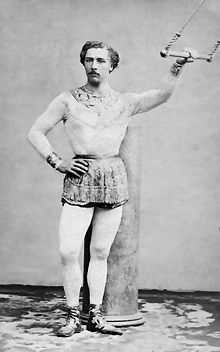 The song has a known history. It was about the exploits—sexual and artistic—of Jules Léotard, who developed the trapeze into an art form in the 1860s. He invented and popularized the one-piece athletic wear now called for him. The suit clearly displayed his underlying physique, a look that charmed women and inspired the song about purloined love. The song was first published in 1867, words written by the British lyricist and singer
 Kenneth Harper Finton