REMEMBERING MAXINE

REMEMBERING MAXINE

DORIS MAXINE HARPER FINTON SACK

born October 18, 1919

died January 20, 2009
It occurs to me that when you are talking about the life of a person and the meaning of the time they spend on earth, you are entering a gray area—a scary place that not many people like to go. You are talking about the evolution of a spirit—the changes that a lifetime makes in a soul. At the same time, you are being judgmental, revealing your own values, beliefs, and patterns of thought in your words and praises — judging how the other person stood up to your own peculiar beliefs and evaluations.

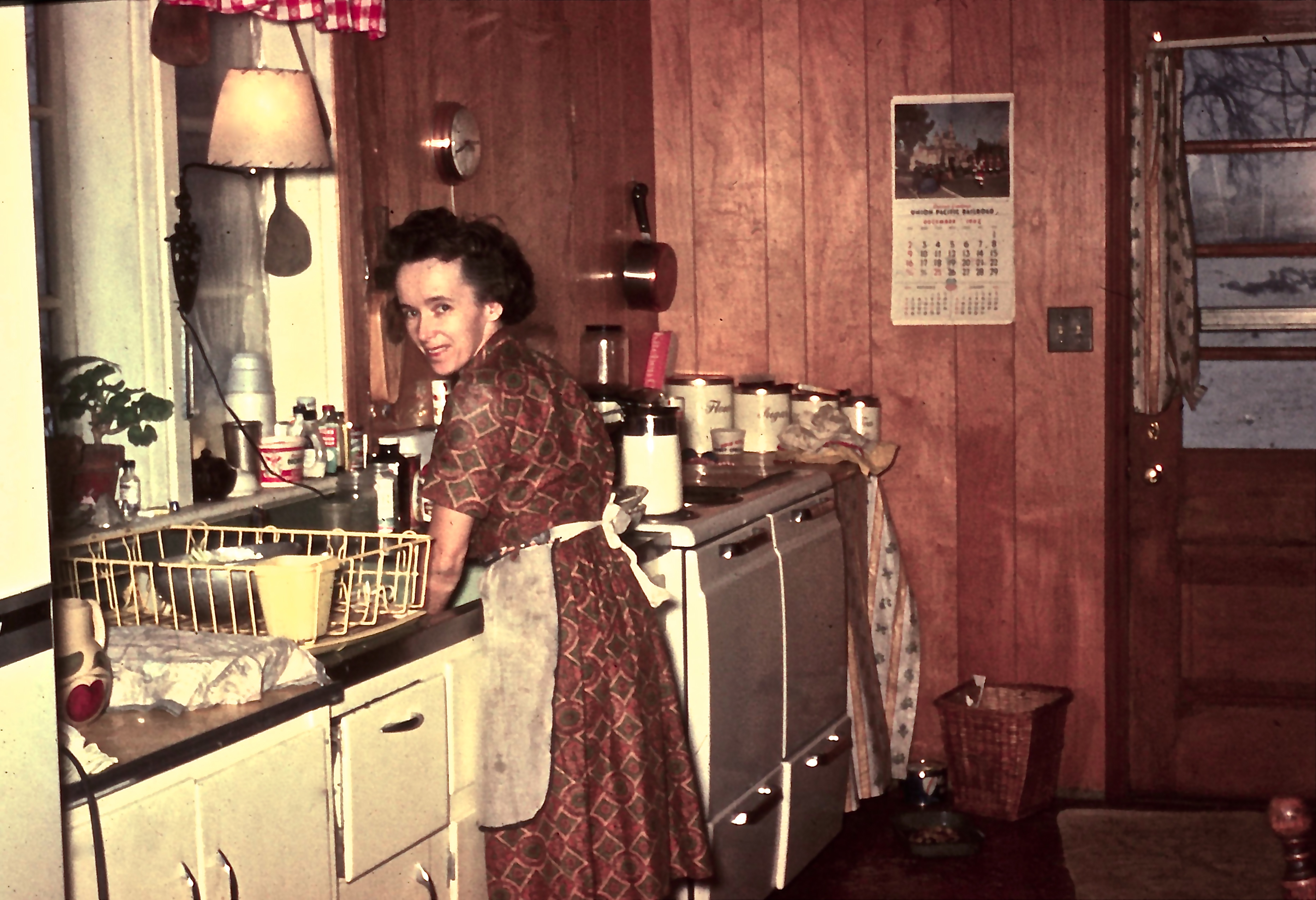
Maxine was one of those rare species of human beings who took pleasure in serving others. Not that she was totally selfless, as few of us are. Not that she was a saint, as none of us has perfect love, perfect lives, or perfect morals. Only the long-dead folks are made saints—and even then, it is only after the life they really lived has been selectively forgotten.

Born in Salem, Oregon, in October 1919 and living into January 2009, mathematically, Maxine was 89 years old when she died, but the view outside the window of her person was truly remarkable. She never knew her father, Clinton Byron Harper. He died of Spanish Influenza before she saw the first light of day. She was raised by her mother, Cora Mae Gilmour, a descendant of European royal families that never had the slightest taste or knowledge of the diluted bluish blood that flowed in her veins. Cora took in washing and did people’s laundry during the Great Depression. She struggled hard to raise her three daughters, Florence, Ruth, and Maxine. Cora left Oregon shortly after Maxine’s birth to live in the middle of the Kansas prairie with her father, Hedron Walker Gilmour, a short, thin and dapper man who loved the arts and entertainment. Hedron was an amateur magician and painter who became another big influence in Maxine’s early years.

After Maxine graduated from the Minneapolis, Kansas High School, she moved to Denver, Colorado, to live with her older sister Florence. She went to beauty school, though she rarely practiced the trade, just as her mother had gone through optometry school and never practiced that trade. Instead, Maxine waited tables on roller skates and went dancing with her friends as much as she could. It was at one of these dances that she met Ken Finton, an indisputably handsome man with Titian gold hair and a baritone voice to match those golden locks. He would become her husband of over 30 years and the father of her children: Kenny, Billy, and Jean Marie.

Ken would move her to Ohio, where they would spend their life together near his family. They were married on November 15, 1941. Just a few short weeks later, Japan bombed Pearl Harbor. This act changed the lives of every American forever.

Maxine did not follow in the footsteps of Rosy the Riveter. She did not go out into the workplace to replace the missing men in the American factories during the war. Instead, she had a baby — namely me — and sat out the war on the sidelines, staying sometimes in small apartments in Cleveland and Greenville, Ohio, and sometimes with Ken’s parents. For a while in 1944 and 1945, she lived in Gainesville, Florida, while Ken was stationed in Fort Blanding. They returned to Greenville, where Ken first found work delivering fuel oil for the space heaters of Darke County’s many farmhouses. Afterward, Ken opened a small gas station with his Flying Red Horse Mobil Oil Company contacts.

Ken’s attempt at an independent life did not last very long. He was forced to take refuge in factory work when a new baby was born into the family. The money was not great, but the job was steady and not overly demanding. He worked in quality control, inspecting taps and dies for a branch of the Detroit Tap and Tool company called Sater Products. This work lasted until he retired at 64.

Around 1950, the schools in Darke County consolidated, leaving quite a few one-room brick schoolhouses vacant. Ken was able to buy one of these abandoned schools and had the idea that he could remodel it into an ideal two-story home with the help of his father and family. However, Ken was not a talented builder. The schoolhouse was divided into four 15×15 rooms with a bath and a hallway, but that is about as far as it went. This was much to Maxine’s dismay. She never liked the dwelling. It remains a schoolhouse on the exterior and a two-bedroom home on the interior to this very day.

Maxine spent the 50’s raising her two boys. There were plenty of instruction manuals on how to do this. Dr. Benjamin Spock had written his famous book that took the world by storm. In 1946, Spock was given the chance to publish his iconoclastic views in The Common Sense Book of Baby and Child Care. Along with everyone else, Maxine and Ken read it, of course.

In the 50’s, strange new gadgets appeared on the roofs of American houses as television became a household necessity. Leave it to Beaver, Father Knows Best, and The Nelson family’s The Adventures of Ozzie and Harriet did not hesitate to show how child rearing in the 50’s ought to be.

None of these shows were much like our own personal lives, but that did not matter much. With TV in most homes, everyone had a living model of the way things should be. A woman’s place was definitely in the home for everyone except schoolteachers and nurses. Thus, Maxine stayed home to raise the kids for most of the fifties, though she secretly preferred to be out in the workplace. Despite the social norm, Maxine did take temporary work as a cashier at some grocery stores and the five-and-ten-cent store now and then. But in 1956, a new daughter that we named Jean Marie came as a complete surprise to everyone—fifteen years after the first baby—and once again life was changed for all.

As for religious views, the family was, for the most part, not serious about churches or religion. This changed a bit in the late fifties when Ken and Maxine started studying the Bible with Steve Timmons and his wife, who were Jehovah’s Witnesses. I am not sure what swept them up into this strange, cultish group. It was probably Steve Timmons’ strong personality more than anything else, but I was young and impressionable, and I was swept up in it myself at the time. By the time I graduated high school, I had moved well beyond fundamentalist viewpoints and developed interests in sciences, as well as philosophy, eastern religions, archeology, history, and music.

Ken died suddenly of a severe stroke in 1972. A few years later, Maxine sold off many of her Ohio possessions and moved to 1289 Clayton Street in Denver, where she lived in a house that originally belonged to the Muckle family. Maxine’s sister, Florence, had married Paul Muckle. His parents had both passed away, and the big old turn-of-the-century home sat empty at the time. Once again, like the time after Maxine’s graduation, her older sister Florence was there for her in her time of need and confusion. 

Florence had come to Ohio when my brother Billy was born, and we had visited her several times in Colorado—once by train when I was around six and several times by auto when Ken took his vacation.

Maxine remarried briefly to a man named Robert Sack, thus getting another last name to append to the Harper-Finton appellation. Bob died of a heart attack within the first year of their marriage. Bob had moved into the Clayton Street house while Billy and I were in California. They did not get along well because Bob drank a lot and Maxine hardly ever has even a sip of wine. After his death, she remained in the house until Florence became ill with Alzheimer’s and had a serious stroke that left her with aphasia. Then Maxine moved in with Florence until Florence’s business affairs were settled and her many possessions were sold. They both retired to an assisted living facility until Florence became too incontinent for that kind of care. My wife Chaya and I bought a bigger home and moved everyone into that, but Florence only lasted about six more months.

Maxine was petite, 4’11” in her stocking feet. When she was young she looked a lot like Judy Garland. These are the facts and the statistics.

What is missing is the soul of the woman—and who am I to describe the soul of any woman, let alone my own mother?

This I can say: she loved word games and puzzles. She kept her mind extremely active and her brain exercised. She excelled at Scrabble and Word Puzzles.

She always looked on the bright side and hardly ever had a depressing day until the very last, when she became ill with ovarian cancer and her pain and discomfort rose to epic proportions.

She easily excused the bad behavior of those around her and loved them anyway, a trait that often drove me to distraction and anger.

Her death came suddenly. In December 2008, she was not feeling well and went into the hospital. They found cancer in the ovaries, and the cancer had spread throughout the abdomen. The doctors said she had a very short time to live.

She lasted one more hour after Barack Obama was sworn in as President of the United States.

Chaya and I spent as much time as we could with her. For years, we had taken her to different places and vacationed with her from California to Ohio and Kentucky. After she broke her hip in 2002, she entered a nursing home. She came to like Allison Care very much, as there were people there of her age, and her days were filled with games and fun. We brought her back to our home most every weekend. We took her to Yellowstone one year, Los Angeles, and Yosemite another. We often went to Saratoga, Wyoming, where we had a motel. Two of her grandchildren lived near the motel. We drove out to see the fall colors every year. We go to see the snow sculptures in Breckenridge every year. We watched the Broncos play football, went to movies, hung around the house, and took her to our musical shows. We saw the Nutcracker Suite ballet in 2007 and went to Garrison Keillor’s show at Red Rocks in 2008.

Those who knew her will surely miss her. She leaves a void that no one else can fill.

She leaves behind her son Kenny and his wife Chaya, her grandson Robert, her granddaughter Tasha, and her great-grandson Zane, who loved to play games with her at every opportunity. She leaves behind her son, Billy, and her grandson, William Jr. She also leaves behind her daughter, Jean Marie, who disappeared in 1998.

Maxine lives on now in our memories, our pictures, and our videos. She is well respected and loved in the minds of all who knew her.

THE TRAGIC STORY OF NOWHERE MAN AND WHISKEY GIRL


[Several years ago I came upon this story of a married duo on Facebook. It seems that Amy had died from a blood infection and her partner, Derrick, killed himself a few days later. The entire drama of their demise took place in social media.

The story still haunts me. Their Facebook page still exists at  https://www.facebook.com/Nowhere-Man-and-a-Whiskey-Girl-32839047843/ -KHF]


It began with a post from Amy Ross on  FACEBOOK.

AMY: Hey kids! Bad news! I died this morning and Derrick didn’t know how to tell you. I love you all and hope you go out and be nice to someone. Funerals are a bore so hopefully I don’t have one. Give Derrick some space… He stinks at this stuff so leave him be for now. Thanks for all the kindness… Please spread it around. -Whiskey

Juliya Pogrebinsky Listening to you was one of my absolute favorite things about Bisbee. It’s been a great privilege and a joy to have known you even a little bit. Much love and condolences to Derrick and the family.
October 14 at 7:25pm · 3

  1. Sorry to bring more bad news but Derrick decided to join me at some point in the night last night. I thought it best you heard it from me. Enjoy every sandwich. We love and will miss you all. Go be nice to someone for us.
    1. Charlene Mitchell No! This cannot be true. Please stop!
      22 hours ago
    1. Juliette Beaumont Oh dear God. Although somehow I am not surprised by this. They were inseparable in both life and now death. Rock on lovers!
      22 hours ago · 4
    2. Bill Higgins This is not funny. Was the page hijacked?
      22 hours ago · 1
    1. Bill Higgins According to Joel Carp
    2. This is not a hoax or hijacking. The police and ambulance showed up at their place about 45 minutes ago.
      22 hours ago
  1. Olivia Herman What!!???? Who’s posting for Amy Ross on FB? There are going to be a lot of VERY relieved but VERY pissed off people, if it comes out that this is a terrible prank.
    1. Rebecca Higgins Oh my lord, this cannot be happening! So so sad.
      21 hours ago via mobile

Nowhere Man and Whiskey Girl had ceased to be. Amy had an ongoing battle with Lupus and had to undergo frequent dialysis. She died from a blood infection. Derrick took his own life later that night. She was 40, he was 39.


Amy and Derrick Ross

Amy and Derrick Ross, “Nowhere Man and Whiskey Girl” Amy and Derrick Ross, the Bisbee couple behind popular folk/Americana duo Nowhere Man and a Whiskey Girl, have died.

Amy Ross, 40, died Monday. According to the Arizona Daily Star, the vocalist and keyboard player, who performed as “Whiskey Girl,” passed away at Tuscon Medical Center from a “blood infection brought on by ongoing dialysis.” She also suffered from Lupus. Derrick Ross, 39, who was “Nowhere Man” in the act and played acoustic guitar, reportedly committed suicide sometime Monday.

News of both of their deaths came via social media, albeit in a peculiar fashion, wherein Amy Ross seemingly announced the couple’s deaths from beyond the grave.

An update to Amy’s Facebook page on Monday evening stated the following:

Hey kids! Bad news! I died this morning and Derrick didn’t know how to tell you. I love you all and hope you go out and be nice to someone. Funerals are a bore so hopefully I don’t have one. Give Derrick some space… He stinks at this stuff so leave him be for now. Thanks for all the kindness… Please spread it around.

Whiskey

Reaction to the post was a combination of shock, surprise, and disbelief from her nearest and dearest. One person claiming to be a family member stated it was a hoax and that she was alive.


See Also: Comedian Doug Stanhope on the Death of His Friends, Nowhere Man and a Whiskey Girl

Earlier today, a second update was made to Amy Ross’ page that suggested her husband had taken his own life.

Sorry to bring more bad news but Derrick decided to join me at some point in the night last night. I thought it best you heard it from me. Enjoy every sandwich. We love and will miss you all. Go be nice to someone for us.

Stand-up comic Doug Stanhope, who lived next door to the couple in Bisbee and was both their landlord and close friend (as well as featuring them at some of his gigs), confirmed via Twitter within minutes of the second Facebook post that Derrick Ross had taken his own life.

UPDATE: It’s been reported by Tucson media outlets that Stanhope had access to Amy’s page and was the one who made the updates.

Amy and Derrick Ross

Amy and Derrick Ross


World Class Thugs and Psycho Square Dance performed many gigs with “Nowhere Man and  Whiskey Girl”. Their guitarist and vocalist, Jim Dustan,  posted the following on Facebook:

I remember the early days and the Bisbee days. We shared some treasured moments growing up. I will always cherish the way your music made me smile and how it inspired me. RIP Amy (whiskey girl) and Derrick (nowhere man), may you both find peace. Until we meet again someday.

Without a doubt, they were one of Arizona’s best acts in the Americana vein, offering a sometimes joyful, sometimes poignant pastiche of down-home lonesome, rootsy touches, and indie quirk that was made even more emotional by Amy’s meanderingly dulcet vocals.

The husband-and-wife duo, who were married for more than a decade, were self-described as a “couple of wanderers” who previously resided in Oregon and Tennessee. They formed the act in 2003, drawing its name from the Gillian Welch country song “Whiskey Girl.”

Although based in Bisbee (where they were regulars at the Copper Queen Hotel’s lounge), Nowhere Man and a Whiskey Girl were musical vagabonds who exhaustively traveled throughout Arizona for performances in Tucson, Flagstaff, and Phoenix. In 2009, they even participated in an episode of our now-defunct Sun Session series.

Singer-songwriter Brodie Foster Hubbard, a former Valley resident who shared the bill with Nowhere Man and a Whiskey Girl on several occasions, says that he hopes that the couple’s fans will “honor the spirit of what Derrick and Amy shared and the joy they put into their music,” instead of just focusing on the weird circumstances involving their deaths.

“The whole situation is surreal. With Amy, it’s not so shocking, because she has had health issues for a long time. It’s still very saddening, of course. But with Derrick, that’s shocking,” Hubbard says. “You can follow the logic, anyone in a deeply committed relationship would probably say they couldn’t go on without their partner. And other folks who have experienced that loss, I’m sure that option has crossed their mind. So it’s not unthinkable. It’s no less horrible, though.”

He also hopes the couple’s friends and fans will able to cope with their loss.

“The best-case scenario in these situations is that we bond and listen to our favorite songs, and cry and laugh over our memories, and we make pacts to stay in better touch and be there for each other,” Hubbard says. I’d really like to see us all see that through.”


Here’s how the duo’s website, no longer active, describes how the name was derived:

When Derrick and Amy Ross began performing as Nowhere Man and a Whiskey Girl in early 2003, their intentions were simple enough: Select a name that hinted at their roots in the American West and established their identity as a determinedly two-person operation.

The name also cast them as a couple of wanderers, too intoxicated with the possibilities of someplace else to settle down. In that sense, the name would prove prophetic as it charted the course of the next five years of their lives.

Unable to locate a satisfactory permanent home, they accumulated more than their fair share of temporary addresses. When it wasnt the pony-trail towns of Bisbee, Tucson, and Willcox in the Arizona Territory, it was cooler locales like Corvallis and Nashville. Upon the release of their debut album, they hit the road for weeks at a time, bypassing the metropolitan centers in favor of the oft-neglected smaller towns in between.

Wherever they went, they brought a simple musical proposition: Her piano and voice, his acoustic guitar, a love of lifes little details, and a sense of humor. Although they traversed a landscape of bleached-husk desolation, they arrived none the worse for wear. Their longing for home unfulfilled, they found something of greater value along the way. They found a legion of like-minded hopeful searchers who believed in what they had to say and how they said it…

PHONE LIGHT

©2016 Kenneth Harper Finton

meditation-sleep-deprivation-gadgets-techniques-tips

Her elegant face was lit

by the soft light of her smartphone.

She sat alone on the bar stool on Valentine’s Day

searching for someone or something

she felt she lacked.

Rock music pulsed around her,

but she was not aware of it.

Romance had eluded her.

Why this pretty girl sat alone

in the dim, noisy bar,

her face illuminated by

the white scream of technology,

is unknown.

Perhaps she expected a companion.

Perhaps she was calling check on them.

Perhaps she was catching up on distant friends

she has never met who lived hundreds of miles away.

Like two fish in a dark sea,

she sat on her stool and he passed her by,

not confident enough to disturb her isolation,

too shy to generate an inquisitive introduction.

THE SUCCUBUS

by Kenneth Harper Finton


She must have come out of the dark of the night, for I awoke one morning and simply found that she was there. Did I wake at all, or did I dream her into my life?

Whether a dream or a mystical succubus, she haunts me to this day. My loins ached for her. As I remember, her parents had been old-time friends of my parents. They stopped for a day to catch up on time that had been lost for a dozen years.

A lassie named Cassie, a vision of grace and elegance. Her very name was a rhyme that rolled off my hungry lips. Had I known where she went I would have crashed the gates of hell to find her, but she came and left like a storm that bent my soul in the winds. Could she still be lazing in the sun or is she standing in the midnight dark waiting on a day that never breaks.

I remember how her father smoked his pipe at breakfast on the day that they arrived. He told us about his work engineering new roads in the West. She said she never stayed the length of time necessary to call a place home. The last place that felt like home was on a desert far to the West among the cactus and the prairie pack rats that stole a birthstone from her dresser top.

Her brother Jess was my age, a tall boy with gangly legs, a wiry frame and short-cropped hair. His husky voice spewed out words fast as an auctioneer. I was sixteen and she was fifteen, every inch of her bursting with the enchanting charms that I desired so much.

In the afternoon the folks all went to town. Cassie and I climbed the creaking stairs to the attic and I brought out a tattered picture album. The thick black pages were loose and filled with dust. She ran back down the stairs and I followed, but she suddenly was gone.

I ran around the house calling out her name, opened a closet door and found her hiding there. She came out of hiding with a laugh and a smile that sent shivers down my spine. Our feet not even touching the ground, we flew straight to the sofa in the hall. She laughed musically and smiled breathlessly as told me that she had never felt like this before. We looked at pictures in the old album for an hour, her head bobbing toward my shoulder, her rounded hips touching my own sun-bronzed leg.

The hour passed as though time has stood still. The light streamed through the window and her hair fell softly down her neck, highlighted by the streaming of the sunlight.

We came upon a picture of a desert plain where steamrolled landscapes were pocked with time-eaten rocks that rose up from the bowels of the earth in grotesquely-shaped tormented forms. She said the the desert looked like that back home and spoke of roaming the sands at night looking up at the ancient stars embedded in a cold desert sky and wondered who her love was meant to be. Silently, she leaned her head my way until it came to rest against my arm. I felt like an angel had lost her cloud and came to rest upon my soul.

Our day was short, just seconds in an hour.

We walked the fence rows with the clinging vines and walked by some malformed trees that were cut long ago with stunted branches flaring up from the stumps. We followed the trail along the brook and sat down on the banks to watch the minnows stir a mist of mud along the bottom of the silver stream. As we edged our way along the hanging suspension bridge, she pretended that she was afraid of falling headlong down into the stream that churned cold over the green, moss-covered rocks.

We brought a picnic lunch and stopped between two pines that stood high on a knoll behind an abandoned house. The cloth she spread is still in place. The shaded spot was cooled by the evergreen and the rumpling, gentle breeze hummed a tune and whispered songs of love in the prickly needles of the pines. I looked into her perfect, loving face––her moist, light lips red as the blood of life.

I hardly dared to kiss her, but I did.

When we walked together back to the house, we knew our moment of separation was near. These precious moments we had shared would become just memories of what once was, something to cherisg while still young and fresh as Spring.

That night the raindrops splattered on the roof. I heard an engine start. a door slam shut, a car pull into the gravel drive and as the sound of the engine slowly disappeared and faded in the night. I knew that she had been swallowed up forever in that swollen mass of people and forgotten dreams. I felt a hollowness within. An emptiness that could never be filled enveloped me.

I promised that I would never forget this memory, this short time that was ours alone forever. For many nights thereafter I lay in awake in bed, wondering if somewhere in a western land, someone stands alone staring at the black and empty sky and wonders who her love was meant to be.

These words were written long ago. The day that stood out like a cat’s eyes at night was choked in the vastness of the days before and the greatness ofd the days to come. Until I found this story on an old trunk, my promise has been broken.

I forgot.

THE BRIDGES OF MADISON COUNTY REVISITED

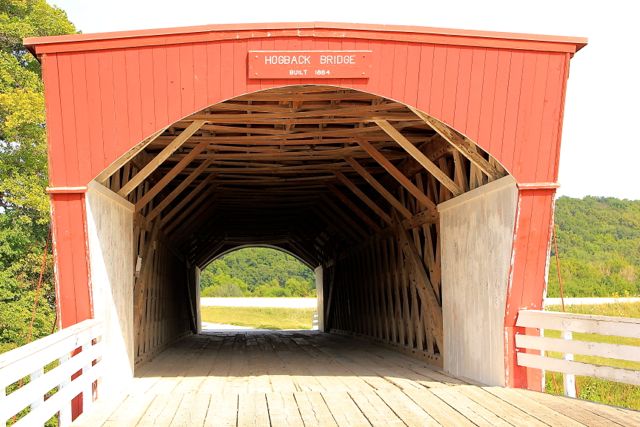
HOGBACK BRIDHE

The book by Robert James Waller and the movie starring Clint Eastwood and Meryl Steep has turned the sleepy Iowa town of Winterset, Iowa into a year-round attraction.

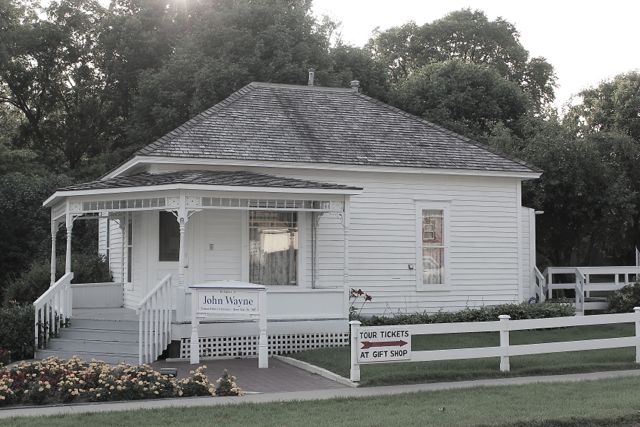
JOHN WAYNES HOUSE

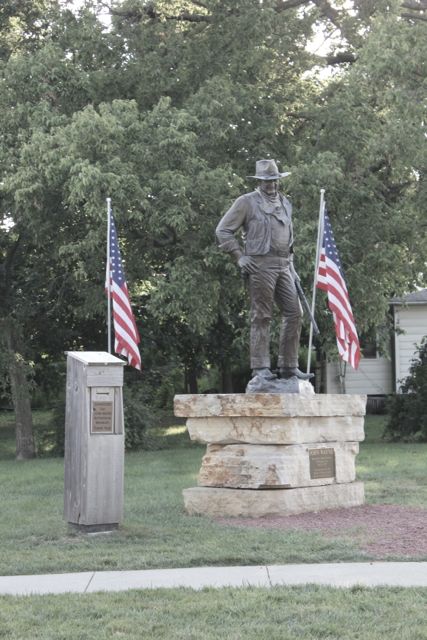
Even before the book was written, the town prided itself on being the birthplace and home of John Wayne. An entire block is now devoted to his memory and one of the main streets has been renamed John Wayne Boulevard.

JOHN WAYNE

People come to see the bridges, but they are really interested in the fictional romance dreamed up by Waller and played exquisitely by Eastwood and Streep. The same women that would condemn their neighbor’s infidelity and shoot their husbands for staring at a young woman come in droves to worship at the spot where Francesca and the cuckolding Robert Kincaid fell into a romantic swoon and gave an added meaning to their lonely lives by finding love on a hot summer day.

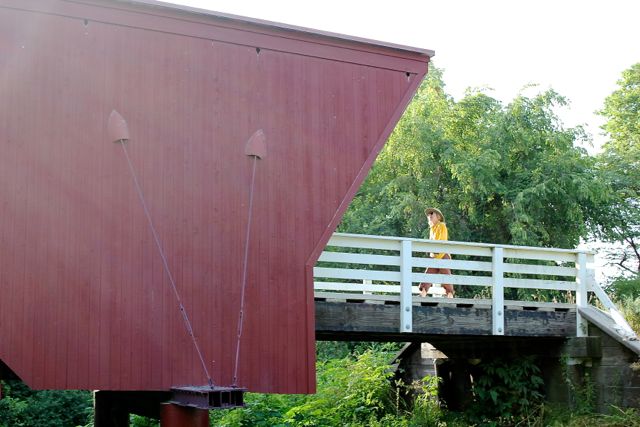
BRIDGE WALKING

Francesca is a woman who holds strong to the country values of keeping her family together. She meets the masculine, free-spirited Kincaid. He is a photographer for National Geographic whose assignment is to photograph the covered bridges. Unable to locate these bridges, he stops at the farm where Francesca lives. Her husband and two children were away at the state fair for a week. After guiding Kincaid to a nearby bridge, she invites him in for ice tea. Within a day, they shed their clothes and inhibitions to commence a four-day romance that the two will never forget. It all feels so natural and so right as they talk of things that Madison County people never talk about. Reality melts in the summer heat and their instant infatuation blooms into a deep love as fast as the quick brown fox can jump over the slow lazy dog.

GRAVEL ROADS

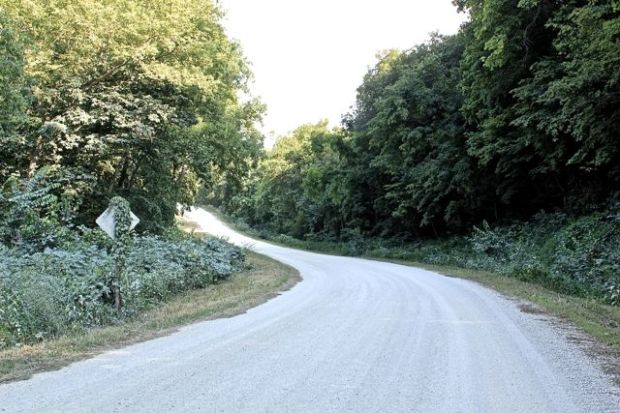
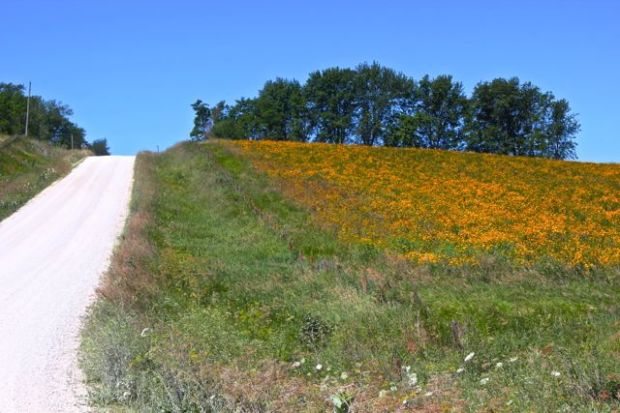
It is understandable that Kincaid had trouble finding the bridges. They are located miles apart and all over the county––down winding gravel roads that leave a white coat of limey dust over all surfaces. Madison County is still a pictorial vision of the 1960s yet today. The rolling hills, the gravel country roads, the semi-pristine hardwood forests salute the past, as do the well-kept farms still owned by individual farmers.

MADISON COUNTY

The story of their romance had a bittersweet ending. After four days, Francesca decides that she will end the affair and stay with her husband and family. It is raining as she drives away with her husband in the pickup. When they pull up behind Kincaid’s truck, it is all she can do not to bolt from the truck and run off to a new life of unimagined adventures. After some years, Kincaid dies and sends his ashes and prized possessions back to Francesca, who keeps them hidden from everyone. They are not found by the family until Francesca herself passes on. The two children, now adults, are made aware of the passionate affair and have to deal with it in their own way.

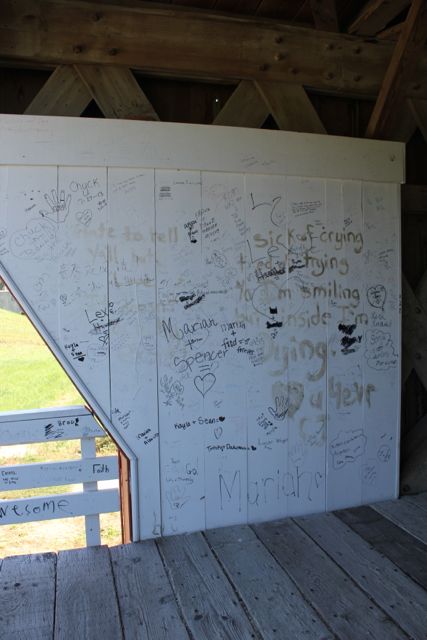
The people who visit these bridges leave their marks behind them. They too search for romance. Lonely teens call out publicly for sex. Couples leave their calling cards on the timbers and the painted boards at the bridge entries.

GRAFITI

love messages

The bridges have been maintained and rebuilt in the 1990s. The rustic work of long-dead carpenters can still be admired and written on by passers-by through the age. The bridges of Madison County still stand as a testimony to the artful lives of rural America in the 19th century. The story of the romance between Francesca and Kincaid also represents a change in American values. These tourists who come to visit do not condemn them. There is no scarlet letter “A” written on Francesca’s memory, Though the story is fiction, the romance is as real in the minds of the visitors as the bridges that brought them together. People do understand and relate to one another. Compassion has not died out completely. People still believe in the power of love to transform.

BRIFDE FRAMEWORK