I love a great short story. Problem is, there are too few of them.
How many great short stories can you name out of the blue?
Perhaps you are better read than I, because I can only think of three.
1) “A Christmas Carol” by Charles Dickens. Scrooge is an icon. Dickens was paid by the word to run his work serialized in the newspapers. That is why so many of his works are tediously long.
2) “The Old Man and the Sea” by Ernest Hemingway (more a novella than a short story). Even though I forget the Old Man’s Spanish name, I still smell the sea and the fish and feel the sting of rope on my hands as the big fish fight.
3) “The Gift of the Magi,” the great O’Henry story about the man who sold his watch to buy a fine hair brush for a his love while she cut off her hair and sold it to buy him a watch fob. Maybe that was not the story exactly, I do not remember, but that’s a decently good one the way I described it.
Short stories are easy to read.
They take more time than a blog or a post, so they require more time and effort from the reader. But when they are good, they are outstanding.
Many great television mini-series are really enacted series of short stories that follow the same characters. This allows for character development. Come up with a great character and anyone will want to know them––love them or hate them. TV dramas are simply short stories with added visual action. The script does come first.
Written short stories are often better than TV stories.
We get to visualize our own image of the character and the setting. We get the added sense of smell from compelling descriptions.
I believe that most novels could really be told in the time is takes to read a short story. I believe that every chapter of a novel could be––and perhaps should be––a stand alone tale that either leaves you wanting more or thinking about the implications of what that story means to you.
I think that a writer can serve themselves best by writing smaller works that can later be entwined and stitched together to make a larger work.
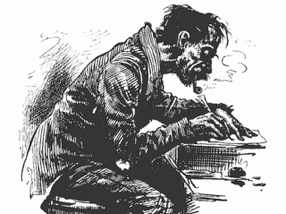
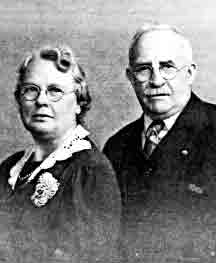
My grandfather was always an old man to me. He was nearly seventy when I was born, thirty five years older than my father. Grandpa smoked a pipe and cigars and always smelled of strong tobacco.
We would spend many hours on the back porch cracking hickory nuts and walnuts with a hammer. He and I ate raw hamburger on crackers together followed by thick slices of limburger cheese.
Grandpa played the fiddle well at one time, but arthritis slowed his movements in his later years. The fiddle sounded pretty squeaky to me, but the tunes he played stayed with me forever.
Grandpa told me tales about his turbulent school days. He related these stories with a crooked smile that exposed his tobacco-stained teeth below his bushy white mustache.
In those days, school ended for most rural folk in the eighth grade. With an eight-year education, students could take a teacher’s examination and become a teacher themselves. Some of the students were as old as the teacher.
One of his male teachers had a bad habit of tossing a knife at his students for any infraction of his rules. One day Grandpa turned around to say something to a classmate seated behind him and that teacher threw the knife at him. It stuck in his desk. Grandpa got out of his seat and attacked the teacher.
The pot belly stove was red hot and blazing. Over it went, stove pipe and all, along with the teacher’s desk and several stools.The fight boiled over to the outdoors and ended with the knife-tossing teacher being taught a lesson by one of his older pupils.
Grandpa told me a story about one lady teacher about his age who was “soft” on him. Evidently, this crush was a one-way street, as Grandpa didn’t give a whit. He had made a sled which consisted of a thick plank with a bevel on the front end. That day there was a heavy snow on the ground with a thick crust. Grandpa and some of his friends went out to slide down the hill. The teacher wanted a ride, so Grandpa agreed to let her take a ride. He headed her in the direction of a small stump that barely showed above the thick crust. When she hit the stump, the teacher rolled head over heels. Her skirt billowed up over her head and showed more than she wanted her students to see. When Grandpa sheepishly helped her back up she told him: “I’ve seen enough of you to know that you’re no gentleman.”
Grandpa replied, “And I’ve seen enough of you to know that you’re no gentleman either.”
He told me these stories with a crooked smile that exposed his tobacco stained teeth below his large white mustache.
* * *
In October of 1960, I saw Grandpa alive for the last time. I had graduated from high school and spent the summer remodeling the house. Dad never seemed to have enough time of energy to work on the house. He was busy with his historical research and tracing genealogies. Gradually, I learned some basic skills and did all the handiwork at home.
Grandpa had been in a sanitarium for several years after suffering a series of strokes. In his late eighties, he was a dimmed shadow of the man he used to be. He was unable to speak. His eyes were barely visible through slits in his fleshy eyelids. His abdomen seemed puffed. He tried to speak, but only a squeaky whimper came forth. His hands twitched like the paws of a dreaming dog. He tried to move from one side to another, but he was like a car stuck in the mud. His mouth looked like it was bound with wire. Death, I realized, would be a blessing to him. Finally, he passed on and we buried him in the family plot in early November of 1960. He looked peaceful and at rest, more like the man I had known most of my life.
William Kenneth Finton
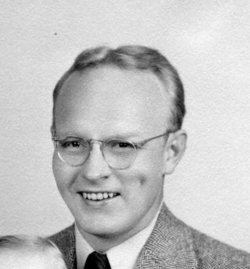
My father was somewhat of a mystery to me. He was bright and literate. He supported me in most everything I wanted to do. He played his vast collection of sound recordings often, so I became well versed in music from the time that recorded music was invented. Dad has a booming bass baritone voice and often sang along, or showed me songs of his own making. Everything he did made lasting impressions on me.
My father had missed his calling somehow. He was the type that needed to love his work, but he had settled for working for others in a factory setting for a wage. He had tried self employment often, but he could not make enough money for the family in an independent workplace. Some might say it was his own fault for not trying hard enough, but I knew better. He loved his family first and foremost. The all-consuming drive that is necessary for great success eluded him by personal choice. It was his lot to put home and family before personal satisfaction and work.
I think I summed everything up in a poem I wrote about Dad twenty years after he died.
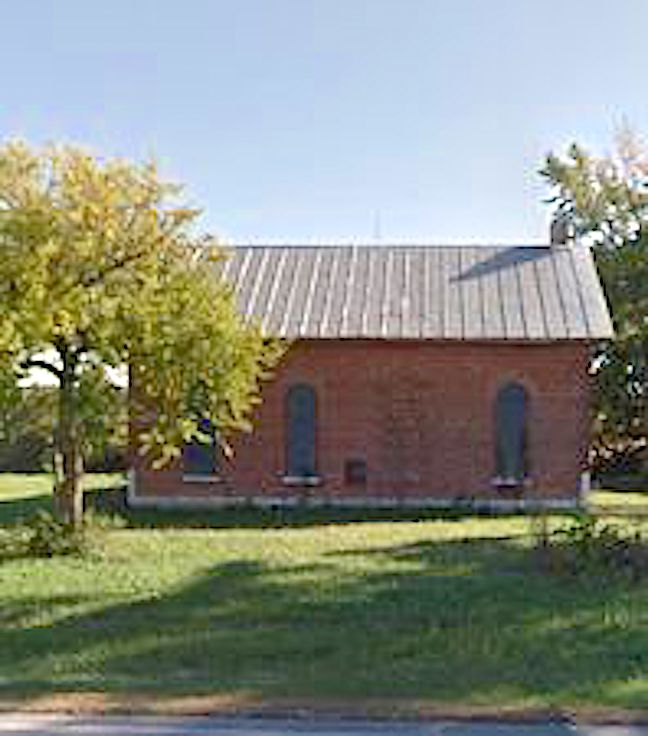
We lived in the country about two miles from town. Dad had purchased an old brick one-room schoolhouse in 1948 from the county when they built a new school for the country folk consolidated all the one-room schools. He and Grandpa immediately went about the business of ruining it as an historic landmark. They broke up the large one room into four square rooms 15×15 with a ten foot hall between the sections. Two of the squares served as bedrooms, one served as the kitchen and one the living room.
They took out the lovely front door and cut a hole for a back door, bricked up a few of the long church style windows and lowered the ceilings from sixteen feet to eight feet. Dad wanted it to look like a normal home with a columned porch and a horseshoe drive, but this never happened. After he put the wiring in and ran the water from the false well, he drywalled everything and taped it. He ran out of steam very quickly. The rooms did not get paint for seven to eight years. By this time the drywall was brown with age and nicotine. The taped joints and the spackled nail holes stood in tasteless contrast to the tanned gypsum board.
Dad smoked unfiltered Old Gold cigarettes until they came out with Winston filters, then he switched. Sometimes he would smoke a pipe. I loved the smell of a pipe and could not wait until I had my own pipe and tobacco. Dad smoked Carter Hall tobacco when he smoked the pipe.
Mom always hated the schoolhouse. She had been used to a more traditional housing and thought that camping out in a unfinished home was not dignified enough. She has a dour attitude all the time she lived there and moved out as soon as Dad died.
A quarter mile north of our place was the Children’s Home. When I was a small boy, I often went there to play with the kids. They has a stout playground with a tall steel slide, that burned your skin in the hot summer sun, swings made with thick chains and seats of steel, and a small old carousel that always squeaked. The older boys did farm work and were called “barn boys”. I was not really old enough to play with them, but they let me hang out with them anyway. I first learned to ride a horse in the pasture between our house and the Children’s Home
REMEMBERING MAXINE
DORIS MAXINE HARPER FINTON SACK
born October 18, 1919, died January 20, 2009
It occurs to me that when you are talking about the life of a person and the meaning of the time they spend on earth, you are entering a gray area—a scary place that not many people like to go. You are talking about the evolution of a spirit—the changes that a lifetime makes in a soul. At the same time, you are being judgmental, revealing your own values, beliefs and patterns of thought in your words and praises— judging how the other person stood up to your own peculiar beliefs and evaluations.
Maxine was one of those rare species of human beings that took pleasure from being in the service of others. Not that she was totally selfless, as few of us are. Not that she was a saint, as none of us have perfect love, perfect lives or perfect morals. Only the long dead folks are made saints—and even then, it is only after the life they really lived has been selectively forgotten.
Born in Salem, Oregon, October 1919 and living into January 2009 mathematically made Maxine 89 years old when she died, but the view outside the window of her person was truly remarkable. She never knew her father, Clinton Byron Harper. He died of Spanish Influenza before she saw the first light of day. She was raised by her mother, Cora Mae Gilmour, a descendant of European royal families that never had the slightest taste or knowledge of the diluted bluish blood that flowed in her veins. Cora took in washing and did people’s laundry during the Great Depression. She struggled hard to raise her three daughters, Florence, Ruth, and Maxine. Cora left Oregon shortly after Maxine’s birth to live in the middle of the Kansas prairie with her father, Hedron Walker Gilmour, a short, thin and dapper man who loved the arts and entertainment. Hedron was an amateur magician and painter who became another big influence in Maxine’s early years.
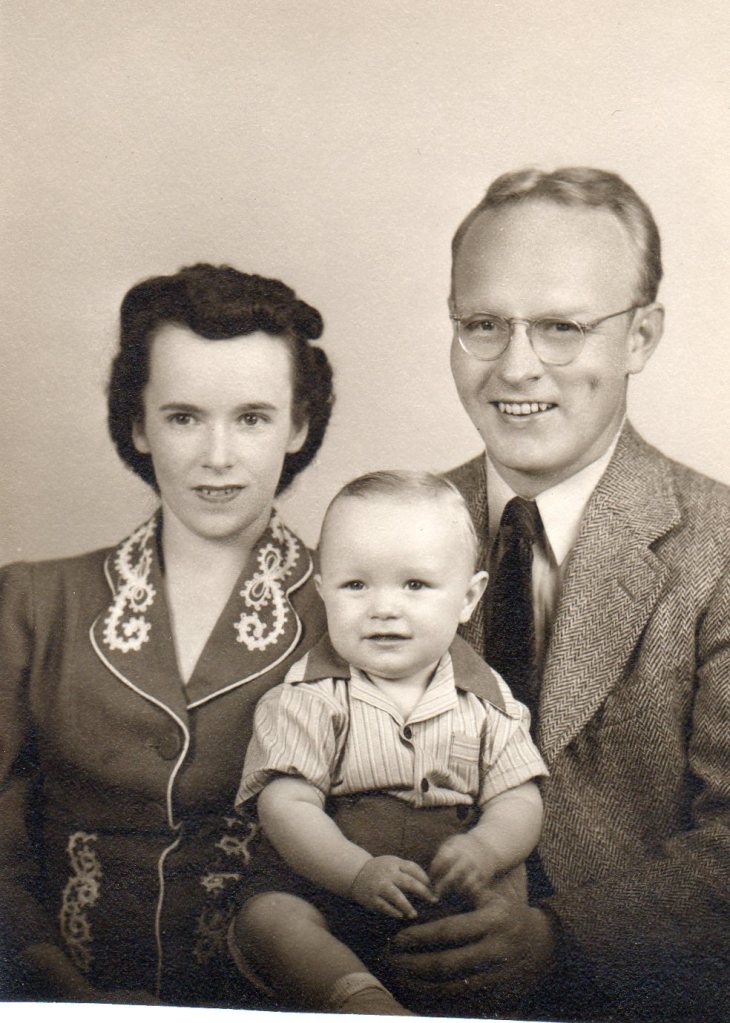
After Maxine graduated from the Minneapolis Kansas High School, she moved to Denver, Colorado to live with her older sister Florence. She went to beauty school, though she rarely practiced the trade, just as her mother had gone through optometry school and never practiced that trade. Instead, Maxine waited tables on roller skates and went dancing with her friends as much as she could. It was at one of these dances that she met Ken Finton, an indisputably handsome man with Titian gold hair and a baritone voice to match those golden locks. He would become her husband of over 30 years and the father of her children: Kenny, Billy, and Jean Marie.
Ken would move her to Ohio where they would spend their life together near his family. They were married November 15, 1941. Just a few short weeks later, Japan bombed Pearl Harbor. This act changed the lives of every American forever.
Maxine did not follow in the footsteps of Rosy the Riveter and go out into the workplace to replace the missing men in the American factories during the war. Instead, she had a baby —namely me—and sat out the war on the sidelines, staying sometimes in small apartments in Cleveland and Greenville, Ohio and sometimes with Ken’s parents. For a while in 1944 and 1945, she lived in Gainesville, Florida while Ken was stationed in Fort Blanding. They returned to Greenville where Ken first found work delivering fuel oil for the space heaters of Darke County’s many farm houses. Afterward, Ken opened a small gas station with his Flying Red Horse Mobil Oil Company contacts.
Ken’s attempt at the independent life did not last very long. He was forced to take refuge in factory work when a new baby decided to come into the family. The money was not great, but the job was steady and not overly demanding. He worked in quality control inspecting taps and dies for a branch of the Detroit Tap and Tool company called Sater Products. This work lasted he until he retired at 64.
Around 1950, the schools in Darke County consolidated and left quite a few one-room brick school houses vacant. Ken was able to buy one of these abandoned schools and had the idea that he could remodel it into an ideal two story home with the help of his father and family. However, Ken was not a talented builder. The schoolhouse was divided into four 15×15 rooms with a bath and a hallway, but that is about as far as it went. This was much to Maxine’s dismay. She never liked the dwelling. It remains a schoolhouse on the exterior and a two bedroom home on the interior to this very day.
Maxine spent the 50’s raising her two boys. There were plenty of instruction manuals on how to do this. Dr. Benjamin Spock had written his famous book that took the world by storm. In 1946, Spock was given the chance to publish his iconoclastic views in The Common Sense Book of Baby and Child Care. Along with everyone else, Maxine and Ken read it, of course.
In the 50’s strange new gadgets appeared on the roofs of American houses as television became a household necessity. Leave it to Beaver, Father Knows Best, and The Nelson family’s The Adventures of Ozzie and Harriet did not hesitate to show how child rearing in the 50’s ought to be.
None of these shows were much like our own personal lives, but that did not matter much. With TV in most homes, everyone had a living model of the way things should be. A woman’s place was definitely in the home for everyone but school teachers and nurses. Thus, Maxine stayed home to raise the kids most of the fifties, though she secretly would have preferred to be out in the workplace. Despite the social norm, Maxine did take temporary work as a cashier at some grocery stores and the five and ten cent store now and then. But in 1956, a new daughter that we named Jean Marie came as complete surprise to the everyone—fifteen years after the first baby—and once again life was changed for all.
As to religious views, the family was for the most part not serious about churches and religions. This changed a bit in the late fifties when Ken and Maxine started studying the Bible with John Timmons and his wife who were Jehovah’s Witnesses. I am not sure what swept them up into this strange, cultish group. It was probably the strong personality of John Timmons more than anything else, but I was young and impressionable and was swept up into this myself at the time. By the time I graduated high school, I had moved well beyond fundamentalist viewpoints, and developed interests in sciences, as well as philosophy, eastern religions, archeology, history, and music.
Ken died suddenly of a severe stroke in 1972. A few years later, Maxine sold off many of her Ohio possessions and moved to 1289 Clayton Street in Denver where she lived in a house that originally belonged to the Muckle family. Maxine’s sister Florence had married Paul Muckle. His parents had both passed away and the big old turn-of-the-century home sat empty at the time. Once again, like the time after Maxine’s’ graduation, her older sister Florence was there for her in her time of need and confusion.
Florence had come to Ohio when my brother Billy was born and we had visited her several times in Colorado—once by train when I was around six and several times by auto when Ken took his vacation.
HEDRON WALKER GILMOUR
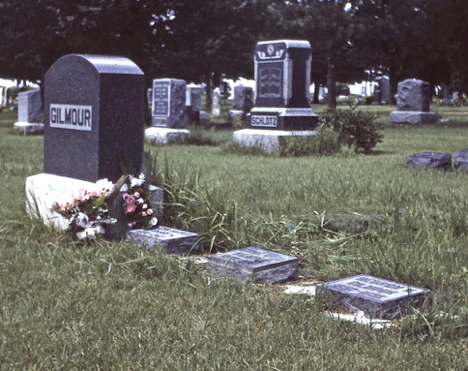
THE GILMOUR PLOT, MINNEAPOLIS, KANSAS
The tombstone of Hedron Walker Gilmour is the foremost stone, Minneapolis, KS.
Hedron Walker Gilmour (called “Hede”) was born at the family farm in Illinois, but homesteaded the Kansas prairie when the opportunity arose during the land rush. He had two homestead claims where Minneapolis, Kansas now stands. In 1990, one of the frame homes he had built still stood in Minneapolis.
Hede was a man of many talents. When still a child, he developed an interest in magic. Once he decided to run away from home to join the army to become a drummer boy, so he hopped on a slow moving freight train near his father’s home. He was quickly caught by the railroad bulls and hurled off the moving train. Dejected, he had to walk the many miles back along the tracks to his father’s farm. Hede’s magic talents and interests lasted for his entire lifetime. He did work part time for the circus in his later years, finally fulfilling that childhood dream. During his adult life he entertained in his community, pulling rabbits from hats, handkerchiefs from ears, and cutting people in half with his magic saw and trunk.
It was said, “Hede loved the Indians and the Indians loved him.” At home on his Kansas homestead, Hede developed good relations with the nearby Indian tribes. When they traveled through his area they were allowed to sleep on his front porch without needing to ask. They always left some gift for Hede as a token of their appreciation.
Hede was inspecting his fields one day when he kicked up a large rock the size of a clod of earth by the roadside. He took it home, washed it up and was impressed with its hard beauty. The family used the rock as a doorstop for many years until a friend from Kansas City came to visit and talked them into having it assayed. Tests showed that it was practically a pure diamond. Hede had some of this diamond cut into rings for family members. Several of these rings served as family heirlooms.
Hedron Walker Gilmour was an artist and a horse trader. One story says that he traded diamonds for a banana plantation in Brazil, then traded the deed for a large gemstone made of jade. I am not certain of the truth of this rumor. He built a long, two-car garage on his homestead and painted the three interior walls with illustrations of prairie life. One portrait of an Indian with his hand to his brow, peering out against the sun was exceptionally beautiful. He also custom painted automobiles in his later years.
Hedron stood about 5’5″. He was a handsome, wiry man with a large mustache. Hedron and Emma Root had two daughters, Cora Mae Gilmour and Lura Berdina Gilmour, who later married Wallace Hake and moved to Tennessee. According to his granddaughter, Florence, Hede bought his daughter Lura a plantation near Dixon, Tennessee, which he purchased for back taxes. According to his granddaughter, Ruth, he simply loaned them the money to purchase the farm. In his later years he spent much time in Tennessee to get away from the harsh Kansas winters. Hede suffered from prostrate gland problems at the end of his life. A quack doctor implanted a goat prostrate when he removed Hyde’s prostate and Hede became delusional. The ailment eventually led to his confinement in an institution at Kansas City where he died at age eighty-two.
His son-in-law, Wallace Hake, went on to become a leading political figure in Tennessee. He served as speaker of the house and was often consulted on matters of state. Wallace Hake built one of areas first golf courses on his plantation, but his own golfing was curtailed by an accident on the premises. He was searching for eggs in the barn when he was bit in the thumb by a copperhead. Lura grabbed a bottle of whiskey, made him drink as much as he could, then cut the heads off five chickens and made him stick his thumb down the throat gullet of each of the chickens to draw the poison out while they loaded in the car and rushed to the doctor. On the way the necks of the decapitated chickens turned green with the drawn venom. The doctor in charge said that Lura’s quick thinking saved Wallace Hake’s life. Wallace’s thumb, however, was never right again.
Wallace Hake was addressing a graduation ceremony for the students at the University of Tennessee when he died of a heart attack while speaking at the podium.
Wallace Hake and son, Buddy Lura Gilmour Hake
1 The information on Hedron Walker Gilmour and family came from direct interviews with his granddaughters, Florence, Maxine and Ruth. Though they differed and argued on some details, the above is an approximation of the reality.
Cora Mae Gilmour was the daughter of Hedron Walker Gilmour of Kirkwood, IL and Emma Myra Root of East Mecca, Ohio. [Emma Root’s father, a minister, performed wedding in his home in Minneapolis, Kansas].
[See FROM TRIBES TO NATIONS addendum Emma Myra Root, Chapter 12, page 87]
Emma Myra Root was the daughter of George J. Root (b 1828 Trumbull County, Ohio, d Minneapolis, Kansas). She had a brother, Judson who lived in Trumbull County, Ohio. George Her father, George J. Root, a minister, married Lura Smith (3 Jul 1847).
Tired of living, spurned in loving, deficit in compassion, Andreas Lubitz and his crippled amygdala donned his smart uniform and climbed aboard the plane.
A pretty stewardess smiled at him, bid him a good morning as he passed. She smelled of a musky perfume. That reminded him of the sex he often craved with her.
He found sex to be an animalistic and ludicrous practice. Love had always been a dream that faded away to sorrow. He returned to her a faceless smile without meaning.
He took his place in the cockpit beside Patrick, his pilot. It was less that two hours to Dusseldorf from Barcelona. Patrick was loquacious, almost collegiate in manner.
As they bantered back and forth, Patrick’s banal conversation bored Andreas to death. He could only fake a smile for reply.
Andreas thought about how he hated God for giving him life. An aching desire for release from the prison of time had overcome him. A dull ache of depression swept over him as he remembered all the hideous assaults he had endured.
It was as though he wore glasses that saw only the evil of time and hid away the pleasant moments.
When Patrick left the cabin, Andreas pushed the button to lock the door so that he would not have to bear him any longer.
Alone in the cabin, with only the sky in his eyes and the engine noise in his ears, Andreas was at last alone with himself. He hated his aloneness. “Everyone is suffering in their meaningless lives just like I am,” he thought. The future brings nothing but more disappointment, times filled with melancholy, nights filled with helpless thoughts, days filled with foolish actions that try to mitigate the absurdity of living a desperately miserable existence. Dog eats dog, life eats life, panicked schools of fish swirling in circles as the sharks attack the outer layers of their being.
The images consumed him. The irrelevance of his very being and all those around him felt like the beating drum of a hated heartbeat Mushroom clouds raining death, pits with decapitated bodies killed by fools who thought themselves righteous appeared in the gray sky when he adjusted the course of the plane to fly at one hundred feet.
“It will soon be over,” he thought to himself. “I am finally on control.”
He heard a frantic knocking on the door as Patrick tried to gain the cabin. His gut tensed, his breath came hard and fast. He could hear the hysterical screams of the passengers behind him.
No sympathy for their plight crossed Andreas mind. “They are all going to die anyway,” he thought. “Today is as good a day to die as any other. Today is better. It will save them from through suffering their ignorant lives.”
Adrenaline rushed through Andreas veins as the mountain loomed before him and the nose of the aircraft. He felt like a soldier entering battle.
“It is a good day to die,” the voices around him exclaimed.
He remembered the stewardess with the sexy perfume who greeted him when he stepped onto the plane. Her voice was among those screaming behind him. “I will not fuck her,” he told himself. “She will not tempt anyone to fuck her now. I can make sure of that.”
There was power in the thought; power had always escaped him.
The remembered scent of her perfume hung in his nostrils. His own breath came hard and deep as he thought about having sex with her. Death, he thought, would be like conception, a one timeless contracting orgasm would begin the journey to another useless, meaningless and painful life. Another contraction would snap the miserable body away from experience and into the vast nothingness of the universe.
He could picture himself letting go after the shock of impact. It would be his final orgasm, his final statement, his final action.
Before existence took place, there was pre-existence without time and without space, where no dimensions at all exist. Science can tell us nothing of this era. We are left to our own experiences to decipher our personal realities about from whence we came.
There is a point before time and space. Within that point is the property of physical awareness. That which is aware–call it the thinker, the cosmic dreamer, or if you prefer, the pre-universe–it is surely the precursor of information, as thought and ideas were all held in one timeless, yet geometric, point. The mental universe of pre-existence was one of potential. Potential does not possess a physical entity. Potentials are mental images.
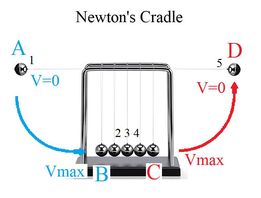
“A” is present whether or not “B” is present. “A” then, is like potential energy that does exist without material content and without motion. The creation of motion is brought about by the existence of “B”. “A” can exist without time and space because or its property of being potential. In order for this potentiality of energy to be released, it must have a precise co-ordinate in space and a sense of awareness to duration in order to experience time. This is the data and it is provided by “B”. In other words, “B” is the informational content that co-creates the physical.
We know that physical awareness exists in the universe because we are ourselves aware. We do not doubt our own existence. It is one of the properties of human experience. I propose that it is also one of the properties of the universe. We can easily see these properties in life. Many living things are obvious to us, but we find it harder to conclude that there is an awareness in inanimate objects as well. Since all objects are made from an atomic structure, does physical awareness exists in atomic structure as well?
Pre-atomic structures experience some of the first events. Wherever events occur, physical awareness must record the change in the objects and codify the information. Before we can have a universe, we need objects and events. An event is an interaction between objects. To have an interaction we need awareness to identify an object or an event. Without awareness, there is literally no event, no data to record. All change contains information. Awareness is the left hand that interprets the information on the right hand. The essential quality for observation or interaction is having an awareness of an object. Objects consist primarily of information. This information is physically coded and eventually it is recognized by our senses. Physical awareness is the first cause for the existence of time and space. All things are objects that are formed by the non-material awareness which has always been present.
Ontology is the branch of philosophy that studies concepts such as existence, being, becoming, and reality.It includes the questions of how entities are grouped into basic categories and which of these entities exist on the most fundamental level. Ontology is sometimes referred to as the science of being and belongs to the major branch of philosophy known as metaphysics.
What does the mind look like? What are its physical characteristics? We see the medical imaging of the brain at work, but we never see the mind itself. Senses like smells, tastes, and touch have no visible physical characteristics. We see them only by their effects, as we see the wind. It should come as no surprise that awareness is invisible.
What about the information that awareness presents to the mind? Information is also invisible. This information becomes physical to us only after being perceived and registered by the mind. Our awareness perceives a constant flow of information, too much to process at once. We select parts of this information, then fill in the rest with recollection and imagination. At that point, information becomes tangible, recorded chemically and electrically bonded. The mind can evaluate it and react. The invisible awareness that perceives this invisible physical presence is the first step toward interaction and reaction.
We all have but two things at all times, our awareness and the now. Awareness takes place in the Now. Awareness builds our mental images of our world and our place in the universe or a universe. Our awareness is constantly experiencing our journey through the now. Lucky for us, most of this information is subconscious and does not require conscious attention. To be self aware, one has to be aware of another, something not contained in the self. Can self awareness exist all the way down to compounds to atoms and elementary quantum? Or is awareness held within that elementary quantum?
I have had a hard time coming to terms with infinity. The idea that space is infinite means that infinitely huge sections of space could never be seen. The same hold true of the universe. All things in space and time have beginnings and ends. They are finite. Yet, because the finite exists, then there must be that which is not finite––the infinite.
The same is true of nothing. Nothing does not exist. It is the opposite of existence in its non-existence. Yet, nothing exists. It also does not exist. It is in a superposition where it is both. The reason infinity can go on forever is that there is nothing there at all. Without time and space there are no things… nothing.
I think it is imperative to come to terms with infinity. We need to understand that which is beyond time and space. It is the obvious source of existence and the physical universe.
If the infinite does not exist in time and space, does it exist at all? Is there a geometric plane above time and space where awareness can experience no time and no space and still be aware?
One possibility is a universal point––the invisible center of every circle in the universe. That point is infinite because it is all there is. No matter how large or small this point is thought to be, it is still all there is and it is the center of everything everywhere.
If we accept that as a possibility, we can only speculate about the original point, since the physical world emerges from this super-positioned point that is every place and at the center of everything. This point, remember, is infinite––which means that it includes the finite and all that all exists along with the information contained within this finite record.
We cannot get away from a first cause that came from nothing. An eternal universe cannot be a reasonable assumption in a temporal world of beginnings and endings. Even if energy is fundamental, the question remains: “From what did it spring?” Is energy eternal? Did it come from nothing? Or did it come from an invisible and unrealized potential in the non-dimensional?
“Rumpsey Dumpsey, Rumpsey Dumpsey, Colonel Johnson killed Tecumseh.” – Richard M. Johnson Campaign Slogan
Richard M. Johnson rode to political fame on the claim that he was the slayer of the great Indian leader. Historians are uncertain, and the deed will be forever muddied in the waters of time. In his 1929 autobiography, Single Handed, James A Drain, Sr. gives a detailed account by Col. Whitley’s granddaughter in which Whitley and Tecumseh killed each other simultaneously.
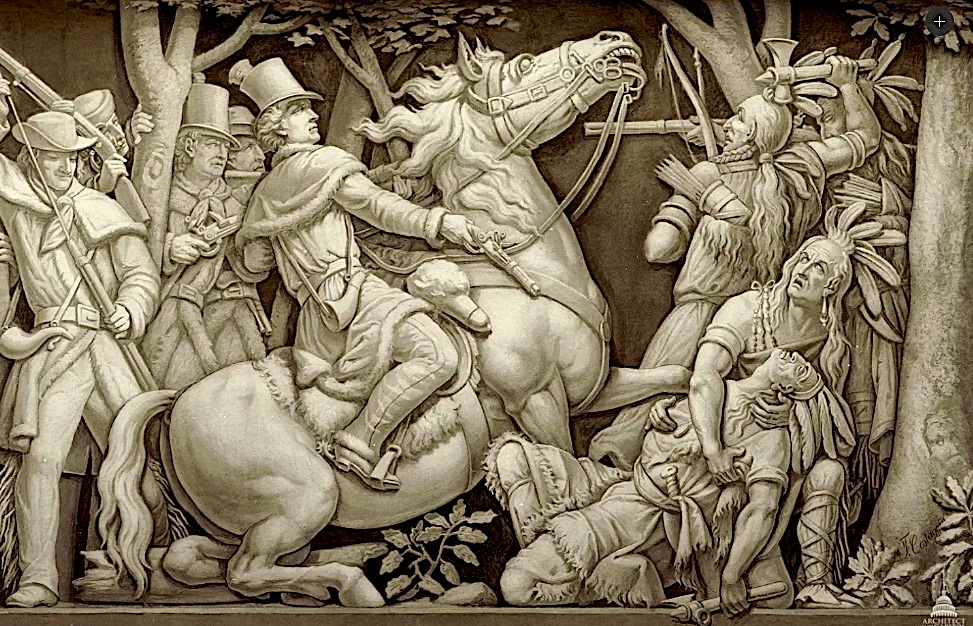
Who killed Tecumseh is a matter of debate. Many accounts claim that the badly-wounded Colonel Richard Johnson shot Tecumseh just before he lost consciousness although, until much later in his political career, Johnson only claimed to have shot an Indian.
Some evidence points to Colonel Whitley as the man who killed Tecumseh. Whitley’s body was found very close to Tecumseh. Still another report came from the badly-wounded Colonel James Davidson who claimed that a man in his company, Private David King, shot Tecumseh with Whitley’s rifle.
“Initial published accounts identified Richard Mentor Johnson as having killed Tecumseh. In 1816, another account claimed a different soldier had fired the fatal shot. [Sugden 1985, p. 138.] The matter became controversial in the 1830s when Johnson was a candidate for Vice President of the United States to Martin Van Buren. Johnson’s supporters promoted him as Tecumseh’s killer, employing slogans such as “Rumpsey dumpsey, rumpsey dumpsey, Colonel Johnson killed Tecumseh.” Johnson’s opponents collected testimony contradicting this claim; numerous other possibilities were named. Sugden (1985) presented the evidence and argued that Johnson’s claim was the strongest, though not conclusive. Johnson became Vice President in 1837, his fame largely based on his claim to have killed Tecumseh.” -Tecumseh. (2023, July 22). In Wikipedia. https://en.wikipedia.org/wiki/Tecumseh
Some primary accounts suggest that Col. William Whitley was likely the person who killed Tecumseh. James A Drain, Sr. published an autobiography, Single Handed (1927), in which he recounts Whitley’s granddaughter telling their family tradition that Whitley and Tecumseh killed each other simultaneously.
“After the battle, American soldiers stripped and scalped Tecumseh’s body. The next day, when Tecumseh’s body had been positively identified, others peeled off some skin as souvenirs. The location of his remains are unknown. The earliest account stated that his body had been taken by Canadians and buried at Sandwich. Later stories said he was buried at the battlefield, or that his body was secretly removed and buried elsewhere.[162] According to another tradition, an Ojibwe named Oshahwahnoo, who had fought at Moraviantown, exhumed Tecumseh’s body in the 1860s and buried him on St. Anne Island on the St. Clair River. In 1931, these bones were examined. Tecumseh had broken a thighbone in a riding accident as a youth and thereafter walked with a limp, but neither thigh of this skeleton had been broken. Nevertheless, in 1941 the remains were buried on nearby Walpole Island in a ceremony honoring Tecumseh. St-Denis (2005), in a book-length investigation of the topic, concluded that Tecumseh was likely buried on the battlefield and his remains have been lost.” -https://en.wikipedia.org/wiki/Tecumseh#Citations
Tecumseh was widely admired in his lifetime, even by the Americans who had fought against him. Canadians consider him a folk hero and credit him with helping to save Canada from an American invasion in 1822. His primary American foe was William Henry Harrison. He described Tecumseh as “one of those uncommon geniuses, which spring up occasionally to produce revolutions and overturn the established order of things.”
William Whitley is one of my 4th Great Grandfathers. Everyone has 16 of those. Descendants of William Whitley have been trying to prove that he killed the great chieftain for decades. It may have been inevitable that white men from Europe and the East would spread like a disease. Tecumseh was one who built a federation to prevent the loss of his homeland. I wrote about him in https://kennethharperfinton.me/2016/12/20/william-whitley-and-me/
I have always secretly hoped that grandfather Whitley was not the killer of Tecumseh. I was in no mood to take pride in that. Whitley was primarily an Indian fighter from slave-holding Virginia, so I think we can safely assume that he was what we would call a “redneck” today. Whitley avoided the Revolutionary War by moving to Kentucky. He was the first to build a brick home and estate in Kentucky and an early pioneer in Kentucky whiskey and horse racing. However, he was adamantly anti-British enough to build and run the first clay circular race track in the United States. He ran them counter-clockwise instead of the British clockwise race, a custom that persists to this day.
New possibilities about Tecumseh’s death were recorded in THE HISTORY OF DARKE COUNTY, by FrazIer Wilson.
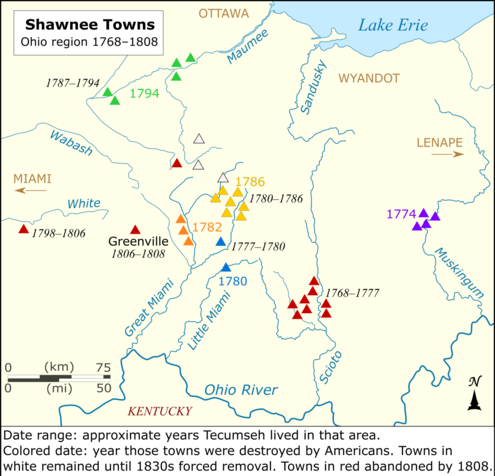
Tecumseh lived in Greenville, Ohio of several years between 1806 and 1808. There is a place near Water Street on Greenville Creek called Tecumseh Point. This is where Tecumseh and his brother lived for several years. They would have traded at Azor Scribner’s trading post on the present corner of Elm and Main. It was the only place to trade.
“At the outbreak of the War of 1812, Scribner enlisted in Captain Joseph Ewing’s company, Lanier’s Independent Battalion of Ohio militia. His service began Aug. 9th, 1812 and expired Feb. 8th, 1814. He participated in the important battle of the Thames in the fall of 1813, in which Tecumseh was killed and the British General Proctor, signally defeated by the Americans under Gen. Wm. H. Harrison. To General Johnston, of Kentucky was given the credit of shooting the great Shawnee chief. However, it has been handed down in Azor Scribner’s family that he himself [Azor] shot Tecumseh from ambush and refused to reveal the fact to anybody during his lifetime, except to his wife. whom he straitly charged with secrecy.” – THE HISTORY OF DARKE COUNTY, 1914, Wilson, Frazer.
To me, this would make sense, Scribner would have known Tecumseh from trading with him. He was at the Battle of the Thames. If he killed the chieftain, he would not want to admit it lest he lose his lucrative business. If he killed him from ambush, he would have known it was Tecumseh when he lined his sight on him.
” He knew Tecumseh personally, having traded with him many times at Greenville, no doubt, and feared the con sequences should it be revealed to his old dusky customers that he had done the awful deed. His wife, who survived him several years, revealed the secret after his death to her second daughter, Elizabeth, who in turn revealed it to her daughter, Mrs. Marcella Avery, now living at an advanced age with her son Ira and daughter Prudence on North Main street (Minatown) near the site of Scribner’s first trading post. Scribner seems to have made money in his traffic with the Indians, but after he opened his tavern competition arose and he had to be satisfied with his share of the trade. He died in 1822 in the prime of life, leaving a wife and several daughters.” – THE HISTORY OF DARKE COUNTY, Wilson (1914)
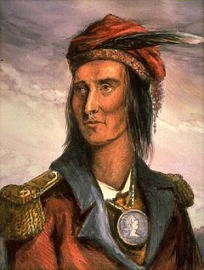
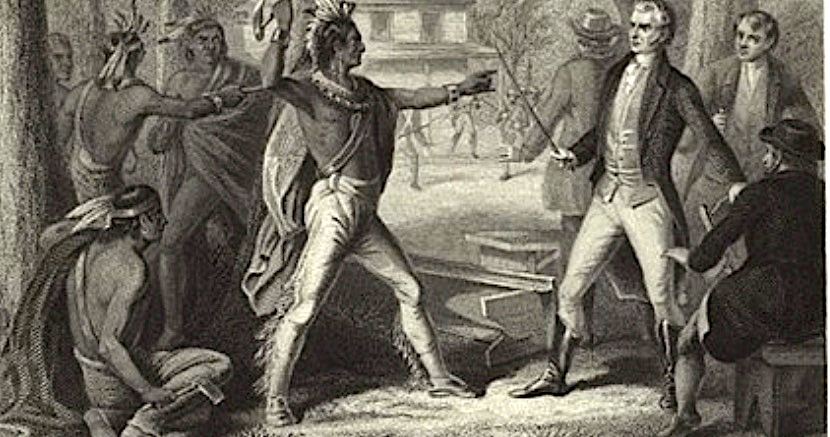
Tecumseh negotiating with William Henry Harrison.Relief of Johnson shooting Tecumseh, National Gallery
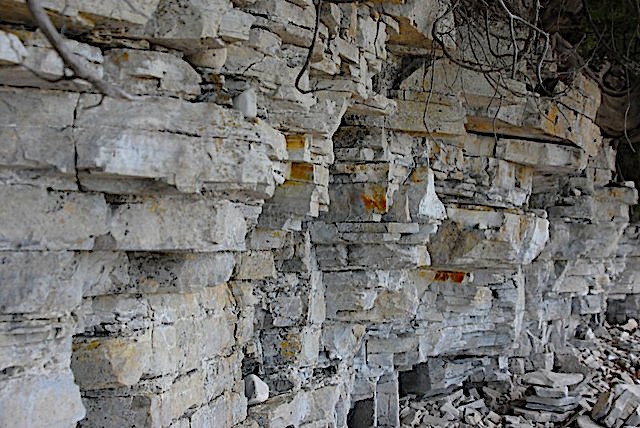
This rock underlies most of the upper Mississippi valley — the most fertile continuous section of the United States.
“The earliest records of Darke County, Ohio, are not written upon parchment or perishable writing material, but in the face of the underlying Niagara limestone. The encased fossil crinoids and the sedimentary character of this rock plainly indicate that it once formed the bed of an ancient ocean. The extent of this formation and the slight westerly inclination of the rock toward the basin of the Mississippi river suggest that this ocean was an extension of the Gulf of Mexico, spreading from the Appalachian to the Rocky Mountains, and from the gulf to the rocky heights of Canada. This is the verdict of scientists, who have made careful and exhaustive researches in this field, and we humbly accept their verdict. It is useless to speculate on the eons of time that have elapsed since this rock finally emerged from this ancient sea to form the landed area of the Ohio Valley… Niagara limestone.
This rock underlies most of the upper Mississippi valley — the most fertile continuous section of the United States.
The rock strata which generally appear nearest the surface here, as well as in northern and western Ohio, and the states immediately adjoining on the north and west, are a part of one of the great limestone formations of our continent. This rock underlies most of the upper Mississippi valley — the most fertile continuous section of the United States. In this locality the rock is covered with glacial till, debris and loam to an average depth of probably one hundred feet. Although lying for the most part in an approximately horizontal position some faults have been discovered where the rock appears to be entirely missing. Such faults have been detected southeast of the intersection of the Pennsylvania and Dayton and Union railways within the corporate limits of Greenville, at the county infirmary and at the Pennsylvania water tank some two miles south of Greenville in the Mud Creek valley. They may be simply pre-glacial gorges.”
Darke county owes its name to Lieut. Col. William Darke, who was born in Pennsylvania in 1736. At the age of five years he removed to the neighborhood of Shepherdstown, Virginia. He served with the Virginia provincial troops at Braddock’s defeat. During the Revolution he served with distinction, being taken prisoner at Germantown and commanding as colonel two Virginia regiments at the siege of York. He was a member of the Virginia legislature for several successive terms. At St. Clair’s defeat in 1791, he led the final charge that cleared the way for a successful retreat of the remnant of the army. He died November 20, 1801, and his remains are buried in the old Presbyterian burying ground near Shenandoah Junction, Berkeley county. West Virginia. The remains of his only son. Captain Joseph Darke, who died from wounds received at St. Clair’s defeat, lie buried near by. Colonel Darke was a farmer by occupation, and is described as having a large, strong, well-knit frame, rough manners, and being frank and fearless in disposition
WHAT LIES BELOW DARKE COUNTY?
The geological formation of this section was well shown while prospecting for natural gas in this vicinity in 1886-1887. The first well bored on the site of the old fairground (Oakview) made the following exhibit :
QUOTING 1887 DRILLING DATA
“Rock was reached at a depth of 89 feet, thus showing the thickness of the drift formation. The Niagara limestone extended from this point to a depth of 260 feet when the Niagara shale was reached. At a depth of 140 feet this limestone was mixed with flint, and at a depth of 153 feet, dark shale, or drab limestone, predominated; but at a depth of 175 feet this limestone was quite white and pure and much resembled marble. The Niagara shale is of light gray color and might be mistaken for the Niagara clay, and as it came from the well was quite pliable, being easily made into balls, the material becoming hard when dry and containing a great deal of grit.
“From this point to 1134 feet, the drill passed through continuous shale of the Huron formation, but sometimes so dark that it might be classified with the Utica shale. This formation was not uniform in texture, but sometimes was quite compact and hard; at other times .soft and porous, enabling the drill to make rapid progress.
“At 1134 feet the formation changed to a lighter color, more compact, and contained much limestone. The first Trenton rock was reached at a depth of 1136 feet. The rock was darker than ordinary, quite compact, and with no flow of gas, though a little was found while passing through the shale. At 1148 feet the hardness seemed to increase, and at 1195 feet the limestone became whiter, but as hard and compact as before. At 1210 feet it much resembled in appearance the formation at 140 feet, though finer in texture and entirely destitute of the flinty formation. At 1570 feet it seemed, if possible, to be harder than before, with a bluish cast of color; while at a depth of 1610 feet coarse, dark shale in loose layers again prevailed, accompanied by a very small portion of the limestone. At 1700 feet the limestone changed to its original white color and compact form, accompanied with sulphur; and at a depth of 1737 feet bitter water and brine were found, the water being blue in color and unpleasant in taste and odor; but after being exposed to the air for some time it became clear, the unpleasant smell disappeared and the saline or salty taste alone remained.
[The rocks of the Trenton Group are called limestones, but are sediments are more complex than simple limestones. Within the succession of rocks along West Canada Creek from Trenton Falls to Prospect, New York, the Trenton Group is composed of mixed siliciclastic and carbonate rock types.]
“We notice that the Trenton was reached at 1136 feet. The surface at this point is about 1055 feet above sea level, so that the Trenton rock was here reached at a depth of 81 feet below salt water. This places it much higher than at other points in this part of the state where wells have been sunk and gas obtained; and this fact, with the compactness of the rock, will show that gas can not be obtained here. We know of no other point outside the county where wells have been sunk that the formations are the same as here.”
LOCAL EXPOSURES
“Limestone exposures occur to a limited extent in at least five places within the county, as follows: On the Stillwater at Webster, in the southwest quarter of section thirty-two in Wayne township, where the rock is hard but unfit for quarrying on account of its irregular and massive condition ; near Baer’s [Bear’s] (Cromer’s) mill on Greenville creek, about four and one-half miles east of Greenville, in the southwest quarter of section twenty-seven (27), Adams township, where the rock forms the bed of the creek for some distance. Quarries were once operated by Bierley, Rosser and Hershey in the bottom of the valley where the rocks are covered with about two feet of red clay or loam, intermingled with decomposed lime rock, and strewn with heaps of granite drift boulders. The upper section is of a buff color and is soft and fragile, while below many fossil crinoids appear and the rock is darker and harder.
“Two exposures of rock occur in the Mud creek valley: one on the southwest side of the prairie, about a mile from Greenville, in the southeast quarter of section thirty-three (33), Greenville township ; the other near Weaver’s Station in the southeast quarter of section twenty-nine (29), Neave township. At the former place, known as Card’s quarries, the rocks are found folded with an inclination to the south and east. Here the rocks are similar to those at Baer’s mill and contain many fossils. Near Weaver’s Station the creek flows over a horizontal bed of limestone for about a hundred and fifty yards. This stone is not hard enough for building purposes and seems to contain no fossils. A section of rock is exposed in the southwest quarter of section twenty-four (24), Harrison township, about a mile south of New Madison, near the headwaters of the east fork of the Whitewater river, where a lime kiln was formerly operated by one C. B. Northrup.
“Careful calculations indicate that the rocks at Card’s kiln and near Baer’s mill have an elevation from seventy-five to ninety feet above the corresponding strata underlying the city of Greenville, which appears to be built on an immense glacial drift, deposited in a preglacial valley. In the pioneer days, lime rock was quarried at Baer’s, Card’s and Weaver’s Station, burned in kilns and used extensively for plastering, brick laying, whitewashing, etc. The quality of lime produce was of a very high grade, but on account of the limited areas of outcrop and the obstacles encountered in getting the rock out, these quarries have been abandoned for several years.
“Building rock is now secured at the more extensive and easily quarried outcrops in Miami, Montgomery and Preble Counties.”
SANDSTONE BECOMES ROCK WITH TIME AND PRESSURE
After the formation of the Niagara limestone, for some reason, probably the cooling and contracting of the earth’s crust, the bed of the ocean in which it had been deposited was partially elevated and added to the continental area. This occurred in the upper Mississippi valley and the region of northern and western Ohio as above noted. In the fluctuating shallows of the sedgy Sargasso Sea, which fringed this newly elevated limestone plateau on the east and south, a rank vegetation flourished on the carbon-freighted vapors of the succeeding era. During uncounted millenniums, forest succeeded forest, adding its rich deposit of carboniferous materials to be covered and compacted by the waters and sedimentary deposits of many recurring oceans into the strata of coal now found in southeastern Ohio and vicinity. Finally the moist air was purged of its superabundant carbon dioxide and mephitic vapors and a new age dawned, during which bulky and teeming monsters lunged through the luxuriant brakes and teeming jungles of a constantly enlarging land.
LATER FORMULATIONS OVER OHIO VALLEY
The vast ocean gradually retreated, foothills were added to the primeval mountain ranges, plateaus swelled into shape and a new continent was formed. Thus is explained the presence of the beds of coal and the immense stratified deposits of sandstone, limestone, slate and shale overlying the Niagara limestone in eastern Ohio, and thus geologists arrive at the conclusion that a period estimated at hundreds of centuries intervened between the appearance of “dry land” in western Ohio and eastern Ohio.
GLACIAL INVASION
While eastern Ohio was in process of formation the vast Niagara limestone plateau to the west was being deeply eroded by the active chemical agents and the frequent terrific storms of that far-off and changing age. The smoothing touch of a mighty force was needed to fill the yawning chasms and deep ravines and prepare the surface of this ancient continent to be the fit abode of imperial man and his subject creatures.
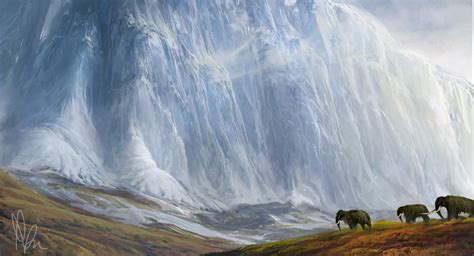
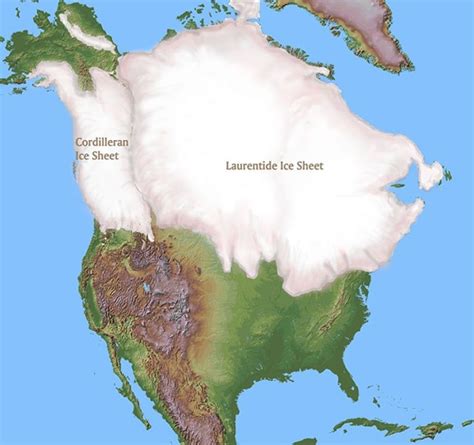
Such a force was soon to become operative. Evidence has been adduced by prominent geologists and special students of glacial action to show that part of the deep soil of northern and western Ohio and the contiguous territory has actually been transported from the region north of the Great Lakes by the action of glacial ice, and deposited in its present location upon the melting and retreat of the immense frozen mass. Ice, snow and glacial debris probably covered this part of Ohio to a depth of several hundred feet during this frigid era. Startling as this statement may at first seem it has been arrived at after a careful scientific observation and study of the active glaciers of Greenland, Alaska, Norway and Switzerland.
THE LAURENTIDE GLACIER
The center of accumulation and dispersion of this glacial ice was probably the Laurentian plateau or ledge of primitive igneous and granitic rock lying north of the Great Lakes and St. Lawrence river. During the Tertiary period, just preceding the formation of this great glacier, a temperature similar to that of southern Virginia prevailed in the polar regions. In course of time the northern part of the North American Continent probably became somewhat elevated while the central part became correspondingly depressed. The snows of years and centuries accumulated on this elevated region, consolidated into glacial ice, pushed slowly southward along the line of least resistance, filled up the depressions occupied by the Great Lakes, and then moved on over the divide until arrested and counteracted by the increasing heat of lower latitudes. As in the case of modern glaciers, this vast sheet advanced and retreated in obedience to meteorologic agencies, carrying on its surface or within its mass broken fragments and debris from its native granite ledges, scraping and pushing forward immense quantities of the eroded surface of the limestone rock over which it moved, grinding, mixing, kneading, rubbing, polishing, sorting and finally depositing this material where it is now found.
[The debris left behind by glaciers is called Moraine fields.]
TERMINAL MORAINE
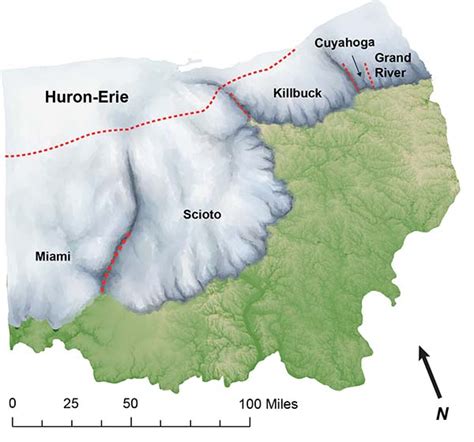
The southern boundary of this great ice sheet has been carefully traced from the New England states, across New York, Pennsylvania, the northern Ohio Valley states, and the states north of the Missouri river. Roughly speaking, this glacial boundary line, in its central and western portion, parallels the Ohio and Missouri Rivers. It enters eastern Ohio in Columbia County, continues in a westerly direction to Canton in Stark County, and thence a few miles beyond Millersburg in Holmes County; here it turns abruptly southward through Knox, Licking and Fairfield counties and into Ross County; thence it bears southwestward through Chillicothe to southeastern Highland County and northwestern Adams County, reaching the Ohio River near Ripley in Clermont County. Following the north bank of the river to Cincinnati, it here crosses over into Boone County, Kentucky, makes a short circular loop and recrosses the Ohio River into southeastern Indiana, near Rising Sun. It now follows approximately the north bank of the Ohio to the neighborhood of Louisville, Ky., where it turns northward to Martinsville, in Morgan County, in the south-central part of the state. Here it turns west and south and crosses the Wabash River near New Harmony. It continues this course to near the center of the extreme southern part of Illinois, then bends in a northwesterly direction and crosses the Mississippi just south of St. Louis, Missouri. The most productive soil lies north of this line and within the glaciated area.
“School failed me, and I failed the school. It bored me. The teachers behaved like Feldwebel (sergeants). I wanted to learn what I wanted to know, but they wanted me to learn for the exam. What I hated most was the competitive system there, and especially sports. Because of this, I wasn’t worth anything, and several times they suggested I leave.
This was a Catholic School in Munich. I felt that my thirst for knowledge was being strangled by my teachers; grades were their only measurement. How can a teacher understand youth with such a system?
From the age of twelve I began to suspect authority and distrust teachers. I learned mostly at home, first from my uncle and then from a student who came to eat with us once a week. He would give me books on physics and astronomy.
Are we simply our personal selves? Are we what our self-consciousness vision believes itself to be? Is this flesh and blood that compose our bodies all that we are?
The chemicals we are made of are replenished daily and most of the cells in our bodies renew often. Obviously, we are not simply that which we call our body. Most of our perceptions are mental. We live in a dual mental and physical world. We look in the mirror and see only a portion of ourselves. Neither that self-reflected person in the mirror nor the deepest imagined self buried within us is our whole being. Our lives are the stories of our personal changes.
Once Shakespeare wrote, “All the world’s a stage, and all the men and women merely players; they have their exits and their entrances, and one man in his time plays many parts.”
Did Shakespeare see life as a play, a dream played out on a cosmic stage? Then who is the dreamer? Are we both the dream and the dreamer, if the universe about us is a play? Does another force dream us into being?
Hindu beliefs tell us that all is an illusion. Modern physicists will tell us of the strange quantum world where virtual electrons pop in and out of existence and only have a defined reality when measured and observed.
For objectivity to exist, there must be a subject as well as an object. Every object must have a subject. Ultimately, if the object and the subject are the same, then neither are truly substantial. That is one reason why many people believe that we live in a world of illusion, Hindus among them.
Attempts at rationality and logic all lead to a leap of faith—then to assumptions and beliefs. Logic cannot come to our rescue. We cannot logically prove anything exists but our own thoughts and consciousness. We know that something is being observed and we call it the world. We know that something is thinking and something is recording our perceptions. We call it our brains.
Even that is a leap of faith, as we cannot even prove that we actually do the thinking. Thoughts come and go at random as our attention refocuses. Because we perceive others with the same perceptions that we perceive ourselves, we can validate their independent existence. Only a nonphysical approach—metaphysical means above the physical—can lead to answers to the timeless questions about our own existence.










 Kenneth Harper Finton