INSULTS

INSULTS

by Kenneth Harper Finton

The definition of a verbal insult is to disparage and speak with abuse and disrespect. People in the public eye are often insulted. You write song and you can be sure there will be those who doe not like it. You paint a picture and you can be sure some call it terrible. You write an article and someone calls you a hack. Receiving insults are part of being known by your peers. The adage is that we must develop ‘thick skin’ so that we remain unaffected by verbal and indirect defamations.

Unknown-1There are many ways to deal with insults and disparaging remarks. Some work better than others. Anger is probably the worst way to deal with an insulting person. It shows the insulter that we take them seriously and suggests that there is some truth to the insult.

When we are insulted, we are forced to judge the person doing the insulting. Do they have a valid point? Is their remark worth a retort? Is the insult really a statement of fact that we can learn from?

The first reaction to being insulted is to return it. This is the famous “put down” approach. The problem with this is that we must be very clever to do this. There is a problem with this approach in that is tends to raise the insulter to higher level and can add credence to the accusation. Very clever minds can come up with wonderful retorts. Winston Churchill, for example, said to a woman who called him a drunk said: “I may be drunk, Miss, but in the morning I will be sober and you will still be ugly.”

“Put down” reactions are best made with humor and among friends. Few of us have the ability to be so clever as this in an instant. Dorothy Parker was an exception. When a drunk told her that he could not bear fools, she replied:  “Apparently your mother could.”

As we can see, humor is possibly the most effective retort to an insult. It not only mitigates the seriousness of the situation, but mocks the insulter. If there is an audience, they are brought to  your side, not the side of the disparager.

Those who are not so quick might find that ignoring the insult might be the best imagesremedy. The down side there is that when someone throws mud at you, some of it is going to stick. Ignoring an insult is also likely to show that you are not in control any longer. This turning of the other cheek might me the Christian approach, but repeatedly ignoring a barrage of insults is harmful to your self-esteem. “Hear no evil, see no evil, speak no evil” does not rid the world or your persona of evil. It might be better to study a few clever retorts and have them at your fingertips.

Most people who bully and throw insults do so out of personal insecurity. They are trying to cover up their own inadequacies. Developing ways to point that out is a good defense. If someone calls you a fat pig, you can say, “I love pigs. Don’t you think bacon is the greatest.”

If you chose to say nothing at all, you can walk away freely and say, “You have crossed the line and I have nothing more to say.”

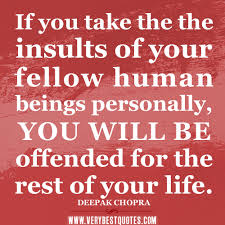
UnknownDeepak Chopra has it right. You cannot go through life and not be insulted. The pain caused by insults are symptoms of a more universal human condition. In the social hierarchy where people have the need to be among people, insults will surely result. Wolves and other predators fight to establish an order for their pack. Humans more often use words. As children we are taught that “sticks and stones may break my bones, but words can never hurt me.”

Unfortunately, that is not so. Words do hurt. We are naturally wired to seek social acceptance and we feel good when we get it. A jibe from a good friend might not hurt us, but we feel we lose status when strangers do the same.

It all comes down to not taking ourselves and the world so seriously. When we do, we feel bad and get depressed. It is better to listen, evaluate what we hear and see if there is any truth to the mud that is slung at is. Those who speak bullshit will always have a trace of it on their lips.

Antidepressant Studies Found Tainted by Pharma Company Influence

Docs and Big Pharma

BIG PHARMA CONTROLS THE RESULTS OF THEIR OWN STUDIES. THIS CONFLICT OF INTEREST NEEDS TO BE REGULATED.

“The medical profession is being bought by the pharmaceutical industry, not only in terms of the practice of medicine, but also in terms of teaching and research. The academic institutions of this country are allowing themselves to be the paid agents of the pharmaceutical industry. I think it’s disgraceful.”  – Arnold Seymour Relman (1923-2014), Harvard Professor of Medicine and Former Editor-in-Chief of the New England Medical Journal

“It is simply no longer possible to believe much of the clinical research that is published, or to rely on the judgment of trusted physicians or authoritative medical guidelines. I take no pleasure in this conclusion, which I reached slowly and reluctantly over my two decades as an editor of the New England Journal of Medicine” Dr. Marcia Angell, a physician and long time Editor in Chief of the New England Medical Journal (NEMJ) 

SEE ENTIRE ARTICLE HERE:

http://www.scientificamerican.com/article/many-antidepressant-studies-found-tainted-by-pharma-company-influence/

By Roni Jacobson | October 21, 2015

After many lawsuits and a 2012 U.S. Department of Justice settlement, last month an independent review found that antidepressant drug Paxil (paroxetine) is not safe for teenagers. The finding contradicts the conclusions of the initial 2001 drug trial, which the manufacturer GlaxoSmithKline had funded, then used its results to market Paxil as safe for adolescents.

The original trial, known as Study 329, is but one high-profile example of pharmaceutical industry influence known to pervade scientific research, including clinical trials the U.S. Food and Drug Administration requires pharma companies to fund in order to assess their products. For that reason, people who read scientific papers as part of their jobs have come to rely on meta-analyses, supposedly thorough reviews summarizing the evidence from multiple trials, rather than trust individual studies. But a new analysis casts doubt on that practice as well, finding that the vast majority of meta-analyses of antidepressants have some industry link, with a corresponding suppression of negative results.

The latest study, published in the Journal of Clinical Epidemiology, which evaluated 185 meta-analyses, found that one third of them were written by pharma industry employees. “We knew that the industry would fund studies to promote its products, but it’s very different to fund meta-analyses,” which “have traditionally been a bulwark of evidence-based medicine,” says John Ioannidis, an epidemiologist at Stanford University School of Medicine and co-author of the study. “It’s really amazing that there is such a massive influx of influence in this field.”

Almost 80 percent of meta-analyses in the review had some sort of industry tie, either through sponsorship, which the authors defined as direct industry funding of the study, or conflicts of interest, defined as any situation in which one or more authors were either industry employees or independent researchers receiving any type of industry support (including speaking fees and research grants). Especially troubling, the study showed about 7 percent of researchers had undisclosed conflicts of interest. “There’s a certain pecking order of papers,” says Erick Turner, a professor of psychiatry at Oregon Health & Science University who was not associated with the research. “Meta-analyses are at the top of the evidence pyramid.” Turner was “very concerned” by the results but did not find them surprising. “Industry influence is just massive. What’s really new is the level of attention people are now paying to it.”

DREAMS

DREAMSsleep-paralysis-lucid-dream-e1297199806299

I often wish that dreams were more useful. I am talking about the dreams found in sleep that mix the past and present together in ways that can never exist in our reality. I am talking also about the recurring themes of dreams that form the outline and background of nightmares and sleep disturbances.

No one, in all the ages of mankind’s existence, has ever found a satisfactory explanation for dreams. Freud tried, but many think he failed miserably. Dreams are often so divorced from our daily routines that they appear to be random fantasies of a brain desiring content. Dreams do take us on an emotional ride, especially when we wake up and remember them vaguely. Yes, they can be positive and they can be negative to our emotional being.

Most often our dreams have some basis in experiences that we have lived and places we have been or called home. These dream experiences are distorted and take on extra dimensions, as though we are eternally reinventing our past and re-visualizing someone or some place based in our experience.

I have noticed that I am almost always young in my dreams. Aging, as yet, has never been a part of my dreams. I also dream of places that were at the cusp of great changes in my life. I can dream of my hometown dressed in bejeweled glamor, places I have lived or worked rewritten in seemingly endless fictional dramas––people and family that I have known are often present, even though they no longer live or are close to me.

Above all, dreams are emotional. They come with intense feeling and awareness. Sexual dreams may involve a person that we may or may not know. It is as though all our sensuality is wrapped in a longing for a person who is more a symbol of our desire than a real person, even if that dreamed person is someone we knew or know presently. Often, the object of a sexual dream is an unknown fantasy that embodies that which we desire. For this reason, some think that dreams serve the purpose of wish fulfillment, but many dreams can take us to places we have no desire to go.

Try as we will, we cannot find a real purpose for our dreams. This is likely that they have no real purpose. Like life itself, the purpose is simply the experience. They most often have no value or reason. The mind is restless and invents images and stories filled with emotional feelings that seem more real than their counterparts in our waking lives.

Vivid dreams tend to waken me from sleep and leave me restless and emotionally confused. Often I cannot get back to sleep right away after a vivid dream. Rarely does the dream continue after falling back to sleep. Vivid dreams are characterized by rapid eye movement and is a state of sleep called REM. The scientific study of dreams is called oneirology.

Most people have rather vivid dreams for several hours during the course of a night’s sleep. More often than not, these dreams are nor remembered upon awakening. Dreams with REM can be measured with an electroencephalogram (EEG) and last for a few minutes to a 20 minute maximum.

Sleep is necessary to repair body functions. All animal and some reptiles are shown to have dream episodes. Who has not seen a dog sleeping and moving their legs spasmodically in short bursts, sometimes emitting a muffled bark as though they are on the chase of running from a predator? Sleep deprivation is used as a technique for torture. Severe deprivation can actually harm the body tissue.

Déjà vu

Then we have déjà vu, the feeling of having experienced something before that becomes manifest in the waking state when simulated with a real event or place that mysteriously feels quite familiar. Two-thirds of the human population experience déjà vu at some time. No one has found any reasonable explanation for the phenomena.

It is easy to speculate that dreams could be connections with multiple unseen dimensions that exist within the mental universe. Since time and space is a product of dimensional awareness, there could well be other dimensions in the eternal now where we tap into electrical stimulus that awakens alternative dimensions. In other words, it might be possible that we live our personal existence many times during the illusory course of time and connect with them in our dreams. However, some dreams are so divorced from our waking reality that is seems impossible that these fictional visions have any actuality at all.

And then there are the productive dreams that inspire and can be built into waking realities. There are man examples of inventors, composers, writers, and makers of films using their dreams for creative purposes that become actuality. Horror films, for example, are filled with black dreams filled with fear and loathing. Some movies and literature describe the dream state,attempting to show that the dream state is the precursor to something real. The line between dreams and really become blurred in many a pop culture film. These dreams are not symbolic so much as an expression of the dreamer’s desires and fears.

Yet there are symbolic dreams. We recognize the symbolism when we wake and remember them. The disliked relative or acquaintance takes on a forbidding and villainous quality. A failed romance from the past becomes a sexual fantasy and we rewrite our lives in vivid visions.

Obviously,we need these dreams. They serve the purpose of making us think and contemplate. Just as sleep renews our energy and body functions, dreams  can heal our emotional pains and help us re-envision a future that is more in tune with our desires.

THE PERPETUAL SEARCH FOR TRUTH

Source: THE PERPETUAL SEARCH FOR TRUTH

QUEEN ISABELLA, THE SHE-WOLF OF ENGLAND

Ken Finton's avatarKenneth Harper Finton

Isabella of Angouleme, queen of king John

 Queen Isabella was ripe for romance. She was a passionate woman in her late twenties, a striking beauty with plaited blonde hair. Furthermore, she had endured the loveless marriage with Edward since she was thirteen.

Roger de Mortimer, 8th Baron of Wigmore, was serving a life sentence in the Tower. His hair had grown long, his cheeks pale, and his eyes glowed with desperation. One glance at the handsome prisoner was enough to strike romantic interest in Isabella. It is not difficult to believe that the queen, her emotions stirred by the prisoner’s dark eyes, had made an opportunity to see him.

On the night of August 1 it was customary for the prison guards to celebrate the feast of St. Peter with food and drink. This time, the drink was drugged by the sub-lieutenant of the guards, Alspaye. When all the guards had fallen into a stupor, Mortimer dug…

View original post 1,374 more words

REUNION

Ken Finton's avatarHELIOS

REUNION

by Kenneth Harper Finton

Who in 1960 could imagine life in 2015? Those who did try  to visualize the future were horrified by the novel 1984 and the dictatorial police state that it portrayed. For the generation that grew up in the shadow of nuclear war, their expectations for their own futures were cloudy and uncertain.

The turn of the each century has aways brought grave change to the American landscape and culture. The year 1700 brought to the world the seeds of revolution against monarchal tyranny and religious repression. 1800 heralded a new spirit of expansion into unknown lands with the promise of greater freedom for all than the world had ever known before. 1900 brought dreams of industrial expansion as the railroads opened up the western regions. Capitalists conceived of factories that could bring a better life to all and great profits for those whose dreams and ambitions…

View original post 1,666 more words

BEAR’S MILL

IMG_2398

When I was a child I lived about twelve miles from Bear’s Mill. In the  summer I would occasionally ride my bike down the gravel backroads that led from my home to the mill. I would spend some time sticking my hot feet in the  cool waters and watching the waters fall hypnotically over the dam.

IMG_2403

At that time, the mill was still a working mill run by a miller that got to know me and my bike from the frequent trips I made. I had one of the first thin-tired Schwinn bikes with three gears in the county. They were called English bikes at the time. The narrow tires made the bike hard to control on the graveled roads.

I know that 99.9% of the people will never get to Bear’s Mill. It matters little, as it is worth knowing about. That is why I write this. I will probably never get to the pyramids, but I still find them of great and abiding interest.

BEAR'S MILL

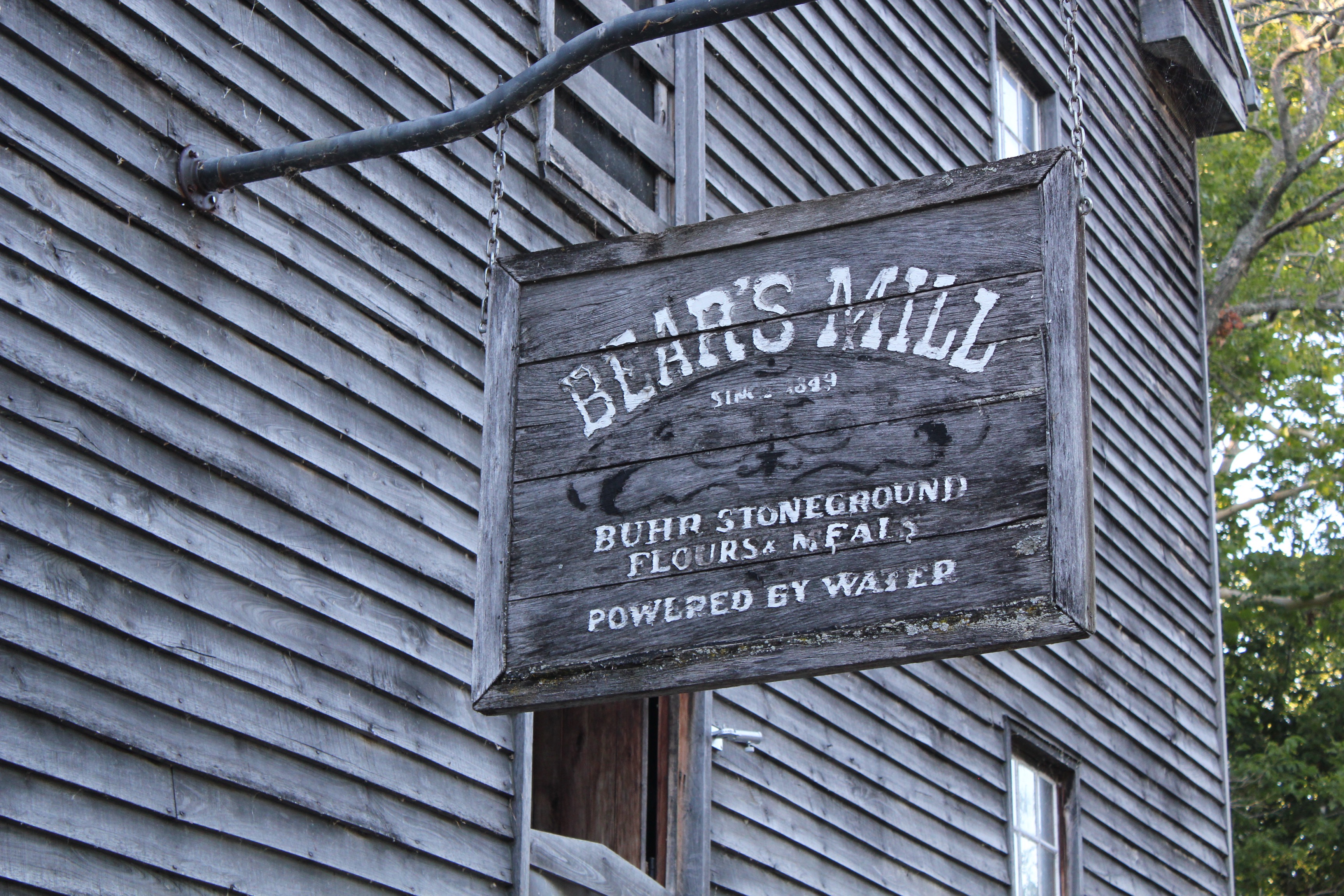
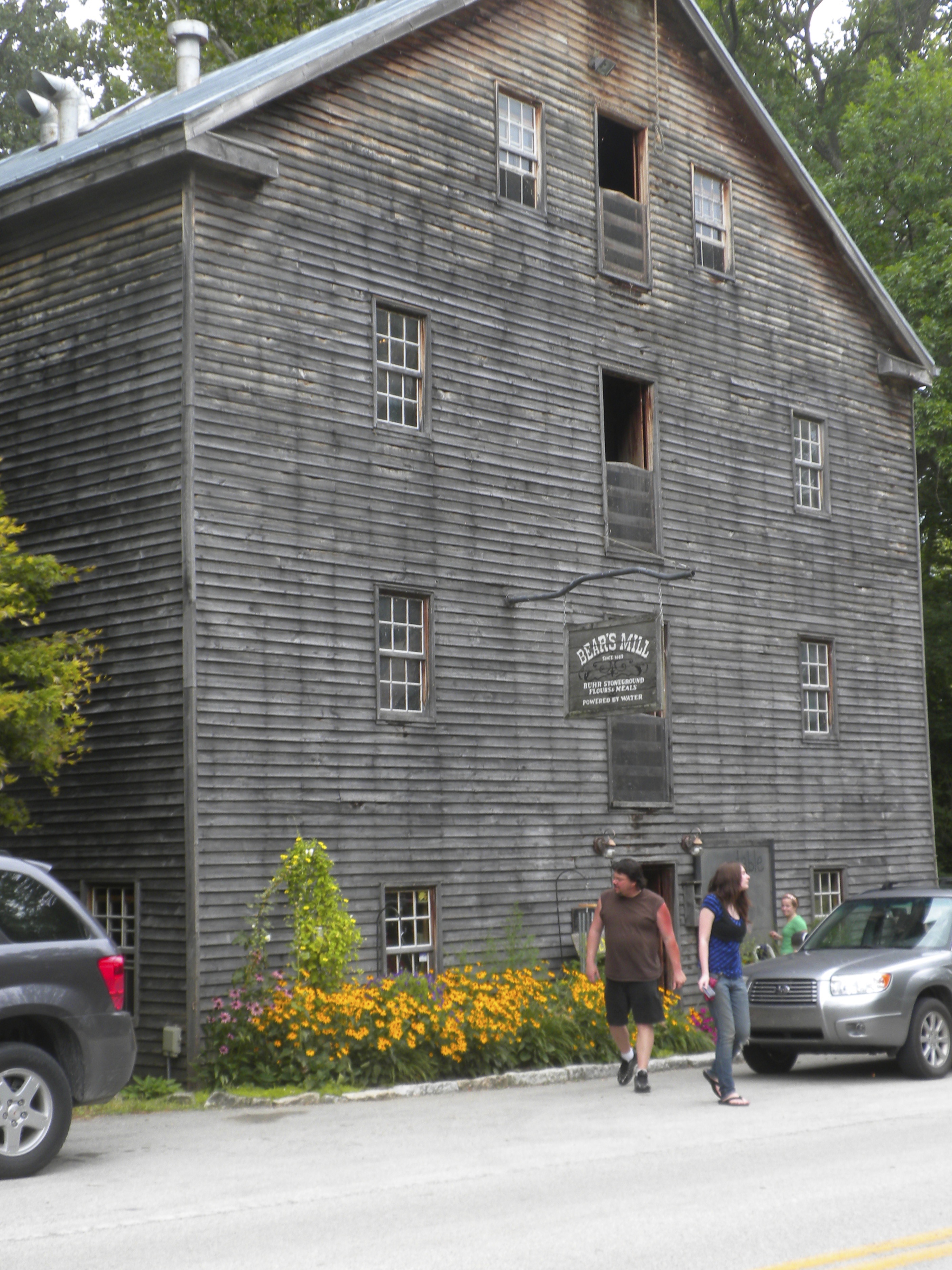
It is not that Bear’s Mill is one of the great wonders of the world that everyone needs to see. It is simply an historic grist mill in Darke County near Greenville, Ohio, the oldest existing industrial building in the county. It was built in 1849 after settlers had cut the trees out of the Ohio wilderness and grew crops on the newly cleared lands. Before it was put into operation it was purchased from Manning Hart, the builder and contractor, by Gabriel Baer. The stones used for grinding the grains were not hard enough, so Baer traveled to France to purchase high quality milling stones that fit his purpose. The original name was Baer’s Mill, but somehow along the way Bear’s Mill became the referred spelling.

The wood siding on the mill has been in place since 1849. It is a hardwood lap siding made from American Black Walnut and has served the building for over 165 years. In the 1970’s the miller retired and turned the mill over to a non-profit organization called Friends of Bear’s Mill. They still use the mill occasionally to grind a limited amount of grain. The bottom floor now contains a gift shop and an art gallery for local midwest artists to show their works. In 1975 the mill was placed on the National Register of Historic Places. It is both a museum for milling history and a stopping place for tourists who are as fascinated with the mill race and the dam as I was as  a child.

IMG_2425

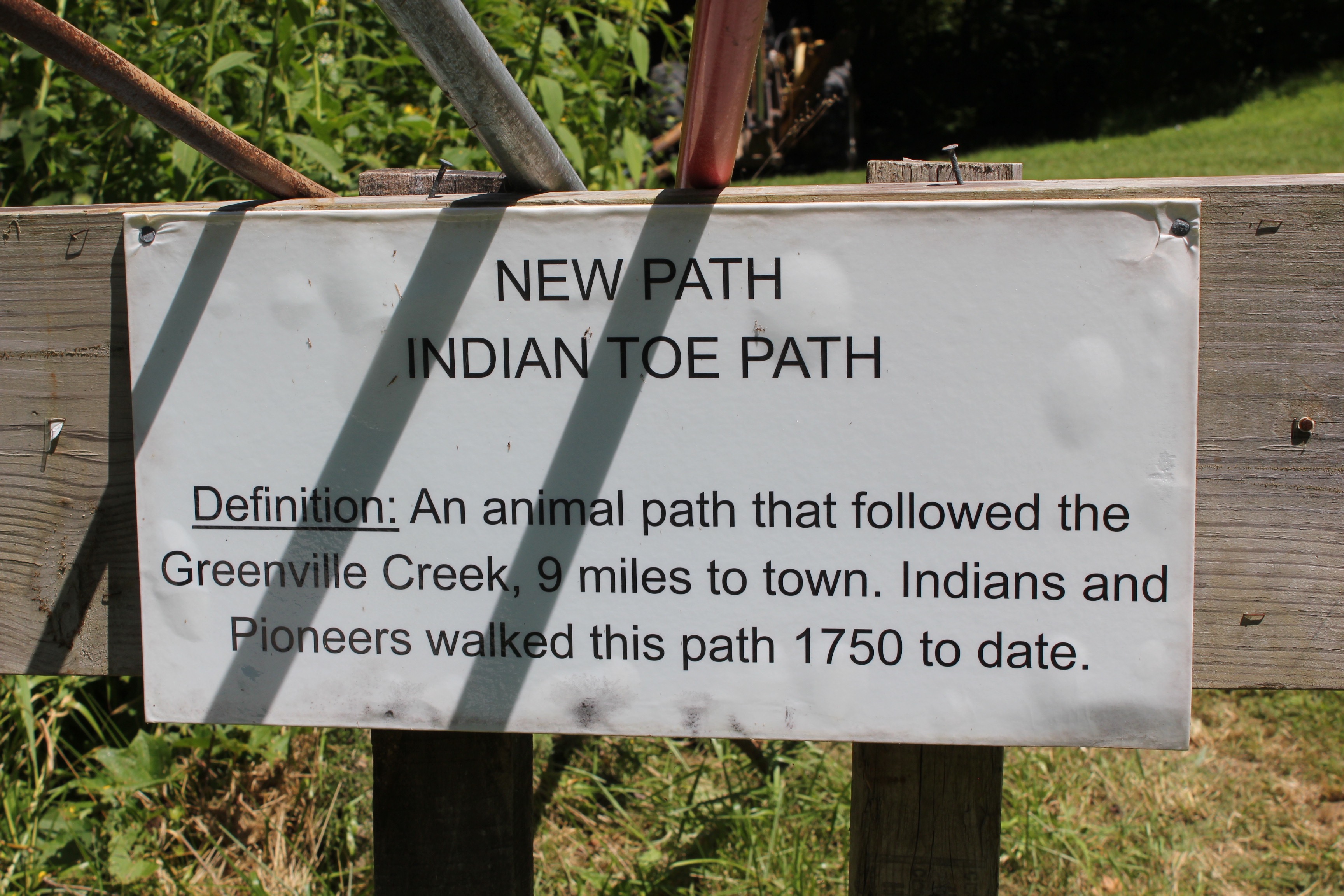
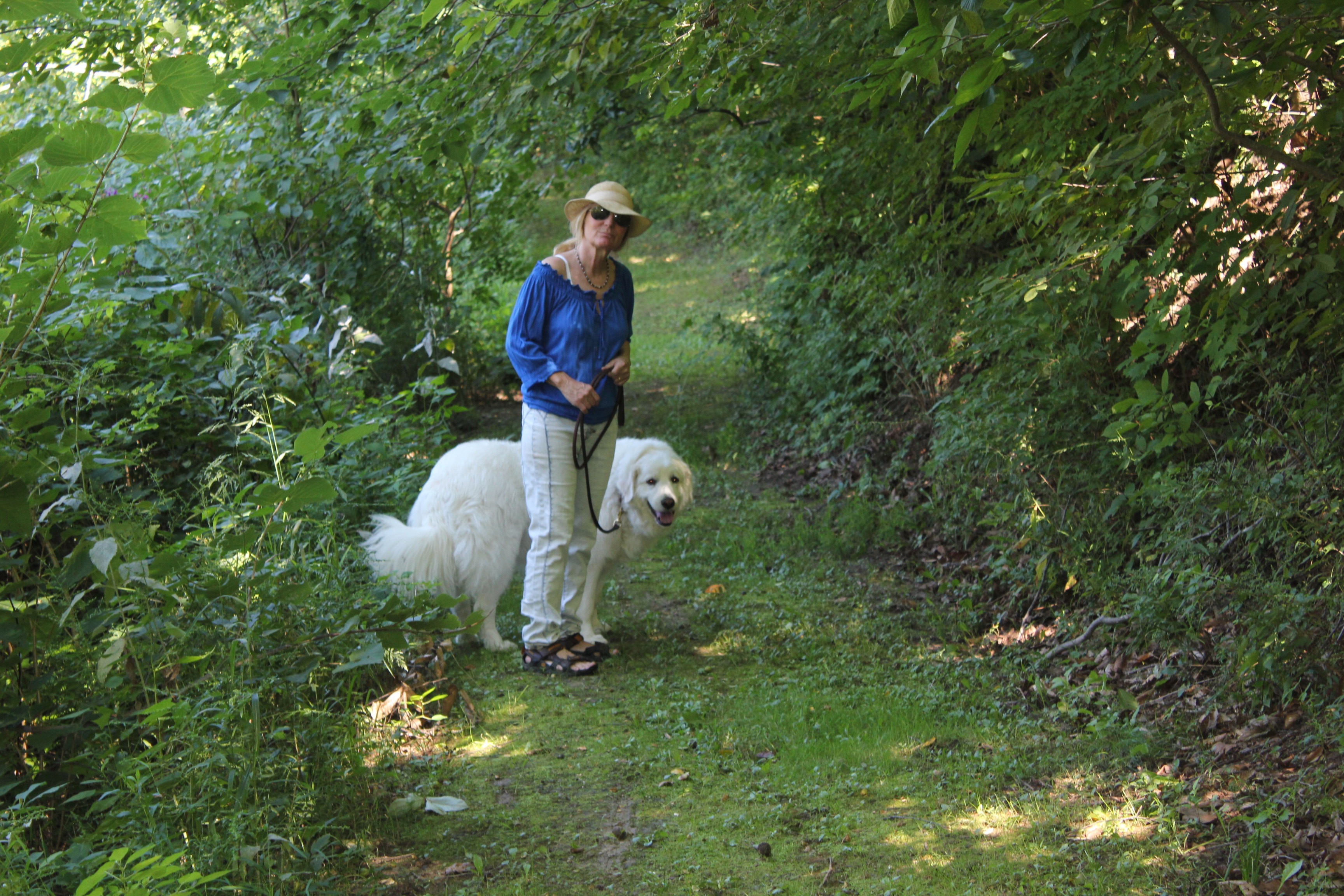
Remnants of the old Indian Toe Path run for half a mile along the creek. The visitors to the mill can take a mild, cooling walk in the summer sizzle where the pioneers and animals walked the hard nine miles to  the settlement at old Fort Green Ville.

IMG_2407

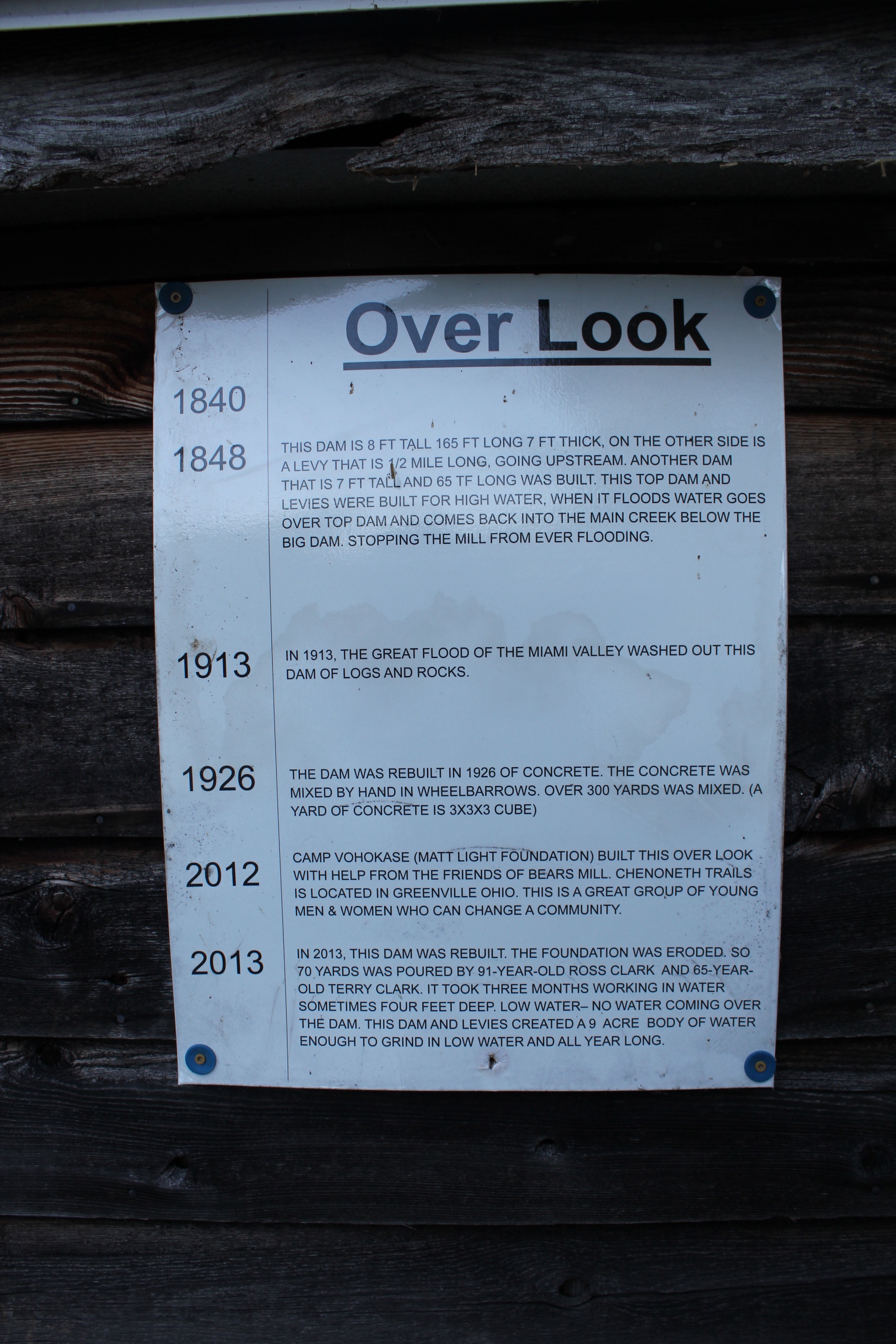
An overlook has been built along the creek by the ancient pathway where deer and panthers once roamed and fed.

IMG_2408

The steeple of the Darke County Courthouse failed and was replaced in the 1980’s. The old steeple was moved to Bear’s Mill to serve as a memorial to the Viet Nam veterans that died in that horrible war.

IMG_2401

The names of the men who died are tagged on the plaque, including one classmate of mine, Gerry Greendyke who never made it home. My classmates and I owe a debt to Gerry and the others that we can never repay. He took our place in the war. He was the one that was killed while we went on to live our own lives. Some came home and many did not. So it is with wars and the young men who fight and die in them.

IMG_2401.1

Away from the memorial, the  woods along the creek remain as they have been for many thousands of years. A cleared path allows the visitors to walk unobstructed in the same spots as ancient mound builders walked ten thousand years ago when the ice sheets were melting and the rivers of Ohio took shape. The birds tweet and the young folk Twitter. And the water, as always, flows forever to the sea.

IMG_2424

Click to make the water run on the video.

THE WORK OF EDWARD CURTIS

Ken Finton's avatarHELIOS

What is a Photogravure?

Photogravure-plate-of-Geronimo

Paul Unks, of Denver, nicknamed Mountain Hawk, explains the craft of printing photogravures: “Developed in the 1850’s, an intaglio photogravure is produced through a complex painstaking hand-made process whereby the original photographic image is etched into a metal plate allowing the plate to hold ink. Then, oil based ink is carefully applied by hand onto the etched plate so that the ink is pushed down into the etched grooves of the plate that range in depth from deep (dark) to shallow (light). Once the printing plate is properly inked, high quality moistened paper is placed on the inked plate and then hand cranked in a press at 10,000 lbs of pressure causing the paper to squeeze down into the grooves of the plate. After the paper fibers have absorbed the ink, the paper is carefully peeled off the plate leaving the image deeply embossed into the paper…

View original post 1,466 more words

THE WRITER’S DILEMMA

Ken Finton's avatarKenneth Harper Finton

by Kenneth Harper Finton ©2015

a2351c22-19ff-40c4-8852-cbf36ff8bda3 It is said that writers “write to be read.” Then painters paint to be seen, actors act to impress and singers sing to be heard. If this is the case–and most often it is–the newer writers of the world are setting themselves up for great disappointment. They will not find the audience that they did on the past. They will not achieve the fame that others did in the past. They will quite likely not enjoy the riches that others have had In the past. Technology and world Internet communications have obviously changed the world.

Though it has democratized the ability to be read and seen and heard, by doing so it has practically eliminated the institutions that originally supported and brought culture to the world. Some vestiges of the old system remain, but they are losing ground with each passing year. They have been…

View original post 661 more words

THIS LAND IS YOUR LAND

soundcloud.com/…/this-land-is-your-land-1

“This song is Copyrighted in U.S., under Seal of Copyright #154085, for a period of 28 years, and anybody caught singin’ it without our permission, will be mighty good friends of ourn, cause we don’t give a dern. Publish it. Write it. Sing it. Swing to it. Yodel it. We wrote it, that’s all we wanted to do.”

-Woody Guthrie


“WHEN WOODY GUTHRIE arrived in New York City he was known as “the Oklahoma cowboy.”

Guthrie was embraced by its leftist folk music community.  For a time, he slept on a couch in Will Geer‘s apartment. Guthrie made his first recordings—several hours of conversation and songs recorded by the folklorist Alan Lomax for the Library of Congress—as well as an album, Dust Bowl Ballads, for Victor Records in Camden, New Jersey.

Guthrie was tired of the radio overplaying Irving Berlin‘s “God Bless America.” He thought the lyrics were unrealistic and complacent. Partly inspired by his experiences during a cross-country trip and his distaste for “God Bless America,” he wrote his most famous song, “This Land Is Your Land“, in February 1940; it was subtitled: “God Blessed America for Me.” The melody is adapted from an old gospel song, “Oh My Loving Brother.” This was best known as “When The World’s On Fire,” sung by the country group The Carter Family. Guthrie signed the manuscript with the comment, “All you can write is what you see, Woody G., N.Y., N.Y., N.Y.”

He protested against class inequality in the fourth and sixth verses:

As I went walking, I saw a sign there,

And on the sign there, It said “no trespassing.” 

[In another version, the sign reads “Private Property”]

But on the other side, it didn’t say nothing!

That side was made for you and me.

In the squares of the city, In the shadow of a steeple;

By the relief office, I’d seen my people.

As they stood there hungry, I stood there asking,

Is this land made for you and me?

These verses were often omitted in subsequent recordings, sometimes by Guthrie. Although the song was written in 1940, it was four years before he recorded it for Moses Asch in April 1944. Sheet music was produced and given to schools by Howie Richmond sometime later.

EARLY LIFE:

Guthrie’s early life was no an easy road. His older sister, Clara, died in a coal oil fire from a heating stove when he was seven.  His mother, Nora Belle, was institutionalized after setting a fire that severely burned Guthrie’s father.

In 1920, oil was discovered in Okemah, which led to a boom for a few years. Then the oil dried up, and the people of Okemah were, Guthrie said, “busted, disgusted, and not to be trusted.” His father quit the town for Texas, leaving 14-year-old Guthrie to play harmonica for sandwiches and coins on the streets of Okemah. His older brother, Roy, became the struggling family’s main source of support.

Woody’s father ended up in Pampa, Texas, and sent for his son.

When he was 19, Guthrie met and married his first wife, Mary Jennings, with whom he had three children, GwendolynSue, and Bill.[

With the advent of the Dust Bowl era, Guthrie left Texas, leaving Mary behind, and joined the thousands of Okies who were migrating to California looking for work. Many of his songs are concerned with the conditions faced by these working-class people.

in 1931, formed the Corn Cob Trio, and enjoyed his first taste of public success before succumbing to the realities of the Great Depression. He hitchhiked and freight-trained his way across several states, soaking up the stories of “dustbowl refugees” and refining his songwriting skills. In Los Angeles, he joined up with a woman named “Lefty Lou” and became popular with the relocated Okies living in cardboard and tin shelters.

He wrote his most famous song, “This Land is Your Land,” in New York City while living in a building for transients called Hanover House, at the corner of 43rd Street and Sixth Avenue, one block east of where the ball now falls on New Year’s Eve in Times Square.

He’d seen enough during his travels to know that for many Americans, there was nothing blessed about their lives. He wrote the song in 1940 but didn’t record it until 1944. It was published in 1945 in a mimeographed booklet with 10 other songs and some of Guthrie’s drawings. The booklet cost 25 cents

Sources:    https://en.wikipedia.org/wiki/Woody_Guthrie, The Writer’s Almanac

THIS LAND IS YOUR LAND

(words and music by Woody Guthrie)

Chorus:

This land is your land, this land is my land

From California, to the New York Island

From the redwood forest, to the gulf stream waters

This land was made for you and me

As I was walking a ribbon of highway

I saw above me an endless skyway

I saw below me a golden valley

This land was made for you and me

Repeat Chorus

I’ve roamed and rambled and I’ve followed my footsteps

To the sparkling sands of her diamond deserts

And all around me a voice was sounding

This land was made for you and me

Repeat Chorus

The sun comes shining as I was strolling

The wheat fields waving and the dust clouds rolling

The fog was lifting a voice come chanting

This land was made for you and me

Repeat Chorus

As I was walkin’  –  I saw a sign there

And that sign said – no tress passin’

But on the other side  …. it didn’t say nothin!

Now that side was made for you and me!

Repeat Chorus

In the squares of the city – In the shadow of the steeple

Near the relief office – I see my people

And some are grumblin’ and some are wonderin’

If this land’s still made for you and me.

Repeat Chorus

©1956 (renewed 1984), 1958 (renewed 1986) and 1970 TRO-Ludlow Music, Inc. (BMI)