Time is a measurement. Because a measurement takes place only in the cognizant world, time is in the mind.
We who measure time create a timeline.
A line is simply a point that moves. Add time, and a moving point becomes a line. The same point is repeated over and over in the line’s appearance, the difference being the time and space. The same point is everywhere at one moment. To me, this is the secret of singularity.
Space-time exists in an eternal now, a pseudo moment that holds all that ever was and that which will ever be. Because time itself is relative to movement and speed, a photon begins and ends at the same moment, much as the Higgs boson does. We measured the duration of a moment differently because we measure it from our own viewpoints.
As humans, we have a past and a future because we live and operate in a time and space that travels at a particular speed, and we view ourselves as being in a specific region of space-time.
We can discern the artifacts and traces left by events that occurred in what we see as ‘then’, even though they take place in the eternal now. We are in different sections of space-time, experiencing some of the infinite number of experiences that can come into being in a world of endless possibilities.
We do not define space-time occurrences. What we define as individuals is infinitesimal. The part does not represent the whole. The whole defines the part.
While perception is observing and creating, what we see as being in the past – traces of particles and waves from the observed portion of time and space – can be seen in other sections of space and time that also exist in the eternity of now. Our perceptions create the world we live in, just as the perception of that world makes us.
Consciousness has no mass. It only needs awareness of another, and in that awareness, our entire personal universes are built. We exist in potentiality and come into existence in a space-time where we find ourselves materialized. Individually, we are but one small facet in the infinite number of potentialities that consciousness makes possible.
Because the now is an eternal moment, there is literally no such thing as a beginning and an ending. The eternal components of reality constantly change form. This change makes it appear that there are beginnings and endings, but what is changing is the conversion between matter and energy and between energy and matter. These are eternal processes. Even the information involved in these processes is preserved both physically and consciously, as in memory and relics, though both are sketchy representations of the past events.
Our universe can be viewed as a field of perceptive awareness that behaves in a quantum fashion. Its task is to experience and create new experiences. It is everywhere at once. It exists for us at this exact moment. That one moment is eternal. It never ends. Nothing came before it, and nothing comes after it. It is eternal. This very moment that we experience now is written in time and space in that eternal moment.
This process does not begin, but it has always been in the moment we call now. It was now, then, and it will be now in the future. That which changes is our viewpoints.
Most people honestly believe that we have left the feudal system behind us, though I cannot imagine why they believe this. They are correct only in the respect that the economics have changed and feudalism was not just one system, but many different systems in many different places.
We no longer have kings; we have presidents and prime ministers. These rulers are often elected to office, yet the system is set up so that the same principal families still rule the vast majority of the wealth in the world. Democratization has diminished the power of the elite, but only superficially. Lower classes may now join the elite in principle, but that is not something new, as rising from the ranks has been accepted for millennia.
We are still a world of lords and ladies. We still call our owners of land “landlords.” Lenders administer over the estates, both directly and with agents acting in their behalf. The sheriff still handles the land disputes and tenant problems. The vast majority of apartment dwellers and tenants of commercial buildings are still peasants, though we refuse to call them such. Their living conditions have improved dramatically, but their rights and social status have improved little.
Most of us are at the mercy of our respective lords for employment, a human condition equal to the right to work the land. Those of us who are self-employed enjoy a freeman status, often mixed with the duties of the lord. The retailers around us are still shopkeepers, but the trend is toward a mass merchandising economy that reduces the status of the in- dependent retailer to a managerial occupation, more akin to being man-servant to the lord. That lord, in turn, owes allegiance to a higher duke. Eventually, the money flows back to the lenders, who maintain a form of control through governmental policy and free market control.
Those of us who are talented or highly educated have become the modern versions of scholars and artists. Endowments from governmental and private sources still allow the caretakers of the wealth to control the direction of research and artistic expression.
We have a tendency to create kings and queens whenever the position is vacant. We refer to John Wayne as “the Duke”, giving his imaginary roles a place in our reality that was once taken by a noble warrior or knight.
The fact that he never lived any of his screen exploit does not diminish our need to believe in such a hero. The need for heroes is innately human, as ancient as the race itself.
Likewise, the need for kings and queens is a human condition. If the political system does not bring them forth, we crown heroes, actors, athletes, and entertainers. For a brief time in the early 1960’s, America had three kings––John Kennedy, Martin Luther King and Elvis Presley. All had varying degrees of popularity and none were popular to all the population, but there is little point in denying that they were treated and referred to as “kings”. Everyone who lived in the 1960’s remembers Camelot.
The very act of enthronement changes the person who ascends the throne. Responsibility is a heavy cloak that wears the one who wears it. People of strong vision and personality, people capable of setting a course for the future, have always been plentiful. Each of us play our own role in this drama each day of our lives. Yet, great world shapers are swept by the tides of the time. Their importance is judged by future standards, in the light of yet another time.
Historical novels, romances, and science fiction combine to tell us that our human condition is essentially the same in any age. Jean Aul points to the basic humanity of the tribes soon after the Ice Age in her novels about “Earth’s Children”, Robert Heinlein divides parallel universes with different time lines where the details of historical events can differ in each universe. Other dreamers project their fantasies far into the future, but the basic humanity of the characters differs little from the projected future, to the present, back again to the ice-age brother.
Our self consciousness itself, in itself, sets were us apart from any other living thing, we all do little but pass time in many different ways. This flowering makes us individual, each one of us passing time differently, creating many diverse and individual legacies in our wakes. Thus, we create riches and distinctions, and these creations lead us to then illusory belief that we are important.
Our nature requires us to feel that we are important, despite massive evidence to the contrary. Each of is feel that we are right. Each of us need a positive self image to function in the world, even those of us who have committed heinous acts. We find ways to rationalize and excuse out behaviors to hat we may accept ourselves.
We stratify like rocks. We cling to one another. We combine like chemical reaction to produce yet another wonder. We build out neighborhoods like natural elements pooling into deposits. We seek out status like liquid gold pressed into veins.
The judgments of one era may be reprehensible to another. When we socially ban slavery and then continue to discriminate against the new class, we create a large class of the disenfranchised. We seem to often trade one form of slavery for another. We condemn genocide and the political systems that have used it, but we are often helpless to prevent its recurrence.
The passing of power and the combining of age are seldom smooth transitions. We see small examples of this in the conflict of the generations. Nature devises adolescent rebellion and discontent so that the species may propagate in different locales.We, like the beavers who build the dams, pride ourselves for learning to tame and harness the forces or nature. We prosper when we make nature work for our own ends. Often, we think of ourselves as a species that has risen above nature to a position of empowerment and control, but more and more we are learning that these are only the delusions of a lesser god.
In fact, we are rooted in nature and we are but a small part of it. Our cities have become a part of the natural landscape. Our smog has become a part of the environment. Our polluted waters have become a part of the natural setting, and our mastery over other forms of life has changed the ecosystem. We are possessed by nature and have, in turn, changes our possessor.
For much of my life, I have been trying to understand cosmic origins. I have tried to relay by words, music, and verse concepts of the many visions have come to me over the years. It is a most difficult task to bring together––atheists and theists, true believers and deists. We are a divided people in more that our politics and religions. We are segregated by custom, sex, national borders, local borders, economics, levels of education, genetic makeups, intellectual levels, personality types and race. Hope, essential as it is in social interactions, seems to be sinking when it needs to rise. Our world needs a release from the web of existential anxiety the modern world has created.
Scientists tell us that the universe was born about 13.8 billion years ago. Through the aeons that passed, our modern lives evolved from nothing into the complex situations that we find ourselves immersed in and call the present time. Everyone seems to have a theory of why this is so. Some ideas seem much better than others, yet all lead that same demise that our emotional states want desperately to reject, the cessation of being itself.
We try to contemplate the nature of the world—develop ideas about the building blocks of nature that create this world around us—by looking into the atoms that make our physical universe searching for the smallest particles.
Is there such thing as the smallest particles? How could there be? Something would always be smaller than the smallest until it disappeared into infinity—which is exactly what matter seems to do.
Matter seems to be made of vibrating wave frequencies. Electrons have different states of energy. We see solidity in our immediate world, but the micro world seems to be a sea of informational energy that creates the appearance of solidity, while most of the manifest universe is a vacuum in space. We do not live in the micro world. We know that if we crash into these solid mountains of elemental rocks, it will injure or destroy us.
Donald Hoffman—professor of cognitive science at the University of California, Irvine—wrote: “On the other side are quantum physicists, marveling at the strange fact that quantum systems don’t seem to be definite objects localized in space until we come along to observe them—whether we are conscious humans or inanimate measuring devices. Experiment after experiment has shown—defying common sense—that if we assume that the particles that make up ordinary objects have an objective, observer-independent existence, we get the wrong answers. The central lesson of quantum physics is clear: There are no public objects sitting out there in some preexisting space. As the physicist John Wheeler put it, “Useful as it is under ordinary circumstances to say that the world exists ‘out there’ independent of us, that view can no longer be upheld.”
Hoffman continues: “Not only are they ignoring the progress in fundamental physics, they are often explicit about it. They’ll say openly that quantum physics is not relevant to the aspects of brain function that are causally involved in consciousness. They are certain that it’s got to be classical properties of neural activity, which exist independent of any observers—spiking rates, connection strengths at synapses, perhaps dynamical properties as well. These are all very classical notions under Newtonian physics, where time is absolute and objects exist absolutely. And then [neuroscientists] are mystified as to why they don’t make progress. They don’t avail themselves of the incredible insights and breakthroughs that physics has made. Those insights are out there for us to use, and yet my field says, “We’ll stick with Newton, thank you. We’ll stay 300 years behind in our physics.”
In other words, Hoffman thinks that the universe itself if a mental conception composed of independent conscious agents with varying degrees of complexity, all of which are but informational viewpoints that communicate with one another. From the smallest to the largest, all is composed of the same non-material—awareness and consciousness. Communicating conscious agents can merge to form other conscious agents.
DOES IT MATTER?
Does it matter much if the universe is a mental conception or a physical reality? Are the results not the same? Both lead to the same questions and dilemmas either way. Can understanding of the cosmos as a mental conception be an emotional solace to existential anxiety?
Life becomes one riddle after another for the thinking person. Solving one riddle creates many more to take their place. Debunking one myth leads to another, as the world is both mystic and mythic.
We peer into the universe with our telescopes and our probes and find awe-inspiring beauty of all kinds. Who can object to the beauty of Saturn’s rings set in the blackness of the sky or the wonderful things that nature provides for our eyes and ears to hear and see? At the same time, we wonder why these things even exist for us to see. Why should the beauty of the world go unseen and unappreciated for billions of years while life on Earth evolves enough to care about it? Who or what experienced these wonders before the dawn of time or the emergence of living things? What was the observer that brought our universe into view?
This is where the idea of a mental conception of the world is most convincing. In order for there to have been an evolutionary past through the birthing of elements in stars, there had to be an observer.
Many believe that God is the creator of the universe and experienced the void of the universe alone long before the world came into being, but everyone has their own conception of what this God might be. The Abrahamic religions give God a male gender, a father figure—though giving birth to the universe seems to be a female attribute. Cultures create their own myths to explain their existence.
In the long run, does it matter whether God created the universe (as some religions claim) or physicality came into being and evolved into the present (as some scientists believe). Either point of view is obsolete with quantum mechanics. Yet, both views point to an event from an undefinable zero dimension. Whether we call it creation or the Big Bang, we refer to the same event that came from beyond time and space.
Some assume our universe came from the remnants of a previous universe. Some think it came from nothing at all, and some say something cannot come from nothing.
I, for one, find it much easier to visualize timelessness than to envision the beginnings and endings of time. I also find it easy to visualize timelessness as having no concept of duration, but focused on experience instead. The timelessness of the dimensions above our own experience seems to perfectly balance our mortal experiences with the immortal potential of our existence. Duration is a concept stamped upon experience by intellectual branders. Someone dreamed up the idea of measuring time, but did not really comprehend the nature of timelessness and pure experience. How long the experience is felt is not nearly as important as the experience itself.
Where did our consciousness reside before we came to be born? Is it possibly the same non-place in which we dwell when we die? We have all experienced the place where our awareness of ourselves was blank and united with everything. Before we began to exist in this time and space, we all experienced a blank infinity of time and memory. On a personal level, eternity is that which your consciousness was before this life experience. Eternity can be pictured as a sleeping form of awareness that—when awakened—develops sensory experience such as touch and perceptions. In time, the subconscious and the self-conscious carry out the business of life and survival. As the universe is born from infinity, we are as well. Infinity is that which was before this life experience. The world about us is similar to a continuous dream that is made real by our consciousness awareness.
Because the zero dimension is static and unchanging, the first and second dimensional structures are also timeless in that they are everywhere at once. That there is structure in the lower dimensions has some experimental evidence.
“So far, there may already be one piece of experimental evidence for the existence of a lower-dimensional structure at a higher energy scale. When observing families of cosmic ray particles in space, scientists found that, at energies higher than 1 TeV, the main energy fluxes appear to align in a two-dimensional plane. This means that, above a certain energy level, particles propagate in two dimensions rather than three dimensions.” (https://phys.org/news/2011-03-physicists-dimensions-universe.html#jCp)
The emergence of first and second dimensions begin the structure of our physical universe. Time is of no concern in these dimensions. The second dimension creates space where energies can move and react, physical fields can form universally in this dimension. The third dimension ads depth and height and the fourth expands space by creating the duration that we know as time.
Everything in the universe is projected in three dimensions from its zero dimensional source. It has been called the Void, God, Infinity, First Cause, The Great Spirit, Universal Mind, or many other such name devised to express the idea of an unknowable non-thing that is beyond existence, being and conception.
Infinity, since it contains all things and all events began from within it, must be the source of the physical laws that we discover in nature. The finite is contained within infinity.
INFINITY AND THE UNIVERSE
There are those who cannot accept that there is such a thing as infinity. They consider infinity a simple conception or a mathematical symbol. For some people, the dogmatic religious world hurt them emotionally when they came realize that that the dogma the world fed them is false.
But it is not that easy to dismiss infinity. If something is finite, then there must be something that is not finite. That would be the infinite.
1 a: the quality of being infinite. b: unlimited extent of time, space, or quantity: boundlessness. 2: an indefinitely great number or amount such as an infinity of stars.
When we think about how the world about us came to be, we have only two choices. It has a beginning or it is endless and has no beginning. Having no beginning leaves us in a quandary, as the universe should have run out of energy and depleted itself long, long ago. There would have to be a continual creation of new energy to replace that which was lost to the entropy of dissipation for a universe to be eternal.
If no universe existed before the Big Bang, then what was there? What was in its place when there was no place? Nothing? But nothing cannot exist because it has no being. The ‘it’ we seek cannot be anything but infinite and boundless nothingness which cannot have existence.
The world, it is said, cannot come from nothing. ‘Nothingness’ may not operate under the same laws of physics by which ‘somethingness’ operates. We cannot assume anything about the physics within nothingness. We cannot really say anything about what nothing is.
However, there are potentially satisfactory answers to the puzzle of eternity, infinity and first causes. These answers are simple to understand by any person that is able to shed his or her preconceptions that have been fostered by the cultural experience.
That answer is that physical reality is built in dimensional layers. The first dimension is infinite and eternal—no beginning nor endings—no particular spot in space nor place in time.
The first dimension is an infinite point that contains all that is possible to exist within it because it is all that exists. It is much like the singularity that the Big Bang theorists posit as the infinity dense point from which all came. The universe always exists within this eternal first-dimension, but not in physical form.
The second dimension is a flat plane which spreads in all directions from the infinite point. Being infinite as well, this dimension has no beginnings and endings. This second-dimension is without the perception of time, but originates all further dimensional experience. It is the foundation for the concept of space.
Ultimately, dimensions are viewpoints. Viewpoints are mental constructions. Each dimension contains all the information from the previous dimension while adding important new perceptions.
The two-dimensional line, for example, is the point replicating itself over and over, appearing to travel in a straight line, a vector from the original infinite point. The universal lines that form the universal field is the repetition of the infinite point throughout space. The point is endless and timelessly recurrent. By the expansion of its being, the point fuses with those primal copies of itself to form space and a second dimension. That fusion releases vast amounts of virtual energy that radiates from the original point to form myriads of universal fields. As this radiation spreads there is an expansion of space in the second-dimension.
It is the second dimension that contains the blueprint for the three-dimensional world we see with height, length and width. The two-dimensional universe is flat, like a blueprint. The beginning of the universe is easily comprehended if we hold the view that the physical laws which determine the mathematics, probabilities and shapes essential to universal existence exists in the second dimension. We do not create these laws and principles. We discover them.
As a picture of the natural world can be recorded on flat surfaces like paper and film from the artists perspective, the second dimension can hold our three-dimensional viewpoint in an encoded series of digital bits.
The third and fourth dimensions limit the space of the second, changing its physicality to a closed, temporal space where duration, height, volume, and depth become apparent. The process can be visualized as similar to the Japanese art of origami where three dimensional space is unfolded from the two dimensional patterns. By the folding of space, volume, height, and width emerge in a three-dimensional universe, but some space is lost in the process, the same way that some paper is lost on origamic folds. The three-dimensional universe is finite.
The step to physical reality comes through events in four-dimensional space.
Four-dimensional space combines time and duration with three dimensional space. It is the basis for the theory of relativity. Time and space are fused and effect one another as the fourth-dimension emerges and posits another aspect to the third dimensional viewpoint.
In this simple explanation of dimensions, there is a missing ingredient of vital importance to the universe—the mental component of the observation.
THE MENTAL UNIVERSE
Awareness precedes physical existence . Awareness is invisible. It cannot be touched or measured, yet it is ever present even when we are not conscious of it. Awareness builds consciousness through the fusion of random information into organized information.
The cosmos is projected into being from a non-dimensional and timeless zero dimension. Even if the remains of previous universes should form the present incarnation, those first universes have to start somewhere. That somewhere is beyond time. It has to come from the non-dimensional.
What we experience comes from our personal consciousness—our awareness of being in the moment. What is this awareness? Is it a sense that arises from our human brains and nervous systems? If so, then awareness dies when we die. Are plants are aware? Are microbes aware? If you think they are not, perhaps you have the wrong conception of what awareness is.
Many people think that awareness emerges late in evolutionary history. To some, it is unthinkable that awareness should precede evolutionary development. Consider an unthinking rock or an ignorant chemical reaction. Where is this awareness in primal nature? What causes awareness to rise in the first place? Is it inherent in the natural order? Are reactions awareness, or are we mincing words? Are interactions aware?
In quantum physics an observer and an interaction is the same thing. Only objects interact. Even a particle colliding with another particle is an interaction and therefore an observation as well. Observations and interactions do not need to have to have concepts to produce effects and events. They are the events.
Our awareness uses the tools of perception to identity itself and the outer world. Were dinosaurs unaware? Are single-celled life forms unaware? A better question is to ask if they have any form of perception. Obviously, if they react to stimuli they have some form of perception. If they have perception, they have awareness—not on the grand scale that mammals have developed, but their reaction to observation and touch shows that they have awareness built into their systems.
Quantum mechanics posits that the universe is a connected unit, each part having an effect upon another. Everything in space and time has a cause and an effect. If it has no cause and effect, it is not in space and time. Quantum mechanics also posits that events must have an observer/interaction to be an event. The event itself would not happen unless and until it is observed. The interaction itself is an observation.
This is another clue that the world might be a mental system with a physical component. Observers are generally thought of as being people, but they can also be a system. An observer is person or a system that observes. In other words, before we can have a world, we need events. To have events we need an observer. To have an observation we need awareness of an object or an event.
The essential quality for an observation or an interaction is to have awareness of an object. Mental awareness, then, is essential for the existence of time and space. All things are not only produced by mental awareness in its myriads of localized forms, but all things are formed from the eternal and non-material awareness which has always been present in the eternal now.
Something has to be a first cause for the parade of time and space to exist. This first cause cannot be material, yet the material world was produced from it. Our dreams are not material nor real, but the fields involved in neural synapses produce what appear as images in our minds. This is similar to the construction of the universe as well.
Awareness is invisible. It is not something that we can touch or measure, yet it is ever present even when we are not consciously aware of anything.
Awareness is the observer that is awakened by reactions to objects from within and outside ourselves. These reactions to our inner and outer worlds create information that eventually organizes itself and becomes experience.
Awareness does not need the concept of time and space. It creates time and space when it awakens to stimulus from another.
Awareness is essential for the building of a universe.
Eternal awareness may be the proper name for the concept of the mind of God.
Nature is the child of awareness.
Science does not know precisely what a mind is or from whence intelligence springs. Physical theories surmise that it emerged from physical-chemical reactions deep in the remote past. However, we cannot deny the intelligence manifested by nature that experiments with form after form and drives evolutionary change. We cannot deny the subconscious that regulates not only our personal physical systems but the intelligent patterns found in nature. If the mind were made only of nerves and synaptic systems alone, evolution would not have produced our unique world. Plants and chemical bondings have no nervous systems at all, but come up with intelligent and elegant solutions to problems and events. The mind is not a material thing. It is a primal force.
The universe is eternally present even though it may not always be manifest as it appears to be in our three-dimensional reality. Reality takes shape in all dimensions, but we are primarily concerned with the third and fourth-dimensions where our experiences are realized.
Our experience is also recorded in the second dimension in an eternal and timeless form. One unique property of awareness is that it does not have to be aware of anything at all. It can be empty—void of content of any kind—and still be awareness. Awareness needs no physical objects of which to be aware. It does not even need to be aware of itself.
Even our personal awareness rests and ceases to be aware temporarily. It happens daily. Why cannot these lapses of awareness last for eons or epochs, perhaps billions and billions of years. In these empty spaces, universes cease to be. When they exist, the blueprint for reality exists infinitely in the second dimension which holds all time and events, potential or actual.
Then how does the world come to be?
Consider the dimensional foundation of the universe. Assuming that awareness is non-material, massless and infinite, then a universe without dimension is the zero dimension, an immaterial zone beyond time and space where primal awareness sleeps and dreams. Only when awareness awakens does the first dimension come into being. That first dimension is a point that exists everywhere and contains everything that is possible to contain. It is much like the singularity envisioned in the original big bang theory. This point is infinite. Quadrillions of copies of itself exist at this point. All are infinite and massless as they take up no time and inhabit no space.
When these points move to form a second dimension, as awareness awakens from its slumber, infinite fields and lines are formed and space is born. This space has no place in time, as time has not yet emerged. It simply expands from the first dimension, pushed in all directions by the radiating energy from the point. This virtual energy radiated from the 1st-dimension is not vibratory because there is no vibrational dimension until time emerges in the third dimension. Instead, this radiation is a homogeneous mass of timeless energy. Vibrations have duration. Radiating lines only have motion. They are not in time because they have no duration.
These radiating lines create two-dimensional quantum fields throughout the universe, fields which trace patterns for the actualization of that which comes to be physical in the third-dimension. These fields include electromagnetic fields, weak gauge fields, strong gauge fields, and gravitational fields—all flat two-dimensional fields that occur everywhere in the universe and regulates how matter is born from infinite virtual energy.
As vibrations emerge in these waveforms the saga of time begins. Duration differentiates one form from another through vibrational frequency (duration).
Mass is added from passing through the second-dimensional fields (the Higgs field) which is a filter that further limits the virtual energy. Mass emerges as particles that eventually form elemental hydrogen, and helium—the basic elemental building blocks of our three-dimensional physical reality.
Eventually, a primal soup of extremely dense gases is built up. As the elements interact, they form pockets of different densities—material lumps that are no longer homogenous. The inequality of the mass in their combined states react to the second-dimensional gravitational fields that regulate the influence of unequal masses upon one another.
As the material lumps grow larger they revolve about one another before fusing themselves with the larger mass. These gravitational fields attract even more elemental gas and the first massive stars appear in the universe, using the principle of fusion to form heavier elements and radiant energy.
Fusion is the process or result of joining two or more things together to form a single entity. The entity formed is greater than the sum of its parts and the extra energy is released as radiation from stars.
Fusion is even more than a factory for heavier elements and radiated energy. It is a process of assimilation of two lesser parts into one which is greater than the parts themselves. It is the abstract process that fuels change and ignites evolution. Even reproduction uses an abstraction of the fusion process to propagate.
Definition\: fu’sion: the process or result of joining two or more things together to form a single entity.” 2) a fusion of an idea from anthropology and an idea from psychology”
HOFFMAN NOTES: “Over the years, we have written extensively about why QM seems to imply that the world is essentially mental (e.g. 1990, 1993, 1999, 2001, 2007, 2017a, 2017b). We are often misinterpreted—and misrepresented—as espousing solipsism or some form of “quantum mysticism,” so let us be clear: our argument for a mental world does not entail or imply that the world is merely one’s own personal hallucination or act of imagination. Our view is entirely naturalistic: the mind that underlies the world is a transpersonal mind behaving according to natural laws. It comprises but far transcends any individual psyche.”
Recall Max Planck’s position: “I regard consciousness as fundamental. I regard matter as derivative from consciousness. We cannot get behind consciousness.” (Emphasis added.
Our consciousness is formed from our awareness. Awareness is invisible. It is not something that we can touch or measure, yet it is ever present even when we are not consciously aware of anything. Awareness is the observer that is awakened by reactions to objects from within and outside ourselves. These reactions to our inner and outer worlds create information that eventually organizes itself and becomes experience.
Awareness does not need the concept of time and space. It creates time and space when it awakens to stimulus from another. That awareness precedes existence is essential for physical reality.
Before existence took place, there was pre-existence without time and without space, where no dimensions at all exist. Science can tell us nothing of this era. We are left to our own experiences to decipher our personal realities about from whence we came.
There is a point before time and space. Within that point is the property of physical awareness. That which is aware–call it the thinker, the cosmic dreamer, or if you prefer, the pre-universe–it is surely the precursor of information, as thought and ideas were all held in one timeless, yet geometric, point. The mental universe of pre-existence was one of potential. Potential does not possess a physical entity. Potentials are mental images.
“A” is present whether or not “B” is present. “A” then, is like potential energy that does exist without material content and without motion. The creation of motion is brought about by the existence of “B”. “A” can exist without time and space because or its property of being potential. In order for this potentiality of energy to be released, it must have a precise co-ordinate in space and a sense of awareness to duration in order to experience time. This is the data and it is provided by “B”. In other words, “B” is the informational content that co-creates the physical.
We know that physical awareness exists in the universe because we are ourselves aware. We do not doubt our own existence. It is one of the properties of human experience. I propose that it is also one of the properties of the universe. We can easily see these properties in life. Many living things are obvious to us, but we find it harder to conclude that there is an awareness in inanimate objects as well. Since all objects are made from an atomic structure, does physical awareness exists in atomic structure as well?
Pre-atomic structures experience some of the first events. Wherever events occur, physical awareness must record the change in the objects and codify the information. Before we can have a universe, we need objects and events. An event is an interaction between objects. To have an interaction we need awareness to identify an object or an event. Without awareness, there is literally no event, no data to record. All change contains information. Awareness is the left hand that interprets the information on the right hand. The essential quality for observation or interaction is having an awareness of an object. Objects consist primarily of information. This information is physically coded and eventually it is recognized by our senses. Physical awareness is the first cause for the existence of time and space. All things are objects that are formed by the non-material awareness which has always been present.
I think I can now understand more about what feels wrong in my life. It is a fairly simple thing. Writing is not a full-time job for me. For me to be creative requires a certain mood. I can never sit down and schedule my work unless something has already started. Even then, if I’m not inspired by that small spark of something, that germinal idea of what to say, nothing comes of it.
Yesterday, I did not go to the Manhattan office to pick up my paycheck. That money feels more like a chain that keeps me tied to New York City. Zita and I decided to try hiking on Fire Island. I asked my brother Billy if he wanted to go. That led me to ask my partner Gary if he wanted to go. Everybody jumped at the idea of doing something different, though it was really the idyllic dream of getting back to nature that we jumped at. We forgot, for a time, the realities of hiking through the sand, the constant sunshine, no respite or shade. Fire Island is simply a sandbar by the sea –– a primary dune of sand and secondary dunes covered with brush, reeds, and wild, low growth. It is on Long Island’s south shore.
It took us all day to get organized to leave, patiently waiting for everyone to get their gear and arrive. We got to the island at about four PM. It was the hottest day of the year. The temperature was in the high nineties and the sun hotly burned our backs.
We stripped to the waist, donned our packs, and began the long sandy trek. Zita struck out in the lead followed by me, then Gary, then Billy, and his wife, Bonnie. As time passed, the line became very thin and strung out. I dawdled a bit to wait for the others to catch up, but Billy and Bonnie were way behind and Zita kept forging ahead. Gary caught up momentarily but then lagged again while I hurried to catch up with Zita.
We stopped at the bloated carcass of a headless seal, stared for a brief moment, then passed it by. When Gary finally caught up with us, Billy and Bonnie were nowhere to be seen.
A fine mist hung over the sea and the sun busily melted it away. We speculated about where Billy was. Gary thought he was upset because we were so far ahead. I thought that was probably true, but I guessed his bedroll was too heavy and this was too much work for his taste.
Two lonely figures popped up on the horizon, then faded away again. Guessing that it was Billy and Bonnie, I finally turned back to get them only to find that he had returned to the car to drop off his bedroll, intending to hitch back to the city. “It was an ugly thing to do,” he said, because his bedroll kept falling apart and it was really work to hike in the sand. Besides, he felt that the day had started with hassles. He knew more were coming and would rather retreat back to the city. There had been too many arguments about delays and the “hurry-up-we’ll-never-get-there’s” had put an uptight bag around the sunshine.
I felt disappointed that everyone was not in the best of spirits. A feeling of time washed over me and hung heavy in my heart. The changes in my life were splitting both Billy and I apart. Billy became a symbol of the yesterday that never returns and the desolate beach a symbol of the future that we always trudge towards.
There truly was nothing there but sand and sea.
Suddenly two ideas sprang into my head. Two different visions of life were becoming apparent: Billy’s idea that this trip was all a gross absurdity and hard work and his desire to return to the comfort of lying about clashed with my idea that only through constant effort and movement could I find anything worthy of being the focus of my attention. There was nothing but sand and sea, yet there surely was something to be wrought from it. Optimism has always been my goal.
When I returned, Zita came walking down the beach to meet me. We met up with Gary and went back to the dune to smoke where there was no wind.
The heavy packs soon became stones on our backs. Raised in and accustomed to a subjective opulence, we had no real idea about what is superfluous to carry when every ounce counts. We had no mental conception of the bare minimum necessary for survival. The result was a heavy pack filled with too much food and heavy-weight versions of supplies that could and should have been lighter if we had known anything about hiking at all. However, no matter what one does or does not carry, walking in the sun and through the sand is never effortless. It was as if the earth would not hold my weight. As we crossed the spongy sand bars, I sank in up to my ankles.
The sea was forming a brand-new sand bar. A fledgling bay about a foot deep lay behind the waves, a refugee from yesterday’s tide. The village lay ahead of us. Fire Island villages have no roads to speak of, but rely on paths and concrete walkways that constantly are covered over with drifting sand. Only four-wheel drive vehicles can navigate, so the villagers use either Jeeps or boats to get around. It is an odd colony of summer homes and a few rugged naturalists who live in the windswept ravages of an Atlantic winter. Gary talked in his double-thought manner about how the villagers would react to our trudging through with packs on our backs. He speculated as to whether we would be stared at, asked to leave, or perhaps boiled in hot oil and eaten by a pre-pork generation.
Zita and I attempted to quell his fancy with realism, but to no avail. His double-think was contagious. Soon, I found myself feeling like an intruder in a private domain.
A Jeep pulled out onto the sand and entered the concrete path where we were now walking. Four men jumped out, as though on a signal, bent toward each of the four wheels, and then hopped back in the Jeep. They were disconnecting the four-wheel drive. They seemed to stare at us rather disturbingly as they passed.
Of course, nothing happened in the village. There was no mad ghoul in the lighthouse. In a way, it seemed a shame, but living nightmares are never pleasant. We bought some cold drinks at the village store. I got some tobacco for my pipe and dropped the burden of the packs for a moment.
We could not make it very far before darkness fell. Two villages come together and the area is inhabited for a two-mile strip, so we had to curve around a dune in an area that seemed more deserted than the others. After darkness fell, it was silent except for Jeeps running up and down the beach now and then. The moon was full and hung over the sea.
I found myself wondering if my conception of the Moon had changed now that man had circled it. Only a week ago, a ship had descended to within nine miles of the surface. I remembered the intense excitement of the Christmas Eve broadcast a few months ago when the first live television pictures of the Moon’s surface were broadcast to Earth. One in four of our Earth’s inhabitants sat mentally suspended before their television sets, their breath held short, commonly involved in the moment. Yet, with all we have learned of the Moon, my conception of it remains the same as I have always had. It is the most romantic light in the night sky. The mountains were darker than the valleys. The craters I saw on television were like science-fiction movies that had no bearing on the living luxury of the night sky.
I tried to imagine how Earth looked from the Moon. The pictures they beamed back to the planet lacked depth and comparison to the familiar sky. I tried to picture the Earth as large as a Sunday dinner dish hanging in space, colored with the now familiar blue and swaddled in unbelievably thick swirls of abstract cloud formations.
Though it was still light, the moon still hung like a distant quarter over the rolling liquid matter of the sea. I had Zita open her mouth so I could peer at the moon like a large chunk of Gouda cheese about to be devoured. I got my camera and shot a picture of her mouth attempting to devour the cheese moon.
Zita was tired. She wanted to return to the car and leave before the sun went down, but we decided to spend at least the night on the dunes and think about it in the morning.
In the morning, I saw things her way. We returned to the car.
Ontology is the branch of philosophy that studies concepts such as existence, being, becoming, and reality.It includes the questions of how entities are grouped into basic categories and which of these entities exist on the most fundamental level. Ontology is sometimes referred to as the science of being and belongs to the major branch of philosophy known as metaphysics.
What does the mind look like? What are its physical characteristics? We see the medical imaging of the brain at work, but we never see the mind itself. Senses like smells, tastes, and touch have no visible physical characteristics. We see them only by their effects, as we see the wind. It should come as no surprise that awareness is invisible.
What about the information that awareness presents to the mind? Information is also invisible. This information becomes physical to us only after being perceived and registered by the mind. Our awareness perceives a constant flow of information, too much to process at once. We select parts of this information, then fill in the rest with recollection and imagination. At that point, information becomes tangible, recorded chemically and electrically bonded. The mind can evaluate it and react. The invisible awareness that perceives this invisible physical presence is the first step toward interaction and reaction.
We all have but two things at all times, our awareness and the now. Awareness takes place in the Now. Awareness builds our mental images of our world and our place in the universe or a universe. Our awareness is constantly experiencing our journey through the now. Lucky for us, most of this information is subconscious and does not require conscious attention. To be self aware, one has to be aware of another, something not contained in the self. Can self awareness exist all the way down to compounds to atoms and elementary quantum? Or is awareness held within that elementary quantum?
I have had a hard time coming to terms with infinity. The idea that space is infinite means that infinitely huge sections of space could never be seen. The same hold true of the universe. All things in space and time have beginnings and ends. They are finite. Yet, because the finite exists, then there must be that which is not finite––the infinite.
The same is true of nothing. Nothing does not exist. It is the opposite of existence in its non-existence. Yet, nothing exists. It also does not exist. It is in a superposition where it is both. The reason infinity can go on forever is that there is nothing there at all. Without time and space there are no things… nothing.
I think it is imperative to come to terms with infinity. We need to understand that which is beyond time and space. It is the obvious source of existence and the physical universe.
If the infinite does not exist in time and space, does it exist at all? Is there a geometric plane above time and space where awareness can experience no time and no space and still be aware?
One possibility is a universal point––the invisible center of every circle in the universe. That point is infinite because it is all there is. No matter how large or small this point is thought to be, it is still all there is and it is the center of everything everywhere.
If we accept that as a possibility, we can only speculate about the original point, since the physical world emerges from this super-positioned point that is every place and at the center of everything. This point, remember, is infinite––which means that it includes the finite and all that all exists along with the information contained within this finite record.
We cannot get away from a first cause that came from nothing. An eternal universe cannot be a reasonable assumption in a temporal world of beginnings and endings. Even if energy is fundamental, the question remains: “From what did it spring?” Is energy eternal? Did it come from nothing? Or did it come from an invisible and unrealized potential in the non-dimensional?
“Rumpsey Dumpsey, Rumpsey Dumpsey, Colonel Johnson killed Tecumseh.” – Richard M. Johnson Campaign Slogan
Richard M. Johnson rode to political fame on the claim that he was the slayer of the great Indian leader. Historians are uncertain, and the deed will be forever muddied in the waters of time. In his 1929 autobiography, Single Handed, James A Drain, Sr. gives a detailed account by Col. Whitley’s granddaughter in which Whitley and Tecumseh killed each other simultaneously.
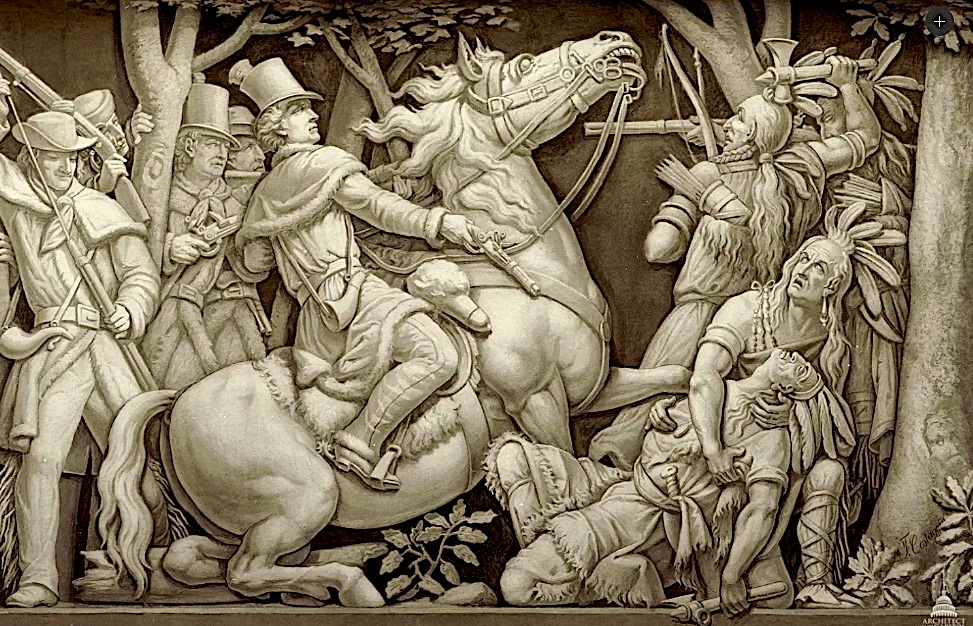
Who killed Tecumseh is a matter of debate. Many accounts claim that the badly-wounded Colonel Richard Johnson shot Tecumseh just before he lost consciousness although, until much later in his political career, Johnson only claimed to have shot an Indian.
Some evidence points to Colonel Whitley as the man who killed Tecumseh. Whitley’s body was found very close to Tecumseh. Still another report came from the badly-wounded Colonel James Davidson who claimed that a man in his company, Private David King, shot Tecumseh with Whitley’s rifle.
“Initial published accounts identified Richard Mentor Johnson as having killed Tecumseh. In 1816, another account claimed a different soldier had fired the fatal shot. [Sugden 1985, p. 138.] The matter became controversial in the 1830s when Johnson was a candidate for Vice President of the United States to Martin Van Buren. Johnson’s supporters promoted him as Tecumseh’s killer, employing slogans such as “Rumpsey dumpsey, rumpsey dumpsey, Colonel Johnson killed Tecumseh.” Johnson’s opponents collected testimony contradicting this claim; numerous other possibilities were named. Sugden (1985) presented the evidence and argued that Johnson’s claim was the strongest, though not conclusive. Johnson became Vice President in 1837, his fame largely based on his claim to have killed Tecumseh.” -Tecumseh. (2023, July 22). In Wikipedia. https://en.wikipedia.org/wiki/Tecumseh
Some primary accounts suggest that Col. William Whitley was likely the person who killed Tecumseh. James A Drain, Sr. published an autobiography, Single Handed (1927), in which he recounts Whitley’s granddaughter telling their family tradition that Whitley and Tecumseh killed each other simultaneously.
“After the battle, American soldiers stripped and scalped Tecumseh’s body. The next day, when Tecumseh’s body had been positively identified, others peeled off some skin as souvenirs. The location of his remains are unknown. The earliest account stated that his body had been taken by Canadians and buried at Sandwich. Later stories said he was buried at the battlefield, or that his body was secretly removed and buried elsewhere.[162] According to another tradition, an Ojibwe named Oshahwahnoo, who had fought at Moraviantown, exhumed Tecumseh’s body in the 1860s and buried him on St. Anne Island on the St. Clair River. In 1931, these bones were examined. Tecumseh had broken a thighbone in a riding accident as a youth and thereafter walked with a limp, but neither thigh of this skeleton had been broken. Nevertheless, in 1941 the remains were buried on nearby Walpole Island in a ceremony honoring Tecumseh. St-Denis (2005), in a book-length investigation of the topic, concluded that Tecumseh was likely buried on the battlefield and his remains have been lost.” -https://en.wikipedia.org/wiki/Tecumseh#Citations
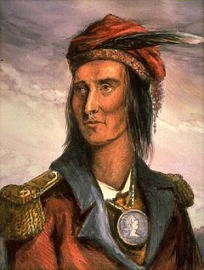
Tecumseh was widely admired in his lifetime, even by the Americans who had fought against him. Canadians consider him a folk hero and credit him with helping to save Canada from an American invasion in 1822. His primary American foe was William Henry Harrison. He described Tecumseh as “one of those uncommon geniuses, which spring up occasionally to produce revolutions and overturn the established order of things.”
William Whitley is one of my 4th Great Grandfathers. Everyone has 16 of those. Descendants of William Whitley have been trying to prove that he killed the great chieftain for decades. It may have been inevitable that white men from Europe and the East would spread like a disease. Tecumseh was one who built a federation to prevent the loss of his homeland. I wrote about him in https://kennethharperfinton.me/2016/12/20/william-whitley-and-me/
I have always secretly hoped that grandfather Whitley was not the killer of Tecumseh. I was in no mood to take pride in that. Whitley was primarily an Indian fighter from slave-holding Virginia, so I think we can safely assume that he was what we would call a “redneck” today. Whitley avoided the Revolutionary War by moving to Kentucky. He was the first to build a brick home and estate in Kentucky and an early pioneer in Kentucky whiskey and horse racing. However, he was adamantly anti-British enough to build and run the first clay circular race track in the United States. He ran them counter-clockwise instead of the British clockwise race, a custom that persists to this day.
New possibilities about Tecumseh’s death were recorded in THE HISTORY OF DARKE COUNTY, by FrazIer Wilson.
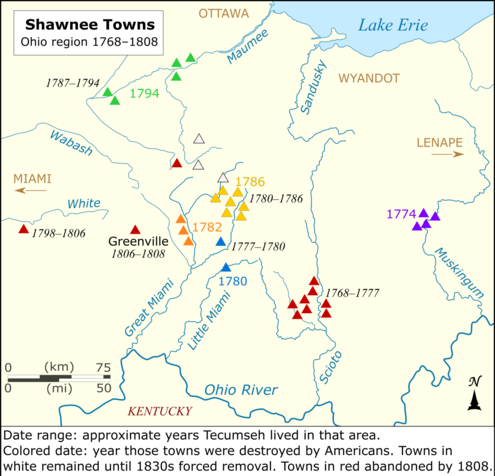
Tecumseh lived in Greenville, Ohio of several years between 1806 and 1808. There is a place near Water Street on Greenville Creek called Tecumseh Point. This is where Tecumseh and his brother lived for several years. They would have traded at Azor Scribner’s trading post on the present corner of Elm and Main. It was the only place to trade.
“At the outbreak of the War of 1812, Scribner enlisted in Captain Joseph Ewing’s company, Lanier’s Independent Battalion of Ohio militia. His service began Aug. 9th, 1812 and expired Feb. 8th, 1814. He participated in the important battle of the Thames in the fall of 1813, in which Tecumseh was killed and the British General Proctor, signally defeated by the Americans under Gen. Wm. H. Harrison. To General Johnston, of Kentucky was given the credit of shooting the great Shawnee chief. However, it has been handed down in Azor Scribner’s family that he himself [Azor] shot Tecumseh from ambush and refused to reveal the fact to anybody during his lifetime, except to his wife. whom he straitly charged with secrecy.” – THE HISTORY OF DARKE COUNTY, 1914, Wilson, Frazer.
To me, this would make sense, Scribner would have known Tecumseh from trading with him. He was at the Battle of the Thames. If he killed the chieftain, he would not want to admit it lest he lose his lucrative business. If he killed him from ambush, he would have known it was Tecumseh when he lined his sight on him.
” He knew Tecumseh personally, having traded with him many times at Greenville, no doubt, and feared the con sequences should it be revealed to his old dusky customers that he had done the awful deed. His wife, who survived him several years, revealed the secret after his death to her second daughter, Elizabeth, who in turn revealed it to her daughter, Mrs. Marcella Avery, now living at an advanced age with her son Ira and daughter Prudence on North Main street (Minatown) near the site of Scribner’s first trading post. Scribner seems to have made money in his traffic with the Indians, but after he opened his tavern competition arose and he had to be satisfied with his share of the trade. He died in 1822 in the prime of life, leaving a wife and several daughters.” – THE HISTORY OF DARKE COUNTY, Wilson (1914)
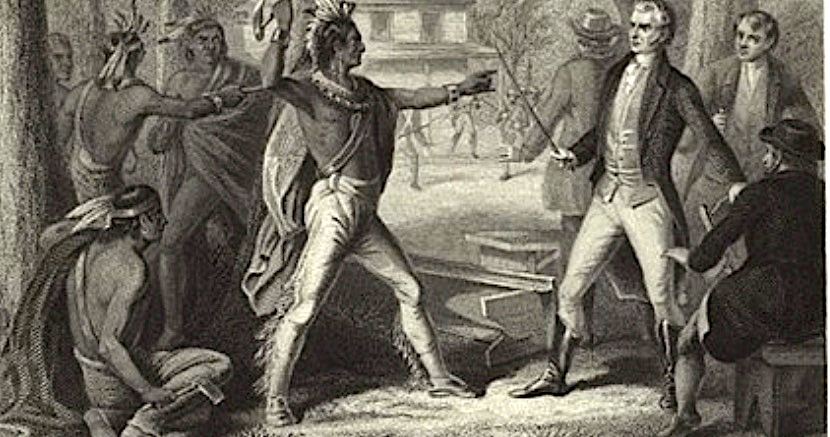
Tecumseh negotiating with William Henry Harrison.Relief of Johnson shooting Tecumseh, National Gallery
The real question is this: Is the universe physical or mental? If it is both, which came first? If matter appears as a result of observation and/or interaction, then the mental (thought) came first, as to appear it had first to be perceived––meaning awareness comes first, preceding essence. The only other alternative is that physical matter has always existed––and builds awareness, but this is not logical. Since matter and energy are interchangeable, matter’s basis is 1st-dimensional energy, a non-local universal mental field.
The universe is entirely viewpoints. Yours and mine are but two examples, but everything has viewpoints because the universe is primarily manifested thoughts. Dimensions are themselves viewpoints, not physical realities. An electron lives not in a sea of probability as some modern physics posits, but they exist everywhere at once without time and space until something is observed or interacted with. Then the object takes on a ‘real’ place in space and time and becomes a part of the physical world that physicists study. It is not the localized human mind that creates these events. It is a non-local mental field that remains a mystery that creates space and time and the events that populate the universe. This mental field is not a willful force with a purpose, but a method by which the randomly growing universe is actualized and made manifest for that which comes later in time. Difficult to comprehend, but I believe this is true.
When contemplating infinity and the universe, there is no way to escape the concept of God. Most cultures have had gods since the beginning of civilization. Something in us wants to give a name to that which existed before the universe came to be and will continue after the universe has ended.
That which existed before anything and after anything, even though it be nothing or Void, is still another concept for God in the minds of many. Nothing is, of course, no thing. God is not a thing as well. There is a parallel here, but God is not nothing.
An empty void has no existence without a world in which to place it. We cannot see nothing because it is not there. If it is not there, then it logically does not exist.
We live in a universe of complementary states. We have bad and we have good. We have right, we have left. We have up, we have down. We cannot have a subject without an object. One needs the other like a child needs a mother.
Quickly, picture a place without time and space where even thought has melted into a pool of possibility–a seemingly endless ocean of events and experiences that have not yet occurred. All is still for the briefest of instants because when time stops, existence ceases and the one is no longer measured as being separate from the other. Measurement occurs in spacial dimensions, but not in primary dimensions where only points, lines, and possibilities exist.
Physical changes are what create an experience. Experience creates events. In order to have experience, we need the perception of an event. In order to perceive anything, we need awareness. It is the mental world of awareness that comes before all else. In the remote past, it was simply primal awareness, the ability to differentiate one from another.
Primal awareness could be called ‘God’ by some, but there is a great social danger in calling anything holy and above natural law. Creation is a process and an act, not an unexplained miracle. The act of creation spreads knowledge and organization across the universe.
Most of us have outgrown the God-king or God-the-Father who in his divinity imposes his will and plans upon the world. We see religious thought for what it for what it is, a pattern of social development.
We can describe the world as not only a work-in-progress, but a record of historical events and experiences where thoughts were made manifest and tangible by actions, recorded by the bricks and mortar of matter, and re-interpreted by the mind to formulate experience from contiguous entangled events.
Awareness is the cause of time and space, though it forever dwells outside of time and space. It is of another dimension that has no beginning nor end. This awareness is potentially infinite, yet responsible for the existence of the finite. It is beyond self, yet produces not only the act of consciousness but describes and brings to being a forever-changing universe of unlimited potential.
Consciousness creates the idea of time, then measures the duration as well. We should understand that the realization of our world is both a mental conception and a physical reality. The world around us has myriad viewpoints that change as our consciousness moves through the now. The person I call myself is but a collection of memories, hereditary information, experiences, learning, emotions, and patterns of thinking. We are here in the now because this is the only place for us to be. We cannot be in the past or the future except in mental processes. The physicality of our existence changes as the mental universe changes. Being in the now is a conscious mental state.
This is quite a confusing concept for some. Many corollary dilemmas spring from accepting the mental and physical universe as two aspects of the same universal state. An entire stand-alone universe outside of my person exists and contains all these things separate from me.
Knowledge and experience form our four-dimensional viewpoints. Modern viewpoints revolve around the physical aspects of the mind. These scientific interpretations often hold that the mind is roughly identical to the brain and is reducible to physical phenomena such as the firing of neurons and the chemical encodings of memory. Yet, we did not always think in this manner.
Throughout the age of human reasoning, the mind has been connected to the psyche. The term “soul” is often used synonymously with the psyche—which includes the totality of the human mind, both the conscious and unconscious elements. The soul has long been thought to be the immortal aspect of the human condition, a ghostly spirit where the personality and moral compass reside.
Carl Jung used the words ‘soul’ and ‘psyche’ as they are the same word in the German language. Of this he wrote: “I have been compelled, in my investigations into the structure of the unconscious, to make a conceptual distinction between soul and psyche. By psyche, I understand the totality of all psychic processes, conscious as well as unconscious. By soul, on the other hand, I understand a clearly demarcated functional complex that can best be described as a “personality”. (Jung, 1971: Def. 48 par. 797).
In a universe paired with a mental aspect and a physical aspect, the dimensional realities in each pair would be different. The first dimension of the one point would be the same in both, but the second dimension of two points forming a line would be different. It is through this difference that they come to be independent entities. If one point is infinite and the other is temporal, then the world line of the second dimension would be a straight line to infinity in the mental state while the world line of the other would curve and eventually return to its own starting point, creating an orbit—a geometric figure. It would be temporal and physical because it had a beginning and an ending.
Infinity is not one thing. Even infinity must be paired with its opposite, the finite. Infinity simply has no beginning or end. There can be many infinities in a larger infinity because small infinities, like endless numbers, take up no space at all and are not in time.
Objects exist beyond my personal awareness—such as the place I dwell, the people I know, and the universe I inhabit. They too have being in the now. They are a product of consciousness, but they cannot be of my consciousness alone. They are in the consciousness of all. We all have a similar basic vision of the world about us. A common sharing of conscious knowledge between existing entities and objects obviously occurs, though much of nature works through an unconscious mental process. Our conceptions reside in the mental state and deal directly with the infinite process of energy transformation and electrical connections. This mental state has to be of universal proportion—just as the physical state is of universal proportion.





 Kenneth Harper Finton