The Legacy of Alfred the Great: A Study of Leadership

Chapter 27: From Tribes to Nations, by Kenneth Harper Finton

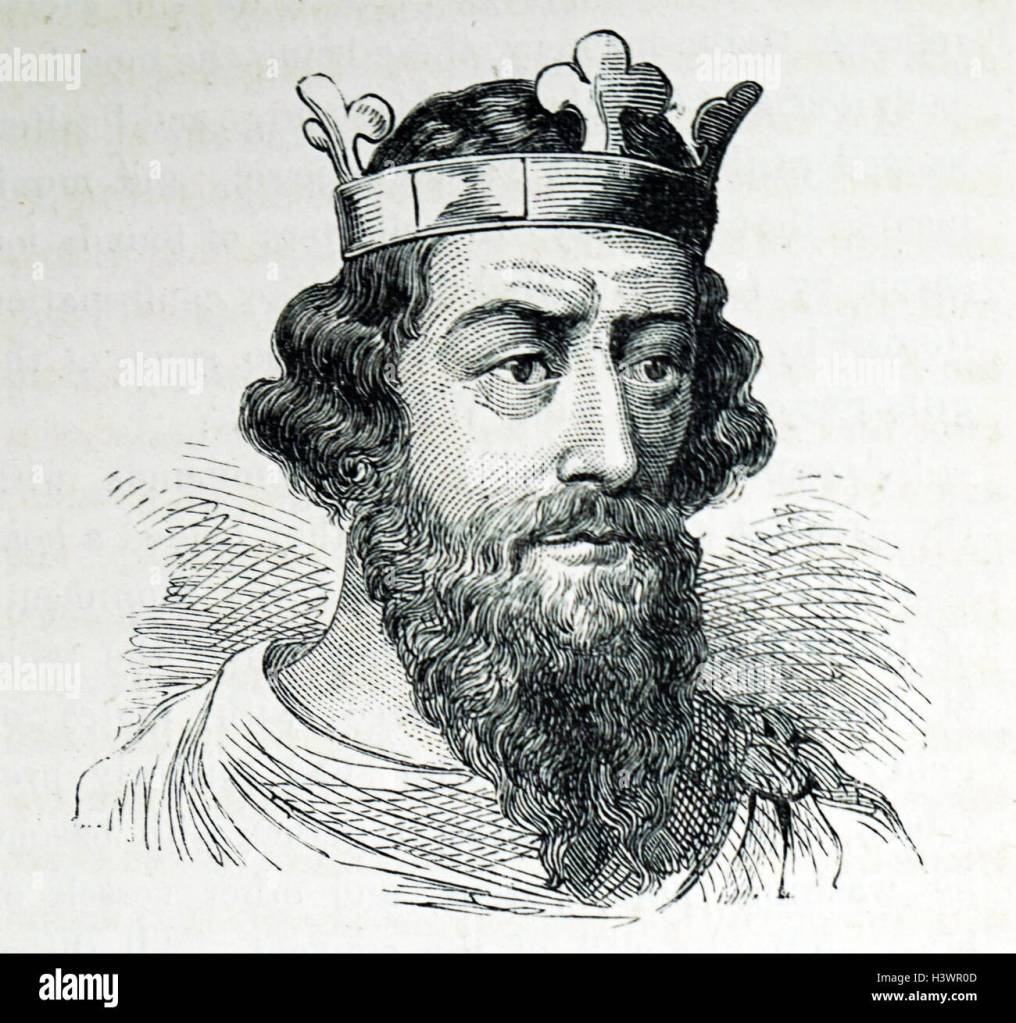
ALFRED THE GREAT

Alfred, the fifth son of his father, Æthelwulf, was a child of unusual talent and bearing. He was a handsome lad, prematurely an adult from his earliest days. At the age of five, Alfred was sent off to Rome . There, Leo IV confirmed him and hallowed him as “king”. This was most unusual, since at the time Alfred had three living brothers older than he in line for succession. 

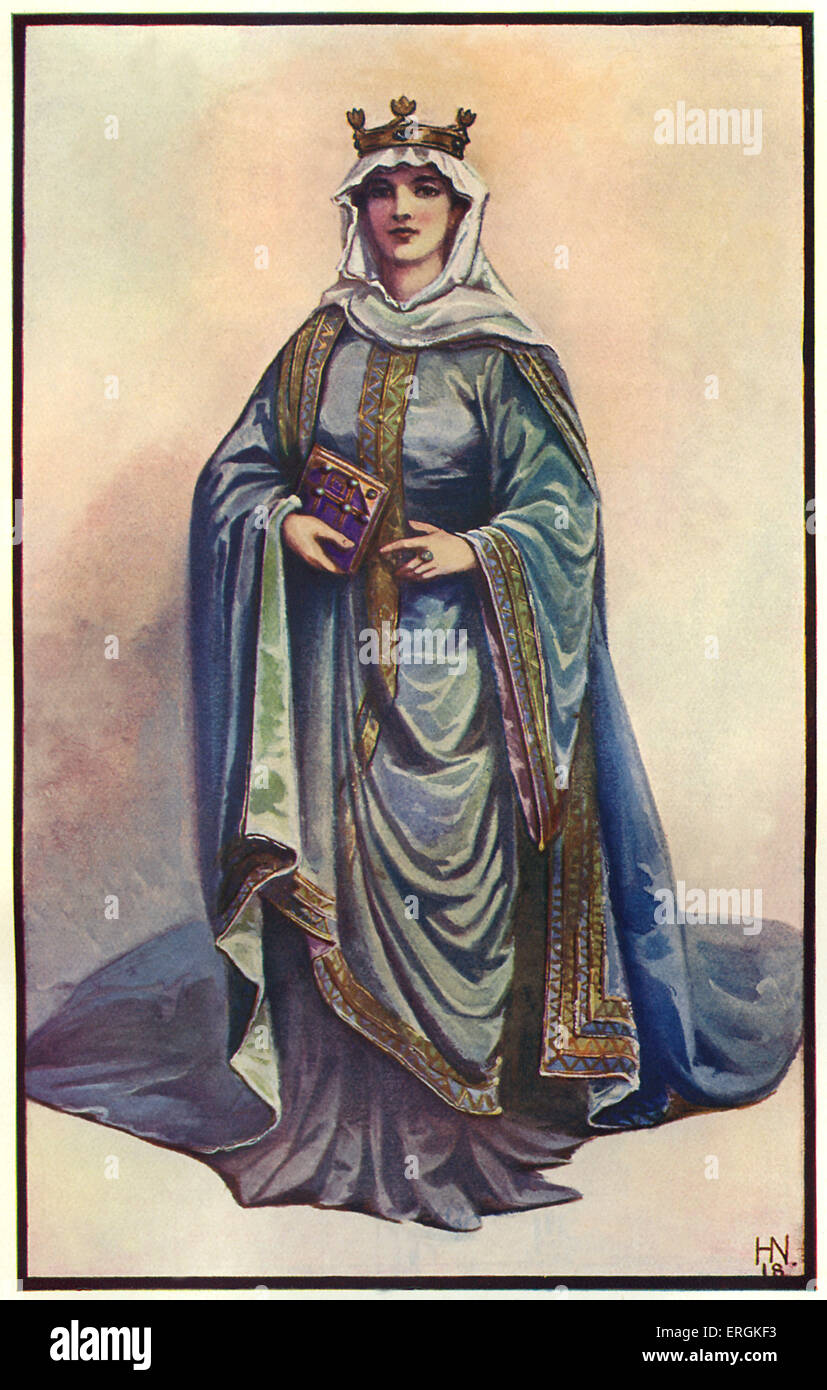
At age fourteen, the lovely Judith became the second wife of Alfred’s father, Æthelwulf. When he died two years later, she shocked the country by marrying her stepson, Æthelbald, who was Alfred’s brother. Upon his death, after a very short reign, she returned to France.and, in 862, married Baldwin I [Iron Arm], Count of Flanders.

Queen Judith

During this time with hid mother in France, Alfred’s playmates were Charles, the boy king of Aquitaine, and his sister Judith, both children of Charles the Bald, Holy Roman Emperor and grandson of Charlemagne.

Again in 855 Alfred went to Rome with his father, possibly to secure some titles that were to be bestowed upon him. Two years later, his father died. Alfred’s older brother Æthelbald took the throne, followed shortly thereafter by Æthelbert who ruled until 866. Alfred the Great married Elsywyth of Mercia in 868. Elsywyth was born in 848 in Wantage, Berkshire, the daughter of Æthelred Mucil, who died on the 22nd of October of 899.

The Danes had occupied London and their army had been fortified at Reading. London was not the capital and bustling city of later years, but a town in the Kingdom of Mercia. From these points, the Danes moved forward and met the West Saxons on the Berkshire downs in January of 871. Here was fought the important Battle of Ashdown.

Though he was warned that the battle must be joined, Alfred’s brother Æthelred, the King, tarried for hours in his prayers. According to Bishop Asser, who left an account of Alfred’s life: “seeing the heathen had come quickly on the field and were ready for battle… [Alfred] could bear the attacks of the enemy no longer, and he had to choose between withdrawing altogether or beginning the battle without waiting for his brother. At last, like a wild boar, he led the Christian forces boldly against the army of the enemy… in spite of the fact that the King had not yet arrived.”

The battle lasted through the day. The King finally joined Alfred in the field. At last the Danes gave way and retreated, pursued by the Saxon forces until the whole length and breadth of the Berkshire downs [Ashdown] was filled with their corpses. One of the Viking kings and five of his jarls were found among the slain.

Though this battle did not break the back of the Danes, it takes its place in history for the significance of the issue. Had the West Saxons lost, all England would have fallen before the Danes. The victory restored the confidence of the West Saxons and gave Alfred the fame and support necessary to continue his resistance. When brother Æthelred died later that year, there was no debate as to whom his successor would be. At twenty-four, Alfred was King.

The Danes were strongly reinforced from overseas. Six or seven battles were fought and the Danes held their ground. The “summer armies” were difficult to beat and Alfred’s forces were whittled down through desertion and death. Alfred decided to come to terms while he still had an army left.

A treaty was signed whereby the Danes would make peace if the Saxons retreated and paid tribute. Alfred did so and enjoyed five years to consolidate his defenses and power. What led the Danes to make such a treaty is unknown, but a change had come over the Northmen. Those who had for centuries invaded and plundered had begun to take up the land. The sailors had turned soldier, the soldier turned yeoman. It was not that they wanted peace. They still desired all of England, but Alfred’s stubborn group had taken its toll. For now, they were content to settle the lands they already held.

Five years later Alfred’s truce ended. The Danes, under Guthrum, had developed a plan to take Wessex. Alfred sought peace and offered to pay a tribute for it. The Danes took the gold and swore they would keep the peace, but suddenly they seized Exeter.

Alfred and his troops were after them, but found them in a fortress where they could not be touched awaiting reinforcement. They lay siege for a month as the fortress ran low on supplies. The Danes finally decided to break away from the fortress by sea and sent more than a hundred longships to their rescue.

In those days, people believed that the weather was ruled by God and Alfred was fortunate to have God on his side. A dense fog followed by a frightening storm came over the sea. A hundred and twenty Viking ships were sunk and more than five thousand of the perjured Danes died before the storm’s onslaught. Alfred, watching safely from the shore, found the Danes in the mood for another treaty. This, they kept for five months.

In January of 878, Alfred’s fortunes reversed. While his army celebrated the Twelfth Night, the Danes swooped down on them in the dark, killing many. Most of his army fled to their individual homes and Alfred was left with a handful of officers and personal attendants, forced to take refuge in the swamps and forests of Somerset.

For some months he lived as did Robin Hood many centuries later. Here, Alfred found security in his wilderness retreat.

One day it was so cold that the waters were frozen underfoot. Alfred’s attendant shad gone out to find food  enough to feed them for the day while Alfred stayed alone in the royal hut with his mother-in-law, Eadburga. The King always carried a writing tablet along with the Book of Psalms by David. 

A poor man appeared suddenly at the door begging for bread. Alfred, in his usual manner, received the stranger as a brother and called upon Eadburga to give him food. She replied that there was only one loaf of bread and a little wine left in the pitcher, but Alfred insisted that he be given what was left. Alfred then fell asleep while reading. He dreamed that St. Cuthbert stood before him and said he had taken the form of the beggar. He told Alfred that God had noted his afflictions and assured him that his fortune was about to change.

When Alfred awoke, the beggar was not to be seen. The loaf of bread remained whole and the pitcher of wine was filled to the brim. Alfred recounted his dream to his mother-in-law. She said that she too had fallen asleep and had the same dream. While they still talked of the amazing event, the attendants returned with enough fish and fowl to feed an army.

Toward the end of Lent, the Danes attacked one of Alfred’s strongholds on Exmoor. According to Hodgson: “…in besetting it they thought the King’s thanes would soon give way to hunger and thirst… since the fortress had no supply of water. The Christians, before they endured any such distress, by the inspiration of heaven judged itto be better either to suffer death or to gain the victory. Accordingly at day-break they suddenly rushed forth against the heathen, and in the first attack they laid low most of the enemy, including their king. A few only escaped by flight to their ships.”

Eight hundred Danes were killed that day. Among the spoils of victory, the Saxons captured the sacred flag of the Vikings called “The Raven”. This enchanted banner whose lifelike bird fluttered in the wind was said to have been woven in one day by three daughters of Ragnar Lodbrok. According to Hodgkin: “…in every battle in which that banner went before them the raven in the middle of the design seemed to flutter as though it were alive if they were to have the victory.”

On this day, the wind did not blow and the raven hung lifelessly in its silken folds. News of this defeat was quick to spread. When Alfred heard of it he left his hideout and once again raised a call for arms. News that he was alive and well excited the masses and the warriors returned in great number. Soon, Alfred was again marching in front of a grand army.

They met the Danes on the downs at Æthandun, now called Eddington, and fought the culminating battle of all Alfred’s wars. Everything was at stake. Both sides dismounted their horses. The shield walls formed and the two armies clashed for hours with sword and axe. The Danes were routed and Guthrum found himself entrapped in his own camp. Desperate, he begged for peace, offering to give Alfred as many hostages as he desired if he would let him leave these lands forever.

Alfred, however, had other designs with a more farsighted point of view. He meant to make a lasting peace with the Danish king. They were in his power. He could have starved or slaughtered them to a man. Instead, he received Guthrum into his camp, entertained him for twelve days, convinced him to be baptized to the Christian faith, and called him his on. Realizing that East Anglia (a small territory north of London) was a Danish province, Alfred offered to divide the land with him so that both could share in the glory of the new nation.

“The sublime power to rise above the whole force of circumstances, to remain unbiased by the extremes of victory or defeat, to persevere in the teeth of disaster, to greet returning fortune with a cool eye, to have faith in men after repeated betrayals, raises Alfred far above the turmoil of barbaric wars to his pinnacle of deathless glory.”  -Winston Churchill

Fourteen years of peace were to follow. Alfred began the gargantuan task of reorganizing his lands and brought culture back to his island nation. He restored London, rebuilt the walls and started the town on the road toward becoming the capital city. He reorganized the “fyrd”, dividing the peasantry into two classes which rotated service in forty day increments. Now the soldiers would not desert on long campaigns, knowing that someone was there to care for his lands and that he could return home and do the same shortly.

Next, Alfred’s attention turned toward the sea. He made great departures from the norms in ship design, building much larger vessels that rode higher and steadier than the others. His work was premature only due to the fact that the big ships were beyond the skill of the inexperienced  seamen to handle.

He founded schools and universities and caused translations of great works to be made in the English language. Until his time the English had only written songs and epic poems. Alfred began the Anglo-Saxon Chronicle to compile the history of the land, and English prose was born.

The Laws of Alfred, continually added to by his successors, eventually grew into the English Common Law. Alfred’s Book of Laws or Dooms attempted to blend the Mosaic code with Christian ethics and Old Germanic principles. “Do unto others as you would that they should do  unto you”, became in Alfred’s words: “What ye will that other men should not do to you, that do ye not to other men. By bearing this precept in mind a judge can do justice to all men. He needs no other law books. Let him think of himself as the plaintiff and consider what judgment would satisfy him.”

He gathered scholars about him. He used every spare hour he could to read. He also listened to books read by others. He carried with him a little handbook, constantly pausing to write down thoughts as they occurred to him. The singers in the court found Alfred to be a fellow troubadour. He loved to gather the old songs of his people. He taught these songs to his children. The children that he raised proved to be the most able leaders of their time.

Alfred drew up plans for buildings. He took care of the affairs of his court. Alfred instructed craftsmen in their workings with gold. He would pause in his travels to converse with strangers. He taught even the falconers and dog breeders new things about their business. It seemed there was little in the world of ideas with which he was not more than adequately familiar.

He spent many an hour soothing his depressions with the music of the Psalms. He wrote: “Desirest thou power? Thou shalt never obtain it without sorrows–sorrows from strange folk, and yet keener sorrows from thine own kindred… hardship and sorrow, not a king but would wish to be without these if he could. But I know that he cannot.”

Alfred took the time to translate books into English himself. Yet, he was more than just a translator. He was an editor for his people, omitting this, expanding upon that, changing the whole design of English literature.

One final war was Alfred’s lot. The Vikings had invaded France, sailing up and down the rivers with every device of war known to man. They laid siege on Paris; they invaded Germany. The Danes seemed to fan out in all directions. However, they faced resistance on too many fronts. It was more than they could handle. Once again Viking ships looked toward England. Guthrum died in 891, keeping peace with Alfred to his last breath, but with his death, Guthrum’s Peace ended. The next year, a hostile armada of two hundred and fifty Viking ships arrived. They landed at the edge of the forests near Appledore. A second force of eighty ships sailed up the Thames. Kent was to be attacked from two sides.

Alfred had prepared the country well. Food and wealth had been gathered again. Additionally, Alfred’s twenty-two year old son, Edward, had become an able commander. He could lead his father’s forces in the field. Alfred avoided war for several years. He preferred to pay some Danegeld to Haesten, the Viking king. This payment was for promises of peace. Alfred also convinced Haesten to have both his sons baptized as Christians.

In 893, a third force arrived and attacked Exeter. Young Prince Edward routed the raiders. He sent them swimming up the Thames for their lives. The Danes had fortified themselves below London. Edward and his brother-in-law, Æthelred, raised a strong army in London, then fell upon the Danes at Benfleet. According to the Anglo-Saxon Chronicle: they “put the army to flight, stormed the fort, and took all that was therewithin, goods as wells as women and children,  and brought them all to London.”

Among the hostages were the Danish leader’s wife and two sons. Alfred sent Haesten’s wife back to him on humanitarian principles, an act unheard of and highly criticized for many years.

“As for the two sons, they had been baptized; he [Alfred] was Godfather to one of them, and Æthelred of Mercia to the other. They were therefore Christian brethren, and the King protected them from the consequences of their father’s wrongful war. People in the ninth century found it very hard to understand this behavior. During that time, the kingdom was fighting desperately against brutal marauders. However, this is one of the reasons why in the after-time the King is called ‘Alfred the Great’. The war went on, but so far as the records show Haesten never fought again. It may be that mercy and chivalry were not in vain.” -Winston Churchill

“So long as I have lived,” Alfred said, as death closed in upon him, “I have striven to live worthily.”

The Mind of Pilot Andreas Lubitz

Tired of living, spurned in loving, deficit in compassion, Andreas Lubitz and his crippled amygdala donned his smart uniform and climbed aboard the plane.

A pretty stewardess smiled at him, bid him a good morning as he passed. She smelled of a musky perfume. That reminded him of the sex he often craved with her.

He found sex to be an animalistic and ludicrous practice. Love had always been a dream that faded away to sorrow. He returned to her a faceless smile without meaning.

He took his place in the cockpit beside Patrick, his pilot. It was less that two hours to Dusseldorf from Barcelona. Patrick was loquacious, almost collegiate in manner.

As they bantered back and forth, Patrick’s banal conversation bored Andreas to death. He could only fake a smile for reply.

Andreas thought about how he hated God for giving him life. An aching desire for release from the prison of time had overcome him. A dull ache of depression swept over him as he remembered all the hideous assaults he had endured.

It was as though he wore glasses that saw only the evil of time and hid away the pleasant moments.

When Patrick left the cabin, Andreas pushed the button to lock the door so that he would not have to bear him any longer.

Alone in the cabin, with only the sky in his eyes and the engine noise in his ears, Andreas was at last alone with himself. He hated his aloneness. “Everyone is suffering in their meaningless lives just like I am,” he thought. The future brings nothing but more disappointment, times filled with melancholy, nights filled with helpless thoughts, days filled with foolish actions that try to mitigate the absurdity of living a desperately miserable existence. Dog eats dog, life eats life, panicked schools of fish swirling in circles as the sharks attack the outer layers of their being.

The images consumed him. The irrelevance of his very being and all those around him felt like the beating drum of a hated heartbeat Mushroom clouds raining death, pits with decapitated bodies killed by fools who thought themselves righteous appeared in the gray sky when he adjusted the course of the plane to fly at one hundred feet.

“It will soon be over,” he thought to himself. “I am finally on control.”

He heard a frantic knocking on the door as Patrick tried to gain the cabin. His gut tensed, his breath came hard and fast. He could hear the hysterical screams of the passengers behind him.

No sympathy for their plight crossed Andreas mind. “They are all going to die anyway,” he thought. “Today is as good a day to die as any other. Today is better. It will save them from through suffering their ignorant lives.”

Adrenaline rushed through Andreas veins as the mountain loomed before him and the nose of the aircraft. He felt like a soldier entering battle.

“It is a good day to die,” the voices around him exclaimed.

He remembered the stewardess with the sexy perfume who greeted him when he stepped onto the plane. Her voice was among those screaming behind him. “I will not fuck her,” he told himself. “She will not tempt anyone to fuck her now. I can make sure of that.”

There was power in the thought; power had always escaped him.

The remembered scent of her perfume hung in his nostrils. His own breath came hard and deep as he thought about having sex with her. Death, he thought, would be like conception, a  one timeless contracting orgasm would begin the journey to another useless, meaningless and painful life. Another contraction would snap the miserable body away from experience and into the vast nothingness of the universe.

He could picture himself letting go after the shock of impact. It would be his final orgasm, his final statement, his final action.


A TRIP TO FIRE ISLAND

Friday, May 30, 1969 

I think I can now understand more about what feels wrong in my life. It is a fairly simple thing. Writing is not a full-time job for me. For me to be creative requires a certain mood. I can never sit down and schedule my work unless something has already started. Even then, if I’m not inspired by that small spark of something, that germinal idea of what to say, nothing comes of it. 

Yesterday, I did not go to the Manhattan office to pick up my paycheck. That money feels more like a chain that keeps me tied to New York City. Zita and I decided to try hiking on Fire Island. I asked my brother Billy if he wanted to go. That led me to ask my partner Gary if he wanted to go. Everybody jumped at the idea of doing something different, though it was really the idyllic dream of getting back to nature that we jumped at. We forgot, for a time, the realities of hiking through the sand, the constant sunshine, no respite or shade. Fire Island is simply a sandbar by the sea –– a primary dune of sand and secondary dunes covered with brush, reeds, and wild, low growth. It is on Long Island’s south shore.

It took us all day to get organized to leave, patiently waiting for everyone to get their gear and arrive. We got to the island at about four PM. It was the hottest day of the year. The temperature was in the high nineties and the sun hotly burned our backs. 

We stripped to the waist, donned our packs, and began the long sandy trek. Zita struck out in the lead followed by me, then Gary, then Billy, and his wife, Bonnie. As time passed, the line became very thin and strung out. I dawdled a bit to wait for the others to catch up, but Billy and Bonnie were way behind and Zita kept forging ahead. Gary caught up momentarily but then lagged again while I hurried to catch up with Zita. 

We stopped at the bloated carcass of a headless seal, stared for a brief moment, then passed it by. When Gary finally caught up with us, Billy and Bonnie were nowhere to be seen.

A fine mist hung over the sea and the sun busily melted it away. We speculated about where Billy was. Gary thought he was upset because we were so far ahead. I thought that was probably true, but I guessed his bedroll was too heavy and this was too much work for his taste.

Two lonely figures popped up on the horizon, then faded away again. Guessing that it was Billy and Bonnie, I finally turned back to get them only to find that he had returned to the car to drop off his bedroll, intending to hitch back to the city. “It was an ugly thing to do,” he said, because his bedroll kept falling apart and it was really work to hike in the sand. Besides, he felt that the day had started with hassles. He knew more were coming and would rather retreat back to the city. There had been too many arguments about delays and the “hurry-up-we’ll-never-get-there’s” had put an uptight bag around the sunshine. 

I felt disappointed that everyone was not in the best of spirits. A feeling of time washed over me and hung heavy in my heart. The changes in my life were splitting both Billy and I apart. Billy became a symbol of the yesterday that never returns and the desolate beach a symbol of the future that we always trudge towards. 

There truly was nothing there but sand and sea. 

Suddenly two ideas sprang into my head. Two different visions of life were becoming apparent: Billy’s idea that this trip was all a gross absurdity and hard work and his desire to return to the comfort of lying about clashed with my idea that only through constant effort and movement could I find anything worthy of being the focus of my attention. There was nothing but sand and sea, yet there surely was something to be wrought from it. Optimism has always been my goal.

When I returned, Zita came walking down the beach to meet me. We met up with Gary and went back to the dune to smoke where there was no wind. 

The heavy packs soon became stones on our backs. Raised in and accustomed to a subjective opulence, we had no real idea about what is superfluous to carry when every ounce counts. We had no mental conception of the bare minimum necessary for survival. The result was a heavy pack filled with too much food and heavy-weight versions of supplies that could and should have been lighter if we had known anything about hiking at all. However, no matter what one does or does not carry, walking in the sun and through the sand is never effortless. It was as if the earth would not hold my weight. As we crossed the spongy sand bars, I sank in up to my ankles.

The sea was forming a brand-new sand bar. A fledgling bay about a foot deep lay behind the waves, a refugee from yesterday’s tide. The village lay ahead of us. Fire Island villages have no roads to speak of, but rely on paths and concrete walkways that constantly are covered over with drifting sand. Only four-wheel drive vehicles can navigate, so the villagers use either Jeeps or boats to get around. It is an odd colony of summer homes and a few rugged naturalists who live in the windswept ravages of an Atlantic winter. Gary talked in his double-thought manner about how the villagers would react to our trudging through with packs on our backs. He speculated as to whether we would be stared at, asked to leave, or perhaps boiled in hot oil and eaten by a pre-pork generation. 

Zita and I attempted to quell his fancy with realism, but to no avail. His double-think was contagious. Soon, I found myself feeling like an intruder in a private domain. 

A Jeep pulled out onto the sand and entered the concrete path where we were now walking. Four men jumped out, as though on a signal, bent toward each of the four wheels, and then hopped back in the Jeep. They were disconnecting the four-wheel drive. They seemed to stare at us rather disturbingly as they passed. 

Of course, nothing happened in the village. There was no mad ghoul in the lighthouse. In a way, it seemed a shame, but living nightmares are never pleasant. We bought some cold drinks at the village store. I got some tobacco for my pipe and dropped the burden of the packs for a moment. 

We could not make it very far before darkness fell. Two villages come together and the area is inhabited for a two-mile strip, so we had to curve around a dune in an area that seemed more deserted than the others. After darkness fell, it was silent except for Jeeps running up and down the beach now and then. The moon was full and hung over the sea.  

I found myself wondering if my conception of the Moon had changed now that man had circled it. Only a week ago, a ship had descended to within nine miles of the surface. I remembered the intense excitement of the Christmas Eve broadcast a few months ago when the first live television pictures of the Moon’s surface were broadcast to Earth. One in four of our Earth’s inhabitants sat mentally suspended before their television sets, their breath held short, commonly involved in the moment. Yet, with all we have learned of the Moon, my conception of it remains the same as I have always had. It is the most romantic light in the night sky. The mountains were darker than the valleys. The craters I saw on television were like science-fiction movies that had no bearing on the living luxury of the night sky. 

I tried to imagine how Earth looked from the Moon. The pictures they beamed back to the planet lacked depth and comparison to the familiar sky. I tried to picture the Earth as large as a Sunday dinner dish hanging in space, colored with the now familiar blue and swaddled in unbelievably thick swirls of abstract cloud formations. 

Though it was still light, the moon still hung like a distant quarter over the rolling liquid matter of the sea. I had Zita open her mouth so I could peer at the moon like a large chunk of Gouda cheese about to be devoured. I got my camera and shot a picture of her mouth attempting to devour the cheese moon.

Zita was tired. She wanted to return to the car and leave before the sun went down, but we decided to spend at least the night on the dunes and think about it in the morning.  

In the morning, I saw things her way. We returned to the car.

FROM WHENCE COMETH THE SONG: 1963

Wednesday – Sept. 11, 1963 

Two weeks ago I bought some new tires for my car. The old tires were worn so smooth that the cord was showing, yet and I had not had the first flat. The garage man at Firestone said that if he’d have tried to drive on those tires he would have never made it home. But somehow I had been driving just like normal and I was only a hair away from a blowout. Two days after I bought the tires, I had two flats, both at once. Nails! 

Today I looked out of the window upon a beautiful September morning––and another flat tire. I pulled on the emergency brake to keep the car from moving and the brake handle popped off.

The rest is a situation comedy. I went to the trunk to get the spare and the car began to move. I stood there pondering the next action. I decided to go ahead and fix the flat, so I silently cursing as the car crashed to the ground, the wheel thudding sickly on the hard graveled mud. I managed to get the car back up back up and put the tire on, only the spare is a whitewall and flat as well. The spare had a nail sticking in it, but it was still up and full of air. Back to the jack again, and after three tries I finally got the tire changed.

Monday – Oct. 7,1963 

This weekend my life has been under water with no contact with the outside world. I have basked in laziness, accomplishing little, singing for my own enjoyment, and watching television. I read a few books, rewrote the ending to “The Fantasy of Fowler’s Hill” and Friday I finally started the story that began with Shannon. I hope it turns out to be a spellbinder. 

Over the weekend Billy and I went to Columbus to practice with Sheri. We left Saturday afternoon, found Sheri’s dorm, practiced until suppertime, then Billy and I went over to find Fred L. He lives in a fine frat house at the top of a giant hill that falls off to the street. Fred went with us to pick up Sheri. He has a great big, gigantic, block-busting guitar that he uses as a prop when he hoots. 

It’s handmade as a prop and unique in all the world. We loaded this in the trunk, picked up a drummer and some Congo drums, then headed for the Hoot at the Sacred Mushroom. We did two sets. The first was mediocre, but the second was the greatest we’ve ever done. The showmanship was fine, the songs perfect, and the audience appreciated it thoroughly. Sheri introduced  me to a black-eyed, black haired Spanish girl named Maria Louisa Francisca Cervantes just before we went on for the second set. Being preoccupied and thinking about what I was going to use for showmanship, I barely spoke and she left. 

When I tried to find the rest of my trio Sheri gave me a scalding for not being polite, because the girl wanted to meet me. She came back, thank God, and I looked again. What I saw, I liked––saucy, hot-blooded, typically Spanish-American. I’ll bet she had a temper like forged steel. I acted a bit more civil to her then we did our set and I was left free for the night. The girls both had taken a two-o’clock leave. They are entitled to two per month. Any other weekend they must be in by one. We got them in at the appointed hour, then went back to Fred’s frat house and into the music room. About four musicians with guitars and a piano player played until 4:00 A .M., then went all went to bed. At ten, I got up. We ate and at 1:00 we went over to pick up Sheri. She wanted to practice, but I was all practiced out and wanted no part of it. 

Sheri, Bill, Maria, Fred, and a girl that we fixed Fred up with named Gloria, went out  for a ride. We went downtown where Maria had to return a key to an apartment to a fellow. Hmmmm.We picked up some beer and went out to find a place in the country. We ended up in a quarry along a railroad track with woods on both sides. We sat on the rails while Maria sketched Sheri’s face, drank the beer and walked along the tracks. It was a pleasant, but not a very eventful afternoon. 

Monday – Oct. 15, 1963 

Billy got a part in the school play (Junior class) last week, the male lead, and lost it today. The director dismissed him for some debatable reason. Billy said it was because he was sick Friday and missed play practice. I rather doubt it. He got two letter saying that he was failing both English and Algebra II. The play director is his English teacher. But if’ she knew he was failing, why would she give him the part in the first place? 

We practiced with Sheri over the weekend. Billy and Dad got into fight and Billy called Dad and I trash. He was forbidden to go to Dayton to practice, so I had to bring Sheri down here. She added trio a bass player in Columbus. 

I went to Dayton to drop off’ the matte of’ the group f’or paper publication, The big hoot is Saturday at Wayne High School, while I was on Dayton I decided to look up Shannon. Last week her story, which has been playing in my mind for some time, finally took shape and became “Yellow is the Color of’ Love” It is very good, I think, but also very weird. I thought it only fitting that she should read it. I went out to her old house and asked the neighbors where they had moved. A blonde woman across the street on Timberline gave me the forwarding address. Shannon was there with her mother. I talked with her and took her to the grocery store. Here’s what happened. She had an argument with her father and took another overdose of sleeping pills. The ambulance could not find their house for forty minutes, and by this time her lungs had collapsed and she was nearly dead. They rushed her to the hospital where she lay on the brink of’ death for several days. It was also a psychiatric ward. When she recovered, she still had after-effects like a kidney ailment and heart spasms. They said that the only way they would release her was that she must get married. That sounded quite phony to me, but she said that was so. It was sort of a straight-jacket marriage instead of a shotgun wedding, as usual. So, she married Tom, the guy from Oregon. He’s working at NCR and they’re moving from place to place. I sent the story in the mail today with a cover-letter telling her about the character and how she inspired it. Anyhow, I’m happy that I know her situation, but very unhappy to see it. She’s a good kid and
really deserves much more than that, but doesn’t know how to harvest love and happiness. 


Wednesday – Oct 23,1963 

Friday was Mother’s birthday. I got her a pair of fleece lined slippers and they went down to the Stein’s Saturday afternoon for dinner.We had another concert Saturday night––one that brought $200. We had practiced all day. We spent the night over in Dayton and practiced Sunday. Billy and I are working out intricate guitar accompaniments and our harmony is getting very good. We have improved vastly and the hope that we will go big time does not seem so vast and reaching now. 

Today Shannon mailed back my story. The morning is generally a happy time for me. I wait in bed until I’m sure the mailman has come, then rush out immediately to reap the harvesting from the galvanized box. Today I found my story with the postmark from Dayton. There was no return address, and no name. I knew it was from Shannon. 

I rather hated to open it. I was afraid that she would not like the story and I would find some cutting, harsh comments inside. Instead, the letter read like this: 

“Ken, I’m really quite surprised at your amazing story. So many things are reconstructed with such total perceptiveness. I don’t know whether this was meant be a tribute or a disarmament, so I say––with great caution––well, done. If, by this, you feel you have found me out, as I feel you have––again––well done. I’m older now, Ken, and much wiser than I sometimes appear. I’ve lost the part of me that would do such things as in yesteryear. I am sad, but on the same hand quite relieved of the burden.”

I read the letter over several times. What was she talking about? Finally, it struck me. I had written a bit of fiction into the story. I said that if a yellow balloon walked the aisle of matrimony it walked it by itself. I hinted that the character in the story had not been married but had the baby illegitimately. Unknowingly, I hit upon the truth. That is her burden. Her sadness is her marriage and the suicide attempts. 

The knowledge came gradually and I was lost in thought. How much more of a story is there behind the part that I know? I should imagine that the story is not yet complete. She had lied about her first marriage. Who can blame her. But one lie leads to another, and to make her stories believable she twisted one lie around the another to protect what reputation she had left. And probably to protect the baby. 

“I too wish you well, my friend,” she wrote. “Your life will be good as the daughter of Thane predicted.”

She doesn’t love her husband and her baby needs a father. I will probably never see her again, but I will remember her forever. 

Oct 1963 – Sunday 

Billy and I went to Columbus Friday (he was off school). Sheri was just getting ready to go home. I thought we’d probably be spending the night there, but instead we headed for Dayton after running out to the TV station and setting up an audition. Sheri seemed to be in a better mood this week, or perhaps it was me. Maybe I’ve finally come to the realization that she’s indispensable to the outfit and I’m trying to get along a little better. We went to the Lemon Tree and did a terrible set. It was absolutely a stinker. We had not practiced for a week and it showed up in the performance.

Joe D., Mike, Sheri, Bill and I went down to Charlie’s where the Osborne Brothers play often play, but they had a rock and roll band that night and five drunk girls running around with provocatively sexual glances and actions. “C’mon in, we’re gonna have a party,” the one blonde had said just before we entered. She showed us in and made certain that we had a seat, then danced around, twisting her pelvis, shimmering to the pulsating wham of the rotten music. A couple of girls got up on the stage and sang with the lead singer. They fingered his guitar and shook their hips at him. I nearly f’ell off the chair with laughter. 

Saturday we practiced all day, worked out several new songs and listened to ourselves on the tape recorder. For the first time we are beginning to sound well on tape. Everything is coming out so much better. Actually, the three of us had a ball just being together over the weekend. We talked of our future and the sound are putting out, joked, and laughed continually. We are going to New York by next summer, we hope. That’s not a definite hope, but if everything goes right, maybe we can make it. I am putting my future at stake. Saturday night before coming home went to the Art Institute and walked around the shaded lawns looking out over the city. We descended the spiral steps to the river and walked along the banks, talking and feeling very good. We drove around the city here and there circling and looking for the finer views, content with just watching the lights and the people, drinking the atmosphere of happiness that can quickly be lost in the turmoil of living. We are living fast, but we are enjoying it. Before everything grinds to a shattering halt or we enjoy the :j!!D fruits of the promise that now shows, I have a. feeling that things will move much faster. The main message is that we must not forget that we must
enjoy life and take the time out to have a little fun. 

I thought that Shannon was out of my life. Perhaps she is, but that haunting damn girl isn’t out of my memories. I dreamed of her last night, just as I used to dream of Russene and ached with the feeling that she was gone, like I dreamed of Shirley that one night in Cleveland and awoke wanting her so badly. I remember the dreams because the wanting is so hard afterwards, and it seems as though I never dream of a girl with such intensity until it is too late for us. 

In the dream, Shannon was still married and lived in Greenville. I remember that she lived behind a row of buildings without faces that stretched endlessly, like an ancient, musty arcade. I entered down a road at first from the back and came to a place that I’d never seen and never thought existed around Greenville. It was dusty and there was a little lake with some not-too-shady-trees, and a row of little white cottages where Shannon and her husband lived. 

She was sitting on a white bench in her swimming suit next to the lake. I got out of the car and walked over to her. She was sad and lonely and confided her loneliness to me. It was a long dream. I remember waking and thinking that it was practically a story complete in itself, but the details have now escaped me. Somehow we loved one another, not physically, just spiritually. I remember her driving away in her little red Volvo and I returned from the front.

 I entered the wrong door in the faceless building. The lettering on the front said, “The Explorer’s Club”. Inside, the arcade was colored with a strange orange light and there were little rooms full hunting debris and trophies. The smell of cigars and liquor were warm in my nostrils. In one of the unseen rooms in the forbidden interior, men laughed and the sounds of their laughing were strange, like the laugh of a lost old man who once a day finds a little happiness at a card game in the local pool hall. The entire place has the atmosphere of a pool hall. 

I remember passing one little room where the door was open. A toilet with rough-hewn wooden urinals were standing in a row like tree trunks. Then, I went back outside and entered the next door where Shannon’s little corner of paradise laid before me in a blurry vision. I don’t know what happened to her husband. She and I lived together in a strange way. It was very fine though. I thought it best that she not be strained in her happiness. I did my best to make, her life pleasant, restore her happiness, and dispel those sorrows carried in her life. It was a dream, but somehow I awoke wanting the dream to be truth. I was almost ready to run to Dayton, find her and whisk her away. Funny, she really might be happy by now, but I doubt it. 

Life with her would be life on a bed of nails. It would sap of my strength and that would be hard to take, but subconsciously I wanted to help her like I’ve haver wanted to help another. 

Then I woke up.

Speaking of dreams… twice now I’ve dreamed about the trio. No, three times, and all were sex dreams. Sheri, to me, is not femme fatale that some of the other girls are. In fact, she is almost
sexless to me. I admit she has her charms, but somehow, I don ‘t see her as a sexual stimulus. Yet that is the way it popped up in my dreams. Once I dreamed that she was running around naked
at a party. Another time I dreamed of Billy, she and I driving along the streets, bare from the waist down. A few nights ago the dream took on story form, but now again the details and continuity are forgotten. It’s surprising how many of my dreams are truly short stories and absolutely complete (though usually with several flaws). I dreamed that Sheri, Billy and I were living together. I don’t know whether we were spending the night at her house or we had an apartment of our own, but it was decided that to save on expanses and to bring compatibility to the trio, Sheri would double as mistress for both Billy and I. The first night together was a night of wonder. Evidently I had already lost my virginity, because after the night was over and day had broken over the city, a little box lay on a footstool for Billy. It was a reward for losing his virginity, much like pennies under the pillow from the good fairy for losing your first tooth.

Sheri’s father came in and picked up the box. I had not looked at it and ‘I remained hidden behind the couch because the box was blue and white and looked similar to a prophylactic box that is  on the market. (I worked at a drug store and even remember the brand name, as I sold them often enough.) Her father opened the box and a slew of gumballs rolled out on the floor. It was queer. 

I laughed and remember thinking, “What sort of an oaf is that stupid fairy, leaving gum balls for losing your maidenhead. 

The dream ended. Now it seems almost funny when I remember it. It really wasn’t sexy at all, more like a delicately made movie. 

Monday – Nov. 4, 1963 

Last Tuesday I drove to Columbus to dig up some jobs. I found one advertised in the student paper at CSU and Sheri and I looked into it. I found that Hootenanny, the ABC Saturday night show, probably isn’t coming to Ohio State after all. Also, I looked in the phone directory f’or entertainment management agencies and found one that looked promising. I went over to the agent, who had the unlikely name of Howdy Gorman. He said he’d set up an audition at a TV station f’or us. The audition was tonight. We got the job f’or Saturday at the Fort Hayes Hotel, Presidential Suite, entertaining some drunken foot doctors and made another sixty bucks. This evening Dad drove Billy to Columbus, picked up Sheri, and then went to Howdy Gorman’s office. We followed him over to the TV station (Columbus Channel 10). 

Gorman had brought two groups for the audition. The show is called “Gather Round,” leans rather heavily toward folk. It is being aired once a month. Starting, in December they expect to air it weekly on Friday night.We went through a f’ew songs. They had told us that it was an informal audition without a mike, etc. They then wanted me to introduce a song, so I introduced Darlin’ Corey. They thought we were very good. There was another entertainment manager f’rom a nightclub called “The Gloria” there to hear the audition. Gorman said he was killing several birds with one shot by auditioning us f’or several jobs at once. Anyhow, our audition was successful and they thought that we did a an excellent job.


Then came the other group. They brought along their manager and a public address system and they let them use it. The result was that they seemed more professional than we had seemed, because they introduced their numbers and didn’t adhere to the informal setup.


Live and learn. I don ‘t know the result of’ the audition yet. We had some fine comments, but it seemed as though the talk .liraS about the other group rather than ours. Even Gorman gathered around the other group’s manager. The TV man said that he wants to pit us on the air and he will be getting ahold of Gorman. I don’t know anything about the nightclub. What’ll come of it,  I don’t know. I’ve got to talk with Gorman again Saturday and see what’s cooking.  Anyhow, this Gorman says he has recording contacts and can do us up right. He’s a very short little man, probably f’ive-f’oot one or two with sandy hair and mustache. Things will either stand still or move fast now that we are pushing ourselves. 

Nov. 11, 1963 – Sunday

Dick T. is home on furlough. Friday night we went to Dayton so that he could hear the Osborne Brothers. Clark Crites, the Lemon Tree’s new manager, had called on Thursday and wanted us to see him. He had a job lined up and wants to, act as a sort of’ agent f’or jobs that come through the Lemon Tree, getting the usual ten per cent. 

We went to Dayton to tell Sheri’s folks, then went over to the Lemon Tree to see Clark. He was tied up with another man in the office and couldn’t see us right then. We sat through a set of the Canadian folksinger, Cedric Smith, then scooted down to the Bitter End––which is the new name for Charlie’s Bar––to hear the Osborne Brothers. After their set was over it was back to the Lemon Tree to see Clark. I found that Clark had just gone down to the Bitter End to see us. After that came a comedy of errors. We went back down to see Clark and found that he had just gone back to the Lemon Tree to meet us. We went Back to the Lemon Tree and found that he had just left to meet us at the Bitter End.

There we sat at the Lemon Tree waiting for him to come. There he sat at the Bitter End waiting for us to come back. Half an hour later, the phone rang: “Are they still there?” he asked. When told yes he said, “Keep them there, I’ll be right up.” 

Finally we get together and talked over business matters, then went back down to hear the Osborne Brothers finish up another set. Both Sonny and Benny Birchfield were in great moods tonight and we talked with them for a long time. 

Saturday, Billy and I took Dick to Columbus with us. It was the first time he got to hear the trio perform. It was nothing special, really, just an afternoon practice session in a cemetery, then Sheri’s dorm room, and an evening practice. Sheri got me a date for tonight and one for Dick too. Gayle O. was Dick’s date, the same girl who dated Fred the other week. 

Sheri’s been feeding me a lot of information about a roommate of hers that wants but a tall, good looking, rich man. She sounded rather like a snob from the conversation about her. Once, when I called Sheri, she answered the phone. From her voice I could tell she was overly sophisticated and perhaps a bit oily. Well, suddenly, it seems, she turned an about face. She had heard us practice, though I’ve never met her, and she read my story “The Fantasy of Fowler’s Hill” last week. Sheri was shocked when she started questioning her about me and even more shocked when she asked her to set up a date with me. In fact, she was flabbergasted. The girl’s name is Joan. I was sure she was in for a boring evening and I was certain she was not my type. Finally, in the afternoon, we met. She’s a very pretty girl and looks much like I pictured her as looking––tall, well-groomed and collegiate. In the evening we drove around town and stopped at a bar which was crowded to capacity. We had tried several other places offering entertainment, but we ended up back up near the campus. The bars are filled with students on Saturday night.We bought a pizza next door and then got some beer to go from the bar and headed out in the country to eat. 

I found a nice little spot of a not-to-traveled road where we had a beer, ate. and talked. Joan and I got along surprisingly well. Conversation seemed strained at times and things did not flow naturally, but all in all it was a fairly well-matched date. I didn’t go out of my way to impress her, I just joked along and acted the hick that I really am––dropping the “g”on “goin'” and speaking in the normal Darke County dialect that sometimes makes me feel out of place in collegiate crowds. It’s not that my speech is a real dialect or that I do not express myself well. I really, I do. But the folks around Greenville do have a distinct midwestern twang in their speech. 

We were sitting at a deserted barnyard eating our pizza and almost ready to leave when a cop pulled up. He asked to see my driver’s license and asked what I was doing there, then told us that we were on private property and had to move on. 

Back in Columbus heading to the dorm we found a little park that looked rather inviting in the night. Everyone hopped out of the car and walked over to a lagoon that spouted water from a fountain in the center. When we got back in the car another cop saw us coming out of the park and the same damned procedure started all over again. It was against the law to be in the park that time of night. I was not happy about the interference. Why, then, have the fountain running? I thought, but I said nothing. I have learned that being overly civil near people who are armed is more often the best choice.

We all slept in a moth-eaten hotel on High Street––not the girls, just the fellows––and Sunday afternoon we met again and went off for another drive. We went to the art museum and walked through the halls into the velvet draped rooms viewing both trash and some masterpieces like Renoir and Monet. We took a drive through the city and went to the park that we had seen in last night’s moonlight––only this time it was lawful. I took them for a beautiful country drive by the Columbus Zoo, tried to get into the closed Olentangy Caverns, then drove for miles along a scenic little road that followed the stark autumn banks of the Olentangy. We passed an old stone mill that looked like it belonged in a page from European history, made of stone, now deserted with a little damn up creek and finally the observatory.


The time was spent talking and joking and taking in the autumn beauty. Dick had the time of his life and said that he would remember that afternoon for years to come. I don’t believe I will forget it either. Joan became very congenial and looked very pretty. 

Everything has been at a standstill for quite some time in my romantic existence. I believe I could be ready to fall in love myself. We parted company at 7:00. Joan made me promise to write her and send me some other stories and I promised that I would. Dick will probably never see Gayle again, but he will remember her. All in all it was a very pleasant, well-remembered weekend. I didn’t fall in love, but I feel as though I somehow made happiness possible somewhere––and it’s a good feeling. 

Friday – Nov. 15, 1963 

Mom and Dad’s twenty-second anniversary was today. In celebration, they did something that they would not usually think of doing––they went to the Bitter End to hear the Osborne Brothers. The boys were very friendly this evening and talked quite a bit. Sheri was there and while Billy, Mel, Dick, Sheri and I went down to the Tree, Mom and Dad sat and talked with Sonny and Benny Birchfield. It was a pleasant evening. Sonny said that if we wold give him a tape he would take it with him and try to get us some jobs so we decided to get a very good tape made on professional equipment. 

Sunday – Nov. 17, 1963

Yesterday it was practice. Dick went down to Dayton with us. We spent the night at Stein’s then came back to Greenville to make a tape at WDRK . 

We wrestled in the lawn and practiced in the park, then at 3:15 went out to WDRK to make the tape. The tape turned out very, very well. We have never heard ourselves on professional equipment, except perhaps on TV that one time. Then TV show qualitywas bad and the songs were not our best at that time, but we’ve improved so much since then. We were very pleased with the sound and patted one another’s backs for an hour. Sheri gave me a letter from Joan that she wrote to me just after receiving mine. Sheri said that Joan would be up next weekend. I also got called back from layoff at Corning for one week.

Thursday – Nov. 21, 1963 

I’ve been dumping cullet and hating every moment at Corning all this week. The job was only temporary. It gripes my soul to think that they can take or leave me at their discretion and I have to abide by their goddamn whims. I wrote a little letter to Joan this week expressing my views about this factory system of ours. Sometimes I think that it is a detriment to progress, rather then an aid as it is usually considered. How many men––like me––are pushed and pulled by forces greater than they can fight, placed in degrading jobs, their potential wasted, their lives and happiness decaying around them. How many men have committed mental suicide while working the grind day in and day out, having no escape without the risk of losing everything––their family, their income, and the little joy they manage to reap out of their barren existence? 

Automation is taking over at Corning. Automation is taking over everywhere. They will be laying practically everyone off within the next few years. The bastards are getting by with it. They keep a man in chains economically, then turn him loose and knock him on the ground without breath, without fight, without hope. 

November 22,1963 

Some days you wish had never been,

That time be whisked away like dust

And a day that drips with grief be taken back, 

The hourglass started once again anew.    

This gloomy, drizzling day was such a day. 

The rain’s no longer rain, but falling tears. 

My heart is aching and my soul is sick.

I’ve cried out, cursed, and sorrow shudders in me.

There is no room for eloquence inside, only grief.

Today, a hand I’ve never shaken,

A face I’ve never touched,

A friend I’ve never met

Was cut down on the streets of Dallas, Texas.

A bullet through the brain that ruled the nation

And stilled the heart that loved

An undeserving world. 

Words do not tell the story well.

I shuddered when just three short years ago

The nomination turned from Stevenson to him.

And then with magic and determination

He fought his way through prejudice

To win and saddle greatness.

I longed for his success

And when it came,

His triumph was mine.

He caught a nation’s fancy 

With his mellow voice and new ideas.

He brought youth and life and color   

When things were rather stale and needed spice

Now his youthful smile will never age

His thick, brown hair will never thin.

A hundred years ago another man was shot

And another man named Johnson took his place.

There must have been an emptiness then as now

As fires dimmed and died in human hearts.

Words fail me.

I could not feel more desolate and grieved.

I could not feel more shocked or numbed with sorrow.

You and I, he never knew by name,

But yet he cleared a way through tangled webs

That we might see the clouds with silver lining 

And watch tomorrow’s light shine even brighter.

Friday – Nov 22, 1963

This is how I feel and how I will always remember feeling this tragic, horrible weekend. It is completely unbelievable. I will wake up tomorrow and find that it has been a bad dream. I was working when I heard the news, sitting in the cafeteria on my two o’clock break. A couple of fellows were talking about a ten thousand dollar reward. One said to the other, “I’d even turn you in if you had a ten thousand dollars reward on your head.” The other said, “I’d wait till it was twenty-thousand.” 

There was more talk about a reward. “Who the hell’s got a tag on his head?” I asked. “What’s this reward talk about?” 

“Somebody shot President Kennedy this afternoon,” someone said. 

They told me more about it, more or less jokingly. Some took it seriously. Some wouldn’t believe it. News trickled in. Actually, he was dead when I had first heard that he had been shot. I went back to work. After thinking about it, I finally decided that I must go home. I could not work any longer.

I asked the foreman to take the rest of the day off, but he refused to give me leave. Hurt and angry, I decided to quit the job and vowed never to work in another factory as long as I lived.

The car radio warmed tip just as I was leaving the parking lot. The first words I heard were “The late President Kennedy, who died in Parkland Hospital.” 

I drove on home, numbed, glassy-eyed, full of hate for a man who could do such a despicable, twisted thing.

Joan and Sheri were coming up from Columbus. Billy and I went on to Dayton, even though I knew I would be very poor company this evening. Together we got away from the tragedy the best we could. I called to make certain the concert was cancelled for tomorrow night. I could not entertain and do a good job. I have no feeling for it now. It is as though my father had died, for Kennedy was so personal a president to me. His youth and good looks made me like him from the start, then his speeches full of glowing phrases and ideas took possession of me. I became a staunch supporter, even though I really didn’t want him to win the nomination three years ago. He became a symbol to the American youth, that age was not a barrier and the world was ready for a young man’s ideas. He and his family captivated the news media and publicity poured into print and photographs. 

Life came to the country with Jack and Jackie––their touch football, the clannishness, their youth, their vigor, the rocking chair and stories that the press delighted in printing. 

When I think back about leaving the church where I used to be active and fanatically associated, I find that many of the clashes that came between me and the other members was my supporting of Kennedy and their assurance that he was going to be the devil’s instrument and would tool the way to the world’s end. Then I realized how little their minds were and my mind expanded. I fully comprehended the fanaticism that I really thought was mere zealousness. It was logical to an extent, but things crumbled at the base and I realized that it was not for me. I learned a bit about reasoning and I’m not sorry for my experience, but somehow, even though Kennedy himself, was enshrouded in the darkness of the Roman Catholic Church, I think he made me think and perhaps because of him I have turned away from them. People used to call me Kennedy at work because my hair is so much like his. I looked and read of him. There was an identification there that I suppose will never be felt with any other president. This free-style poem that I wrote is the only way I can think of even beginning to express my emotions.

Joan and I talked in the evening. We kissed and she gave me a letter she had written about how she thought that we were so much alike. I read it thoroughly and agreed, but knew through her actions that she feared me and there was something more unsaid.

Saturday – November 23, 1963

I awoke this morning and it was still true. Yesterday was reality after all. It was not a bad dream. President Kennedy is as dead as Caesar or Alexander the Great. All I can see is his cheerful grin and the way his hair blew as he stood before the television cameras speaking in some windy place.

I went to Dayton this afternoon. Billy and I got in late and Dad refused to let Billy go out of the house. I went alone. Mo was there with Joan and Sheri. We played our tapes and I made a tape with Mo, backing him with my guitar while he played the banjo.

We went down to the bus station to get Billy around 6:00. I had told him to catch the bus.

He was not there and Sheri was disappointed. She gave me a letter to read that she has written last night about her being in love with Billy. Sheri has a scheming mind. She’s been introducing me to girls and trying to get my attention hooked by someone else. 

Joan fell in love with me without any pushing on Sheri’s part. Now Sheri thinks she’s ready for bolder steps with my younger brother, 

Frankly, I don’t give a damn about it. I’m afraid that the trio just won’t make it because of other things. Billy is doing so poorly in school and he’s so young that Dad won’t let him have any of the freedoms, that I’m accustomed to having. Rightly so. There would be travel, travel and more travel if we should ever make it big, and I don’t think it would work out at all with Billy. 

I’m sure that Sheri would fly away too if it weren’t for him. Besides, he is necessary to the existence of the trio. He makes it sound rounded and full, we harmonize extremely well, and his guitar playing goes hand in hand with mine since we grew musical in the same atmosphere. I’m so uncertain of the future right now. There’s little reason to be optimistic despite out great sound.

We did do a set later at the Lemon Tree coffee house. Dad brought Billy down to the Lemon Tree later in the evening. It was the best set we ever did there, and everyone was very impressed with the strides we’d taken since they last heard us.

Sunday – November 24, 1963

Lee Oswald, the assassin of President Kennedy, was shot to death over nationwide television today as they were transferring him to the county jail. The secrets of the assassination probably went to the grave with him. The murderer is being held in custody. Had anyone foretold correctly the events of this weekend one week, even three days ago, he would have been laughed off the face of the earth. It’s still feels impossible and feels as though it couldn’t really be happening.

Today the President’s body lies in state and mourners pass by. I had wanted to go to Washington so badly, but my money from the last week of work hasn’t come in yet. Yesterday Kennedy lay in state at the East room of White House. After a moving, beautiful transfer by caisson to the Capitol (shown very poignantly on TV) he was placed in the rotunda for the nation. TV has suspended all commercial announcements and entertainment programs and have been giving minute by minute, hour by hour coverage since the news that the shot was fired on Saturday.

Once again I was in Dayton. Joan told me something today that made me understand her so much better. She and I can talk and be frank with one another. When she seemed to shy away from my kisses I told her that she was going to have to delve into her subconscious to find out about her ‘kissing complex’. Her letter that was delivered a few day’s before has mentioned a date that she had had a week before she met me. She was with a boy who wanted to touch her before she had been able to know or like him. After our first kisses she said that she was trying to make up her mind whether or not her image of me had been broken down. She (in the letter) had referred to that part in my short story “The Fantasy of Fowler’s Hill” where I wrote: “I thought about the movie I had seen the night before, a tale of simpler days… when romance bloomed slowly and a simple kiss was almost a proposal. Sometimes I would long to go back in those days.”

I knew something was bothering her. She wanted to let herself go and enjoy herself, but could not for some reason. She is a very shy, quiet sort of person, very unusual for a very attractive girl. And then the answer came. She told me that when she was young her uncle had taken advantage of her, and that this had gone on for years. Finally, possibly in her early teens, she realized what was happening, and now the heartbreak and the remembrance of him is with her whenever she is around men. 

I can really feel for her plight, I can really understand her feelings when we kiss. After she told me as much as she wished to tell at the time she relaxed and we kissed again while she responded more warmly. She is a lonely person. If it be in my power to ease that loneliness… so be it.

Monday – Nov. 25, 1963

 Now he belongs to the earth.

Business is stopped. The nation mourns and watched the funeral. I watched fully attentive at Sheri’s house until the actual funeral ceremonies were being performed in the cathedral. The Catholic ritual with it’s mumbo jumbo of Latin and changing of vestments was too much for my anti-ritualistic soul to bear. 

I took the girls and Mo back to Columbus where we stopped while I went in to see our agent, Howdy Gorman. I gave him one of the tapes we made and he’s going to talk with some record companies during the week. Maybe something will come of it, maybe nothing. 

We took a country drive and then I took the girls back to the campus. The folks want to go to Nashville to visit my great Aunt over the Thanksgiving holidays. Joan has invited me to supper Saturday night at her home in Cincinnati. I probably will go with the folks, although I would like to see Joan’s family. I think that they must be pretty well-to-do, as her father is a construction engineer and travels extensively in Latin and South America. Her mother teaches Home Economics in a Cincinnati High School.

WHO KILLED TECUMSEH?

by Kenneth Harper Finton

“Rumpsey Dumpsey, Rumpsey Dumpsey, Colonel Johnson killed Tecumseh.” – Richard M. Johnson Campaign Slogan 

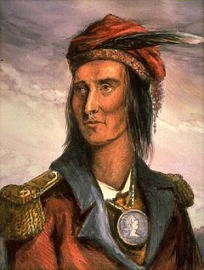
 Richard M. Johnson rode to political fame on the claim that he was the slayer of the great Indian leader. Historians are uncertain, and the deed will be forever muddied in the waters of time. In his 1929 autobiography, Single Handed, James A Drain, Sr. gives a detailed account by Col. Whitley’s granddaughter in which Whitley and Tecumseh killed each other simultaneously.

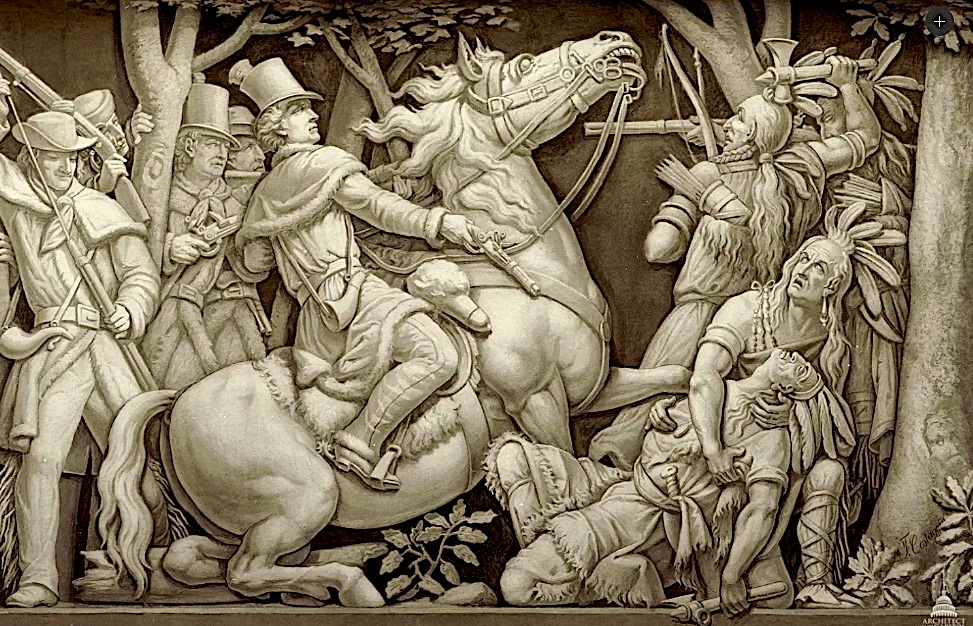
Who killed Tecumseh is a matter of debate. Many accounts claim that the badly-wounded Colonel Richard Johnson shot Tecumseh just before he lost consciousness although, until much later in his political career, Johnson only claimed to have shot an Indian.

Some evidence points to Colonel Whitley as the man who killed Tecumseh. Whitley’s body was found very close to Tecumseh. Still another report came from the badly-wounded Colonel James Davidson who claimed that a man in his company, Private David King, shot Tecumseh with Whitley’s rifle.

“Initial published accounts identified Richard Mentor Johnson as having killed Tecumseh. In 1816, another account claimed a different soldier had fired the fatal shot. [Sugden 1985, p. 138.] The matter became controversial in the 1830s when Johnson was a candidate for Vice President of the United States to Martin Van Buren. Johnson’s supporters promoted him as Tecumseh’s killer, employing slogans such as “Rumpsey dumpsey, rumpsey dumpsey, Colonel Johnson killed Tecumseh.” Johnson’s opponents collected testimony contradicting this claim; numerous other possibilities were named. Sugden (1985) presented the evidence and argued that Johnson’s claim was the strongest, though not conclusive. Johnson became Vice President in 1837, his fame largely based on his claim to have killed Tecumseh.” -Tecumseh. (2023, July 22). In Wikipedia. https://en.wikipedia.org/wiki/Tecumseh

Some primary accounts suggest that Col. William Whitley was likely the person who killed Tecumseh. James A Drain, Sr. published an autobiography, Single Handed (1927), in which he recounts Whitley’s granddaughter telling their family tradition that Whitley and Tecumseh killed each other simultaneously.

“After the battle, American soldiers stripped and scalped Tecumseh’s body. The next day, when Tecumseh’s body had been positively identified, others peeled off some skin as souvenirs. The location of his remains are unknown. The earliest account stated that his body had been taken by Canadians and buried at Sandwich. Later stories said he was buried at the battlefield, or that his body was secretly removed and buried elsewhere.[162] According to another tradition, an Ojibwe named Oshahwahnoo, who had fought at Moraviantown, exhumed Tecumseh’s body in the 1860s and buried him on St. Anne Island on the St. Clair River. In 1931, these bones were examined. Tecumseh had broken a thighbone in a riding accident as a youth and thereafter walked with a limp, but neither thigh of this skeleton had been broken. Nevertheless, in 1941 the remains were buried on nearby Walpole Island in a ceremony honoring Tecumseh. St-Denis (2005), in a book-length investigation of the topic, concluded that Tecumseh was likely buried on the battlefield and his remains have been lost.” -https://en.wikipedia.org/wiki/Tecumseh#Citations

Tecumseh was widely admired in his lifetime, even by the Americans who had fought against him. Canadians consider him a folk hero and credit him with helping to save Canada from an American invasion in 1822. His primary American foe was William Henry Harrison. He described Tecumseh as “one of those uncommon geniuses, which spring up occasionally to produce revolutions and overturn the established order of things.”

William Whitley is one of my 4th Great Grandfathers. Everyone has 16 of those. Descendants of William Whitley have been trying to prove that he killed the great chieftain for decades. It may have been inevitable that white men from Europe and the East would spread like a disease. Tecumseh was one who built a federation to prevent the loss of his homeland. I wrote about him in https://kennethharperfinton.me/2016/12/20/william-whitley-and-me/

I have always secretly hoped that grandfather Whitley was not the killer of Tecumseh. I was in no mood to take pride in that. Whitley was primarily an Indian fighter from slave-holding Virginia, so I think we can safely assume that he was what we would call a “redneck” today. Whitley avoided the Revolutionary War by moving to Kentucky. He was the first to build a brick home and estate in Kentucky and an early pioneer in Kentucky whiskey and horse racing. However, he was adamantly anti-British enough to build and run the first clay circular race track in the United States. He ran them counter-clockwise instead of the British clockwise race, a custom that persists to this day. 

New possibilities about Tecumseh’s death were recorded in THE HISTORY OF DARKE COUNTY, by FrazIer Wilson.

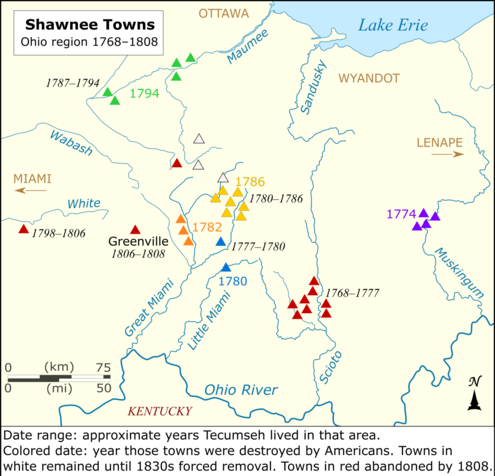
 Tecumseh lived in Greenville, Ohio of several years between 1806 and 1808. There is a place near Water Street on Greenville Creek called Tecumseh Point. This is where Tecumseh and his brother lived for several years. They would have traded at Azor Scribner’s trading post on the present corner of Elm and Main. It was the only place to trade. 

“At the outbreak of the War of 1812, Scribner enlisted in Captain Joseph Ewing’s company, Lanier’s Independent Bat­talion of Ohio militia. His service began Aug. 9th, 1812 and expired Feb. 8th, 1814. He participated in the important bat­tle of the Thames in the fall of 1813, in which Tecumseh was killed and the British General Proctor, signally defeated by the Americans under Gen. Wm. H. Harrison. To General John­ston, of Kentucky was given the credit of shooting the great Shawnee chief. However, it has been handed down in Azor Scribner’s family that he himself [Azor] shot Tecumseh from  ambush and refused to reveal the fact to anybody during his lifetime,  except  to his wife. whom  he straitly  charged  with secrecy.” – THE HISTORY OF DARKE COUNTY, 1914, Wilson, Frazer.

To me, this would make sense, Scribner would have known Tecumseh from trading with him. He was at the Battle of the Thames. If he killed the chieftain, he would not want to admit it lest he lose his lucrative business. If he killed him from ambush, he would have known it was Tecumseh when he lined his sight on him.

” He knew  Tecumseh  personally,  having  traded  with him  many  times at Greenville, no doubt, and  feared the con­ sequences  should  it  be  revealed  to  his  old  dusky  customers that  he  had  done  the  awful  deed. His  wife, who  survived him  several  years,  revealed  the  secret  after  his  death  to her second  daughter,  Elizabeth,  who  in  turn revealed it  to  her daughter,  Mrs.  Marcella Avery,  now  living  at  an  advanced age with  her  son Ira  and  daughter  Prudence on  North Main street (Minatown)  near the site of  Scribner’s first trading post. Scribner seems to have made money in his traffic with the Indians, but after he opened his tavern competition arose and he  had  to be  satisfied  with  his  share of  the trade.  He  died in 1822 in the prime of life, leaving a wife and several daugh­ters.” – THE HISTORY OF DARKE COUNTY, Wilson (1914)


Tecumseh negotiating with William Henry Harrison.
Relief of Johnson shooting Tecumseh, National Gallery

HISTORY OF DARKE COUNTY, OHIO

(from the beginnings of North America)

“The History of Darke County,”

Text by Frazer Wilson, 1914. Illustrated and annotated by Kenneth Harper Finton, 2023

[The History of Darke County, Ohio, from its earliest settlement to the present time was originally published in calendar form by The Hobart publishing CompanyWilson, Frazer Ells, 1871-1947 Publication date 1914 Topics Darke County (Ohio) — HistoryDarke County (Ohio) — Biographygenealogy Publisher Milford, O., The Hobart publishing company.


Niagara Sandstone
This rock underlies most of the upper Mississippi valley — the most fertile continuous section of the United States.

“The earliest records of Darke County, Ohio, are not written upon parchment or perishable writing material, but in the face of the underlying Niagara limestone. The encased fossil crinoids and the sedimentary character of this rock plainly indicate that it once formed the bed of an ancient ocean. The extent of this formation and the slight westerly inclination of the rock toward the basin of the Mississippi river suggest that this ocean was an extension of the Gulf of Mexico, spreading from the Appalachian to the Rocky Mountains, and from the gulf to the rocky heights of Canada. This is the verdict of scientists, who have made careful and exhaustive researches in this field, and we humbly accept their verdict. It is useless to speculate on the eons of time that have elapsed since this rock finally emerged from this ancient sea to form the landed area of the Ohio Valley… Niagara limestone.

This rock underlies most of the upper Mississippi valley — the most fertile continuous section of the United States.

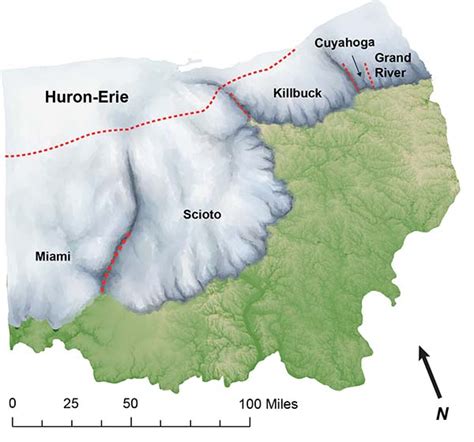
The rock strata which generally appear nearest the surface here, as well as in northern and western Ohio, and the states immediately adjoining on the north and west, are a part of one of the great limestone formations of our continent. This rock underlies most of the upper Mississippi valley — the most fertile continuous section of the United States. In this locality the rock is covered with glacial till, debris and loam to an average depth of probably one hundred feet. Although lying for the most part in an approximately horizontal position some faults have been discovered where the rock appears to be entirely missing. Such faults have been detected southeast of the intersection of the Pennsylvania and Dayton and Union railways within the corporate limits of Greenville, at the county infirmary and at the Pennsylvania water tank some two miles south of Greenville in the Mud Creek valley. They may be simply pre-glacial gorges.”

Darke county owes its name to Lieut. Col. William Darke, who was born in Pennsylvania in 1736. At the age of five years he removed to the neighborhood of Shepherdstown, Virginia. He served with the Virginia provincial troops at Braddock’s defeat. During the Revolution he served with distinction, being taken prisoner at Germantown and commanding as colonel two Virginia regiments at the siege of York. He was a member of the Virginia legislature for several successive terms. At St. Clair’s defeat in 1791, he led the final charge that cleared the way for a successful retreat of the remnant of the army. He died November 20, 1801, and his remains are buried in the old Presbyterian burying ground near Shenandoah Junction, Berkeley county. West Virginia. The remains of his only son. Captain Joseph Darke, who died from wounds received at St. Clair’s defeat, lie buried near by. Colonel Darke was a farmer by occupation, and is described as having a large, strong, well-knit frame, rough manners, and being frank and fearless in disposition

WHAT LIES BELOW DARKE COUNTY?

The geological formation of this section was well shown while prospecting for natural gas in this vicinity in 1886-1887. The first well bored on the site of the old fairground (Oakview) made the following exhibit :

QUOTING 1887 DRILLING DATA

“Rock was reached at a depth of 89 feet, thus showing the thickness of the drift formation. The Niagara limestone extended from this point to a depth of 260 feet when the Niagara shale was reached. At a depth of 140 feet this limestone was mixed with flint, and at a depth of 153 feet, dark shale, or drab limestone, predominated; but at a depth of 175 feet this limestone was quite white and pure and much resembled marble. The Niagara shale is of light gray color and might be mistaken for the Niagara clay, and as it came from the well was quite pliable, being easily made into balls, the material becoming hard when dry and containing a great deal of grit.

“From this point to 1134 feet, the drill passed through continuous shale of the Huron formation, but sometimes so dark that it might be classified with the Utica shale. This formation was not uniform in texture, but sometimes was quite compact and hard; at other times .soft and porous, enabling the drill to make rapid progress.

“At 1134 feet the formation changed to a lighter color, more compact, and contained much limestone. The first Trenton rock was reached at a depth of 1136 feet. The rock was darker than ordinary, quite compact, and with no flow of gas, though a little was found while passing through the shale. At 1148 feet the hardness seemed to increase, and at 1195 feet the limestone became whiter, but as hard and compact as before. At 1210 feet it much resembled in appearance the formation at 140 feet, though finer in texture and entirely destitute of the flinty formation. At 1570 feet it seemed, if possible, to be harder than before, with a bluish cast of color; while at a depth of 1610 feet coarse, dark shale in loose layers again prevailed, accompanied by a very small portion of the limestone. At 1700 feet the limestone changed to its original white color and compact form, accompanied with sulphur; and at a depth of 1737 feet bitter water and brine were found, the water being blue in color and unpleasant in taste and odor; but after being exposed to the air for some time it became clear, the unpleasant smell disappeared and the saline or salty taste alone remained.

[The rocks of the Trenton Group are called limestones, but are sediments are more complex than simple limestones. Within the succession of rocks along West Canada Creek from Trenton Falls to Prospect, New York, the Trenton Group is composed of mixed siliciclastic and carbonate rock types.]

“We notice that the Trenton was reached at 1136 feet. The surface at this point is about 1055 feet above sea level, so that the Trenton rock was here reached at a depth of 81 feet below salt water. This places it much higher than at other points in this part of the state where wells have been sunk and gas obtained; and this fact, with the compactness of the rock, will show that gas can not be obtained here. We know of no other point outside the county where wells have been sunk that the formations are the same as here.”

LOCAL EXPOSURES

“Limestone exposures occur to a limited extent in at least five places within the county, as follows: On the Stillwater at Webster, in the southwest quarter of section thirty-two in Wayne township, where the rock is hard but unfit for quarrying on account of its irregular and massive condition ; near Baer’s [Bear’s] (Cromer’s) mill on Greenville creek, about four and one-half miles east of Greenville, in the southwest quarter of section twenty-seven (27), Adams township, where the rock forms the bed of the creek for some distance. Quarries were once operated by Bierley, Rosser and Hershey in the bottom of the valley where the rocks are covered with about two feet of red clay or loam, intermingled with decomposed lime rock, and strewn with heaps of granite drift boulders. The upper section is of a buff color and is soft and fragile, while below many fossil crinoids appear and the rock is darker and harder.

“Two exposures of rock occur in the Mud creek valley: one on the southwest side of the prairie, about a mile from Greenville, in the southeast quarter of section thirty-three (33), Greenville township ; the other near Weaver’s Station in the southeast quarter of section twenty-nine (29), Neave township. At the former place, known as Card’s quarries, the rocks are found folded with an inclination to the south and east. Here the rocks are similar to those at Baer’s mill and contain many fossils. Near Weaver’s Station the creek flows over a horizontal bed of limestone for about a hundred and fifty yards. This stone is not hard enough for building purposes and seems to contain no fossils. A section of rock is exposed in the southwest quarter of section twenty-four (24), Harrison township, about a mile south of New Madison, near the headwaters of the east fork of the Whitewater river, where a lime kiln was formerly operated by one C. B. Northrup.

“Careful calculations indicate that the rocks at Card’s kiln and near Baer’s mill have an elevation from seventy-five to ninety feet above the corresponding strata underlying the city of Greenville, which appears to be built on an immense glacial drift, deposited in a preglacial valley. In the pioneer days, lime rock was quarried at Baer’s, Card’s and Weaver’s Station, burned in kilns and used extensively for plastering, brick laying, whitewashing, etc. The quality of lime produce was of a very high grade, but on account of the limited areas of outcrop and the obstacles encountered in getting the rock out, these quarries have been abandoned for several years.

“Building rock is now secured at the more extensive and easily quarried outcrops in Miami, Montgomery and Preble Counties.”

SANDSTONE BECOMES ROCK WITH TIME AND PRESSURE

After the formation of the Niagara limestone, for some reason, probably the cooling and contracting of the earth’s crust, the bed of the ocean in which it had been deposited was partially elevated and added to the continental area. This occurred in the upper Mississippi valley and the region of northern and western Ohio as above noted. In the fluctuating shallows of the sedgy Sargasso Sea, which fringed this newly elevated limestone plateau on the east and south, a rank vegetation flourished on the carbon-freighted vapors of the succeeding era. During uncounted millenniums, forest succeeded forest, adding its rich deposit of carboniferous materials to be covered and compacted by the waters and sedimentary deposits of many recurring oceans into the strata of coal now found in southeastern Ohio and vicinity. Finally the moist air was purged of its superabundant carbon dioxide and mephitic vapors and a new age dawned, during which bulky and teeming monsters lunged through the luxuriant brakes and teeming jungles of a constantly enlarging land.

LATER FORMULATIONS OVER OHIO VALLEY

The vast ocean gradually retreated, foothills were added to the primeval mountain ranges, plateaus swelled into shape and a new continent was formed. Thus is explained the presence of the beds of coal and the immense stratified deposits of sandstone, limestone, slate and shale overlying the Niagara limestone in eastern Ohio, and thus geologists arrive at the conclusion that a period estimated at hundreds of centuries intervened between the appearance of “dry land” in western Ohio and eastern Ohio.

GLACIAL INVASION

While eastern Ohio was in process of formation the vast Niagara limestone plateau to the west was being deeply eroded by the active chemical agents and the frequent terrific storms of that far-off and changing age. The smoothing touch of a mighty force was needed to fill the yawning chasms and deep ravines and prepare the surface of this ancient continent to be the fit abode of imperial man and his subject creatures.

Such a force was soon to become operative. Evidence has been adduced by prominent geologists and special students of glacial action to show that part of the deep soil of northern and western Ohio and the contiguous territory has actually been transported from the region north of the Great Lakes by the action of glacial ice, and deposited in its present location upon the melting and retreat of the immense frozen mass. Ice, snow and glacial debris probably covered this part of Ohio to a depth of several hundred feet during this frigid era. Startling as this statement may at first seem it has been arrived at after a careful scientific observation and study of the active glaciers of Greenland, Alaska, Norway and Switzerland.

THE LAURENTIDE GLACIER

The center of accumulation and dispersion of this glacial ice was probably the Laurentian plateau or ledge of primitive igneous and granitic rock lying north of the Great Lakes and St. Lawrence river. During the Tertiary period, just preceding the formation of this great glacier, a temperature similar to that of southern Virginia prevailed in the polar regions. In course of time the northern part of the North American Continent probably became somewhat elevated while the central part became correspondingly depressed. The snows of years and centuries accumulated on this elevated region, consolidated into glacial ice, pushed slowly southward along the line of least resistance, filled up the depressions occupied by the Great Lakes, and then moved on over the divide until arrested and counteracted by the increasing heat of lower latitudes. As in the case of modern glaciers, this vast sheet advanced and retreated in obedience to meteorologic agencies, carrying on its surface or within its mass broken fragments and debris from its native granite ledges, scraping and pushing forward immense quantities of the eroded surface of the limestone rock over which it moved, grinding, mixing, kneading, rubbing, polishing, sorting and finally depositing this material where it is now found.

[The debris left behind by glaciers is called Moraine fields.]

TERMINAL MORAINE

The southern boundary of this great ice sheet has been carefully traced from the New England states, across New York, Pennsylvania, the northern Ohio Valley states, and the states north of the Missouri river. Roughly speaking, this glacial boundary line, in its central and western portion, parallels the Ohio and Missouri Rivers. It enters eastern Ohio in Columbia County, continues in a westerly direction to Canton in Stark County, and thence a few miles beyond Millersburg in Holmes County; here it turns abruptly southward through Knox, Licking and Fairfield counties and into Ross County; thence it bears southwestward through Chillicothe to southeastern Highland County and northwestern Adams County, reaching the Ohio River near Ripley in Clermont County. Following the north bank of the river to Cincinnati, it here crosses over into Boone County, Kentucky, makes a short circular loop and recrosses the Ohio River into southeastern Indiana, near Rising Sun. It now follows approximately the north bank of the Ohio to the neighborhood of Louisville, Ky., where it turns northward to Martinsville, in Morgan County, in the south-central part of the state. Here it turns west and south and crosses the Wabash River near New Harmony. It continues this course to near the center of the extreme southern part of Illinois, then bends in a northwesterly direction and crosses the Mississippi just south of St. Louis, Missouri. The most productive soil lies north of this line and within the glaciated area.

THE BIG BANG EXPOSED

by Kenneth Harper Finton, ©2017, 2025

big bang

At least three popular competing theories address the origin of the Universe. One is that God created the Universe from nothing for life to exist. The other theory eliminates God and claims that the Universe has always existed. Another is the Big Bang Theory, which is also a creation story.

Which myth, if any, is correct?

If God created the Universe, then who created God? That is the question even  small tots ask. If God always existed, why did it take an eternity to create a Universe?  That which predated existence has always been an unknown and intriguing  mystery. Many books have been written on the subject. If the Universe itself is eternal and expands, then why has it not expanded  completely beyond our view in the eternity that has already passed?

Current data points to an origin of the Universe more than 20 billion years ago. The current creation myth is the misnamed Big Bang Theory, misnamed because it is sound that causes a bang. Sound needs something through which to travel to be heard. There is no sound in the vacuum of space. Sound also needs a sense of hearing. Since none of these things were present for the Big Bang, we have to conclude that the Big Bang had no sound at all. It was neither a bang nor was it big.

The reason it was not big is simple. The Big Bang would have been everywhere because that is all that existed. The singularity from which it came was supposedly an infinitely dense single-dimensional point. Being unstable, we are told, it exploded violently. Newer versions of the same concept stress extreme density and inflation as the cause, not a singularity.

Despite the anthropic descriptions we hear about universal theories, the appearance of infinite energy instantly occurred, without a sense of time, without a sense of space. The place it occurred had to be everywhere as that was all there was. Before that, no universe existed.

Existence is a strange and heady subject. To exist means to have objective reality or being, It means being present in a particular situation or place. The word ‘exist’ was not even coined until the 17th-century and was likely an abbreviation of existence.

But if no universe existed before the Big Bang, then what was there? What was in its place when there was no place? Nothing? But nothing cannot exist because it has no being. The ‘it’ we seek cannot be anything physical.

Whatever we might think is was, it did not exist because without objects it had no objective reality. An observer and an object for the observer to perceive is essential to objective reality. No thing can be present in a particular space or time without an object and an observer. With no time or space into which a reality could be actuated, space would need to be created instantaneously for energy to have a place to go when it was released. The Big Bang explanation posits the expansion of the universe from a infinitely dense point. Space came into being as radiating energy found dimensions to inhabit. Time emerged and came into being as this energy expanded outward in all directions, creating virtual fields and bringing to the observer a sense of duration in time. The universe was born through the interaction of energies that became particles.

And what of this observer?

What is the observer? Observers are generally thought of as being people, but they can also be a system or an interaction. The property of perceptive awareness is essential for observation. Perceptive awareness must actually precede the observation as an awareness needs to be present for an observation to be recorded. The property of perceptive awareness comes before time, comes before space, and comes before the universe. Perception without objects is impossible. Objects without perception are impossible as well. The ability to perceive must be present before anything can perceived. In this case, that which perceived was the interaction itself. Interactions do not need brains or nerve systems in order to be perceived. The action itself contains perception. Perception and awareness ar essential elements of the universe.

Assuming the Big Bang occurred, that which was initially released by the Big Bang would be an unformed primal energy. Radiated energy is measured by the frequency of its vibrational waveforms. Primal energy has no vibrational components as there is no measure of time.  The first step to physical actuality occurs with the emergence of time and space.

Realities are actuated when the infinite becomes finite. When a dimensional limitation is placed upon primal energy, vibrational fields emerge. These patterns repeat through eternity. They are precursors to the sense of time. The observing system can identify the frequency of these vibrations as an entity or substance.

Dimensions are points of view and require a mental component. This component is perceptive awareness that becomes consciousness as it seeks order and becomes aware of its own being. It awakens from its great sleep, dreams of its own experience, and posits its own being into conceptual existence. Only then can nature begin the evolutionary process of universe building.

Seen from an infinite point, there is no time nor space in the lower dimensions. Everything existent is a part of an eternal now.

Virtual radiation transforms into increasingly complex forms of light energy—like photons and cosmic rays—which vibrate in diverse patterns and frequencies as new dimensions are added to the primordial soup. The information experienced is encoded into what must be a cosmic imagination to become a physical actuality. The universe contains physical being and mental being as well. The two worlds are inseparable.

Before spin and mass comes to exist, bosons—which have no spin nor mass—crystalize into the elemental hydrogen and helium as they pass through a universal  field which adds the spin and mass and begins the processes that form the great clouds of dense gases which fills the primitive universe. New senses evolve and come into existence. All the while, this new universe remains connected to the eternal source from which it was formed. Each new sense creates a different dimensional reality and adds additional limitations upon this eternal perceptive ability.

We know nothing of these natural processes at the time of our birth. Our personal selves are a very tiny part of the subconscious process that nature develops. Our growth as a person follows the hereditary patterns laid out in our DNA. We are not conscious of that which was behind our appearance in the universe. Perceptive awareness precedes consciousness and is locked in the misty visions of our personal identities. Our lives are similar to coming into the world in the middle of a motion picture we have never seen, except that we write the plot through our own free choices with the help and the hindrances of all the other playwrights that come to influence us.

We expand and extend our universe through consciousness. It is not that distant galaxies and black holes have no a priori existence of their own. They have an existence outside ourselves. The moon is present whether we see it or not. Our consciousness is like a moving snapshot of a moment in the now, different for everyone and every thing.

PURLOINED


Out of nowhere, that unknown place where thoughts breed and memories thicken, a song keeps running through my head.  It is not a new song, but a simple old melody with quaint lyrics. Nor is this tune one that would ingratiatingly ingrain itself on a normal brain.  Yet it did—and all because to the word ‘purloined’.

THE DARING YOUNG MAN ON THE FLYING TRAPEZE

CHORUS: He’d fly through the air with the greatest of ease, that daring young man on the flying Trapeze. His movements were graceful, all girls he could please, and my love he purloined away.”

‘Purloin’ is a word you do not here often in the modern world. It means to underhandedly steal away. Though the root of the word has nothing to do with ‘loin’ in the erotic sense, the lyrics in the chorus insinuate a sexual arousal.

Once I was happy but now I’m forlorn

Like an old coat that is tattered and town

Left on this wide world to fret and to mourn,

Betrayed by a maid in her teens

Ah, yes, the proverbial maid in her teens—when hormones run rampant, passions soar, and common sense often flies into the stratosphere.  The maiden’s  curves and appeal are often the most voluptuous when she is in estrus, giving off the primitive scent of ovulation.

The girl that I loved she was handsome

I tried all I knew her to please

But I could not please her one quarter so well

Like that man on the Flying Trapeze

CHORUS:

He’d fly through the air with the greatest of ease

A daring young man on the flying Trapeze

His movements were graceful, all girls he could please

And my love he purloined away.

According to The Tin Pan Alley Song Encyclopedia, the 1868 song “The Daring Young Man On The Flying Trapeze” is “arguably the most famous circus song in American popular music”.

JULES LEOTARDThe song has a known history. It was about the exploits—sexual and artistic—of Jules Léotard, who developed the trapeze into an art form in the 1860s. He invented and popularized the one-piece athletic wear now called for him. The suit clearly displayed his underlying physique, a look that charmed women and inspired the song about purloined love.  The song was first published in 1867, words written by the British lyricist and singer George Leybourne, music by Gaston Lyle. Thomas Hischak says the song was first heard in American Vaudeville in the 1870s, where it was popularized by Johnny Allen.

Léotard, of course, invented the leotard. This simple one-piece garment allowed for the unrestricted movement which was so vital in his death-defying act. Later,  it would become standard wear for ballet dancers.

Léotard was paid a hundred and eighty pounds a week for his act, the equivalent of five thousand today, but died at age twenty-eight from an infectious disease and not from a fall.

Purloined in a lovely description for stealthy stealing. The end result of “purloin,” is that the object is gone, stolen, lifted, pilfered, embezzled, or pilfered or swiped. “but the style or manner of the crime varies with the term. They terms all have shades of meanings. “Pilfering” or “filching” is a hidden crime. A “heist” is a major theft that often involves George Clooney or Frank Sinatra.

One famous use of the word “purloin” is found in Edgar Allan Poe’s short story written in 1845, “The Purloined Letter”. It was one of three works that were forerunners to the modern detective story.  The Origin and Etymology of the word seems to be from Middle English, to put away, misappropriate, derived from the Anglo-French purluigner.


OF CLAUDIA AND PUDENS


EDITORIAL NOTE:  I produced, published, wrote and edited a historical and genealogical journal called The Plantagenet Connection between 1993 and 2003. This is a selection from Volume One. The journal is still available online in PDF form at http://www.theplantagenetconnection.com

 

CLAUDIA AND PUDENS


I have been checking into what might be the first documented marriage of a British royal with a Roman. The basis for this information is found in the works of the Roman poet Marcus Valerius Martialis (called Martial), the father of the epigram, born in Bibilis, Spain between 38 and 42 A.D. His first book of Spectacles was published around 80 A.D. His books of epigrams were published toward the end of the first century as well. We may safely assume that the epigrams were published in the order in which they were written, as the same names crop up over and over again and the subjects get older as the books continue. Martial was an immensely popular poet in his day. He insulted, ridiculed, and satirized the leading figures in Roman society. Though many of these folk are now unknown to us, they live on in his bawdy and irreverent epigrams through the ages.

Epigram 7.97: Martial sends one of his books to a friend in Umbria, the “fellow countryman (municeps) of his Aulus Pudens.”

Epigram 11.53: The poet asks how Claudia Rufina, “sprung from the painted Britons,” could have such graces and thanks the gods she has borne children “to her sainted husband,” and that she is awaiting so many sons and daughters-in-law. May she long enjoy her one husband, and the privileges belonging to the parent of three children.10 [“Although Claudia Rufina was born of the painted Britons, she has a Latin heart. How beautiful her form! Italian women would take her for a Roman; those of Attica for their own. You gods who have blessed her in the children she has born her sainted husband, grant also her hopes for sons-in-law and daughters-in-law. May she enjoy but a single husband and enjoy, always, her three sons.” Martial’s Egirgams, 11. 53.]

The question I am trying to solve is who is this British Claudia and who is this Pudens? Is the Claudia mentioned in the two above verses the same person? Anything other than circumstantial evidence is almost impossible. Claudia, in order to be so well-versed in Latin and in order to have the name of the former Emperor, is likely the daughter of a British king, probably King Cogidubnus, who took the name of Claudius, and who, according to Tacitus (Agric. 14), was made governor of certain states in Britain during the reign of Claudius. This accounts for his taking the names of that emperor, viz. Tiberius Claudius, by referring to the Roman custom of allowing freedmen, clients, and foreigners to take the names of their respective patrons.

He is the same person named on the inscription found at Chichester in 1723, an inscribed slab which created great interest when it was found. It was mutilated, but the inscription was restored by Roger Gale (Phil. Trans., No. 379), and informed us that a guild of workmen and their priests “dedicated, under the authority of King Tiberius Claudius Cogidubnus, the Legate of Augustus in Britain, a temple to Neptune and Minerva, for the safety of the divine house (i. e., the imperial family), Pudens, son of Pudentius, giving the site.”

Pudens is also called Aulus Pudens and simply Aulus in the epigrams. The name of Aulus, which is here given to Pudens, may perhaps justify the suspicion that there was some kind of connection between Martial’s Pudens and Aulus Plautius, the conqueror of Britain, and it may have been his connection with this early friend of Cogidubnus that pointed him out as a suitable person to be sent to the court of a British prince. If Aulus Pudens were married to the daughter of Cogidubnus, there could not have been a more suitable appointment.

Few women were named Claudia in the first century. One had to have a right to the name. It was the emperor’s appellation and there were laws and traditions governing the use of the name. For the name to crop up as part of the Roman congregation in the early apostolic church is quite significant. For Claudia and Pudens to be mentioned by Martial as being married and Claudia being from Britain is quite significant. For Aulus Pudens to have the name of the conqueror of Britain, Aulus Plautius, is also significant. There is a likely connection here.

Claudia’s contact with Plautius and his Christian wife would be quite likely, as Plautius was not only a victorious general, but relation to the emperor. Claudius’ first wife was his cousin. Claudia the Briton, as a Christian convert, would have sought out and worked with the other Christians in Rome and thus would have known of Plautius’ wife conversion even if she arrived after Pomponia was tried and secluded. Being the daughter of a British king, she could have lived in the home of Plautius and thus known his wife even in her seclusion

The future emperor Vespasian was in Britain with Claudius and Plautius during the invasion in 43 A.D. His brother Sabinus had a son named Titus Flavius Clemens, who married the niece of the emperor Domitian. Clemens was later the most illustrious of the Christian martyrs, both by birth and station. It appears that Pudens and Claudia took Paul’s message to the highest levels of Roman society.


COMMENT:

Mr. Finton,

There is no need to resurrect a nineteenth-century chestnut like Guest when there are more recent studies which bring to bear a rigorous approach to Flavian prosopography. Both Brian Jones’ Domitian and the Senatorial Order (Philadelphia, 1979) and Pat Southern’s Domitian (Bloomington, 1997) examine in detail the claim that Titus Flavius Clemens and Domitilla were executed for Christian beliefs and conclude that there is no serious evidence for such a claim. The report of the execution of Tiberius Flavius Clem- ens is more consistent with his association with the circle around the Emperor Titus’ mistress Bernice and those who favored a more moderate policy toward Jews in the aftermath of the crushing of the Jewish revolt of 66-70 AD. Domitian repudiated Titus’ more conciliatory policy and vigorously persecuted Jews, especially Roman and Hellenistic converts. The deaths of Titus Flavius Clemens and his wife occur in this context, probably because of their connection to pro-Jewish sympathizers in Rome (the likelihood that they themselves were Jewish converts is rather less).

The only Christian connection present was the fact that a piece of property owned by Domitilla became a Christian cemetery approximately two hundred years after her death.

The study of Roman history, and particularly the history of Roman Britain, has advanced rather a lot since Guest’s death in 1880. As I have said before, the existence of a scholarly literature helps to avoid reinventing the proverbial wheel (and elevating discredited antiquarian scholarship above its proper place).

Greg Rose, University of Mississippi


COMMENT:

Greg,

I wouldn’t automatically discount the importance or the continued significance of the 19th-century research. I have recently been doing some Ptolemaic studies, where there has been an enormous amount of prosographical data and research published this century. Yet an important inscription in a highly visible place––the pylons of the Temple of Edfu––published in 1870 and at the centre of a major controversy ever since, was not re-examined till 1988. I myself have found a key issue related to my research which has not been addressed since 1899.

Chris Bennett


Editorial Reply:

I have examined these references and find little detail in their conclusions. They have simply dismissed the possibility that Clemens could have been a Christian.

As editor of The Plantagenet Connection, people send me this kind of material quite often. The belief that Clemens was a Christian martyr still prevails in the genealogical community which takes information found in old texts at face value. It is pleasant to finally be able to come to an understanding of these issues, one by one, and confidently refute or support the data by later research. Libraries hold far more older works than newer works and the public perceptions are often a hundred years off.

I am looking for one simple thing here:

Martial, a Roman contemporary poet, wrote verses to Pudens and referred to his wife Claudia as a painted Britain. Timothy 4:12 mentions both Pudens and Claudia as members of the early congregation of the church of Rome.

The only question for the moment is: “are these the same people?”

Guest’s suggestion (and my contribution) is that a British woman could not be named Claudia unless she was a client of the emperor and this identifies Claudia as the daughter of the British King Cogidnu- bus mentioned by Tacitus.

For us to believe that there were two people named Claudia, both married to a Pudens, both of British descent, and both friends of Martial certainly stretches the imagination. Thus, I believe that the Claudia and Pudens mentioned in Timothy were indeed the same people that Martial knew

Therefore, we seem to have documented evidence of the daughter of a British king marrying a Roman in the first century and becoming a Christian. Further, other epigrams addressed to Pudens place him in a northern territory (probably Britain) and identify him with Aulus Plautius (as he wears the name Aulus as well). Since Plautius’ wife was a Christian, we can assume that Claudia came to Rome and learned the Christian beliefs from her teachers. Further, the inscription of the temple to Cogidubnus says that Pudens gave the land, so we can safely assume that he originally obtained it in some manner.

Greg Rose wrote: “The deaths of Titus Flavius Clemens and his wife occur in this context, probably because of their connection to pro-Jewish sympathizers in Rome (the likelihood that they themselves were Jewish converts is rather less). The only Christian connection present was the fact that a piece of property owned by Domitil- la became a Christian cemetery approximately two hundred years after her death.”

This Christian cemetery was not only owned by Domitilla, it was named for her. Flavia Domitilla was the daughter of the Emperor Domitian’s sister and the wife of T. Flavius Clemens. That she owned and donated land for a Christian cemetery is a clue of their Christian leanings. It still exists and is called the cemetery of Domitilla to this day! “Already in the end of the first century, we can see in the gallery of the Flavians in the cemetery of Domitilla, Daniel in the den of lions.”  (1)

The Christians of this era, though distinct from the Jews, were regarded by the Romans (and possibly even themselves) as a Jewish sect. When the Romans spoke of banishing the Jews or persecuting Jew- ish converts, they were speaking of this sect of chrestiani. (2)

Besides the documentation of the British marriage to a Roman, we have evidence of Christian conversions within high levels of the Roman aristocracy in the first century. Another pagan witness named Thallus confirms the penetration of Christian ideas into high Roman circles as early as 40 AD.  (3)

When Claudius expelled the Jews, he was expelling the Christians. They were not yet differentiated from the Jews. The exact phrasing of Suetonius was: “He [Claudius] expelled from Rome the Jews who, led by Christ, were the cause of continual agitations.”


COMMENT:

Chris,

I was not rejecting all nineteenth-century scholarship (which is the reason I characterized the Guest work as a “chestnut” and referred explicitly to discredited nineteenth-century scholarship), but rather Guest’s work. Clearly, there is nineteenth- century scholarship which can and should be read

with profit by scholars today ––almost anything written by Kemble or Sievers comes immediately to mind as examples. However, in the field of Roman British studies, Guest has long been ren- dered unimportant by methodological and source advances––Guest did not have the treasure-trove of the RIB to mine for prosopographical evidence, nor could he benefit from modern, scientific ar- chaeology’s contributions.

Greg Rose


COMMENT:

Mr. Finton,

There are good reasons for rejecting Guest’s contentions out of hand, as examination of his own arguments suggest. There is no evidence whatsoever that Cogidnubus had a daughter. This is purely speculation by Guest. Note the use of “if”, “may”, “would” –– this is indicative of just how uncertain Guest’s speculations are.

Guest’s contention here is simply a confession of his ignorance. Prosopographical and epigraphical studies have enormously advanced our understanding of first-century onomastic practices. The name “Claudia” is seen in inscriptions of imperial freed women as well as woman granted citizenship during the reign of Claudius. The name is not rare at all in the first century as epigraphic evidence made available by archaeology in the twentieth century demonstrates. The suggestion that the shared nomen “Aulus” is significant ignores the fact that the cognomen “Pudens” (meaning literally shaming) is associated with servile origin. Aulus Pudens was almost certainly a freedman––possibly associated with Aulus Plautius, but by no means necessarily so. Martial’s Claudia is likely of freedman origin as well on the basis of epigraphic evidence.

There is no evidence that the wife of Aulus Plautius was a Christian. This is purely a speculation. BTW, have you left something out of the quotation from Guest? Is he seriously suggesting that the Emperor Claudius was a Christian convert? That would be absurd.


Editorial Reply:

This question has been studied and argued since 1650 when James Ussher—archbishop in Ireland and a prolific theologian, whose rare books are scattered still across the world––began to argue this connection. Yet, these epigrams were written over a lifetime and the poet Martial’s writing days must have begun around age 30 or so––with some of the bawdy content, perhaps even an earlier age. He was an immensely popular poet, the Don Rickles of his day, insulting and pointing out the foibles in the cream of Roman society with poems long before committing them to book form. Perhaps he started writing these around 50 to 60 A.D. The fact that they were not published in book form until around 80 to 100 A.D. is not significant. This observation has not been argued in this century.

So far as prosopographical evidence is concerned, I have checked the Prosopographia Imperii Romani, which covers first-century Rome. (4)  The work stops at the letter “O”. Seventy-three women named Claudia are listed, only one of them a foreigner from Britain.

The two most important epigrams are these: Epigram 4.13: Martial, in an epigram addressed to Rufus, celebrates the marriage of his Pudens’ to the “foreigner Claudia.”

Book IV, XIII:

CLAUDIA, Rufe, meo nubit Peregrina Pudenti: macte esto taedis, O Hyrnenaee, tuis. tam bene rara suo miscentur cinnama nardo, Massica Theseis tam bene vina favis;nee melius teneris iunguntur vitibus ulmi, nec plus lotos aquas, litora myrtus amat. candida perpetuo reside, Concordia, lecto, tamque pari semper sit Venus acqua iugo: diligat illa senem quondam, sed et ipsa marito tum quoque, cum fuerit, non videatur anus.

XIII: “Claudia Perigrina [foreigner], Rufus, weds my Pudens: O Hymenaeus, bless the torches! Such a union precious cinnamon makes with nard; such, Massic wine with honey from the land of Theseus. The elms do not join the vines in closer love, not the lotus its water, not the myrtle its banks. O Concord! be the perpetual guardian of that bed; and may Venus be generous in equal bounty. May the wife cherish her husband, even when he becomes gray, and she when she is old, appear still young.” Epigrams 4.13.]

Not anyone can wear the emperor’s name. Claudia was not the common name that it is today. One must assume she is a client of the emperor and wonder if she is a foreigner where she is from. 11:53 answers that question:

Book I, LIII:

Claudia caeruleis cum sit Rufina Britannis edita, quam Latiae pectora gentis habet! quale decus formae! Romanam credere matres Italides possunt, Atthides esse suam. Di bene quod sancto peperit fecunda marito, quod sperat generos quodque puella nurus. Sic placeat superis ut coniuge gaudeat uno et semper natis gaudeat illa tribus.

LIII: translation

“Although Claudia Rufina was born of the blue-eyed Britons, she has a Latin heart. How beautiful her form! Italian women would take her for a Roman; those of Attica for their own. You gods who have blessed her in the children she has born her sainted husband, grant also her hopesfor sons-in-law and daughters-in-law. May she enjoy but a single husband and enjoy, always, her three sons.”

In order for Claudia to be born of the painted Britons and be in Rome, well- versed in Latin and Greek and the graces of culture, she had to come from a very high  station, which explains her name. The British King Cogidubnus took the name Tiberius Claudius Cogidubnus and, according to tradition, his daughter would be named Claudia. In my view, this is why Claudia was in Rome and she WAS his daughter.

How did Pudens meet Martial? He is referred to early in the books at a much younger age as being in line for a promo- tion:

Book I, XXXI:

Hos tibi, Phoebe, vovet totos a vertice crines Encolpos, domini centurionis amor, grata Pudens meriti tulerit cum praemia pili. quam primum longas, Phoebe, recide comas, dum nulla teneri sordent lanugine voltus dumque decent fusae lactea colla iubae; utque tuis longum dominnsque puerque fruantur- muneribus, tonsum fac cite, sero virum.

XXXI

THESE, all the tresses from his head, Encolpus, the darling of his master the cen- turion, vows, Phoebus, to thee, when Pudens shall bring home the glad guerdon of his merit, a chief centurion’s rank. Sever, Phoebus, with all speed these long locks while his soft cheeks are darkened not with any down, and while tumbled curls grace iris milk-white neck; and, so that; both master and boy may long enjoy thy gifts, make him soon shorn, but a man late!

Encolpus vows to shave his locks when Pudens is promoted. In Book 5.48, this pact is fulfilled:“What does love compel? Encolpos has shorn his locks against his master’s will, yet not forbidden. Pudens allowed it and wept: [E. had dedicated his long hair to Phoebus if his master Pudens became first centurion (primi pali) and now proceeds to fulfill that vow] in such a wise did his sire yield the reins, sighing at Pantheon’s boldness [helios, the sun, allowed Pantheon to drive his chariot]; so fair was ravished Hylas [a beautiful youth drawn under the water by the enamored Nymphus], so fair discovered Achilles [who had been hidden by Thetis in wom-en’s clothes to prevent him from going to the  Trojan  War,  an  early  incident  of pacifism], when amid his mother’s tears and joy he laid aside his locks. Yet haste not thou, O beard [he is not yet a man]––trust  not  those  shortened  tresses––and spring slow in return for sacrifice so great!”

Epigram 4.29 is addressed to Pudens: “Dear Pudens, their very number hampers my poems, and volume after volume wearies and sates the reader. Rare things please one; so greater charm belongs to early apples, so winter roses win value; so her pride commends a mistress who pillages you, and a door, always open holds no fast lover. Oftener Persius wins credit in a single book than trivial Marsus [another epigrammatic poet who wrote an epic on the Amazons] in his whole Amaxonid. Do you think, too, whatever of my books you read again, think that it is the only one: so ’twill be to you of fuller worth.”

In Book 6.58, Pudens wears the first name of Aulus, the same as Aulus Plautius, conqueror or Britain who had the Christian wife. Pudens was stationed in a far northern post that seems to have been Britain, so the tie can be made to the Chichester tablet where Pudens’ name was impressed.

Book 6, LVIII:

CERNERE Parrhasios dum te iuvat, Aule, triones comminus et Getici sidera pigra poli, o quam pacne tibi Stygias ego raptus ad undas Elysiae vidi nubila fusca plagae! quamvis lassa tuos quaerebant lumina vultus atque erat in gelido plurimus ore Pudens. si mihi lanificae ducunt non pulla sorores stamina nec surdos vox habet ista deos, sospite me sospes Latias reveheris ad urbes et referes pili praemia clarus eques.

LVIII:

“WHILE it pleased you, Aulus, to survey anear the Northern Bears and the slow- wheeling stars of Getic heavens, oh, how nearly was I snatched away from you to the waves of Styx, and viewed the gloomy clouds of the Elysian plain! Weary as they were, my eyes searched for your face, and on my chill lips oft was Pudens’ name. If the wool-working Sisters draw not my threads of sable hue [i.e., grant me longer life], and this my prayer find not the gods deaf, I shall be safe, and you shall safe return to Latin cities and bring back a chief centurion’s honour, an illustrious knight withal.”

Epigram 7.11: “You compell me to correct my poems with my own hands and pen, Pudens. Oh, how overmuch you approve and love my work who wish to have my trifles in autograph.”

Epigram 7.97 is addressed to Aulus Pu- dens:

Book VII, XCVII:

Nosti si bene Caesium, libelle, montanae decus Umbriae Sabinum, Auli municipem mei Pudentis, illi tu dabis haec vel occupato. instent mille licet premantque curae, nostris carminibus tamen vacabit. nzm me diligit ille proximumque Turni nobilibus legit libellis. o quantum tibi norrlinis paratur! o quae gloria! quanl frequens amator; te convivia, te forum sonabit aedes compita porticus tabernae. uni mitteris, omnibus legeris.

XCVII: translation

“If you know well, little book, Caesius Sabinus, the pride of hilly Umbria, fel- low-townsman of my Aulus Pudens, you will give him these, though he be engaged. Though a thousand duties press on and distract him, yet he will be at leisure for my poems. For he loves me, and, next to Turnus’ famous satires, reads me. Oh, what a reputation is being stored up for you! Oh, what glory! How many an admirer! With you banquets, with you the forum will echo, houses, by-ways, colonnades, bookshops! You are being sent to one, by all will you be read.”

The other epigrams are these:

Epigram. 13.69: The poet never gets any cattae from Umbria; Pudens prefers sending them to his Lord.

Besides these epigrams, there are seven addressed by Martial to one Aulus, who is likely the same person as Aulus Pudens:

Epigram 5.28: Never Aulus, whatever your conduct be, can you make Mamercus speak well of you, even though you surpassed the whole world in piety, peacefulness, courtesy, probity, justice, flow of language, and facetiousness––no one can please him.

Epigram 6.78: The physician, Aulus, told Phryx, the noble toper, he would lose his eyesight if he drank. Eye, fare well (farewell), said Phryx; he drank and lost his sight.

Epigram 7.14: A coarse epigram on a woman––one of Martial’s acquaintances.

Epigram 11.38: Aulus! Do you wonder why a certain slave was sold for so large a sum? The man was deaf––that is, could not play the eaves-dropper on his master.

Epigram 12.51: Aulus, why do you wonder that “our Fabullinus” is so often deceived? A good man is always a tiro.

Martial also wrote nine epigrams ad- dressed to Fabullus. He seems to have been one of the Martial’s intimate friends, but was ill-regarded with no great respect or affection.

Greg Rose wrote: “There is no evidence whatsoever that Cogidnubus had a daugh- ter. This is purely speculation by Guest. Note the use of “if”, “may”, “would”––this is indicative of just how uncertain Guest’s speculations are.”

The only mention of Cogidnubus was in Tacitus, so there is no evidence of any children, yet kings had children with regularity. The evidence is in the existence of Claudia the painted Briton in Martial’s epigram. For those remote times it is as good as a birth certificate. If we are open about this, the answer is evident. Who else could it possibly be? What other British woman who spoke Latin and Greek like a native and had the manners of a queen could Claudia be? How else would this Briton wear the proud name of Claudia? How many of the women named Claudia in Rome were born of the “blue-eyed Britons” and spoke fluent Latin and Greek. Remember that Cogidnubus was made king right after the Roman invasion. Before that time, his daughter would not have known Latin and Greek, nor had Roman manners. Nor would have anyone else the island. It would take until 60-65 AD for such learning to occur. Reason tells me there was only one Briton named Claudia. Who else could she be other than Tiberius Claudius Cogidubnus’ daughter? Who can name one more candidate?

Greg Rose wrote: “Aulus Pudens was almost certainly a freedman––possibly as- sociated with Aulus Plautius, but by no means necessarily so. Martial’s Claudia is likely of freedman origin as well on the basis of epigraphic evidence.”

What epigraphic evidence? And I agree that Aulus Pudens was associated with Aulus Plautius, but I would eliminate the “not necessarily so.”

Greg Rose wrote: There is no evidence that the wife of Aulus Plautius was a Christian. This is purely a speculation. By the way, have you left something out of the quotation from Guest? Is he seriously suggesting that the Emperor Claudius was a Christian  convert? That  would  be absurd.”

No, he was not arguing that Claudius was a Christian convert, but Aulus Plautius had a cousin who was one of the wives of Claudius. Plautius and Claudius had a family relationship. Claudius’ first wife was Plautia Urguanilla, who bore him a daughter named Claudia Antonia, born 27 A.D., died 66 A.D., and a son named Drusus. Plautia was a cousin of Plautius. Young Drusus choked to death when he threw a pear in the air and tried to catch it with his mouth. Claudius later divorced Plautia for adultery and supposedly for murder as well, but no one knows whom she was supposed to have murdered. [Suetonius, Claudius.26.]

The conqueror of Britain, Plautius, had a Christian wife. Her name was Pomponia Graecina. She was charged with “some foreign superstition when Plautius returned to Rome. The trial was recorded by Tacitus and took place in 57 A.D. She was handed over to her husband for judicial decision. He found that she was “innocent,” but she remained in seclusion the rest of her life. [The Annals, Tacitus 13:32.]

What other “foreign superstition” would she be charged witch if not Christianity? We must be open about this. Only when we recognize the truth in the pieces does the puzzle fit together.

There are Christian inscriptions of a Pomponius Graecinus at the end of the second or the beginning of the third cen- tury and several of Pomponii Bassi. (5} Plautius, a consul whose cousin espoused the Emperor Claudius, had become suspect because she led a life which was too austere in the eyes of those in her circle and has been accused of ‘foreign superstition.’” (6)

Mr. Finton,

The problem is one of interpretation of the evidence and distinguishing between evidence and speculation.

You wrote: “Remember, not anyone can wear the emperor’s name. Claudia was not the common name that it is today. One must assume she is a patron of the emperor and wonder if she is a foreigner where she is from. 11:33 answers that question.”

This completely misrepresents the onomastic situation. Every imperial freedman freed during the reign of Claudius could take the Claudian nomen (and every freed woman the Claudian praenomen), as could their descendants, as well as any person granted citizenship during the reign of Claudius (which is the only way Cogidubnus could hold the Claudian nomen), and their descendants. The same is true for every freedman and freed woman of any member of the Gens Claudia and their descendants. For the rules of Roman name formation, look at Bruno Doer’s Der Ro- mische Namengebung: ein Historischer Versuch (Hildesheim, 1974). For the onomastic practices and social and political roles of imperial freedmen (and their numbers), see Gerard Boulert’s Esclaves et affranchis imperiaux sous Haut-Empire (Naples, 1970), P.R.C. Weaver’s Familia Cae- saris: a Social Study of the Emperor’s Freedmen and Slaves (Cambridge, 1972), and W. Eck’s and

J. Heinrichs’ Sklaven und Freiglassene in der Ge- sellschaft der Romischer Kaiserzeit (Darmstadt, 1993).

You wrote: “In order for Claudia to be born of the painted Britons and be in Rome, well-versed in Latin and Greek and the graces of culture, she had to come from a high station, which explains her name. The British King Cogidubnus took the name Tiberius Claudius Cogidubnus and, according to tradition, his daughter would be named Claudia. In my view, this is why Claudia was in Rome and she WAS his daughter.”

I defy you to show a single piece of evidence which suggests that Cogidubnus fathered any daughters, much less one who was spirited off to Rome. Why is it not equally possible for Claudia to have been an imperial slave from Britannia lat- er freed, or the daughter of a Claudian imperial freedman? High levels of literacy and cultural at- tainment are certainly not unknown among Julio- Claudian and Flavian imperial slaves and freedmen/women. Why does Claudia have to be the daughter of a British king? Just because you want it to be?

You wrote: “How did Pudens meet Martial? He is referred to early in the books at a much younger age as being in line for a promotion.”

A primus pilus––the first centurion of a legion––was of no more than Equestrian rank (if that, since promotion was from the ranks). This is attested by virtually all of the first century AD epigraphic evidence. This makes it unlikely that the Aulus Pudens of Martial was a close relative of Aulus Plautius (he would have been, then, Senatorial or Equestrian by birth and would have entered legionary service as a military tribune, not as a ranker). Pudens and its related forms is not quite so rare a name as you appear to think––there are at least six inscriptions with this cognomen prior to 114 AD and the wife of Lucius Apuleius was styled Aemilia (the feminine diminutive form of Pudens, entis). The supposed link between Aulus Pudens and Aulus Plautius is weakened by the fact that the senatorial Aulus family was of Picentine origin (there was an Aulus among the clientes of Pompey Strabo, the father of Pompey the Great), while Martial clearly indicates that Aulus Pudens was Umbrian (Epigram 7.97). This increases the probability that Aulus Pudens was the descendant of an Aulan client (probably a freedman) rather than a relative of Aulus Plautius.

You wrote: “In Book 6.58, Pudens wears the first name of Aulus, the same as Aulus Plautius, conqueror or Britain who had the Christian wife. Pudens was stationed in a far northern post that seems to have been Britain, so the tie can be made to the Chichester tablet where Pudens’ name was impressed.”

What is your evidence that the wife of Aulus Plautius was a Christian? What makes you think that Chichester (or more precisely the Romano- British town of Regni) was a legionary fortress or headquarters suitable for the presence of an inscription from a legionary primus pilus in the Flavian period? The archaeology of the site does not sustain such an identification. Only four legions were stationed in Britannia (II Augusta, IX Hispana, XIV Gemina Martia Victrix, and XX Valeria Victrix) from the Claudian invasion to the end of the Flavian period (Legio XIV was re- moved in 67 from Britannia and dispatched to Syria). Does epigraphic evidence of the fasti of any of these legions identify an Aulus Pudens as primus pilus? Your supposition that the Chichester inscription is related to the Aulus Pudens of Martial is mere idle, unsubstantiated speculation.

Finally, what is your evidence that the Pudens and Claudia of II Timothy 4:21 are the Aulus Pudens and Claudia Rufina of Martial’s Epigramma- ta? Don’t tell me who has speculated that the identification is sound. Don’t tell me “because the names are rare.” The epigraphic evidence and the prevalence of the Claudian nomen among imperial freedmen say that is an unfounded claim. This identification is more idle, unsubstantiated speculation––just the same as when Ussher opined it.

You have only indicated what you believe––not what evidence convinces you. The Epigrammata of Martial––no matter whether quoted in Latin or in English––are not evidence. Everyone concedes that the names Aulus Pudens and Claudia Rufina appear there. What is at question is whether they are the same people as in the Chichester epigraph and II Timothy 4:21, and whether Claudia Rufina is the daughter of a British king. And on those points you have cited no evidence whatsoever.

Greg Rose


Editorial Reply:

Greg Rose wrote: “Why, does Claudia have to be the daughter of a British king? Just because you want it to be?”

That is a good question that can also be reversed. If you do not want her to be so, you can argue from the other direction.

Greg Rose wrote: “I defy you to show a single piece of evidence which suggests that Cogidubnus fathered any daughters, much less one who was spirited off to Rome.”

The only reference I know of about Cogidubnus is the passage in Tacitus. That does not mention his children. If there are any more references I would like to know of them. If this is the only one, then there is no written evidence either way. That being so, we can assume he That being so, we can assume h had children. It was a common thing among kings in those days to have an heir. If one wife did not bear, another wife or mistress was taken. Other legends point toward Claudia and being a daughter of Caractacus.

Greg Rose wrote: “Why is it not equally possible for Claudia to have been an imperial slave from Britannia later freed, or the daughter of a Claudian imperial freedman? High levels of literacy and cultural attainment are certainly not unknown among Julio-Claudian and Flavian imperial slaves and freedmen/women.”

This is a good question, perhaps the root question. Since she probably married Pudens in Rome, how did she get to Rome. Where did she learn her manners? Is high literacy and cultural attainment in both Greek and Latin really that likely among freed women? Probably not. And a freed woman would not be born a Briton, as is documented.

Greg Rose wrote: “This makes it unlikely that the Aulus Pudens of Martial was a close relative of Aulus Plautius (he would have been, then, Senatorial or Equestrian by birth and would have entered legionary service as a military tribune, not as a ranker).”

No, I did not say Pudens was a relative of Plautius. He rose from the ranks. The reference was to the family relationship between Plautius and Claudius through Claudius’ first wife. How Pudens knew Plautius is the mystery.

Greg Rose wrote: “Pudens and its related forms is not quite so rare a name as you appear to think––there are at least sixwith this cognomen prior to 114 AD and the wife of Lucius Apuleiuswas styled Aemilia Pudentilla (the feminine diminutive form of Pudens, ___entis).”

I would like to see a reference to all six, as I have only found three. There were few named Pudens in Roman history. The three other known Pudens are: 1) Arrius Pudens, a consul in 165 AD. 2) Maevius Pudens, employed by Otho to corrupt the soldiers of Galba (Tacitus 1.24) 3) Q. Servilius Pudens, a counsul in 166 AD.7 With Lucius Apuleius as husband of Aemilia Pudentilla, we have the Pudens name associated with Lucius. That brings in another can of worms into the picture, as the legends show that Lucius the Great is the ancestor of Helen of the Cross. Perhaps the very name of Lucius came from an association with the descendants of Pudens and Claudia. Would it not be strange if this all did fit together and that the name of Lucius the Great did come from Roman relatives as the legends indicated?

Greg Rose wrote: “What is your evidence that the wife of Aulus Plautius was a Christian?”

The Tacitus description when she was on trial for “foreign superstition” with her husband as judge. There was no name for Christianity at that time. What else is a candidate for “foreign superstition” in such a high social office? Witchcraft? I think not. Nor is Judaism likely.
You wrote: “Your supposition that the Chichester inscription is related to the Aulus Pudens of Martial is mere idle, unsubstantiated speculation.”

This site was the palace of King Cogidubnus. The name Pudens was on the inscription. More recent excavations have found that it was a huge palace, truly fit for a king. It size and layout suggests how far the Roman authorities were prepared to go in rewarding loyal cooperation. This in turn hints to the high value they set upon their newly acquired province of Britannia. (8)

This site was the palace of Cogidnubus––his name is on the slab with Pudens at the right time–– and the inscription had been reinterpreted to show that he was called “the great king.” There is more than idle speculation involved here, considering the rest of the story.

Greg Rose wrote: “Finally, what is your evidence that the Pudens and Claudia of II Timothy 4:21 are the Aulus Pudens and Claudia Rufina of Martial’s Epigrammata?”

If one accepts that Plautius’ wife learned the teaching of Christ from someone like Timothy or Paul––the magnificently convincing founders of the early church in Rome––while Plautius was away on campaign like Tacitus suggests, then the puzzle begins to take form. Pudens was promoted and seems to have been in Britain from the epigrammatic evidence. Pud


ens’ name appears on an inscription with the name of Cogidnubus, so it makes great sense to identify these people with the Claudia with Pudens of Timothy. Pudenswould have obviously been converted by Claudia’s influence, and Claudia by the influence of Plautius’ wife or her children. They would have first-hand information that could be passed down to their grandchildren for generations––and thus the historical origin of the ancient legends.

Another interesting but unsubstantiated (as of now) bit of information was alluded  to by Guest. “The legendaries tell us that this royal missionary was himself converted by a certain Timotheus who visited Britain, and who, in one or two accounts, is described as St. Paul’s disciple. This is an obvious blunder, but there was another member of the early church who figures under the same name, and he, no doubt, was the Timotheus alluded to. The Timotheus in question is represented by certain legendaries as the brother of the sainted virgins Pudentiana and Praxedes, who, according to some, were the daughters, or, according to others, the granddaughters of Pudens. The reader need hardly be reminded that two of the oldest churches in Rome are dedicate to the saints Pudentiana and Praxedes.” I know nothing else of these legendaries.

Greg Rose wrote: “What is at question is whether they are the same people as in the Chichester epigraph and II Timothy 4:21, and whether Claudia Rufina is the daughter of a British king. And on those points you have cited no evidence whatsoever.”

Yes, that is the question. Is this true? Is there really no evidence? Is the slab, the names, the words of Tacitus and the descriptions by Martial all unrelated? I doubt it. I think they are connected. The problem is that if this is so, some other ideas about this time will also crumble. My world will not crumble regardless of the outcome of this matter. I view it as an unsolved mystery that can stand to be brought out of the closet and viewed in the breaking light of the 21st century. The resolution can go either way. The important thing is that it be resolved.


 COMMENT:

Ken,

Even if it turns out that there is no case for Claudia daughter of Cogidubnus, this is an interesting discussion. There is a strong, and totally  bogus, medieval tradition of a descent of British kings through a daughter of the emperor Claudius in Geoffrey of Monmouth. It would be interesting to know how this tradition arose. The type of argument being made here may be closely related to the way medieval genealogists made this deduction.

– Chris Bennett


Editorial Reply:

The bogus connection was through Arviragus’ marriage to Genuissa, daughter of Claudius. Arviragus was an historical person (mentioned in Juvenal) who rebelledagainst the Romans, but Caractacus stole the fire of history by being captured and taken off to Rome. Another legendary source has Caractacus converted to Christianity and having a daughter named Claudia Britannicus. If true, this would beanother British Claudia, but I am not certain about the source of this legend andfeel that the names and identities may have been confused. The origin of the legend ofClaudia Britannica is not with Geoffrey of Monmouth. At first, this confused me as I thought this Claudia might be the Claudiaof Martial.

Greg Rose wrote: “The Epigrammata of Martial––no matter whether quoted in Latin or in English––are not evidence.”

Brian Jones in The Emperor Domitian has this to say about Martial’s epigrams. “… everyone was terrified of the emperor [Domitian]. The evidence provided by the court poets Statius and Martial is consistent with this.”

Jones’ very first end note about Domitian converting his family home into a temple of the gens Flavia was attributed to Martial 9.20 as the source material. (9)  It is clear that Jones believes that Martial’s poetry can be used as evidence and that Martial was a court poet writing about the upper classes.

This issue of Pudens and Claudia has not been examined for a hundred years and the arguments have been forgotten. That is why it is necessary to reexamine them.

Similarly, until Brian Jones came out with his biography of Domitian in 1992, there had not been a book on this emperor for a hundred years. Jones says: “By the time of Domitian’s birth, the Flavians were less influential at court. Once Messallina had been replaced by Agrippina, the [Flavian] group centered on Antonia and became disunited; when Claudius sought advice about a suitable replacement for his third wife, some (e.g. Vitellius) favored Agrippina and others (e.g. Narcissus) favored Aelia Paetina. The victor showed little mercy to the vanquished –– the Plautia [gens] suffered the most, with Aulus Plautius’ wife Pomponia Graecina being charged with practicing a foreign religion (Ann.13.32) and two other Plautii forced to commit suicide (Nero 35.4) … for the Flavians, it meant that Vespasian was no longer welcome at court.” (10)  However, their fortunes recovered by 59 AD when Agrippina was murdered by Nero [her son]. The relationship between the Flavian and the Julii gens remained close. Domitian’s niece, Julia, about 11 years older than he, was born in the early 60’s, daughter of his brother Titus and his wife Arrecinna Tertulla who had close relatives named Julius.

Of Titus Flauvius Clemens, not much is known, in comparison to his brother Sabinus. Clemens married Flavia Domitilla, daughter of Domitian’s sister. They had seven children, two of whom were openly designated as Domitian’s successor. (Dom 15.1)

In 95 A.D. Clemens was appointed ordinary counsel with Domitian, no doubt to groom his sons for succession, but not long afterwards he was charged with atheism. According to Dio, he was executed and his wife banished. The fate of the children is unknown. Jones says: “Finally, the precise nature of Clemens’s ’atheism’ is disputed. Some have argued that they were both Christians or Christian sympathizers, others that they favored Judaism. In neither case is the evidence convincing.” [Ibid, p 48} Now, “atheism” is a strange charge for Romans to make. In those days when the mad emperors declared themselves gods, any sane person should have been an an atheist. It is similar to the strange charge made against Plautius’ wife of “foreign superstition.”


COMMENT:

Ken, I have a few reactions to the Edwin Guest paper you sent me.

1) Victorian sanctimony in full flood is really repulsive. Parts of this just made me cringe.

2) “Rufina” probably has nothing to do with gens affiliation––it means “red-head”––a very likely epithet for a Briton (cf William Rufus). At best its a convenient pun!

3) If the theory is correct, and Pudens was granting land to Cogidubnus during Aulus Plautius’ governorship then he was considerably older than Claudia. To be in a position of such power and trust during the 40s he must have been in at least his late 20s or early 30s at that time; i.e., 15-20 years older than her putatitive age. So you can factor that into reconstructing his career, to see if it fits with the likely age at which he becomes a centurion etc.

4) A “Claudia” in late Flavian Rome was, I think, much more likely to be born with the name than to have been granted it on receiving free status. Here a survey of PIR and whatever other first century prosopographies you can lay your hands on is essential––how many Claudians of any stripe can be traced after the death of Nero? If you can establish this point, then the plausibility of her being the daughter of a British king goes up considerably.

5) The internal evidence on Claudia alone might be sufficient to show that Martial’s epigrams were collected over a period of years before publication (from marriage to three sons in the blink of an eyelid!)––unless the sons were by a previous marriage of Pudens.

Anyway, keep me posted, this is an interesting investigation.

-Chris Bennett


Editorial Reply: To me, it looks as though the age is correct. Pudens could have held the land for quite a while before donating it for the temple, but if he were later a Christian, perhaps he would have done it earlier––before he was converted. It was a pagan temple. That aspect has confused scholars for a while. The fact of the donation presupposes a relationship with Cogidubnus that could have led to a marriage to his alleged daughter.

COMMENT:

Ken,

If the reconstruction on Martial is right, most of the epigrams were written during the period 70- 95––or can they be shown to have been composed under Nero? Pudens became a centurion during that time, lets say c70. But Aulus Plautius was governor of Britain 41-47. So, suppose Pudens was c25 in 45 (quite young), in order to make the grant––birth c20 AD. That means he became a centurion in his late 40’s to early 50’s. Possible, for a blighted career, but I think this is beginning to stretch plausibility a little far––a detailed review of the lower ranking officer corps in the first century Roman army is required. I don’t know of any, though I’m sure one exists.

-Chris Bennett

Editorial Reply:

Martial died no later than 101 AD. He was in Rome for 35 years. For another eight years he took a hiatus from Rome, so Book One of his Epigrams likely were written around 60-70 AD at the earliest. That leaves a problem with the Plautius connection. The first book of Martial’s epigrams has Pudens out of Rome awaiting his promotion to master centurion. Pudens, being the son of Pudentius, could have also received the land from his father,especially if his father was a Roman merchant who traded or held goods for land.

Also, Plautius’ alleged Christian wife, Pomponia, was tried around 47-50 A.D. and went into seclusion thereafter. It seems difficult to prove that she could have been Claudia’s Christian contact if she were truly in seclusion. That her family, especially her children, could have been allowed contact is likely. That would help to explain the legendary Christian strain in her descendants. I find it unlikely that her husband would let her personally attend meetings with Christians after the trial. His position was not that secure. That would leave out any direct contact with other converts for her, but she may have proxied through her family, especially her children. Also, if Claudia was a guest in their home because she was Cogidnubus’ daughter, she could have had personal contact with Pomponia. Pomponia’s teacher could have been either Timothy or Paul. Around 60-70 A.D., Paul back in Rome. Claudia could have met him at this time.

Claudia, as the daughter of Cogidnubus, would have been welcome in Aulus Plautius’ home and in the Roman courts. Martial was not only a court poet, but a frequenter of the royal baths, whose bathers were the subjects of his verses.

So far as Pudens is concerned, a birth date of Around 30 A.D. seems likely. That would make him around fifteen when Britain was being subjugated. He was awaiting promotion as a head centurion around 65 A.D. For Claudia to have been around 25 around 80 A.D., when she was noted as having three children, her birth date would have been circa 55 A.D. She would have been 15 when Pudens was awaiting his promotion and possibly his land grant. Cogidnubus, being described as “long faithful,” would still be around in70 A.D. I would like to think that a romance bloomed between the personable and handsome centurion and the British princess–– that Pudens received his promotion and his land grant, donated the land and carried the British lass away and back to Rome, but that is the imaginative storyteller in me speaking. If he returned with a Greek and Latin-speaking prize of a British princess, he would have achieved court status.

What we could have here are two divergent and separate Christian conversions, the one of Pomponia (carried on through her children and their children), and theone of Claudia the Britain, be she free woman or princess. However, Pomponia’s family (the children) would have been the right age to know Claudia and Pudens at the court. If the Christian strain  in the descendants of Pomponia is assumed, then secretive contacts with other Christians must be likely.

COMMENT:

Ken,

The following contain information on the in- scription: J.E. Bogaers “King Cogidubnus in Chichester: Another Reading of RIB 91” in Bri- tannia 10 (1979) pp.243-254 and plate IX, R.G. Collingwood and R.P. Wright The Roman In- scriptions of Britain, Vol I, Inscriptions on Stone, (Oxford 1965) pp. 25-6, RIB 91.

The original reading was as follows:

[N]eptuno et Minervae / templum / [pr]o sa- lute do[mos] divinae / [ex] auctoritat[e Ti(beri)] Claud(i) / [Co]gidubni r(egis) lega[ti] Aug(usti) in Brit(annia) / [colle]gium fabor(um) et qui in eo / [sun]t d(e) s(uo) d(ederunt) donante aream / … ]ente Pudentini fil(io)

“To Neptune and Minerva, for the welfare of the Divine House by the authority of Tiberius Claudius Cogidubnus, king, imperial legate in Britain, the guild of smiths and those therein gave this temple from their own resources, […]ens, son of Pudentius, presenting the site.”

The new reading is basically the same as the above except line 5 now is shown to read: [CO]GIDVBNI RE[G(is) M]AGNI BRIT

(anniae or annorum?) …

Which makes the inscription read:  “… by the authority   of   Tiberius   Claudius   Cogidubnus, great king in Britain, the guild of smiths …”

More relevant to your present project is the following from Bogaers’s article. When referring to a card from Chichester Museum that reads: “ST. PAUL AND BRITAIN: Notes on the DedIcation Stone of the Temple of Neptune and Minerva, at Chichester, which connects the Roman Senator Pudens, the British Princess Claudia, and St. Paul with the city of Chichester,” he says: “All this has clear reference to the ’hallucinations’ of those who have supposed a close connection of the [Pu?]dens of the Chichester inscription which [sic] the Pudens and Claudia mentioned by St. Paul at the end of his second letter from Rome to Timothy, bishop of Ephesus (4, 21), and with the British lady Claudia Rufina, Claudia peregrina and Pudens known from Martial, Epigr. xi, 53 and iv, 13. Against any such ideas Hubner was strongly and rightly opposed.” (pp. 251-2).

Bogaers gives the following references for the above: A. Hubner, Corpus Inscriptionum Latinar- um, vii, no. 11, p.19, with further references: (Berlin 1873) W. Stukely, Intinerarium Curio- summ (1776), 200; C. Roach Smith “Roman Chichester” in Journal of the British Archaeologi- cal Association, XLIII, 1887, p.17

-Thomas Green, Exeter College, Oxford

Editorial Reply:

I do not understand the passionate displays that critics have about this subject. Tom  referred  to  a  1873  criticism  as “hallucinations”  about  this  connection. That the museum note about the plaque refers to Pudens as a senator shows me that the writer has him confused with a later  Pudens,  perhaps  Arrius  Pudens,  a consul  in  165  AD.  Though  the  data  is sketchy, I believe there is much more to it. The basic evidence in Martial’s poems remains unaltered. That a Pudens did mar- ry a British Claudia is beyond debate. Prosopographia Imperii Romani data showed no other foreign Claudia and only 73 women with that name.

The term “sancto marito” to describe Pudens translates at the least to “sanctified husband” if not “sainted husband.” Therefore, Martial was aware of Pudens’ religi- ous life. Pudens and Claudia are found in the biblical reference with Linus, who also became one of the very first pontiffs of the Roman church (from 67-79 AD), imme- diately after St. Peter. The Roman church became the leader in the Christian com- munity shortly after 50 AD. Martial began to write his poems under the reign of Nero. He was born around 40 AD and was 24 when he went to Rome in 64 AD. Christianity had much room to flourish at this time, even though Peter and Paul were executed and imprisoned. It would only be with the backing of aristocratic and influential Romans that this could happen.

The stone inscription was broken and it is hard to make Pudens out of dens, but the portion that says “son of Pudentius” is intact. No other letters but PV make a match.

A stemma that I picked up from the pro- sopography data shows clearly the family connections between the Julians, the Fla- vians, the Claudians, the Agrippinas, the Platonis, and the Clemens.

Now the crux of this is Guest’s theory that T. Flavius Clemens was the Saint Clemens and the pontiff of the early Christian church. This seems to be on some solid ground. The book Dictionary of Greek and Roman Biography and Mythology [edited by William Smith, Pub. John Murray, London, 1880], has much information on this:

“Clemens, T. Flavius, was cousin to the emperor Domitian, and his colleague in the consulship, AD 95, and married Domitilla, also a relation of Domitian.

His father was Flavius Sabinus, the elder brother of the emperor Vespasian, [remember it was in Vespasian’s reign that Christians had it much easier. Vespasian built many temples to Jupiter and Minerva and poured money into the provinces] and his brother Flavius Sabinus who was put to death by Domitian (Suet. Domit 10). Domitian had destined the sons of Clemens to succeed him in the empire, and, changing their original names, had called one Vespatian and the other Domitian, but he subsequently put Clemens to death during the consulship of the latter. (Seut Dom. 15). Dio Cassius says (lxvii.14) that Clemens  was put to death on a charge of aetheism, for which, he adds, many others who went over to the Jewish opinions were executed. This must imply that he had become a Christian, and for that same reason, his wife was banished to Pandataria by Domitian. (Comp. Phillostr, Apoll. viii 15; Euseb, HE iii.14; Hieronym Ep.27.) To this Clemens in all probability is dedicated the church of St. Clement at Rome on the Caelian Hill, which is believed to have been built originally in the fifth century, although the site is now occupied by a more recent, though very ancient structure. In the year 1725 Cardinal Annibal Albani found under this church an inscription in honor of Flavius Clemens, martyr, which is described in a work called T. Flavii Clementis Viri Consularis et Martyris Tumulus illustatus, Urbino, 1727. Some connect him with the au- thor of the Epistle to the Corinthians, Clemens Romanus.

COMMENT:

Ken,

Bogaers cannot be taken as ’the last word’, particularly as it appears to be a very short piece that cannot surely have considered all the evidence in detail.

-Thomas Green, Exeter College, Oxford


COMMENT:

You may already know this but I just ran across the reference while looking at something else.

In the account of the crucifixion in the Gospel of Mark (KJV), the person who is “compelled” to carry the cross is one “Simon a Cyrenian, the father of Alexander and Rufus.” Now my impression is that Alexander and Rufus are mentioned because the original audience of the Gospel would have known who these people were. That makes it quite possible that they were connected with the Christian church, and thus the Rufus mentioned may well be the same as Claudia’s husband mentioned by the Apostle Paul. However, Simon’s status as one who can be forced to carry the cross of a condemned man argues against the high status of his sons in the Roman Court.

Sarah Love

Editorial Reply:

Sarah,

This cross-carrying legend leads us directly to the origins of the legends of Helen of the Cross and is thus important. I doubt seriously that this biblical Rufus is the same as Pudens (Rufus Pudens) as his name was Aulus Pudens.

There is question as to whether the biblical Rufus was the half brother of the apostle Paul. Rufus was an early Christian, mentioned in the Bible several times. “And when they had mocked him [Christ], they took off the purple from him, and put his own clothes on him, and led him out to crucify him. And they compel one Simon a Cyrenian, who passed by, the father of Alexander and Rufus, to bear his cross.” (St. Mark 15: 20-21).

Here we have Rufus’ father carrying the cross of Jesus. The author, Mark, obviously knew Rufus, but did not seem to know that Rufus was a half-brother of both Paul and Alexander. Pudens’ father was the Roman, Pudentius, as confirmed by the inscription on the British temple, a man of probable high standing in the governing circles, possibly a land owner and dealer in diverse Roman provinces. His mother, probably a Roman as well, remarried the Hebrew, Simon of Cyrene, when her Roman husband either died or divorced her.

Some have interpreted that Paul wrote about his half-brother and their mother in his Epistle to the Romans 16:13, “Salute Rufus, chosen in the Lord, and his mother and mine.” Others see just two women and not the same mother. Claudia’s husband Pudens knew Rufus, if Rufus is the same man to whom Martial addressed his epigram. Pudens would have known him from the congregation. The biblical Rufus is likely the same man referred to by Martial when he wrote: “Claudia Perigrina, Rufus, weds my Pudens.”

Claudia was likely called “Claudia Rufi-na” from the color of her hair, but she could also have lived with a member of the related Rufi Gens. If Rufus and Paul were half-brothers, having the same mother, but different fathers, this would go a long way in explaining the Helen of the Cross mysteries.

One of the families of the Pomponian gens was called the Rufi. If we assume that Pomponia belonged to this family, we can account for Martial’s addressing the first of the two epigrams to a Rufus. Also, it may be the source of the name of Rufina given to Claudia in the second epigram. Rufina was certainly a name borne by female members of the Pomponian gens, as we do find a Pomponia Rufina mentioned in Roman History (Dio. Cass. 77.16).

The letter which St. Paul sent from Rome to Timothy shortly before his death, in the year 68, contained greetings from “Eubulus, and Pudens, and Linus, and Claudia.” (2 Tim. 4. 21). In an epigram addressed to Rufus, Martial mentions the marriage of ‘the foreigner Claudia’ with ‘his Pudens’ (Epigram 4. 13), and in another (Epigram 11. 53) extols the graces of a Claudia Rufina, who though ‘sprung thanks the gods that she had borne children to her ‘sainted husband’ (sancto mari- to).

The Latin sancto translates “sacred” and later “sainted”. This shows me that Martial knew of the Christian leanings of these people. I believe that the Rufus he addressed in the epigram could quite well have been the biblical Rufus. Rufus is a Roman name and the biblical had great associations. Rufus, Eubulus,  Pudens, Linus and Claudia were undoubtedly very important people in the church for them to be mentioned by Paul. They were the real leaders of the early Roman church. Linus went on to become the first Pope, immediately after Peter.

“The name Linus appears as the immediate successor to Peter in all the ancient lists of the bishops of Rome. Irenaeous (11) identifies him with the Linus mentioned by Paul in 2 Timothy 4.21. According to the LiberPontificalis, Linus suffered martyrdom and was buried in the Vatican.” (12)

When Plautius finally left Britain in AD 47, he set up Cogidubnus to reign. Before this time all Britons were Celts, isolated in their island fortress, wearing blue paint to battle. For a woman born in Britain to have the time to learn Latin, Greek and Roman manners––as we have evidence that Claudia did––she would need to have been reared in constant contact with Roman teachers. There was not enough time for anyone else to achieve this learning but the daughter of the great king Cogidnubus. Whether she was taken as an infant to Rome, or was whisked away by Pudens is unclear, but I think it is clear that one way or another, the Pudens of the Bible is the same Pudens whose name is found on the Chichester inscription near the newly excavated palace of Cogidnubus.


END NOTES:

1 The History of the Primitive Church, Lebreton and Zeillor, Macmillan, 1942. Vol 1, p 528.

2 Ibid, Vol. I, p. 296.

3 Transmitted in a fragment of Julius Africanus, conserved by the Byzantine chronicler George Syncellus (Framgmenta historicum graecorum, ed. by Carl Muller, Vol. III, p. 529.

4 2nd editon, ed. E. Groag, A. Stein & L. Peterson, 3 Vols 1933-1987.

5  De Rossi, Roma sotterranea,  Vol. II. p 282,362.

6 The History of the Primitive Church,  Vol. 1, p 383.

7 Dictionary of Greek and Roman Biography and Mythology, edited by William Smith, Pub. John Murray, London, 1880.

8 B. Cunliffe Excavations at Fishbourne 1961-69, (Research Report of the Society of Antiquaries 26, London 1971.

9 The Emperor Domitian, Brian Jones, Routledge, 1992, pp. 1 and 30.

10  Ibid., pp. 8-9.

11 Adv. Haer, iii, 3.3.

12 Encyclopedia Britannica, ‘LINUS’.
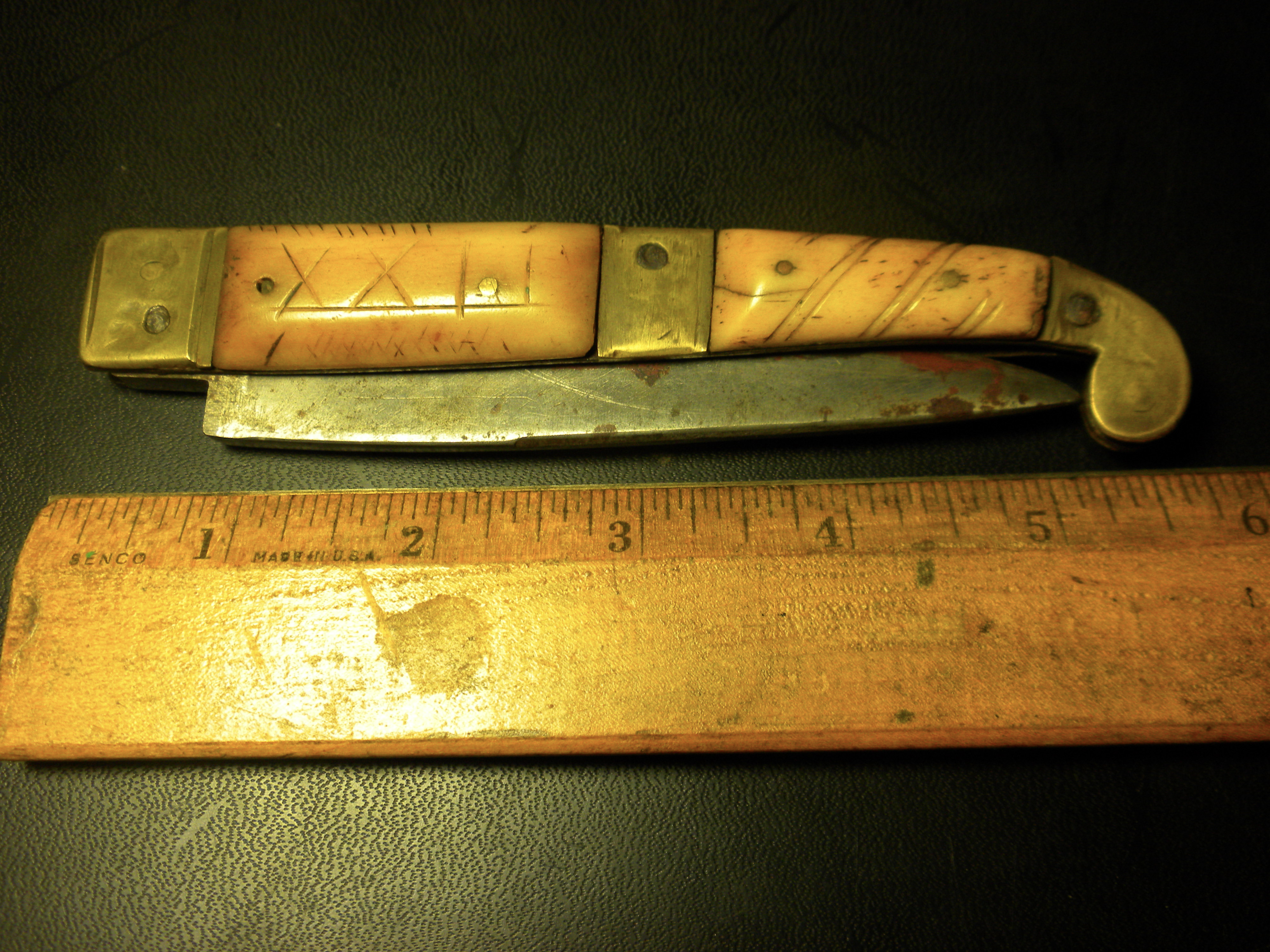


ANNE BOLEYN’S LETTER TO HENRY VIII

TRIBES

Anne Boleyn Letters

This is the letter that Anne Boleyn wrote to Henry VIII from the Tower of London, after her arrest. It is said to have been found in Thomas Cromwell’s belongings which probably means that it never made it into the hands of the King:-

Anne Boleyn in the Tower” Sir, your Grace’s displeasure, and my Imprisonment are Things so strange unto me, as what to Write, or what to Excuse, I am altogether ignorant; whereas you sent unto me (willing me to confess a Truth, and so obtain your Favour) by such a one, whom you know to be my ancient and professed Enemy; I no sooner received the Message by him, than I rightly conceived your Meaning; and if, as you say, confessing Truth indeed may procure my safety, I shall with all Willingness and Duty perform your Command.

But let not your Grace ever imagine that your poor Wife will ever be brought to acknowledge a Fault, where not so much as Thought thereof proceeded. And to speak a truth, never Prince had Wife more Loyal in all Duty, and in all true Affection, than you have found in Anne Boleyn, with which Name and Place could willingly have contented my self, as if God, and your Grace’s Pleasure had been so pleased. Neither did I at any time so far force my self in my Exaltation, or received Queenship, but that I always looked for such an Alteration as now I find; for the ground of my preferment being on no surer Foundation than your Grace’s Fancy, the least Alteration, I knew, was fit and sufficient to draw that Fancy to some other subject.

You have chosen me, from a low Estate, to be your Queen and Companion, far beyond my Desert or Desire. If then you found me worthy of such Honour, Good your Grace, let not any light Fancy, or bad Counsel of mine Enemies, withdraw your Princely Favour from me; neither let that Stain, that unworthy Stain of a Disloyal Heart towards your good Grace, ever cast so foul a Blot on your most Dutiful Wife, and the Infant Princess your Daughter:

Try me, good King, but let me have a Lawful Trial, and let not my sworn Enemies sit as my Accusers and Judges; yes, let me receive an open Trial, for my Truth shall fear no open shame; then shall you see, either mine Innocency cleared, your Suspicion and Conscience satisfied, the Ignominy and Slander of the World stopped, or my Guilt openly declared. So that whatsoever God or you may determine of me, your Grace may be freed from an open Censure; and mine Offence being so lawfully proved, your Grace is at liberty, both before God and Man, not only to execute worthy Punishment on me as an unlawful Wife, but to follow your Affection already settled on that party, for whose sake I am now as I am, whose Name I could some good while since have pointed unto: Your Grace being not ignorant of my Suspicion therein.

But if you have already determined of me, and that not only my Death, but an Infamous Slander must bring you the enjoying of your desired Happiness; then I desire of God, that he will pardon your great Sin therein, and likewise mine Enemies, the Instruments thereof; that he will not call you to a strict Account for your unprincely and cruel usage of me, at his General Judgement-Seat, where both you and my self must shortly appear, and in whose Judgement, I doubt not, (whatsover the World may think of me) mine Innocence shall be openly known, and sufficiently cleared.

My last and only Request shall be, That my self may only bear the Burthen of your Grace’s Displeasure, and that it may not touch the Innocent Souls of those poor Gentlemen, who (as I understand) are likewise in strait Imprisonment for my sake. If ever I have found favour in your Sight; if ever the Name of Anne Boleyn hath been pleasing to your Ears, then let me obtain this Request; and I will so leave to trouble your Grace any further, with mine earnest Prayers to the Trinity to have your Grace in his good keeping, and to direct you in all your Actions.

Your most Loyal and ever Faithful Wife, Anne Boleyn
From my doleful Prison the Tower, this 6th of May.


John West is one of my ancestors. John’s brother, Lord Thomas West, 3rd Lord De La Warr [Delaware], was the first Colonial Governor of Virginia from 1610 to 1611. John and brother Thomas were grandsons of William West, 1st Baron Delaware. Their grandmother, Catherine Carey, was a niece of Queen Ann Boleyn and first cousin to Queen Elizabeth.

On this May 2, 1536, Anne Boleyn, the second wife of England’s King Henry VIII, was arrested for high treason, adultery, and incest. She was intelligent and outspoken, and had educated opinions about politics and religious reform and came to the court of Henry VIII when she was 20 years old, to serve as lady-in-waiting to Queen Catherine of Aragon. She soon caught the eye of the king. For seven years he wooed her, and for seven years she put him off. He managed to get his first marriage annulled by breaking with the pope and declaring himself head of the Church of England and then Anne Boleyn consented to marry him.

Their early months of marriage were happy ones, and their first child, Elizabeth, was born in 1533. Anne had several miscarriages after that, and she never gave Henry the son he so desperately wanted, so he accused her of every capital offense he could think of: numerous affairs, incest with her brother, plotting his murder, and witchcraft. She was convicted and sentenced to death. The only mercy he showed her was in ordering that she be beheaded by a sword, rather than a common axe.


John West

********************************

Lord Thomas West m 19 Nov 1571 Ann Knollys

b 9 Jul 1557 Wherewell, Hampshire, England d 1601/02

[See addendum Lord Thomas West, Chapter 15, page 99]

Ann Knollys

********************************

Sir Francis Knollys Catherine Carey

b 1514

d 1601 d 1569

[See addendum Sir Francis Knollys, Chapter 16, page 101]

Catherine Carey

*********************************

Sir William Carey 1 m 4 Feb 1520 Mary Boleyn

Mary was sister to Anne Boleyn and cousin to Queen Elizabeth. Before her marriage to Sir William Carey, Mary was briefly mistress to King Henry VIII. After William Carey’s death, his sister-in-law, Anne Boleyn was appointed administrator of his estate by Henry VIII. She was given charge of his children as well, despite the fact that Mary was still alive and a grandfather and an uncle still lived who were quite capable of the task.2

Mary Boleyn Henry VIII

1 The descendants of Mary Boleyn, the sister of Queen Anne Boleyn, are now regarded as most likely the descendants of Henry VIII, not of William Cary, Mary’s husband. It was considered very bad form for a man to have sexual relations with his wife while he was being cuckolded by the King, so Catherine was likely the daughter of Henry VIII.

2   Encyclopedia Britannica

Mary Boleyn

**********************************

Sir Thomas Boleyn Elizabeth Howard

Thomas Boleyn, through his mother, Margaret Butler, had some claim to the Butler titles, one English and one Irish, but because of the Civil War between the Lancasters and the Yorks, these were the subject of dispute.

Mary’s sister Anne Boleyn was not a beautiful woman, but her charms led her to Henry. Her intention was to be Queen of England, but Henry’s marriage to Catherine stood in the way. Henry finally divorced his first wife and married Anne in January of 1533. The exact date is not known. Anne was a weak, petty woman with little in the way of stable character. In September of 1533 she gave birth to Elizabeth, later to become queen.

Anne fell into disfavor and was accused of having many court lovers. Her reputed lovers were executed one by one, and Anne was finally confined to the tower. On her way to the chopping block she protested her innocence. The case against her has never been proved. She regarded the prospect of her own death with levity, laughing heartily as she put her hands about her own neck and praised the skills of the executioner. The day after Anne was beheaded, Henry married Jane Seymour.