William Whitley and Me

cardboard-house-940x440

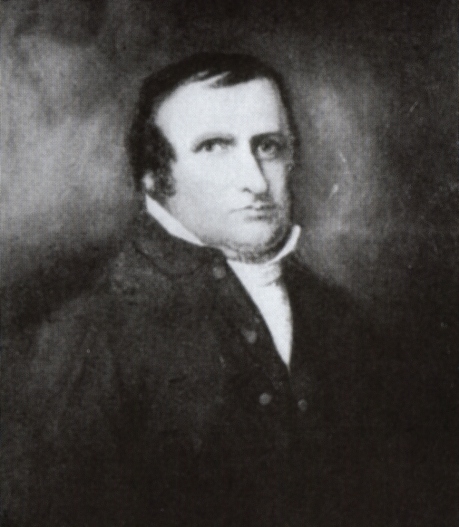
It was a cool September sometime around 1962. I had been playing and singing in London, Ontario, and decided to take a look for my great-grandfather’s graves and place of death to the south in lower Ontario. The relative that I was looking for was Colonel William Whitley. He was one of the first Kentucky pioneers in the days of Daniel Boone. He founded modern horse racing in the United States and made some of the first Kentucky sour mash whiskey. His recipe is still used by Evan Williams and Jack Daniels. He built the first brick home west of the Allegheny mountains as well, but his fame was that of an Indian fighter. The evidence is not conclusive, but eye-witness accounts point to Whitley as being the man who killed Tecumseh at the Battle of the Thames in lower Ontario during the War of 1812.

The death of Tecumseh sealed the fate of the organized Indian resistance to the settlement of the Northwest Territories, as Tecumseh was the leader of this cause. The movement fell apart upon his death. Tecumseh had partnered with the British who were seeking revenge, retribution, and a reclamation of the lands they lost by the success of the American Revolution.

Obviously, Whitley was an important man and I felt that I should try to locate his grave if possible, as he died there in battle and was buried on the battle site. What I did not know was the site was on a Canadian Indian reservation.

Soon after turning onto the gravel roads that led to the battle site a dozen cars filled with young teenagers from the reservation began to follow my car. I sped up.  So did they. When I tried to outrun them, they cut me off and surrounded my vehicle. They were drinking beer and feeling their power.

“What are you doing here? What is your business,” they wanted to know. One of them said. “We are not subject to the laws of Canada here. If we decide to kill you, there is nothing anyone can do about it. We have our own laws.”  He opened his jacket to reveal a nasty-looking pistol.

I quickly told them I was simply looking for the place my Grandfather was buried way back in 1814. “He died here in battle,” I said.

“Was he Indian?” was the response.

As a rule, I like to be truthful at all times, but this was obviously a time when telling the truth would be a very bad idea.

“Yes, he was,” I lied. “Do you know where the graveyard is located?”

“There is no graveyard. You look like a honky to me.”

“It’s been a lot of years. My bloodlines have been mixed since then. I even have some Irish in me,” I said. “English too,” I added, suddenly remembering their British ties of the past and their current status in the United Kingdom. I remember wondering why they still called it a United “Kingdom” when they had only a Queen with little political control over a loose federation in distant countries.

The teenager with the gun took his last swig from the beer can and tossed it to the side of the road. “We’ll let you go, but you take your white ass off this reservation and don’t come back. Follow us.”

He returned to the car and led the way. I followed and behind me was a parade of hostile teenagers.

Driving down the road, I had plenty of time to think about history and the present. Should I even be proud that my great grandfather helped take the lands from the natives? I asked myself. Should I be shocked that white men took native scalps as well in retaliation? How, I asked, is it possible to enjoy doing that?

Maybe they did not enjoy it, I told myself. Maybe they found it to be necessary. How much different was it than cutting off the chicken’s head for Sunday dinner or taking an ax to the cow or pig. Somebody has to do it. Yes, I knew there was a difference. We are talking about what people do to people—but when land gets scarce and populations grow, the natural laws take over and the population disperses.

“If someone else occupies the land, we can share it. There was plenty of land for the white man’s expansions, I thought.” The problem was, that the natives were there and they did not want to change their ways. They had no great architecture, only a few written works, and no literary or artistic record like the European invaders had. Watching the miles roll and the open country reveal itself, there seemed to be plenty of land for everyone even now. I could see how those pioneers who wanted the freedom to own their own land and harvest the fruits of their own sweat would feel about another group that tried to prevent them from doing just that. Tecumseh himself, and then the natives to the West, would all soon learn that the white men would come like swarms of locusts and eat up all the lands that sustained them. Both sides felt themselves to be morally right, as is the case in most disputes.

It was a crossroad in history. My grandfather lived it and I witnessed its effects, Even those who won did not win, as rural life would practically be wiped out within a few centuries and the land would be privately held by the richer and more productive among them.

I was at a loss as to what to do next. “Niagara Falls,” I thought to myself. I’ll go there instead.”

That decision turned out to be another story in itself.


COLONEL WILIAM WHITLEY

wmwhitley

Colonel William Whitley, born August 14, 1749, Augusta County, Virginia; died 5 October 1813 at the Battle of the Thames, Ontario, Canada.

William Whitley was a pioneer in Kentucky in the days of Daniel Boone. He was a tall man with light eyes, sandy hair, and a prominent aquiline nose. In the spring of 1775, accompanied by his brother-in-law, George Clark, Whitley made an expedition into the bowels of the Kentucky wilderness, selected a location on the banks of Dick’s River, and returned to Virginia for his family. He had married Esther Fullen sometime around 1770. She was born May 19, 1755, and was six years younger than he. After scouting the location near a branch of the Dix River called Cedar Creek, they returned to Virginia to prepare their families for a permanent relocation. The families left Virginia in November 1775.

At that time they had two small children, three-year-old Elizabeth (1772), and one-year-old Isabella (1774). Esther and the children rode the same horse, Elizabeth being strapped behind and Isabella carried in Esther’s arms. More than once Esther’s horse stumbled on the rugged terrain and the Whitley girls tumbled in a heap to the ground.

Upon their arrival, Whitley planted 10 acres of corn to establish his claim to the land. After the planting, Whitley and his family moved to the safety of the fort of St. Asaph’s (the present-day town of  Stanford, Kentucky), as Kentucky was still the native American’s hunting ground and attacks upon settlers were both frequent and violent.

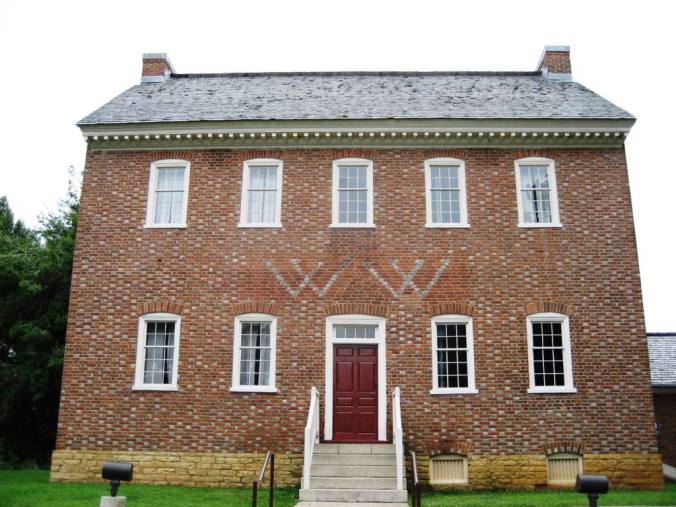
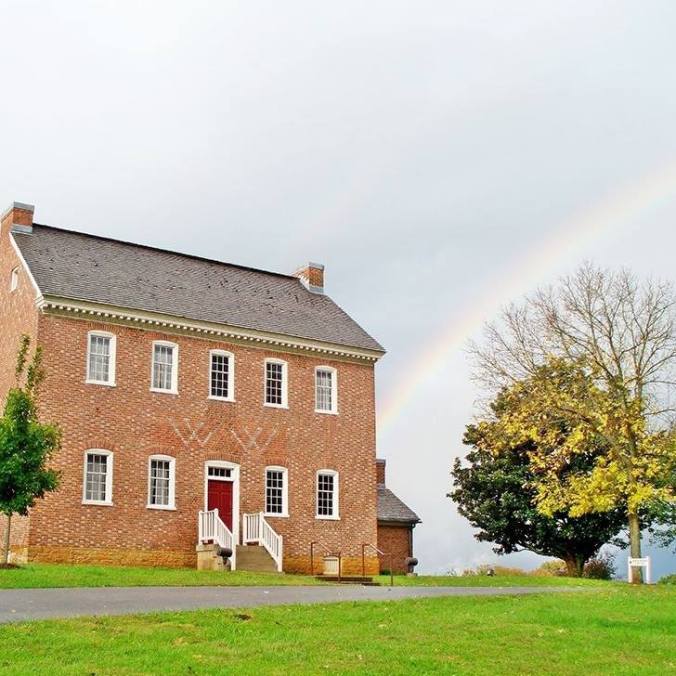
Most of the trip was made in November of 1775. Rain and snow were encountered often. The trip was quite difficult and took thirty-one days to accomplish. Whitley was one of early Kentucky’s most prominent leaders, taking the lead in subduing the Indians and mapping the frontier. He built the first brick house west of the Allegheny Mountains, a veritable mansion with glass painstakingly hauled by pack horses from Virginia. This feat is all the more remarkable considering it was a time when rude cabins and forts were the norms.

It is curious as to what motivated William to go to Kentucky in 1775. Winds of war were flaming fires in Virginia. The American Revolution was about to begin. Whitley, with his anti-British views, would certainly have fought in the Revolution. Perhaps he feared that the colonists would not win and Kentucky would be a safe haven to raise his family without British interference. Certainly, his courageous exploits as a soldier in Kentucky proved he had no fear of—nor moral objection to—war. Whitley was best known for being an Indian fighter. Politics he left to others. Perhaps he, the son of an Irish immigrant, had no use for the revolutionary politics.

By 1779, Whitley returned had for his family and permanently settled on the land he had claimed years earlier.

Whitley’s home was well-appointed and professionally designed. A handmade hardwood staircase had thirteen steps to symbolize the original colonies. An escape tunnel was dug in the case of Indian attacks. The windows were all set high enough to deter an attacker from climbing inside.

Whitley would scalp many natives during his career as a militia leader and frontiersman. He volunteered for service in George Rogers Clark‘s expedition against Indians in the Northwest Territory when the Ohio Territory was yet a wilderness settled by Native Americans.

4bwilliamwhitleyhouses-h-s-4housesiler

THE BATTLE OF THE THAMES

Whitley’s last battle was fought when he was sixty-four, during the War of 1812. The Indian confederation, under the leadership of Tecumseh, had joined with the British in a last-ditch effort to stop the ever-expanding white hordes. Whitley, despite his advanced age, answered Governor Shelby’s calls for volunteers, enlisting as a private in Richard Mentor Johnson’s Kentucky Volunteers.

While the main force was deployed to fight the British in lower Ontario, Johnson’s orders were to contain the Indians. Fearing an ambush, he sent out a small unit of twenty men ahead of the main force. This group was called “The Forlorn Hope”. At the head rode Colonel William Whitley. At the first volley, fifteen of the twenty were unhorsed. When the smoke had cleared, both Tecumseh and William Whitley were numbered among the slain.

It is possible, and perhaps it is so, that William Whitley killed Tecumseh at the exact moment that Tecumseh shot him. Some eyewitnesses to the battle claimed that was what happened. However, Richard M. Johnson rode to political fame on the claim that he was the slayer of the great Indian leader. Historians are uncertain, and the deed will be forever muddied in the waters of time. In his 1929 autobiography, Single Handed, James A Drain, Sr. gives a detailed account by Col. Whitley’s granddaughter in which Whitley and Tecumseh killed each other simultaneously.

Whitley was buried near the battleground, in Chatham, Ontario. His horse, Emperor, had one eye and two teeth shot out during the charge. Whitley’s powder horn and rifle were returned to his wife in Kentucky. The rifle is currently on display at the William Whitley House State Historic Site.

battle-thames-3

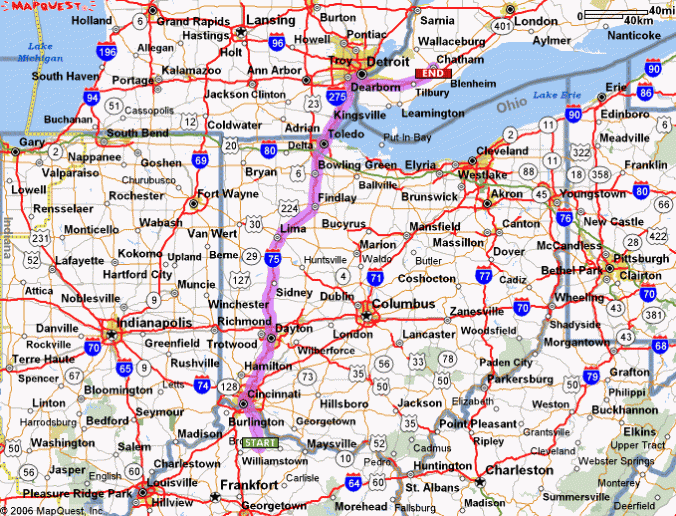
The route that was taken by the Kentucky Militia to the battle in Ontario.

Richard Mentor Johnson later became a Kentucky senator and Martin Van Buren’s vice president. He spent much of his career in debt, although he was able to mortgage properties and avoid prison. His constituents were not so lucky. The financial crisis of 1819 especially hurt farmers and many common people were sent to debtors’ prison. Senator Johnson was outraged, and on this day in 1821, he was responsible for outlawing debtors’ prisons in Kentucky, well ahead of the national curve. After Johnson’s 10-year crusade to end debtors’ prison on the national level, Congress enacted a federal statute in 1832. Johnson said in a speech on the Senate floor: “The principle is deemed too dangerous to be tolerated in a free government, to permit a man for any pecuniary consideration, to dispose of the liberty of his equal.” Bankruptcy protection replaced debtors’ prisons.

13641111_1179899395385394_2565236089948393403_o

Sportsman Hill, the first circular racetrack in the United States.

Whitley called his home Sportsman’s Hill. It was there that he built the first circular race track in the United States. He instituted several racing traditions that changed horse racing in the USA forever. He built the first clay track. Tracks had been turf before Whitley. Being solidly anti-British, he ran his races counterclockwise, as it was the British custom to run them clockwise. American race tracks still run counterclockwise.

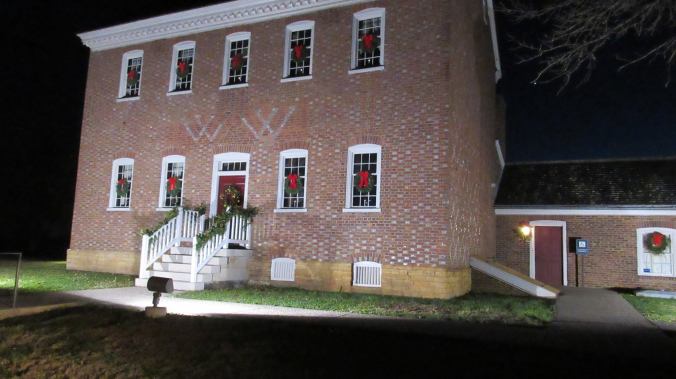
The William Whitley House still stands near Crab Orchard as a Kentucky State Monument and museum.

13615172_1179898435385490_3553319407914075969_n

William and Esther Whitley had eleven children, all of whom survived to maturity.

1. Elizabeth (Mrs. Robert Stevenson) b Virginia about 1830.

2. Isabella (Mrs. Phillip Sublette), b Virginia about 1774, d Kentucky 
about 1820.

Phillip and Isabella's first born son, William, was the famous mountain 
man and fur trader, Bill Sublette, who rose to fame in the far west and 
has vast sections of Wyoming named for him.

3. Levisa (Mrs. James McKinney), b Harrodsburg, KY Feb 24, 1777. Moved to Missouri.

4. Solomon, b Kentucky 1770, moved to Missouri.

5. William, b Kentucky, Apr 20. 1782, d Lincoln Co., KY Aug 23, 1849.

6. Andrew, b Kentucky 1784, d Lincoln Co. 1844.

7. Esther (Mrs. Samuel Lewis), b 1786, d Woodford County. 1815.

8. Mary (called Polly), (Mrs. James Gilmour), b Kentucky 1788, moved to 
Illinois, later to Colorado and Oregon

9. Nancy (Mrs. John Owlsey), b 1790, d prior to 1820 near Crab Orchard.

10. Sally (Mrs. Henley Middleton), b 1792, d 1845 near Crab Orchard.

11. Ann (Mrs. William Harper), b 1795, d Woodford Co., Ky after 1879.

William Whitley was the son of Solomon Whitley and Elizabeth Barnett, 
immigrants from Ireland, who settled in Augusta County, Virginia. He was the oldest of four sons and is thought to have had five sisters as well.
William Whitley was killed at the Battle of the Thames, Lower Ontario, 
Oct 5, 1813. His wife, Esther died at the home of her daughter, Ann Harper, in Woodford County, Kentucky, Nov 20, 1833

SOURCE: The Draper MS. 9 CC 5, 12-13, State Historical Society of Wisconsin. Family Bible of William Whitley, Jr. Filson Club, Louisville, KY.

[My personal connection to this family is through #8, Mary (called Polly).She married  James Gilmour, b Kentucky 1788, moved to Illinois, later to Colorado and Oregon. Polly’s son, William Whitley Gilmour was the father of Hedron Walker Gilmour, my grandfather on my mother’s side. The famed mountain man William Sublette was also a grandson of William Whitley.]


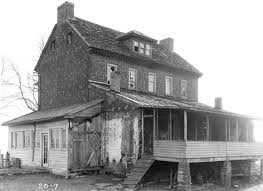
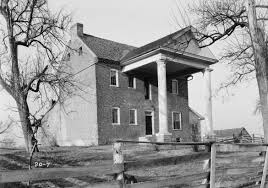
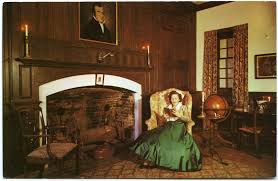
The home went through many changes over the years before the State of Kentucky took possession and restored it as a museum and historical park.

images-1    images-2

images

15403874_1362611730447492_1484140698399166217_o

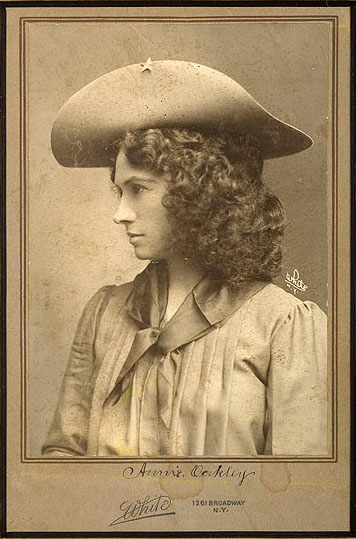
“ANNIE GET YOUR GUN” IN RETROSPECT

ao-photo1

The musical “Annie Get Your Gun” has a interesting and turbulent history. The idea for the musical occurred to Dorothy Fields, the daughter of a Polish immigrant named Lew Fields who worked in vaudeville and became a respected and successful Broadway producer.

Dorothy Fields was a lyricist who wrote the words to such songs as “I Can’t Give You Anything But Love” and “The Sunny Side of the Street” with composer Jimmy McHugh.

Her work with Jerome Kern produced the successful song “Lovely to Look At.” They worked together again on “The Way You Look Tonight: which earned an Academy Award for best original song in 1936.

In 1935, the movie “Annie Oakley” starring Barbara Stanwyck came out based on the story by Dorothy Fields’ brother, Joseph Fields. Soon Dorothy became interested in seeing Annie’s story become a musical that would star her friend Ethel Merman. Mike Todd turned her script down, so she approached Richard Rogers and Oscar Hammerstein II who were freshly invigorated with the success of their musical “Oklahoma” . Rogers and Hammerstein had decided to become producers of both their own works and the works of others. They agreed to produce the musical and asked Jerome Stern to create the music. Dorothy Fields would do the lyrics and she would write the book with her brother Joseph who would later write “Gentlemen Prefer Blondes” and “The Flower Drum Song”, among many other famous screenplays.

This selection began the rocky path that eventually led to “Annie Get Your Gun”. Kern collapsed from a stroke and died in 1945. Rogers and Hammerstein had to replace Kern, so they asked Irving Berlin to step in and take over the play. Knowing that Irving Berlin wrote both the music and words, Dorothy Fields stepped down as lyricist, but Berlin was not certain that he could write the songs that had to fit into a specific scene in the show. Oscar Hammerstein convinced him to try anyway, so Berlin came back with the songs “Doin’ What Comes Naturally”, “You Can’t Get a Man With a Gun” and “There’s No Business Like Show Business.”  Berlin mistakenly did not think that Richard Rogers liked the show business song and dropped it from the libretto. However, during the development of the show, the song was added back and has become a timeless classic.

Ethel Merman played Annie on Broadway and in three years missed only three performances.

The musical was a great hit, It started on Broadway in 1946 and ran for 1147 performances. It had more hits songs than any other Broadway play and was Irving Berlin’s greatest success.

When the time came to make a movie of “Annie Get Your Gun”, Dorothy’s friend Ethel Merman was not even considered for the movie by MGM. Though Doris Day and Judy Canova wanted the part, MGM wanted Judy Garland for the lead role. MGM producer Arthur Freed had paid $650,000 to Irving Berlin for the movie rights just to cast Garland into the title role. Garland shot some scenes as the lead actress, so MGM thought they could bring in an unknown to play Frank Butler. Both John Raitt and Howard Keel auditioned for the role, but Keen got the part. The director, Busby Berkeley insisted that Keel ride his horse on the set over a slick floor, and on the second day of shooting, Keel broke his leg while they were shooting by falling off his horse on the set. They had to shoot close-ups of Keel and Judy Garland was offended that the unknown actor was getting so much attention. Judy was having severe problems with drugs and alcohol addictions as well. Freed eventually fired Busby and brought in Charles Walters who had successfully directed Garland in “Easter Parade”. Judy Garland was convinced that she could not get the performance right after watching the rushes. She could not conquer her addictions nor get to the set on time. MGM felt they had no choice but to fire her. Since Garland was a superstar at the time, firing her was something no one expected. Garland went into a mental hospital and the movie was put on hold.

To add to the confusion, Frank Morgan (the Wizard in “The Wizard of Oz”) was playing Buffalo Bill. He suddenly died in the middle of the film. Only a few shots could be saved from the production. George Sydney suddenly replaced Charles Walters as the director by orders from MGM. They basically had to start all over again with the film, this time with Betty Hutton in the lead role.

The movie had good box office success, but Betty Hutton did not get the best of reviews when compared to the original Broadway role played by Ethel Merman. A dispute between the Irving Berlin estate and MGM kept the film out of circulation from 1973 to 2000. By that time. Merman’s performance was history and Hutton was accepted. A new production with Bernadette Peters and Reba McIntire brought Annie back to a new generation.

The hit songs generated by “Annie Get Your Gun” are quite staggering. Few musicals, have come close to the mass appeal of the songs in this production.

YOU CAN’T GET A MAN WITH A GUN

Written by Irving Berlin

Performed by Betty Hutton

DOIN’ WHAT COMES NATUR’LLY

Written by Irving Berlin

Performed by Betty Hutton

I’M AN INDIAN TOO

Written by Irving Berlin

Performed by Betty Hutton

I GOT THE SUN IN THE MORNING

Written by Irving Berlin

Performed by Betty Hutton

ANYTHING YOU CAN DO

Written by Irving Berlin

Performed by Betty Hutton and Howard Keel

THEY SAY IT’S WONDERFUL

Written by Irving Berlin

Performed by Betty Hutton and Howard Keel

THERE’S NO BUSINESS LIKE SHOW BUSINESS

Written by Irving Berlin

Performed by Ensemble

COLONEL BUFFALO BILL

Written by Irving Berlin

Performed by Chorus

MY DEFENSES ARE DOWN

Written by Irving Berlin

Performed by Howard Keel

THE GIRL THAT I MARRY

Written by Irving Berlin

Performed by Howard Keel

THE FIRST WOMAN CANDIDATE FOR U.S. PRESIDENT: VICTORIA WOODHULL

Major Source: https://en.wikipedia.org/wiki/Victoria_Woodhull
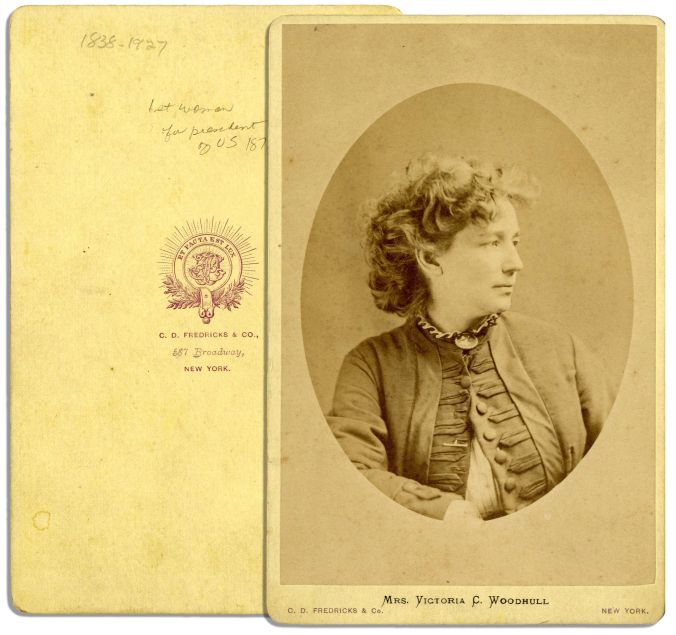
Victoria-Woodhull-by-CD-Fredericks,-c1870

Victoria Woodhull by CD Fredericks. circa 1870


Victoria Woodhull was the first woman to run for President of the United States in 1872. An activist for women’s rights and labor reforms, Woodhull was also an advocate of free love. She believed women should be free to to marry, divorce, and bear children without government interference.

Woodhull was politically active in the early 1870s, when she was nominated as the first woman candidate for the United States presidency, for which she is best known.

Woodhull was the 1872 candidate for the Equal Rights Party, who supported women’s suffrage and equal rights. She was arrested on obscenity charges a few days before the election, for publishing an account of the alleged adulterous affair between the prominent minister Henry Ward Beecher and Elizabeth Tilton. This bit of red meat added to the sensational coverage of her candidacy. Though she was on the ticket, she did not receive any electoral votes, and there is conflicting evidence about popular votes.
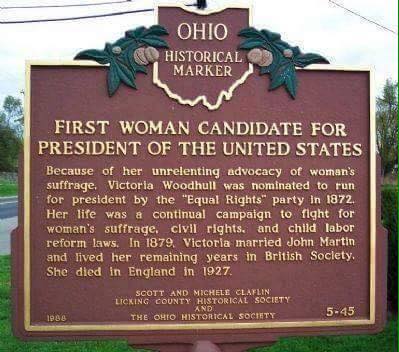
 

LICKING CO, OH SIGN WOODHULL

Licking County, Ohio Historical Sign

EARLY LIFE AND EDUCATION

Born Victoria California Claflin, she was the seventh of ten children (six of whom survived to maturity),in the rural frontier town of Homer, Licking County, Ohio.

“Her mother, Roxanna “Roxy” Hummel Claflin, was illegitimate and illiterate. She had become a follower of the Austrian mystic Franz Mesmer and the new spiritualist movement. Her father, Reuben “Old Buck” Buckman Claflin,  was a con man and snake oil salesman. He came from an impoverished branch of the Massachusetts-based Scots-American Claflin family, semi-distant cousins to Governor William Claflin. -Wikipedia

When seven years old, Victoria was accused of burning down a cupola.

She was beaten, starved and sexually abused by her father when still very young.

She believed in spiritualism – she referred to “Banquo’s Ghost” from Shakespeare‘s Macbeth – because it gave her belief in a better life. She said that she was guided in 1868 by Demosthenes to what symbolism to use supporting her theories of Free Love.

By age 11, Woodhull had only three years of formal education, but her teachers found her to be extremely intelligent. She was forced to leave school and home with her family when her father, after having “insured it heavily,” burned the family’s rotting gristmill. When he tried to get compensated by insurance, his arson and fraud were discovered; he was run off by a group of town vigilantes.  The town held a “benefit” to raise funds to pay for the rest of the family’s departure from Ohio.

FREE LOVE  
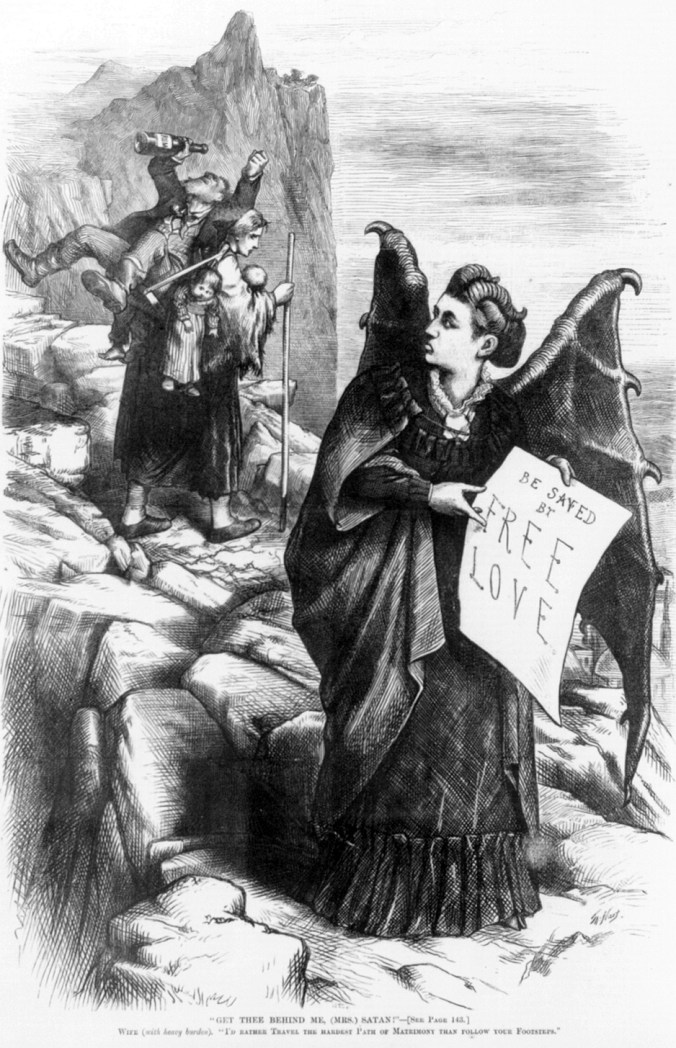
Victoria_Woodhull_caricature_by_Thomas_Nast_1872

VICTORIA WOODHULL caricature by Thomas Nash, 1872.

Woodhull’s support of free love likely started after she discovered the infidelity of her first husband Canning Woodall. Shortly after their marriage she learned that her new husband was an alcoholic and a womanizer.

Women who married in the United States during the 19th century were bound to their unions, even if loveless, with few options to escape. Divorce was limited by law and considered socially scandalous. Women who divorced were stigmatized and often ostracized by society. Victoria Woodhull concluded that women should have the choice to leave unbearable marriages.

Woodhull believed in monogamous relationships, although she also said she had the right to change her mind: the choice to make love or not was in every case the woman’s choice (since this would place her in an equal status to the man, who had the capacity to rape and physically overcome a woman, whereas a woman did not have that capacity with respect to a man).[17]

Woodhull said: “To woman, by nature, belongs the right of sexual determination. When the instinct is aroused in her, then and then only should commerce follow. When woman rises from sexual slavery to sexual freedom, into the ownership and control of her sexual organs, and man is obliged to respect this freedom, then will this instinct become pure and holy; then will woman be raised from the iniquity and morbidness in which she now wallows for existence, and the intensity and glory of her creative functions be increased a hundred-fold . . .”

In this same speech, which became known as the “Steinway speech,” delivered on Monday, November 20, 1871 in Steinway Hall, New York City, Woodhull said of free love: “Yes, I am a Free Lover. I have an inalienable, constitutional and natural right to love whom I may, to love as long or as short a period as I can; to change that love every day if I please, and with that right neither you nor any law you can frame have any right to interfere.”

Woodhull railed ag
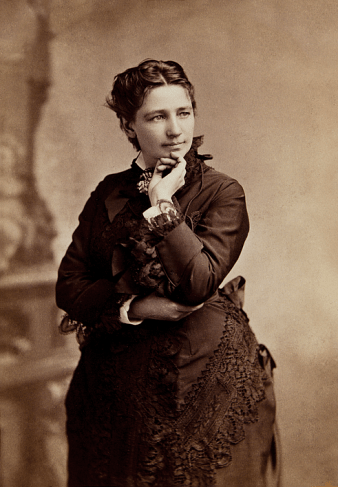
Victoria-Woodhull-by-Bradley-&-Rulofson

Victoria Woodhull by Bradley and Rulofson

ainst the hypocrisy of society’s tolerating married men who had mistresses and engaged in other sexual dalliances. In 1872, Woodhull publicly criticized well-known clergyman Henry Ward Beecher for adultery. Beecher was known to have had an affair with his parishioner, Elizabeth Tilton, who had confessed to it, and the scandal was covered nationally. Woodhull was prosecuted on obscenity charges for sending accounts of the affair through the federal mails, and was briefly jailed. This added to sensational coverage during her campaign that fall for the United States presidency.


PRESIDENTIAL CANDIDATE 

Woodhull announced her candidacy for President by writing a letter to the editor of the New York Herald on April 2, 1870.

Woodhull was nominated for President of the United States by the newly formed Equal Rights Party on May 10, 1872, at Apollo Hall, New York City. A year earlier, she had announced her intention to run. Also in 1871, she spoke publicly against the government being composed only of men; she proposed developing a new constitution and a new government. Her nomination was ratified at the convention on June 6, 1872. They nominated the former slave and abolitionist leader Frederick Douglass for Vice President. He did not attend the convention and never acknowledged the nomination. He served as a presidential elector in the United States Electoral College for the State of New York. This made her the first woman candidate.

While many historians and authors agree that Woohull was the first woman to run for President of the United States, some have questioned that priority given issues with the legality of her run. They disagree with classifying it as a true candidacy because she was younger than the constitutionally m
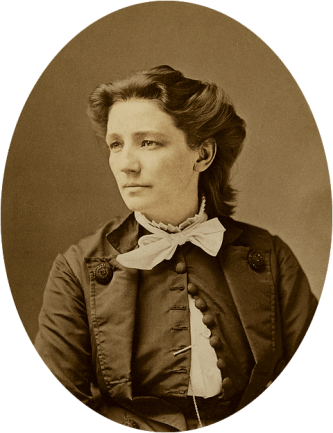
Victoria_Woodhull_by_Mathew_Brady_c1870

Victoria Woodhull by Mathew Brady, c1870

andated age of 35. However, election coverage by contemporary newspapers does not suggest age was a significant issue. The presidential inauguration was in March 1873. Woodhull’s 35th birthday was in September 1873.

Woodhull’s campaign was also notable for the nomination of Frederick Douglass, although he did not take part in it. His nomination stirred up controversy about the mixing of whites and blacks in public life and fears of miscegenation (especially as he had married a much younger white woman after his first wife died).

Frederick Douglass, the famed civil rights activist, was nominated to be her vice president, though he never acknowledged or accepted the nomination publicly. But while historians look back as Woodhull’s nomination as an historic first, her long-shot candidacy caused her serious trouble as soon as the nominating convention was over, Richman and Freemark report.

“As a result of the notoriety of the nomination, Woodhull was evicted from her home and she had some trouble making ends meet,” [biographer Amanda] Frisken tells [reporters Joe] Richman and [Samara] Freemark. Woodhull’s family was forced to sleep in her brokerage office for a period of time, as New York landlords were unwilling to rent to her, Kate Havelin writes in her book, Victoria Woodhull: Fearless Feminist. Woodhull’s 11-year-old daughter, Zula, meanwhile, had to leave her school as other parents didn’t want Zula to influence their children.

The Equal Rights Party hoped to use the nominations to reunite suffragists with African-American civil rights activists, as the exclusion of female suffrage from the Fifteenth Amendment two years earlier had caused a substantial rift between the groups
Having been vilified in the media for her support of free love, Woodhull devoted an issue of Woodhull & Claflin’s Weekly (November 2, 1872) to an alleged adulterous affair between Elizabeth Tilton and Reverend Henry Ward Beecher, a prominent Protestant minister in New York (he supported female suffrage but had lectured against free love in his sermons). Woodhull published the article to highlight what she saw as a sexual double-standard between men and women.

JAILED BEFORE CONVENTION

That same day, a few days before the presidential election, U.S. Federal Marshals arrested Woodhull, her second husband Colonel James Blood, and her sister Tennie C. Claflin on charges of “publishing an obscene newspaper” because of the content of this issue.[32] The sisters were held in the Ludlow Street Jail for the next month, a place normally reserved for civil offenses, but which contained more hardened criminals as well.

The arrest was arranged by Anthony Comstock, the self-appointed moral defender of the nation at the time. Opponents raised questions about censorship and government persecution. The three were acquitted on a technicality six months later, but the arrest prevented Woodhull from attempting to vote during the 1872 presidential election. With the publication of the scandal, Theodore Tilton, the husband of Elizabeth, sued Beecher for “alienation of affection.” The trial in 1875 was sensationalized across the nation, and eventually resulted in a hung jury.

Woodhull again tried to gain nominations for the presidency in 1884 and 1892. Newspapers reported that her 1892 attempt culminated in her nomination by the “National Woman Suffragists’ Nominating Convention” on 21 September. Mary L. Stowe of California was nominated as the candidate for vice president. The convention was held at Willard’s Hotel in Boonville, New York, and Anna M. Parker was its president. Some woman’s suffrage organizations repudiated the nominations, however, claiming that the nominating committee was unauthorized. Woodhull was quoted as saying that she was “destined” by “prophecy” to be elected president of the United States in the upcoming election.

VIEWS ON ABORTION AND EUGENICS

Her opposition to abortion is frequently cited by opponents of abortion when writing about first wave feminism. The most common Woodhull quotations cited by opponents of abortion are:  “the rights of children as individuals begin while yet they remain the fetus.”

“Every woman knows that if she were free, she would never bear an unwished-for child, nor think of murdering one before its birth.” 

One of her articles on abortion not often cited by opponents of abortion is from the September 23, 1871 issue of the Woodhull & Claflin’s Weekly. She wrote: “Abortion is only a symptom of a more deep-seated disorder of the social state. It cannot be put down by law… Is there, then, no remedy for all this bad state of things? None, I solemnly believe; none, by means of repression and law. I believe there is no other remedy possible but freedom in the social sphere.”

Woodhull also promoted eugenics which was popular in the early 20th century prior to World War II. Her interest in eugenics might have been motivated by the profound intellectual impairment of her son. She advocated, among other things, sex education, “marrying well,” and pre-natal care as a way to bear healthier children and to prevent mental and physical disease. Her writings demonstrate views closer to those of the anarchist eugenists, rather than the coercive eugenists like Sir Francis Galton.

In 2006, publisher Michael W. Perry claimed in his book “Lady Eugenist” that Woodhull supported the forcible sterilization of those she considered unfit to breed. He based his claim on a New York Times article from 1927 in which she concurred with the ruling of the case Buck v. Bell. Whether the article accurately stated her views or not, it stands in stark contrast to her earlier works in which she advocated social freedom and opposed government interference in matters of love and marriage.

Other women, including Belva Lockwood, have launched runs for the presidency since, but nearly a century passed between Woodhull’s run and the first woman to vie for the nomination of a major party. Maine Sen. Margaret Chase Smith tried in vain for the Republican nomination in 1964; New York Rep. Shirley Chisholm tried for the Democratic nomination in 1972, as did Rep. Patsy Mink from Hawaii. In more recent years, Colorado Rep. Patricia Schroeder, cabinet secretary and later North Carolina Sen. Elizabeth Dole, Illinois Sen. Carol Moseley Braun, and Minnesota Rep. Michele Bachman would compete for the nomination of the Republican or Democratic parties. It is, when one thinks about it, astonishing that a woman, in a country in which women are the majority of voters, has never been the nominee of either major party. And in 2016, with some 20 competitors for the Republican nomination, all but one—extreme long shot Carly Fiorina—are men.

Read more: http://www.politico.com/magazine/story/2015/04/victoria-woodhull-first-woman-presidential-candidate-116828#ixzz4FxD3FuAS

ADDITIONAL SOURCES:

Felsenthal, Carol. “The Strange Tale of the First Woman to Run for President.” Politico.   5 April 2015.

Greenspan, Jesse: “9 Things You Should Know About Victoria Woodhull.”

History.   23 September 2013.

LaGanga, Maria L: “Women Who Ran Before Hillary Clinton: ‘I Cannot Vote, But I Can Be Voted For.'” The Guardian. 8 June 2016.

Lewis, Danny: “Victoria Woodhull Ran for President Before Women Had the Right to Vote.” Smithsonian SmartNews. 10 May 2016.

REFERENCES:

1 Kemp, Bill (2016-11-15). “‘Free love’ advocate Victoria Woodhull excited Bloomington”. The Pantagraph. Retrieved 2016-04-13.

The Revolution, a weekly newspaper founded by Susan B. Anthony and Elizabeth Cady Stanton, had begun publication two years earlier in 1868.

Goldsmith, Barbara (1998). Other Powers. Alfred A. Knopf. p. 20. ISBN 0394555368.

1850 federal census, Licking, Ohio; Series M432, Roll 703, Page 437; father listed as Buckman, brothers incorrectly transcribed as Hubern (Hubert) and Malven (Melvin).

Wight, Charles Henry, Genealogy of the Claflin Family, 1661–1898. New York: Press of William Green. 1903. passim (use index)

Gabriel, Mary (1998). Notorious Victoria. Algonquin Books of Chapel Hill. p. 12. ISBN 1-56512-132-5.

“Ohio, County Marriages, 1789-2013, index and images, FamilySearch “Marriage records 1849-1854 vol 5 > image 273 of 334; county courthouses, Ohio”. familysearch.org. Retrieved 2015-06-09.

Underhill, Lois Beachy (1996). The Woman Who Ran for President: The Many Lives of Victoria Woodhull. Penguin Books. p. 24. ISBN 0-14-025638-5.

“Woodhull, Zula Maude”. Who’s Who. 59: 1930. 1907.

Dubois and Dumenil, //Through Women’s Eyes: An American History with Documents//. (Bedford; St. Martin’s, 2012)

Andrea Dworkin (1987). Intercourse,Chapter 7: “Occupation/Collaboration”.

“And the truth shall make you free.” A speech on the principles of social freedom, delivered in Steinway hall, Nov. 20, 1871, by Victoria C. Woodhull, pub. Woodhull & Claflin, NY, NY 1871. [1]

Speech is discussed and linked to also in Shearer, Mary L. “Abandoned Woman? A Review of the Evidence.” http://www.victoria-woodhull.com/prostitute.htm

DuBois and Dumenil. //Through Women’s Eyes: An American History with Documents//. (Bedford; St Martin’s, 2012)

Shearer, Mary L. “Frequently Asked Questions about Victoria Woodhull.” http://www.victoria-woodhull.com/faq.htm#who

Constitutional equality. To the Hon. the Judiciary committee of the Senate and the House of representatives of the Congress of the United States … Most respectfully submitted. Victoria C. Woodhull. Dated New York, January 2, 1871

Susan Kullmann, “Legal Contender… Victoria C. Woodhull, First Woman to Run for President”. Accessed 2009.05.29.

Messer-Kruse, Timothy (1998). The Yankee International: Marxism and the American Reform Tradition, 1848–1876. pp. 2–4.

“Notes on the “American split””. May 28, 1872. Retrieved 2010-08-05.

A Lecture on Constitutional Equality, also known as The Great Secession Speech, speech to Woman’s Suffrage Convention, New York, May 11, 1871, excerpt quoted in Gabriel, Mary, Notorious Victoria: The Life of Victoria Woodhull, Uncensored (Chapel Hill, N.Car.: Algonquin Books of Chapel Hill, 1st ed. 1998 (ISBN 1-56512-132-5)), pp. 86–87 & n. [13] (author Mary Gabriel journalist, Reuters News Service). Also excerpted, differently, in Underhill, Lois Beachy, The Woman Who Ran for President: The Many Lives of Victoria Woodhull (Bridgehampton, N.Y.: Bridge Works, 1st ed. 1995 (ISBN 1-882593-10-3)), pp. 125–126 & unnumbered n.

“Arrest of Victoria Woodhull, Tennie C. Claflin and Col. Blood. They are Charged with Publishing an Obscene Newspaper.”. New York Times. November 3, 1872. Retrieved 2008-06-27. “The agent of the Society for the Suppression of Obscene Literature, yesterday morning, appeared before United States Commissioner Osborn and asked for a warrant for the arrest of Mrs. Victoria C. Woodhull and Miss Tennie …”

Woodhull & Claflin’s Weekly (1870)

Wheeling, West Virginia Evening Standard (1875)

“Victoria Martin, Suffragist, Dies. Nominated for President of the United States as Mrs. Woodhull in 1872. Leader of Many Causes. Had Fostered Anglo-American Friendship Since She Became Wife of a Britisher …”. New York Times. June 11, 1927. Retrieved 2008-06-27.
 

FUN FACTS ABOUT NURSERY RHYMES

TWINKLE, TWINKLE LITTLE STAR

Unknown

The joint authors of Twinkle twinkle little star were two sisters called Ann Taylor (1782-1866) and Jane Taylor (1783-1824). The first publication date was 1806. How many of us know all the words?

Twinkle twinkle little star, how I wonder what you are?
Up above the world so high , like a diamond in the sky
When the blazing sun is gone, when he nothing shines upon,
Then you show your little light, twinkle, twinkle all the night.

Then the traveller in the dark, thanks you for your tiny spark,
He could not see which way to go, if you did not twinkle so.
In the dark blue sky you keep, and often through my curtains peep,
For you never shut your eye, ’till the sun is in the sky.
As your bright and tiny spark lights the traveller in the dark,
Though I know not what you are — twinkle, twinkle little star.


WHO KILLED COCK ROBIN?

Unknown-2

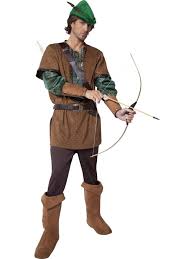
The origin of the “Who killed cock robin” poem: ‘Who killed cock robin?’ Not really a nursery rhyme, this is best described as an English folk song or poem. The words of “Who killed cock robin” are said to refer to the death of the legendary figure of Robin Hood and not that of a bird.

The legend of Robin Hood encompasses the theme that he stole from the rich to give to the poor. The words of “Who killed cock robin” describe how help was offered from all quarters following the death of cock robin thus reflecting the high esteem in which Robin was held by the common folk.

“Who killed Cock Robin?” “I,” said the Sparrow,
“With my bow and arrow, I killed Cock Robin.”
“Who saw him die?” “I,” said the Fly,
“With my little eye, I saw him die.”
“Who caught his blood?” “I,” said the Fish,
“With my little dish, I caught his blood.”
“Who’ll make the shroud?” “I,” said the Beetle,
“With my thread and needle, I’ll make the shroud.”
“Who’ll dig his grave?” “I,” said the Owl,
“With my pick and shovel, I’ll dig his grave.”
“Who’ll be the parson?” “I,” said the Rook,
“With my little book, I’ll be the parson.”
“Who’ll be the clerk?” “I,” said the Lark,
“If it’s not in the dark, I’ll be the clerk.”
“Who’ll carry the link?” “I,” said the Linnet,
“I’ll fetch it in a minute, I’ll carry the link.”
“Who’ll be chief mourner?” “I,” said the Dove,
“I mourn for my love, I’ll be chief mourner.”
“Who’ll carry the coffin?” “I,” said the Kite,
“If it’s not through the night, I’ll carry the coffin.”
“Who’ll bear the pall? “We,” said the Wren,
“Both the cock and the hen, we’ll bear the pall.”
“Who’ll sing a psalm?” “I,” said the Thrush,
“As she sat on a bush, I’ll sing a psalm.”
“Who’ll toll the bell?” “I,” said the bull,
“Because I can pull, I’ll toll the bell.”
All the birds of the air fell a-sighing and a-sobbing,
When they heard the bell toll for poor Cock Robin.


RAIN. RAIN, GO AWAY

Unknown-1

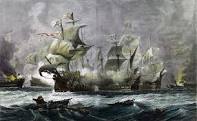
The origin of the lyrics to “Rain rain go away” dates back to the reign of Queen Elizabeth I (1533-1603). During this period in English history there was constant rivalry between Spain and England eventually leading to the launch of the Spanish Armada in 1588.

Once again, most of us know only part of the older poem. When rhe Spanish Armada was sent to invade England.  The attempt failed, not only because of the swifter nature of the smaller English ships but also by the stormy weather which scattered the Armada fleet. Hence the origin of the “Rain rain go away” Nursery rhyme!

Rain rain go away,
Come again another day.
Little Johnny wants to play;
Rain, rain, go to Spain,
Never show your face again!


BANBURY CROSS (RIDE A COCK HORSE)


037187_73abfc8c

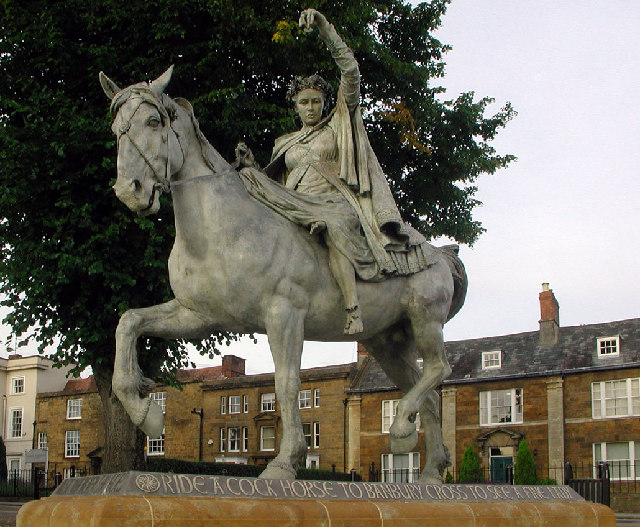
Ride a cock horse to Banbury Cross
To see a fine lady upon a white horse
With rings on her fingers and bells on her toes
She shall have music wherever she goes.


Stallions were called ‘cock’ horses in old England. The reason is obvious to horse people. They say this rhyme is about Elizabeth I who went to Banbury to see the newly erected stone cross. The rings on her fingers anb bells on her toes refer to the Plantagenet dynasty custom of attaching bells to their pointed shoes. Banbury Cross was located at the top of a steep hill. The Queen’s carriage broke a wheel. so Elizabeth chose to get on the white cock horse to make the trip. The people celebrated her arrival with ribbons and hired minstrels to accompany her on her visit, so she had music wherever she went.


QUEEN ISABELLA, THE SHE-WOLF OF ENGLAND

Ken Finton's avatarKenneth Harper Finton

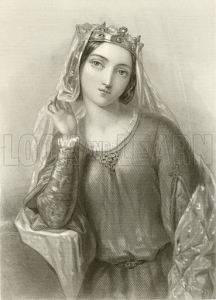
Isabella of Angouleme, queen of king John

 Queen Isabella was ripe for romance. She was a passionate woman in her late twenties, a striking beauty with plaited blonde hair. Furthermore, she had endured the loveless marriage with Edward since she was thirteen.

Roger de Mortimer, 8th Baron of Wigmore, was serving a life sentence in the Tower. His hair had grown long, his cheeks pale, and his eyes glowed with desperation. One glance at the handsome prisoner was enough to strike romantic interest in Isabella. It is not difficult to believe that the queen, her emotions stirred by the prisoner’s dark eyes, had made an opportunity to see him.

On the night of August 1 it was customary for the prison guards to celebrate the feast of St. Peter with food and drink. This time, the drink was drugged by the sub-lieutenant of the guards, Alspaye. When all the guards had fallen into a stupor, Mortimer dug…

View original post 1,374 more words

BEAR’S MILL

IMG_2398

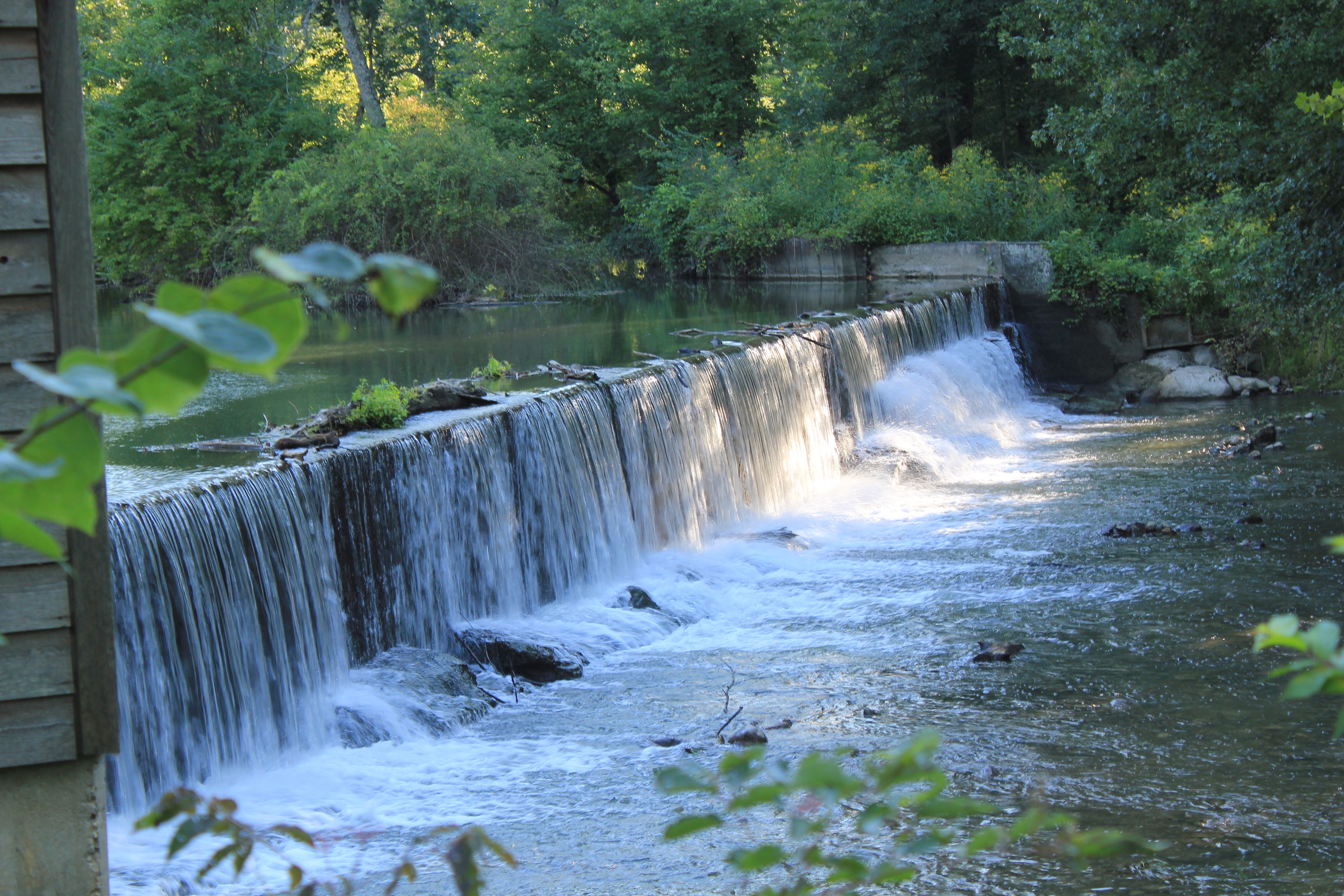
When I was a child I lived about twelve miles from Bear’s Mill. In the  summer I would occasionally ride my bike down the gravel backroads that led from my home to the mill. I would spend some time sticking my hot feet in the  cool waters and watching the waters fall hypnotically over the dam.

IMG_2403

At that time, the mill was still a working mill run by a miller that got to know me and my bike from the frequent trips I made. I had one of the first thin-tired Schwinn bikes with three gears in the county. They were called English bikes at the time. The narrow tires made the bike hard to control on the graveled roads.

I know that 99.9% of the people will never get to Bear’s Mill. It matters little, as it is worth knowing about. That is why I write this. I will probably never get to the pyramids, but I still find them of great and abiding interest.

BEAR'S MILL

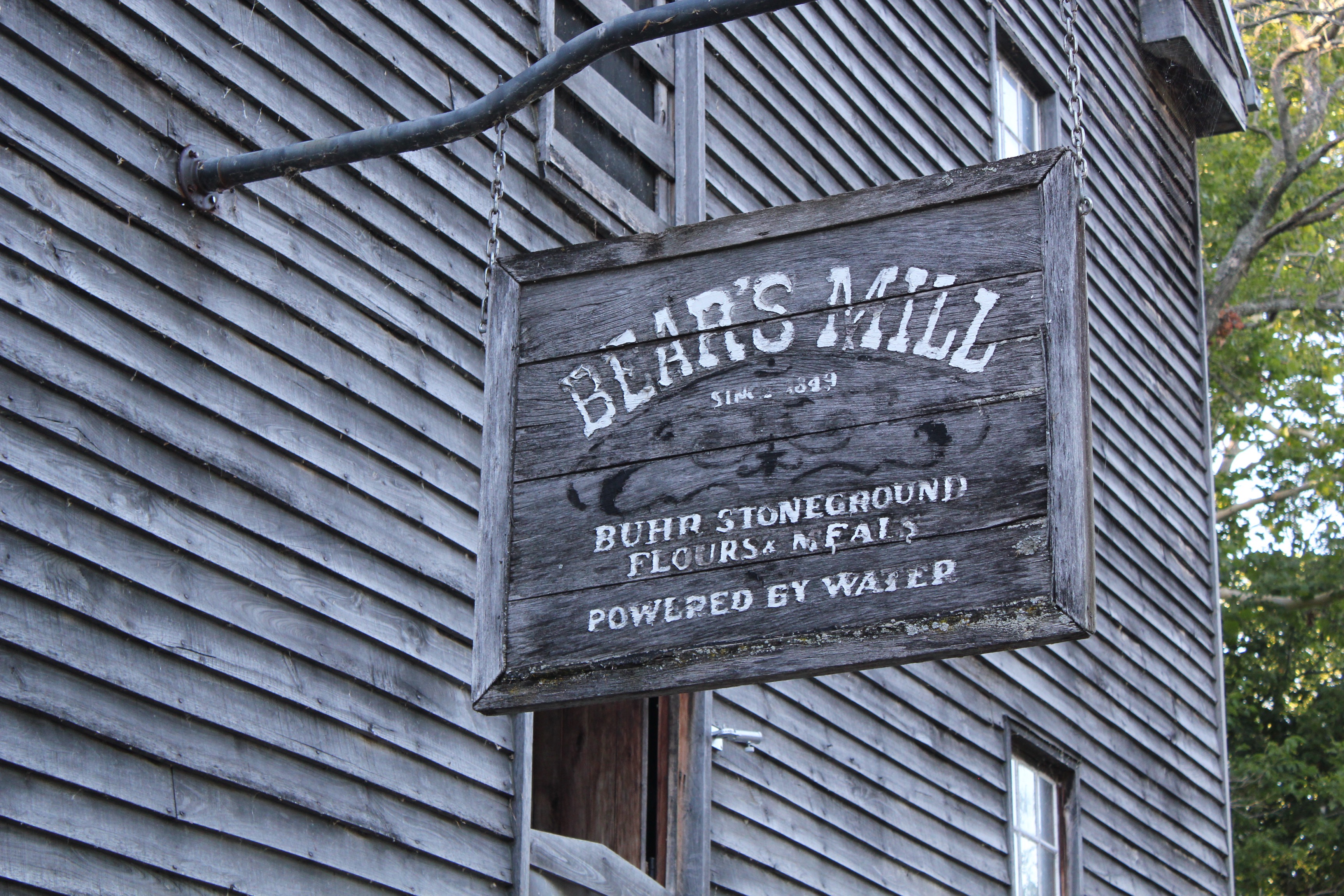
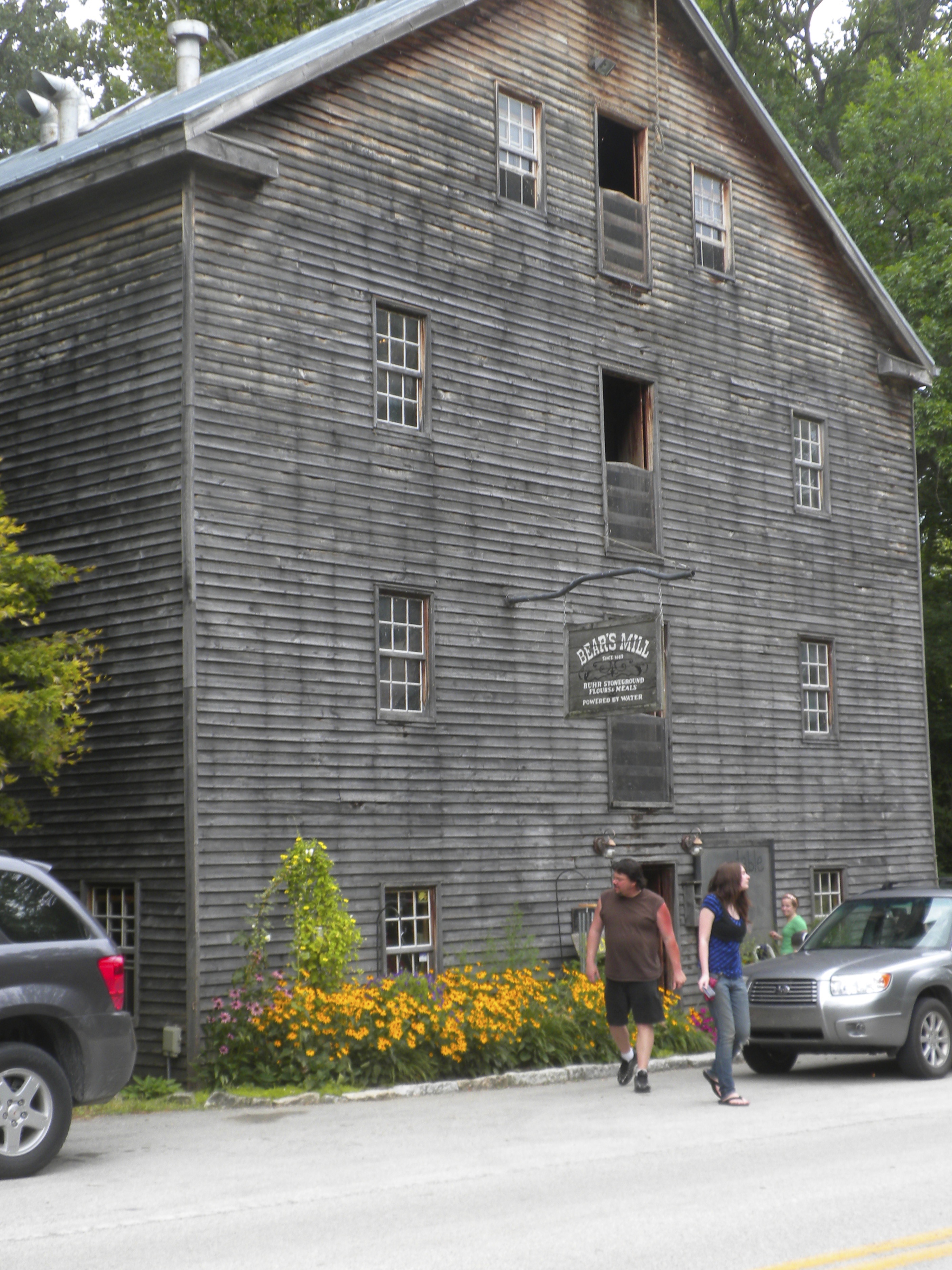
It is not that Bear’s Mill is one of the great wonders of the world that everyone needs to see. It is simply an historic grist mill in Darke County near Greenville, Ohio, the oldest existing industrial building in the county. It was built in 1849 after settlers had cut the trees out of the Ohio wilderness and grew crops on the newly cleared lands. Before it was put into operation it was purchased from Manning Hart, the builder and contractor, by Gabriel Baer. The stones used for grinding the grains were not hard enough, so Baer traveled to France to purchase high quality milling stones that fit his purpose. The original name was Baer’s Mill, but somehow along the way Bear’s Mill became the referred spelling.

The wood siding on the mill has been in place since 1849. It is a hardwood lap siding made from American Black Walnut and has served the building for over 165 years. In the 1970’s the miller retired and turned the mill over to a non-profit organization called Friends of Bear’s Mill. They still use the mill occasionally to grind a limited amount of grain. The bottom floor now contains a gift shop and an art gallery for local midwest artists to show their works. In 1975 the mill was placed on the National Register of Historic Places. It is both a museum for milling history and a stopping place for tourists who are as fascinated with the mill race and the dam as I was as  a child.

IMG_2425

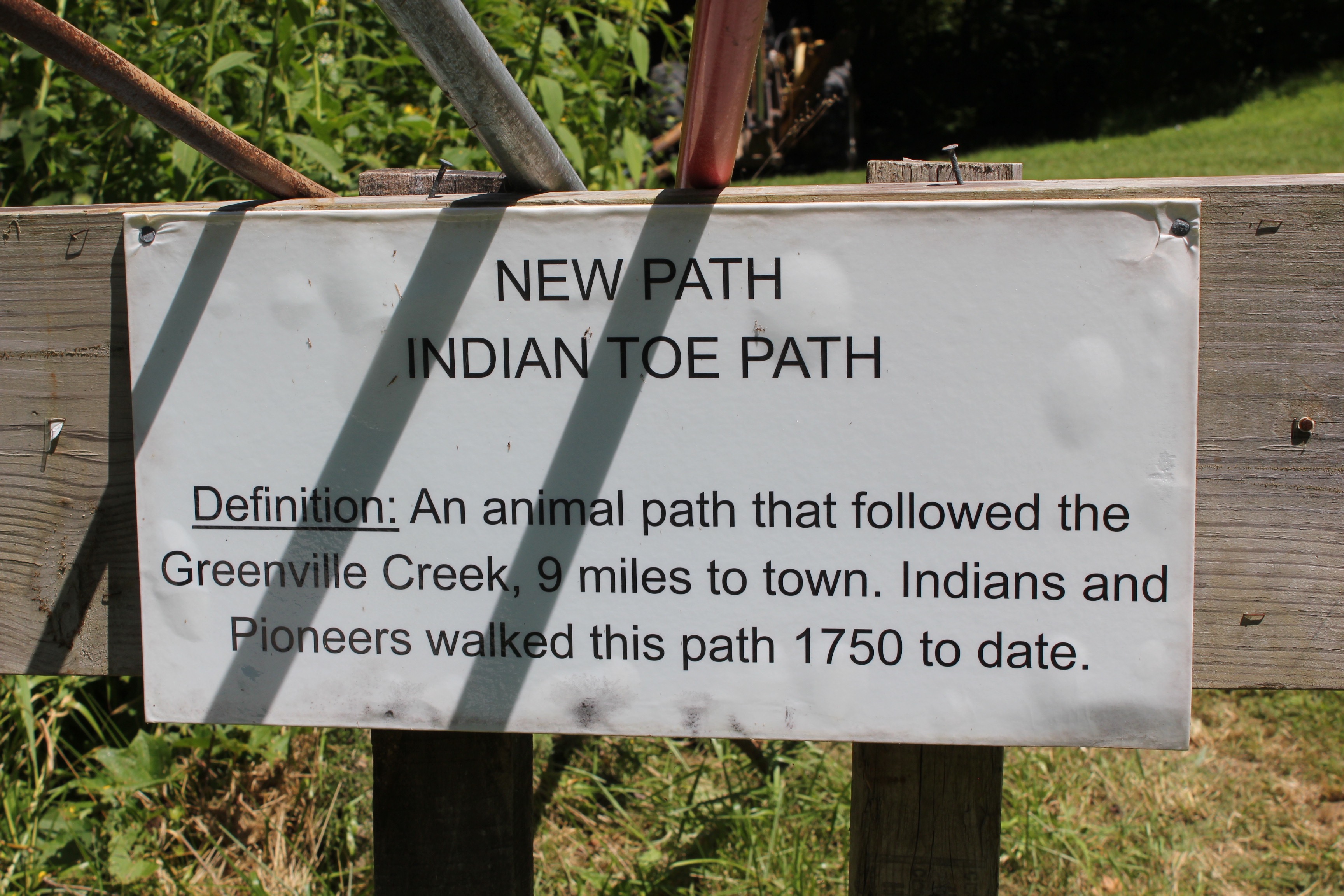
Remnants of the old Indian Toe Path run for half a mile along the creek. The visitors to the mill can take a mild, cooling walk in the summer sizzle where the pioneers and animals walked the hard nine miles to  the settlement at old Fort Green Ville.

IMG_2407

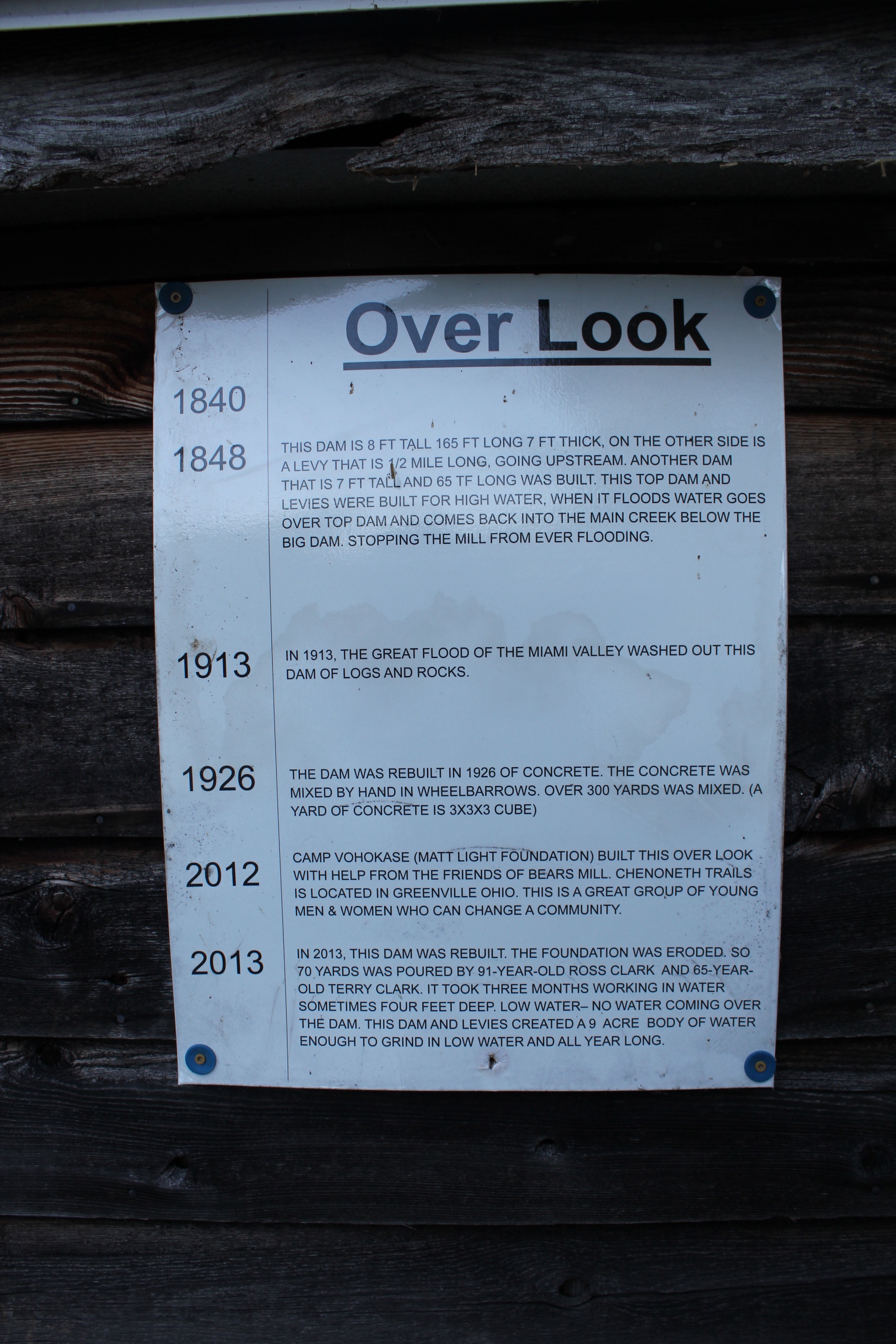
An overlook has been built along the creek by the ancient pathway where deer and panthers once roamed and fed.

IMG_2408

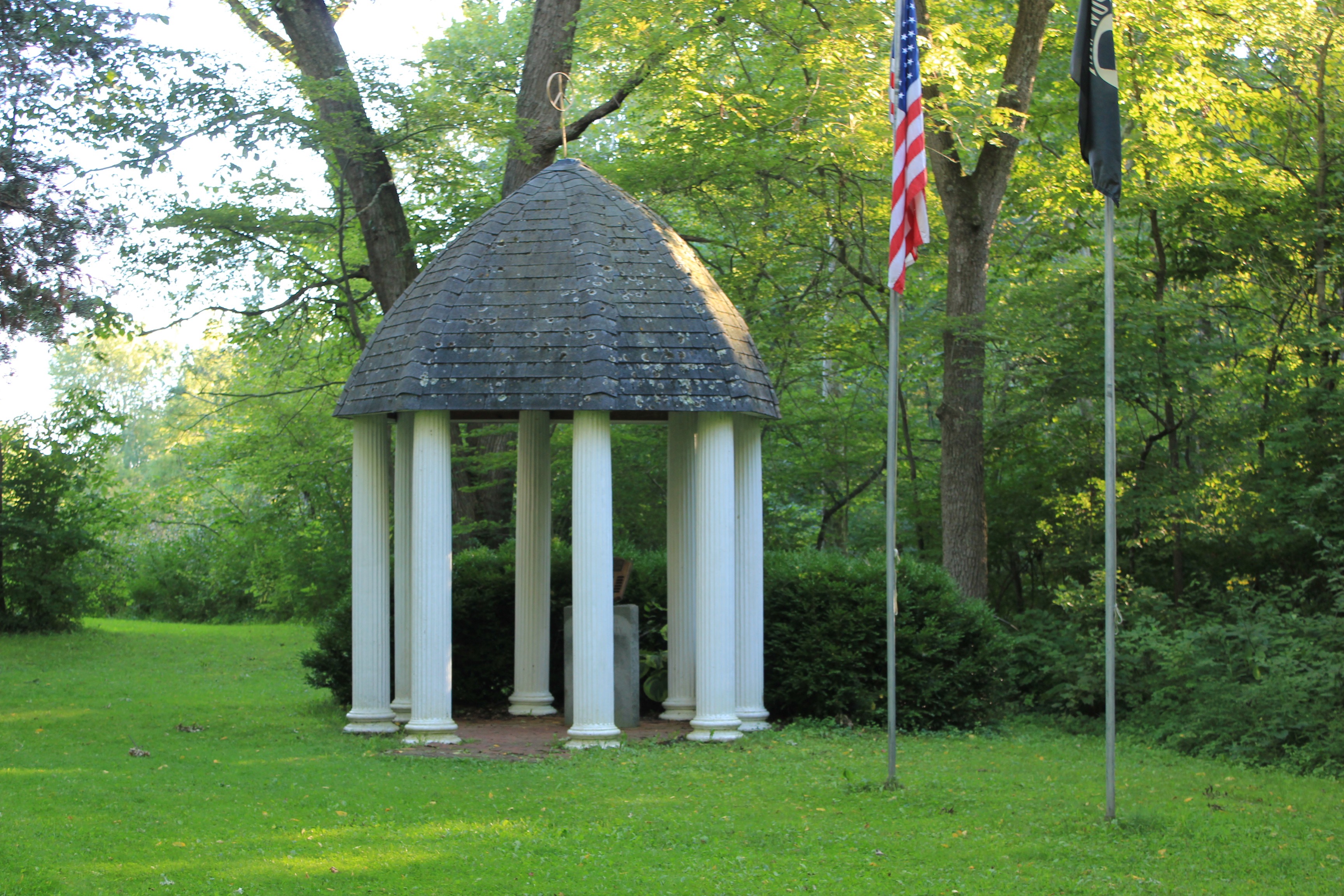
The steeple of the Darke County Courthouse failed and was replaced in the 1980’s. The old steeple was moved to Bear’s Mill to serve as a memorial to the Viet Nam veterans that died in that horrible war.

IMG_2401

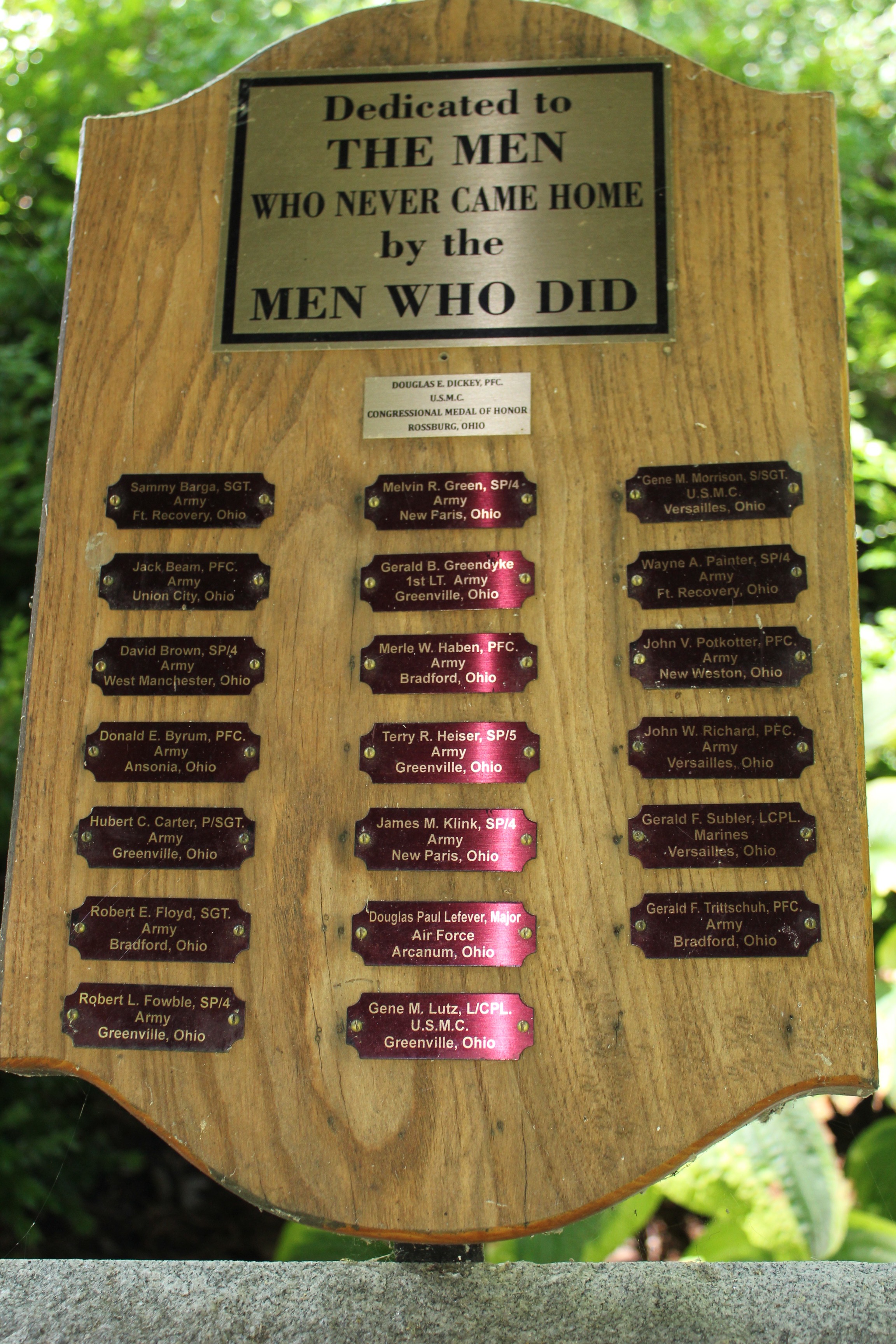
The names of the men who died are tagged on the plaque, including one classmate of mine, Gerry Greendyke who never made it home. My classmates and I owe a debt to Gerry and the others that we can never repay. He took our place in the war. He was the one that was killed while we went on to live our own lives. Some came home and many did not. So it is with wars and the young men who fight and die in them.

IMG_2401.1

Away from the memorial, the  woods along the creek remain as they have been for many thousands of years. A cleared path allows the visitors to walk unobstructed in the same spots as ancient mound builders walked ten thousand years ago when the ice sheets were melting and the rivers of Ohio took shape. The birds tweet and the young folk Twitter. And the water, as always, flows forever to the sea.

IMG_2424

Click to make the water run on the video.

THE WORK OF EDWARD CURTIS

Ken Finton's avatarHELIOS

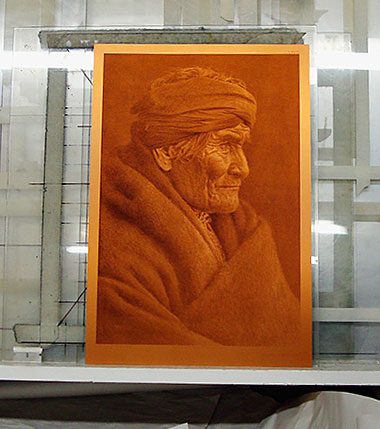
What is a Photogravure?

Photogravure-plate-of-Geronimo

Paul Unks, of Denver, nicknamed Mountain Hawk, explains the craft of printing photogravures: “Developed in the 1850’s, an intaglio photogravure is produced through a complex painstaking hand-made process whereby the original photographic image is etched into a metal plate allowing the plate to hold ink. Then, oil based ink is carefully applied by hand onto the etched plate so that the ink is pushed down into the etched grooves of the plate that range in depth from deep (dark) to shallow (light). Once the printing plate is properly inked, high quality moistened paper is placed on the inked plate and then hand cranked in a press at 10,000 lbs of pressure causing the paper to squeeze down into the grooves of the plate. After the paper fibers have absorbed the ink, the paper is carefully peeled off the plate leaving the image deeply embossed into the paper…

View original post 1,466 more words

THIS LAND IS YOUR LAND

soundcloud.com/…/this-land-is-your-land-1

“This song is Copyrighted in U.S., under Seal of Copyright #154085, for a period of 28 years, and anybody caught singin’ it without our permission, will be mighty good friends of ourn, cause we don’t give a dern. Publish it. Write it. Sing it. Swing to it. Yodel it. We wrote it, that’s all we wanted to do.”

-Woody Guthrie


“WHEN WOODY GUTHRIE arrived in New York City he was known as “the Oklahoma cowboy.”

Guthrie was embraced by its leftist folk music community.  For a time, he slept on a couch in Will Geer‘s apartment. Guthrie made his first recordings—several hours of conversation and songs recorded by the folklorist Alan Lomax for the Library of Congress—as well as an album, Dust Bowl Ballads, for Victor Records in Camden, New Jersey.

Guthrie was tired of the radio overplaying Irving Berlin‘s “God Bless America.” He thought the lyrics were unrealistic and complacent. Partly inspired by his experiences during a cross-country trip and his distaste for “God Bless America,” he wrote his most famous song, “This Land Is Your Land“, in February 1940; it was subtitled: “God Blessed America for Me.” The melody is adapted from an old gospel song, “Oh My Loving Brother.” This was best known as “When The World’s On Fire,” sung by the country group The Carter Family. Guthrie signed the manuscript with the comment, “All you can write is what you see, Woody G., N.Y., N.Y., N.Y.”

He protested against class inequality in the fourth and sixth verses:

As I went walking, I saw a sign there,

And on the sign there, It said “no trespassing.” 

[In another version, the sign reads “Private Property”]

But on the other side, it didn’t say nothing!

That side was made for you and me.

In the squares of the city, In the shadow of a steeple;

By the relief office, I’d seen my people.

As they stood there hungry, I stood there asking,

Is this land made for you and me?

These verses were often omitted in subsequent recordings, sometimes by Guthrie. Although the song was written in 1940, it was four years before he recorded it for Moses Asch in April 1944. Sheet music was produced and given to schools by Howie Richmond sometime later.

EARLY LIFE:

Guthrie’s early life was no an easy road. His older sister, Clara, died in a coal oil fire from a heating stove when he was seven.  His mother, Nora Belle, was institutionalized after setting a fire that severely burned Guthrie’s father.

In 1920, oil was discovered in Okemah, which led to a boom for a few years. Then the oil dried up, and the people of Okemah were, Guthrie said, “busted, disgusted, and not to be trusted.” His father quit the town for Texas, leaving 14-year-old Guthrie to play harmonica for sandwiches and coins on the streets of Okemah. His older brother, Roy, became the struggling family’s main source of support.

Woody’s father ended up in Pampa, Texas, and sent for his son.

When he was 19, Guthrie met and married his first wife, Mary Jennings, with whom he had three children, GwendolynSue, and Bill.[

With the advent of the Dust Bowl era, Guthrie left Texas, leaving Mary behind, and joined the thousands of Okies who were migrating to California looking for work. Many of his songs are concerned with the conditions faced by these working-class people.

in 1931, formed the Corn Cob Trio, and enjoyed his first taste of public success before succumbing to the realities of the Great Depression. He hitchhiked and freight-trained his way across several states, soaking up the stories of “dustbowl refugees” and refining his songwriting skills. In Los Angeles, he joined up with a woman named “Lefty Lou” and became popular with the relocated Okies living in cardboard and tin shelters.

He wrote his most famous song, “This Land is Your Land,” in New York City while living in a building for transients called Hanover House, at the corner of 43rd Street and Sixth Avenue, one block east of where the ball now falls on New Year’s Eve in Times Square.

He’d seen enough during his travels to know that for many Americans, there was nothing blessed about their lives. He wrote the song in 1940 but didn’t record it until 1944. It was published in 1945 in a mimeographed booklet with 10 other songs and some of Guthrie’s drawings. The booklet cost 25 cents

Sources:    https://en.wikipedia.org/wiki/Woody_Guthrie, The Writer’s Almanac

THIS LAND IS YOUR LAND

(words and music by Woody Guthrie)

Chorus:

This land is your land, this land is my land

From California, to the New York Island

From the redwood forest, to the gulf stream waters

This land was made for you and me

As I was walking a ribbon of highway

I saw above me an endless skyway

I saw below me a golden valley

This land was made for you and me

Repeat Chorus

I’ve roamed and rambled and I’ve followed my footsteps

To the sparkling sands of her diamond deserts

And all around me a voice was sounding

This land was made for you and me

Repeat Chorus

The sun comes shining as I was strolling

The wheat fields waving and the dust clouds rolling

The fog was lifting a voice come chanting

This land was made for you and me

Repeat Chorus

As I was walkin’  –  I saw a sign there

And that sign said – no tress passin’

But on the other side  …. it didn’t say nothin!

Now that side was made for you and me!

Repeat Chorus

In the squares of the city – In the shadow of the steeple

Near the relief office – I see my people

And some are grumblin’ and some are wonderin’

If this land’s still made for you and me.

Repeat Chorus

©1956 (renewed 1984), 1958 (renewed 1986) and 1970 TRO-Ludlow Music, Inc. (BMI)


WHY DO RACISTS SEE THE WORLD AS THEY DO?

(A HUMANITARIAN REBUTTAL TO WORLD RACISM)

by Kenneth Harper Finton

29CF0E6900000578-0-image-a-34_1434814613248

A manifesto written by Dylann Roof shortly before he murdered nine black people in Charleston, South Carolina is an important clue into the workings of his mind and the ideas that underlie a universal form of racism and ignorance that is destroying our very world.

Roof states:

‘“I was not raised in a racist home or environment. Living in the South, almost every White person has a small amount of racial awareness, simply beause of the numbers of negroes in this part of the country. But it is a superficial awareness. Growing up, in school, the White and black kids would make racial jokes toward each other, but all they were were jokes. Me and White friends would sometimes would watch things that would make us think that “blacks were the real racists” and other elementary thoughts like this, but there was no real understanding behind it.”

Millions of us were born and raised in this type of an environment. It is easy for whites who do not mingle and relate to black families on a daily basis to come to the conclusion that the blacks are the ‘real racists’. These whites never felt the stings of whips and slavery, the unequal treatment that the law afforded and allowed that still goes on every day. Far too many whites see the average black person as inferior. Many speak in the present tense and in a dialect that is not often used in white families. We are able to distinguish between blacks and whites from the sound of the voice alone in many cases.

Our parochial-styled schools are conservative and filled with narrow-minded ideas. They do little to dissuade the myth that blacks are inferior to whites.

Natural instinct and family practices from the time of the Stone Age inculcate us to believe that the Stranger is a Danger. Our defenses rise, the adrenaline flows. These hormones go to work when a Stranger comes among us.  The stranger must earn trust and always remains a danger to the tribe.

The failure of our educational system is shown by the fact that society has not lifted us from our tribal perspective and fears. It is natural for predators to fear one another. By teaching us to be predators, our schools have failed to make us more human.

Roof writes:

“Black people are racially aware almost from birth, but White people on average dont think about race in their daily lives. And this is our problem. We need to and have to. Say you were to witness a dog being beat by a man. You are almost surely going to feel very sorry for that dog. But then say you were to witness a dog biting a man. You will most likely not feel the same pity you felt for the dog for the man. Why? Because dogs are lower than men. This same analogy applies to black and White relations. Even today, blacks are subconsciously viewed by White people are lower beings. They are held to a lower standard in general. This is why they are able to get away with things like obnoxious behavior in public. Because it is expected of them.”

Here, the disturbed young man has a valid point. White people often view blacks to be inferior. Much of it is subconscious. The Black Stranger is something to be feared. They are often better athletes and dancers and have a genetic sense of rhythm that is different from and more sensual than their white counterparts. Young white men are taught that black men have bigger penises and more sexual stamina. These thoughts lead directly to conflict, hatred and competitive loathing. Such teachings come alive through sports, porno sites, and adolescent angst. Thousands of teachers and parents have these mistaken viewpoints.

Roof writes:

“Modern history classes instill a subconscious White superiority complex in Whites and an inferiority complex in blacks. This White superiority complex that comes from learning of how we dominated other peoples is also part of the problem I have just mentioned. But of course I dont deny that we are in fact superior.”

The history we study WAS written by the white race. Dominance over what is perceived to be the lesser and lower forms of life is the heritage of Western civilization. “Have dominion over every living thing” is supposedly a truth mouthed by God himself. Manifest destiny is our righteous path. Damn and destroy all that stands in the way of it. We learn this in church. We learn this in schools. Parents teach their children to be racists and bigots quite naturally. Even that false God that America prays to backs them up. God is on our side. God loves our team. God will deliver us. We are one nation under God. In God we trust.

Roof writes:

“Integration has done nothing but bring Whites down to level of brute animals. The best example of this is obviously our school system. Now White parents are forced to move to the suburbs to send their children to “good schools”. But what constitutes a “good school”? The fact is that how good a school is considered directly corresponds to how White it is. I hate with a passion the whole idea of the suburbs. To me it represents nothing but scared White people running. Running because they are too weak, scared, and brainwashed to fight.”

Times have changed. The walled cities and castles were built for the protection of the worker populations. The peasants rushed to the fortress to defend their lord and by so doing protected themselves. As cities became smelly and dirty and crowded, the countryside became more appealing when the immediate threat of foreign domination ceased. The suburbs were built by venture capitalists to create new wealth from homes, roads, utility services and expanded business opportunities. The peasants were given a better sounding name–the Middle Class.

Roof says:

“Negroes have lower Iqs, lower impulse control, and higher testosterone levels in generals. These three things alone are a recipe for violent behavior.”

Science, of course, shows that none of this is true, but it is an illusion that has been perpetuated for far too long. The depth of his ignorance is shown by Roof’s statement:  “For example when we learn about how George Washington carver was the first nigger smart enough to open a peanut.”

Our children obviously need a better education. They need to learn how to surf the Internet for accurate information and how to distinguish between fact and half truth. They need to learn respect for scientific studies and intellectual achievement. We do not teach them that. We have brought all this tragedy and stupidity on ourselves. America needs to get smarter and the dumbing down needs to stop. The old bigots may die off, but the young bigots are born again. We need to counter false religion and utter bullshit with real reason and creative thought. Unless we do, tomorrow will bring us another Dark Age.


29CF003800000578-0-image-a-30_1434814579525

THE FULL TEXT OF DYLANN ROOF’S RANT AND LOGIC

http://talkingpointsmemo.com/muckraker/dylann-roof-manifesto-full-text

I was not raised in a racist home or environment. Living in the South, almost every White person has a small amount of racial awareness, simply beause of the numbers of negroes in this part of the country. But it is a superficial awareness. Growing up, in school, the White and black kids would make racial jokes toward each other, but all they were were jokes. Me and White friends would sometimes would watch things that would make us think that “blacks were the real racists” and other elementary thoughts like this, but there was no real understanding behind it.

The event that truly awakened me was the Trayvon Martin case. I kept hearing and seeing his name, and eventually I decided to look him up. I read the Wikipedia article and right away I was unable to understand what the big deal was. It was obvious that Zimmerman was in the right. But more importantly this prompted me to type in the words “black on White crime” into Google, and I have never been the same since that day. The first website I came to was the Council of Conservative Citizens. There were pages upon pages of these brutal black on White murders. I was in disbelief. At this moment I realized that something was very wrong. How could the news be blowing up the Trayvon Martin case while hundreds of these black on White murders got ignored?

From this point I researched deeper and found out what was happening in Europe. I saw that the same things were happening in England and France, and in all the other Western European countries. Again I found myself in disbelief. As an American we are taught to accept living in the melting pot, and black and other minorities have just as much right to be here as we do, since we are all immigrants. But Europe is the homeland of White people, and in many ways the situation is even worse there. From here I found out about the Jewish problem and other issues facing our race, and I can say today that I am completely racially aware.

Blacks

I think it is is fitting to start off with the group I have the most real life experience with, and the group that is the biggest problem for Americans.

Niggers are stupid and violent. At the same time they have the capacity to be very slick. Black people view everything through a racial lense. Thats what racial awareness is, its viewing everything that happens through a racial lense. They are always thinking about the fact that they are black. This is part of the reason they get offended so easily, and think that some thing are intended to be racist towards them, even when a White person wouldnt be thinking about race. The other reason is the Jewish agitation of the black race.

Black people are racially aware almost from birth, but White people on average dont think about race in their daily lives. And this is our problem. We need to and have to.

Say you were to witness a dog being beat by a man. You are almost surely going to feel very sorry for that dog. But then say you were to witness a dog biting a man. You will most likely not feel the same pity you felt for the dog for the man. Why? Because dogs are lower than men.

This same analogy applies to black and White relations. Even today, blacks are subconsciously viewed by White people are lower beings. They are held to a lower standard in general. This is why they are able to get away with things like obnoxious behavior in public. Because it is expected of them.

Modern history classes instill a subconscious White superiority complex in Whites and an inferiority complex in blacks. This White superiority complex that comes from learning of how we dominated other peoples is also part of the problem I have just mentioned. But of course I dont deny that we are in fact superior.

I wish with a passion that niggers were treated terribly throughout history by Whites, that every White person had an ancestor who owned slaves, that segregation was an evil an oppressive institution, and so on. Because if it was all it true, it would make it so much easier for me to accept our current situation. But it isnt true. None of it is. We are told to accept what is happening to us because of ancestors wrong doing, but it is all based on historical lies, exaggerations and myths. I have tried endlessly to think of reasons we deserve this, and I have only came back more irritated because there are no reasons.

Only a fourth to a third of people in the South owned even one slave. Yet every White person is treated as if they had a slave owning ancestor. This applies to in the states where slavery never existed, as well as people whose families immigrated after slavery was abolished. I have read hundreds of slaves narratives from my state. And almost all of them were positive. One sticks out in my mind where an old ex-slave recounted how the day his mistress died was one of the saddest days of his life. And in many of these narratives the slaves told of how their masters didnt even allowing whipping on his plantation.

Segregation was not a bad thing. It was a defensive measure. Segregation did not exist to hold back negroes. It existed to protect us from them. And I mean that in multiple ways. Not only did it protect us from having to interact with them, and from being physically harmed by them, but it protected us from being brought down to their level. Integration has done nothing but bring Whites down to level of brute animals. The best example of this is obviously our school system.

Now White parents are forced to move to the suburbs to send their children to “good schools”. But what constitutes a “good school”? The fact is that how good a school is considered directly corresponds to how White it is. I hate with a passion the whole idea of the suburbs. To me it represents nothing but scared White people running. Running because they are too weak, scared, and brainwashed to fight. Why should we have to flee the cities we created for the security of the suburbs? Why are the suburbs secure in the first place? Because they are White. The pathetic part is that these White people dont even admit to themselves why they are moving. They tell themselves it is for better schools or simply to live in a nicer neighborhood. But it is honestly just a way to escape niggers and other minorities.

But what about the White people that are left behind? What about the White children who, because of school zoning laws, are forced to go to a school that is 90 percent black? Do we really think that that White kid will be able to go one day without being picked on for being White, or called a “white boy”? And who is fighting for him? Who is fighting for these White people forced by economic circumstances to live among negroes? No one, but someone has to.

Here I would also like to touch on the idea of a Norhtwest Front. I think this idea is beyond stupid. Why should I for example, give up the beauty and history of my state to go to the Norhthwest? To me the whole idea just parralells the concept of White people running to the suburbs. The whole idea is pathetic and just another way to run from the problem without facing it.

Some people feel as though the South is beyond saving, that we have too many blacks here. To this I say look at history. The South had a higher ratio of blacks when we were holding them as slaves. Look at South Africa, and how such a small minority held the black in apartheid for years and years. Speaking of South Africa, if anyone thinks that think will eventually just change for the better, consider how in South Africa they have affirmative action for the black population that makes up 80 percent of the population.

It is far from being too late for America or Europe. I believe that even if we made up only 30 percent of the population we could take it back completely. But by no means should we wait any longer to take drastic action.

Anyone who thinks that White and black people look as different as we do on the outside, but are somehow magically the same on the inside, is delusional. How could our faces, skin, hair, and body structure all be different, but our brains be exactly the same? This is the nonsense we are led to believe.

Negroes have lower Iqs, lower impulse control, and higher testosterone levels in generals. These three things alone are a recipe for violent behavior. If a scientist publishes a paper on the differences between the races in Western Europe or Americans, he can expect to lose his job. There are personality traits within human families, and within different breeds of cats or dogs, so why not within the races?

A horse and a donkey can breed and make a mule, but they are still two completely different animals. Just because we can breed with the other races doesnt make us the same.

In a modern history class it is always emphasized that, when talking about “bad” things Whites have done in history, they were White. But when we lern about the numerous, almost countless wonderful things Whites have done, it is never pointed out that these people were White. Yet when we learn about anything important done by a black person in history, it is always pointed out repeatedly that they were black. For example when we learn about how George Washington carver was the first nigger smart enough to open a peanut.

On another subject I want to say this. Many White people feel as though they dont have a unique culture. The reason for this is that White culture is world culture. I dont mean that our culture is made up of other cultures, I mean that our culture has been adopted by everyone in the world. This makes us feel as though our culture isnt special or unique. Say for example that every business man in the world wore a kimono, that every skyscraper was in the shape of a pagoda, that every door was a sliding one, and that everyone ate every meal with chopsticks. This would probably make a Japanese man feel as though he had no unique traditional culture.

I have noticed a great disdain for race mixing White women within the White nationalists community, bordering on insanity it. These women are victims, and they can be saved. Stop.

Jews

Unlike many White naitonalists, I am of the opinion that the majority of American and European jews are White. In my opinion the issues with jews is not their blood, but their identity. I think that if we could somehow destroy the jewish identity, then they wouldnt cause much of a problem. The problem is that Jews look White, and in many cases are White, yet they see themselves as minorities. Just like niggers, most jews are always thinking about the fact that they are jewish. The other issue is that they network. If we could somehow turn every jew blue for 24 hours, I think there would be a mass awakening, because people would be able to see plainly what is going on.

I dont pretend to understand why jews do what they do. They are enigma.

Hispanics

Hispanics are obviously a huge problem for Americans. But there are good hispanics and bad hispanics. I remember while watching hispanic television stations, the shows and even the commercials were more White than our own. They have respect for White beauty, and a good portion of hispanics are White. It is a well known fact that White hispanics make up the elite of most hispanics countries. There is good White blood worht saving in Uruguay, Argentina, Chile and even Brasil.

But they are still our enemies.

East Asians

I have great respent for the East Asian races. Even if we were to go extinct they could carry something on. They are by nature very racist and could be great allies of the White race. I am not opposed at all to allies with the Northeast Asian races.

Patriotism

I hate the sight of the American flag. Modern American patriotism is an absolute joke. People pretending like they have something to be proud while White people are being murdered daily in the streets. Many veterans believe we owe them something for “protecting our way of life” or “protecting our freedom”. But im not sure what way of life they are talking about. How about we protect the White race and stop fighting for the jews. I will say this though, I myself would have rather lived in 1940’s American than Nazi Germany, and no this is not ignorance speaking, it is just my opinion. So I dont blame the veterans of any wars up until after Vietnam, because at least they had an American to be proud of and fight for.

An Explanation

To take a saying from a film, “I see all this stuff going on, and I dont see anyone doing anything about it. And it pisses me off.”. To take a saying from my favorite film, “Even if my life is worth less than a speck of dirt, I want to use it for the good of society.”.

I have no choice. I am not in the position to, alone, go into the ghetto and fight. I chose Charleston because it is most historic city in my state, and at one time had the highest ratio of blacks to Whites in the country. We have no skinheads, no real KKK, no one doing anything but talking on the internet. Well someone has to have the bravery to take it to the real world, and I guess that has to be me.

Unfortunately at the time of writing I am in a great hurry and some of my best thoughts, actually many of them have been to be left out and lost forever. But I believe enough great White minds are out there already.

Please forgive any typos, I didnt have time to check it.

AN UNKNOWN SPECIES BRED WITH OUR ANCESTORS


Spread_and_evolution_of_Denisovans

MORE THAN 40,000 YEARS AGO a sub-species humanoid lived in Siberia. DNA analysis shows that they are a distinct species from the Neanderthal and modern human. Denisova Cave in SIberia housed extinct breeds of humanoids, including both of the above.

In late 2013 a new study was revealed to the Royal Society in London, In the examination of the DNA of a finger fragment found in the cave, they found that one section of the genome seemed to come from a previously unknown species. The same genetic results were confirmed in two teeth found on the site.

As yet, who preceded these extinct species is a great mystery.

How long have intelligent humanoids lived on Earth? It is a question that is less solved than we thought. Perhaps even a million years? More?

Turist_den-peschera


Tourists in front of the Denisova Cave, where “X woman” was found

Further reading:

http://en.wikipedia.org/wiki/Denisovan
http://www.nature.com/news/mystery-humans-spiced-up-ancients-sex-lives-1.14196
http://www.newscientist.com/article/dn24603-mystery-human-species-emerges-from-denisovan-genome.html#.VO9hLLPF_xL