THE THEORY OF COSMIC ORIGINS

By Kenneth Harper Finton
—————————-ABSTRACT—————————-

For much of my life, I have been trying to understand cosmic origins. I have tried to relay by words, music, and verse concepts of the many visions have come to me over the years. It is a most difficult task to bring together––atheists and theists, true believers and deists. We are a divided people in more that our politics and religions. We are segregated by custom, sex, national borders, local borders, economics, levels of education, genetic makeups, intellectual levels, personality types and race. Hope, essential as it is in social interactions, seems to be sinking when it needs to rise. Our world needs a release from the web of existential anxiety the modern world has created.

–––––––––––––––––––––––––––––––––––––––––––––––––––––––––––––––––––––––––––––––––––––––––––––

PREFACE

Scientists tell us that the universe was born about 13.8 billion years ago. Through the aeons that passed, our modern lives evolved from nothing into the complex situations that we find ourselves immersed in and call the present time. Everyone seems to have a theory of why this is so. Some ideas seem much better than others, yet all lead that same demise that our emotional states want desperately to reject, the cessation of being itself. 

We try to contemplate the nature of the world—develop ideas about the building blocks of nature that create this world around us—by looking into the atoms that make our physical universe searching for the smallest particles.

Is there such thing as the smallest particles? How could there be? Something would always be smaller than the smallest until it disappeared into infinity—which is exactly what matter seems to do. 

Matter seems to be made of vibrating wave frequencies. Electrons have different states of energy. We see solidity in our immediate world, but the micro world seems to be a sea of informational energy that creates the appearance of solidity, while most of the manifest universe is a vacuum in space. We do not live in the micro world. We know that if we crash into these solid mountains of elemental rocks, it will injure or destroy us. 

Donald Hoffman—professor of cognitive science at the University of California, Irvine—wrote: “On the other side are quantum physicists, marveling at the strange fact that quantum systems don’t seem to be definite objects localized in space until we come along to observe them—whether we are conscious humans or inanimate measuring devices. Experiment after experiment has shown—defying common sense—that if we assume that the particles that make up ordinary objects have an objective, observer-independent existence, we get the wrong answers. The central lesson of quantum physics is clear: There are no public objects sitting out there in some preexisting space. As the physicist John Wheeler put it, “Useful as it is under ordinary circumstances to say that the world exists ‘out there’ independent of us, that view can no longer be upheld.”

Hoffman continues: “Not only are they ignoring the progress in fundamental physics, they are often explicit about it. They’ll say openly that quantum physics is not relevant to the aspects of brain function that are causally involved in consciousness. They are certain that it’s got to be classical properties of neural activity, which exist independent of any observers—spiking rates, connection strengths at synapses, perhaps dynamical properties as well. These are all very classical notions under Newtonian physics, where time is absolute and objects exist absolutely. And then [neuroscientists] are mystified as to why they don’t make progress. They don’t avail themselves of the incredible insights and breakthroughs that physics has made. Those insights are out there for us to use, and yet my field says, “We’ll stick with Newton, thank you. We’ll stay 300 years behind in our physics.”

In other words, Hoffman thinks that the universe itself if a mental conception composed of independent conscious agents with varying degrees of complexity, all of which are but informational viewpoints that communicate with one another. From the smallest to the largest, all is composed of the same non-material—awareness and consciousness. Communicating conscious agents can merge to form other conscious agents.

DOES IT MATTER?

Does it matter much if the universe is a mental conception or a physical reality? Are the results not the same? Both lead to the same questions and dilemmas either way.  Can understanding of the cosmos as a mental conception be an emotional solace to existential anxiety?

Life becomes one riddle after another for the thinking person. Solving one riddle creates many more to take their place. Debunking one myth leads to another, as the world is both mystic and mythic.

We peer into the universe with our telescopes and our probes and find awe-inspiring beauty of all kinds. Who can object to the beauty of Saturn’s rings set in the blackness of the sky or the wonderful things that nature provides for our eyes and ears to hear and see? At the same time, we wonder why these things even exist for us to see. Why should the beauty of the world go unseen and unappreciated for billions of years while life on Earth evolves enough to care about it? Who or what experienced these wonders before the dawn of time or the emergence of living things? What was the observer that brought our universe into view?

This is where the idea of a mental conception of the world is most convincing. In order for there to have been an evolutionary past through the birthing of elements in stars, there had to be an observer.

Many believe that God is the creator of the universe and experienced the void of the universe alone long before the world came into being, but everyone has their own conception of what this God might be. The Abrahamic religions give God a male gender, a father figure—though giving birth to the universe seems to be a female attribute. Cultures create their own myths to explain their existence.

In the long run, does it matter whether God created the universe (as some religions claim) or physicality came into being and evolved into the present (as some scientists believe). Either point of view is obsolete with quantum mechanics. Yet, both views point to an event from an undefinable zero dimension. Whether we call it creation or the Big Bang, we refer to the same event that came from beyond time and space. 

Some assume our universe came from the remnants of a previous universe. Some think it came from nothing at all, and some say something cannot come from nothing. 

I, for one, find it much easier to visualize timelessness than to envision the beginnings and endings of time. I also find it easy to visualize timelessness as having no concept of duration, but focused on experience instead. The timelessness of the dimensions above our own experience seems to perfectly balance our mortal experiences with the immortal potential of our existence. Duration is a concept stamped upon experience by intellectual branders. Someone dreamed up the idea of measuring time, but did not really comprehend the nature of timelessness and pure experience. How long the experience is felt is not nearly as important as the experience itself.

Where did our consciousness reside before we came to be born? Is it possibly the same non-place in which we dwell when we die? We have all experienced the place where our awareness of ourselves was blank and united with everything. Before we began to exist in this time and space, we all experienced a blank infinity of time and memory. On a personal level, eternity is that which your consciousness was before this life experience. Eternity can be pictured as a sleeping form of awareness that—when  awakened—develops sensory experience such as  touch and perceptions. In time, the subconscious and the self-conscious carry out the business of life and survival. As the universe is born from infinity, we are as well. Infinity is that which was before this life experience. The world about us is similar to a continuous dream that is made real by our consciousness awareness.

Because the zero dimension is static and unchanging, the first and second dimensional structures are also timeless in that they are everywhere at once. That there is structure in the lower dimensions has some experimental evidence. 

“So far, there may already be one piece of experimental evidence for the existence of a lower-dimensional structure at a higher energy scale. When observing families of cosmic ray particles in space, scientists found that, at energies higher than 1 TeV, the main energy fluxes appear to align in a two-dimensional plane. This means that, above a certain energy level, particles propagate in two dimensions rather than three dimensions.” (https://phys.org/news/2011-03-physicists-dimensions-universe.html#jCp)

The emergence of first and second dimensions begin the structure of our physical universe. Time is of no concern in these dimensions. The second dimension creates space where energies can move and react, physical fields can form universally in this dimension. The third dimension ads depth and height and the fourth expands space by creating the duration that we know as time.

Everything in the universe is projected in three dimensions from its zero dimensional source. It has been called the Void, God, Infinity, First Cause, The Great Spirit, Universal Mind, or many other such name devised to express the idea of an unknowable non-thing that is beyond existence, being and conception.

Infinity, since it contains all things and all events began from within it, must be the source of the physical laws that we discover in nature. The finite is contained within infinity. 

INFINITY AND THE UNIVERSE

There are those who cannot accept that there is such a thing as infinity. They consider infinity a simple conception or a mathematical symbol. For some people, the dogmatic religious world hurt them emotionally when they  came realize that that the dogma the world fed them is false. 

But it is not that easy to dismiss infinity. If something is finite, then there must be something that is not finite. That would be the infinite. 

Infinity | Definition of Infinity by Merriam-Webster

1 a: the quality of being infinite. b: unlimited extent of time, space, or quantity: boundlessness. 2: an indefinitely great number or amount such as an infinity of stars.

When we think about how the world about us came to be, we have only two choices. It has a beginning or it is endless and has no beginning. Having no beginning leaves us in a quandary, as the universe should have run out of energy and depleted itself long, long ago. There would have to be a continual creation of new energy to replace that which was lost to the entropy of dissipation for a universe to be eternal. 

If no universe existed before the Big Bang, then what was there? What was in its place when there was no place? Nothing? But nothing cannot exist because it has no being. The ‘it’ we seek cannot be anything but infinite and boundless nothingness which cannot have existence. 

The world, it is said, cannot come from nothing. ‘Nothingness’ may not operate under the same laws of physics by which ‘somethingness’ operates. We cannot assume anything about the physics within nothingness. We cannot really say anything about what nothing is.

However, there are potentially satisfactory answers to the puzzle of eternity, infinity and first causes. These answers are simple to understand by any person that is able to shed his or her preconceptions that have been fostered by the cultural experience.

That answer is that physical reality is built in dimensional layers. The first dimension is infinite and eternal—no beginning nor endings—no particular spot in space nor place in time.

The first dimension is an infinite point that contains all that is possible to exist within it because it is all that exists. It is much like the singularity that the Big Bang theorists posit as the infinity dense point from which all came. The universe always exists within this eternal first-dimension, but not in physical form. 

The second dimension is a flat plane which spreads in all directions from the infinite point. Being infinite as well, this dimension has no beginnings and endings. This second-dimension is without the perception of time, but originates all further dimensional experience. It is the foundation for the concept of space. 

Ultimately, dimensions are viewpoints. Viewpoints are mental constructions. Each dimension contains all the information from the previous dimension while adding important new perceptions.

The two-dimensional line, for example, is the point replicating itself over and over, appearing to travel in a straight line, a vector from the original infinite point. The universal lines that form the universal field is the repetition of the infinite point throughout space. The point is endless and timelessly recurrent. By the expansion of its being, the point fuses with those primal copies of itself to form space and a second dimension. That fusion releases vast amounts of virtual energy that radiates from the original point to form myriads of universal fields. As this radiation spreads there is an expansion of space in the second-dimension.

It is the second dimension that contains the blueprint for the three-dimensional world we see with height, length and width. The two-dimensional universe is flat, like a blueprint. The beginning of the universe is easily comprehended if we hold the view that the physical laws which determine the mathematics, probabilities and shapes essential to universal existence exists in the second dimension. We do not create these laws and principles. We discover them.

As a picture of the natural world can be recorded on flat surfaces like paper and film from the artists perspective, the second dimension can hold our three-dimensional viewpoint in an encoded series of digital bits. 

The third and fourth dimensions limit the space of the second, changing its physicality to a closed, temporal space where duration, height, volume, and depth become apparent. The process can be visualized as similar to the Japanese art of origami  where three dimensional space is unfolded from the two dimensional patterns. By the folding of space, volume, height, and width emerge in a three-dimensional universe, but some space is lost in the process, the same way that some paper is lost on origamic folds. The three-dimensional universe is finite.

The step to physical reality comes through events in four-dimensional space.

Four-dimensional space combines time and duration with three dimensional space. It is the basis for the theory of relativity. Time and space are fused and effect one another as the fourth-dimension emerges and posits another aspect to the third dimensional viewpoint.

In this simple explanation of dimensions, there is a missing ingredient of vital importance to the universe—the mental component of the observation. 

THE MENTAL UNIVERSE

Awareness precedes physical existence . Awareness is invisible. It cannot be touched or measured, yet it is ever present even when we are not conscious of it. Awareness builds consciousness through the fusion of random information into organized information. 

The cosmos is projected into being from a non-dimensional and timeless zero dimension. Even if the remains of previous universes should form the present incarnation, those first universes have to start somewhere. That somewhere is beyond time. It has to come from the non-dimensional.

What we experience comes from our personal consciousness—our awareness of being in the  moment. What is this awareness? Is it a sense that arises from our human brains and nervous systems? If so, then awareness dies when we die. Are plants are aware? Are microbes aware? If you think they are not, perhaps you have the wrong conception of what awareness is.

Many people think that awareness emerges late in evolutionary history. To some, it is unthinkable that awareness should precede evolutionary development. Consider an unthinking rock or an ignorant chemical reaction. Where is this awareness in primal nature? What causes awareness to rise in the first place? Is it inherent in the natural order? Are reactions awareness, or are we mincing words? Are interactions aware?

In quantum physics an observer and an interaction is the same thing. Only objects interact. Even a particle colliding with another particle is an interaction and therefore an observation as well. Observations and interactions do not need to have to have concepts to produce effects and events. They are the events.

Our awareness uses the tools of perception to identity itself and the outer world. Were dinosaurs unaware? Are single-celled life forms unaware? A better question is to ask if they have any form of perception. Obviously, if they react to stimuli they  have some form of perception. If they have perception, they have awareness—not on the grand scale that mammals have developed, but their reaction to observation and touch shows that they have awareness built into their systems.  

Quantum mechanics posits that the universe is a connected unit, each part having an effect upon another. Everything in space and time has a cause and an effect. If it has no cause and effect, it is not in space and time. Quantum mechanics also posits that events must have an observer/interaction to be an event. The event itself would not happen unless and until it is observed. The interaction itself is an observation.

This is another clue that the world might be a mental system with a physical component. Observers are generally thought of as being people, but they can also be a system. An observer is person or a system that observes. In other words, before we can have a world, we need events. To have events we need an observer. To have an observation we need awareness of an object or an event.  

The essential quality for an observation or an interaction is to have awareness of an object. Mental awareness, then, is essential for the existence of time and space. All things are not only produced by mental awareness in its myriads of localized forms, but all things are formed from the eternal and non-material awareness which has always been present in the eternal now.

Something has to be a first cause for the parade of time and space to exist. This first cause cannot be material, yet the material world was produced from it. Our dreams are not material nor real, but the fields involved in neural synapses produce what appear as images in our minds. This is similar to the construction of the universe as well. 

Awareness is invisible. It is not something that we can touch or measure, yet it is ever present even when we are not consciously aware of anything.

Awareness is the observer that is awakened by reactions to objects from within and outside ourselves. These reactions to our inner and outer worlds create information that eventually organizes itself and becomes experience.

Awareness does not need the concept of time and space. It creates time and space when it awakens to stimulus from another. 

Awareness is essential for the building of a universe. 

Eternal awareness may be the proper name for the concept of the mind of God. 

Nature is the child of awareness.

Science does not know precisely what a mind is or from whence intelligence springs. Physical theories surmise that it emerged from physical-chemical reactions deep in the remote past. However, we cannot deny the intelligence manifested by nature that experiments with form after form and drives evolutionary change. We cannot deny the subconscious that regulates not only our personal physical systems but the intelligent patterns found in nature. If the mind were made only of nerves and synaptic systems alone, evolution would not have produced our unique world. Plants and chemical bondings have no nervous systems at all, but come up with intelligent and elegant solutions to problems and events. The mind is not a material thing. It is a primal force.

The universe is eternally present even though it may not always be manifest as it appears to be in our three-dimensional reality. Reality takes shape in all dimensions, but we are primarily concerned with the third and fourth-dimensions where our experiences are realized.

Our experience is also recorded in the second dimension in an eternal and timeless form. One unique property of awareness is that it does not have to be aware of anything at all. It can be empty—void of content of any kind—and still be awareness. Awareness needs no physical objects of which to be aware. It does not even need to be aware of itself.

Even our personal awareness rests and ceases to be aware temporarily. It happens daily. Why cannot these lapses of awareness last for eons or epochs, perhaps billions and billions of years. In these empty spaces, universes cease to be. When they exist, the blueprint for reality exists infinitely in the second dimension which holds all time and events, potential or actual.

Then how does the world come to be?

Consider the dimensional foundation of the universe. Assuming that awareness is non-material, massless and infinite, then a universe without dimension is the zero dimension, an immaterial zone beyond time and space where primal awareness sleeps and dreams. Only when awareness awakens does the first dimension come into being. That first dimension is a point that exists everywhere and contains everything that is possible to contain. It is much like the singularity envisioned in the original big bang theory. This point is infinite. Quadrillions of copies of itself exist at this point. All are infinite and massless as they take up no time and inhabit no space.

When these points move to form a second dimension, as awareness awakens from its slumber, infinite fields and lines are formed and space is born. This space has no place in time, as time has not yet emerged. It simply expands from the first dimension, pushed in all directions by the radiating energy from the point. This virtual energy radiated from the 1st-dimension is not vibratory because there is no vibrational dimension until time emerges in the third dimension. Instead, this radiation is a homogeneous mass of timeless energy. Vibrations have duration. Radiating lines only have motion. They are not in time because they have no duration.

These radiating lines create two-dimensional quantum fields throughout the universe, fields which trace patterns for the actualization of that which comes to be physical in the third-dimension. These fields include electromagnetic fields, weak gauge fields, strong gauge fields, and gravitational fields—all flat two-dimensional fields that occur everywhere in the universe and regulates how matter is born from infinite virtual energy.

As vibrations emerge in these waveforms the saga of time begins. Duration differentiates one form from another through vibrational frequency (duration).

Mass is added from passing through the second-dimensional fields (the Higgs field) which is a filter that further limits the virtual energy. Mass emerges as particles that eventually form elemental hydrogen, and helium—the basic elemental building blocks of our three-dimensional physical reality.

Eventually, a primal soup of extremely dense gases is built up. As the elements interact, they form pockets of different densities—material lumps that are no longer homogenous. The inequality of the mass in their combined states react to the second-dimensional gravitational fields that regulate the influence of unequal masses upon one another.

As the material lumps grow larger they revolve about one another before fusing themselves with the larger mass. These gravitational fields attract even more elemental gas and the first massive stars appear in the universe, using the principle of fusion to form heavier elements and radiant energy.

Fusion is the process or result of joining two or more things together to form a single entity. The entity formed is greater than the sum of its parts and the extra energy is released as radiation from stars.

Fusion is even more than a factory for heavier elements and radiated energy. It is a process of assimilation of two lesser parts into one which is greater than the parts themselves. It is the abstract process that fuels change and ignites evolution. Even reproduction uses an abstraction of the fusion process to propagate.

Definition\: fu’sion: the process or result of joining two or more things together to form a single entity.” 2) a fusion of an idea from anthropology and an idea from psychology”

41.blend, blending, combination, amalgamation, joining, union, marrying, bonding, merging, melding, mingling, integration, intermixture, intermingling, synthesis; coalescence”the fusion of cells”
  • EXTRA READING LIST

HOFFMAN NOTES: “Over the years, we have written extensively about why QM seems to imply that the world is essentially mental (e.g. 199019931999200120072017a2017b). We are often misinterpreted—and misrepresented—as espousing solipsism or some form of “quantum mysticism,” so let us be clear: our argument for a mental world does not entail or imply that the world is merely one’s own personal hallucination or act of imagination. Our view is entirely naturalistic: the mind that underlies the world is a transpersonal mind behaving according to natural laws. It comprises but far transcends any individual psyche.”

Recall Max Planck’s position: “I regard consciousness as fundamental. I regard matter as derivative from consciousness. We cannot get behind consciousness.” (Emphasis added.

Our consciousness is formed from our awareness. Awareness is invisible. It is not something that we can touch or measure, yet it is ever present even when we are not consciously aware of anything. Awareness is the observer that is awakened by reactions to objects from within and outside ourselves. These reactions to our inner and outer worlds create information that eventually organizes itself and becomes experience.

Awareness does not need the concept of time and space. It creates time and space when it awakens to stimulus from another. That awareness precedes existence is essential for physical reality.

For more information see:

https://blogs.scientificamerican.com/observations/coming-to-grips-with-the-implications-of-quantum-mechanics

PRE-EXISTENCE

By Kenneth Harper Finton

Before existence took place, there was pre-existence without time and without space, where no dimensions at all exist. Science can tell us nothing of this era. We are left to our own experiences to decipher our personal realities about from whence we came.

There is a point before time and space. Within that point is the property of physical awareness.  That which is aware–call it the thinker, the cosmic dreamer, or if you prefer, the pre-universe–it is surely the precursor of information, as thought and ideas were all held in one timeless, yet geometric, point. The mental universe of pre-existence was one of potential. Potential does not possess a physical entity. Potentials are mental images.

“A” is present whether or not “B” is present. “A” then, is like potential energy that does exist without material content and without motion. The creation of motion is brought about by the existence of “B”. “A” can exist without time and space because or its property of being potential. In order for this potentiality of energy to be released, it must have a precise co-ordinate in space and a sense of awareness to duration in order to experience time. This is the data and it is provided by “B”. In other words, “B” is the informational content that co-creates the physical.

We know that physical awareness exists in the universe because we are ourselves aware. We do not doubt our own existence. It is one of the properties of human experience. I propose that it is also one of the properties of the universe. We can easily see these properties in life. Many living things are obvious to us, but we find it harder to conclude that there is an awareness in inanimate objects as well. Since all objects are made from an atomic structure, does physical awareness exists in atomic structure as well? 

Pre-atomic structures experience some of the first events. Wherever events occur, physical awareness must record the change in the objects and codify the information. Before we can have a universe, we need objects and events. An event is an interaction between objects. To have an interaction we need awareness to identify an object or an event.  Without awareness, there is literally no event, no data to record. All change contains information. Awareness is the left hand that interprets the information on the right hand. The essential quality for observation or interaction is having an awareness of an object. Objects consist primarily of information. This information is physically coded and eventually it is recognized by our senses. Physical awareness is the first cause for the existence of time and space.  All things are objects that are formed by the non-material awareness which has always been present. 

THE THINKER

THE THINKER

In the beginning

is the thinker.

Second is the thought.

Before the thinker,

is the mind, the place

where the thinker is born.

The mind is awareness.

Without awareness

there can be no mind.

The real question is this: Is the universe physical or mental? If it is both, which came first? If matter appears as a result of observation and/or interaction, then the mental (thought) came first, as to appear it had first to be perceived––meaning awareness comes first, preceding essence. The only other alternative is that physical matter has always existed––and builds awareness, but this is not logical. Since matter and energy are interchangeable, matter’s basis is 1st-dimensional energy, a non-local universal mental field.

The universe is entirely viewpoints. Yours and mine are but two examples, but everything has viewpoints because the universe is primarily manifested thoughts. Dimensions are themselves viewpoints, not physical realities. An electron lives not in a sea of probability as some modern physics posits, but they exist everywhere at once without time and space until something is observed or interacted with. Then the object takes on a ‘real’ place in space and time and becomes a part of the physical world that physicists study. It is not the localized human mind that creates these events. It is a non-local mental field that remains a mystery that creates space and time and the events that populate the universe. This mental field is not a willful force with a purpose, but a method by which the randomly growing universe is actualized and made manifest for that which comes later in time. Difficult to comprehend, but I believe this is true.

MENTAL AND PHYSICAL WORLDS

Consciousness creates the idea of time, then measures the duration as well. We should understand that the realization of our world is both a mental conception and a physical reality. The world around us has myriads of viewpoints that change as our consciousness moves through the now. The person I call myself is but a collection of memories, hereditary information, experiences, learning, emotions, and patterns of thinking. We are here in the now because this is the only place for us to be. We cannot be in the past or the future except in mental processes. The physicality of our existence changes as the mental universe changes. Being in the now is a conscious mental state.

This is quite a confusing concept for some. Many corollary dilemmas spring from accepting the mental and physical universe as two aspects of the same universal state. An entire stand-alone universe outside of my person exists and contains all these things separate from me.

Knowledge and experience form our four-dimensional viewpoints. Modern viewpoints revolve around the physical aspects of the mind. These scientific interpretations often hold that the mind is roughly identical to the brain and is reducible to physical phenomena such as the firing of neurons and the chemical encodings of memory. Yet, we did not always think in this manner.

Throughout the age of human reasoning, the mind has been connected to the psyche. The term “soul” is often used synonymously with the psyche—which includes the totality of the human mind, both the conscious and unconscious elements. The soul has long been thought to be the immortal aspect of the human condition, a ghostly spirit where the personality and moral compass resides.

Carl Jung used the words ‘soul’ and ‘psyche’ as they are the same word in the German language. Of this he wrote: “I have been compelled, in my investigations into the structure of the unconscious, to make a conceptual distinction between soul and psyche. By psyche, I understand the totality of all psychic processes, conscious as well as unconscious. By soul, on the other hand, I understand a clearly demarcated functional complex that can best be described as a “personality”. (Jung, 1971: Def. 48 par. 797).

In a universe paired with a mental aspect and a physical aspect, the dimensional realities in each pair would be different. The first dimension of the one point would be the same in both, but the second dimension of two points forming a line would be different. It is through this difference that they come to be independent entities. If one point is infinite and the other is temporal, then the world line of the second dimension would be a straight line to infinity in the mental state while the world line of the other would curve and eventually return to its own starting point, creating an orbit—a geometric figure. It would be temporal and physical because it had a beginning and an ending.


Infinity is not one thing. Even infinity must be paired with its opposite, the finite. Infinity simply has no beginning nor end. There can be many infinities in a larger infinity because small infinities, like endless numbers, take up no space at all and are not in time.

Objects exist beyond my personal awareness—such as the place I dwell, the people I know, and the universe I inhabit. They too have being in the now. They are a product of consciousness, but they cannot be of my consciousness alone. They are in the consciousness of all. We all have a similar basic vision of the world about us. A common sharing of conscious knowledge between existing entities and objects obviously occurs, though much of nature works through an unconscious mental process. Our conceptions reside in the mental state and deal directly with the infinite process of energy transformation and electrical connections. This mental state has to be of universal proportion—just as the physical state is of universal proportion.


AN ESSAY ON THOUGHT

By Kenneth Harper Finton ©2015, 2022)

THOUGHTS

-KH Finton (2015)

Unconscious thought needs no brain to advertise its presence.

Thought brings to light a spark, impulsive waves that create space

and burns their way through time to start the clock of matter.

Living movements are preceded by thought.

All life thinks, as life is thought made manifest in form.

All of nature thinks, as all of nature is ruled by physical laws.

We see it in the movement of the wind,

We see it in the birthing of desire,

We see it in the crackling of a fire.

Even the cosmos is a living, breathing being

that looks endlessly to propagate and create

and sifts through infinity itself to find its better half.


Our self-centered, self-reflecting species has come to believe that we are the only thing that thinks. Despite the fact that plants seek the sun and tendrils wind their way up and down, despite the fact that insects show intelligence and microbes show awareness, our limited definition of thought has hidden the truth of the world from us. We have equated our brains with our intelligence and our nervous system with our thoughts. It has not occurred to us that thought precedes essence, that the spark of thought ignited the entire big bang that we theorized made the universe itself.

All movement is preceded by thought. It is thought that causes movement. Without movement, we can have no space nor time, or existence. We can experience the truth of this statement within our own selves. In order to do something, we must first contemplate and think about it–even if the thought is unconscious thought.

What is thought? We must define the words to be clear:

The word thought comes from Old English þoht, or geþoht, from the stem of þencan “to conceive of in the mind, consider.” [Harper, Douglas. “Etymology of Though.” Online Etymology Dictionary.]

Noesis (n.)

1820, from Greek noesis “intelligence, thought,” from noein “to have mental perception,” from noos “mind, thought.”

Mind (n.)

late 12c., from Old English gemynd “memory, remembrance, state of being remembered; thought, purpose; conscious mind, intellect, intention,” Proto-Germanic ga-mundiz (cognates: Gothic muns “thought,” munan “to think;” Old Norse minni “mind;” German Minne (archaic) “love,” originally “memory, loving memory”), from PIE root *men- (1) “think, remember, have one’s mind aroused,” with derivatives referring to qualities of mind or states of thought (cognates: Sanskrit matih “thought,” munih “sage, seer;” Greek memona “I yearn,” mania “madness,” mantis “one who divines, prophet, seer;” Latin mens “mind, understanding, reason,” memini “I remember,” mentio “remembrance;” Lithuanian mintis “thought, idea,” Old Church Slavonic mineti “to believe, think,” Russian pamjat “memory”). The meaning of “mental faculty” is mid-14c. “Memory,” one of the oldest senses, now is almost obsolete except in old expressions such as bear in mind, call to mind. Mind’s eye “remembrance” is early 15c. Phrase time out of mind is attested from early 15c. To pay no mind “disregard” is recorded from 1916, American English dialect. To have half a mind to “to have one’s mind half made up to (do something)” is recorded from 1726. Mind-reading is from 1882.

Thought has been linked with the mind since the beginning of language and human communications. Consciousness is also related to the mind, as consciousness is the state of being aware of one’s own existence.

Our physicists envision a singular spot of infinitely dense particles with indescribable temperatures where all particles once congregated in unfathomable density before exploding in the big bang.

Have we failed to comprehend that it was the spark of thought that preceded the observed reality of existence and started the interconnected chains of experience that became our universe?

Experience

[ik-speer-ee-uh ns]

noun

1.   a particular instance of personally encountering or undergoing something:

2.   the process or fact of personally observing, encountering, or undergoing something:

3.    the observing, encountering, or undergoing of things generally as they occur in the course of time:

4.    knowledge or practical wisdom gained from what one has observed, encountered, or undergone:

5.    Philosophy. The totality of the cognitions given by perception; all that is perceived, understood, and remembered.

Prehension

[The term “prehension” indicates that the perceiver actually incorporates aspects of the perceived thing into itself. The term is meant to indicate a kind of perception that can be conscious or unconscious, applying to people as well as electrons.]

The march of time and space begins with prehensions of attraction and repulsion as elemental waves and particles recognize themselves and react. The reality of our world is not made of fundamental bits of matter that exist independently of one another as many believe. Reality is composed of the intermingled and entangled chains of events that make up experience.

These prehensions are felt in the most elemental of particles and waves. Particles and waves are the palpable recorded experience of thought in different states of energy and organization.

Awareness: the basis of existence

noun: awareness; plural noun: awarenesses

knowledge or perception of a situation or fact.

Awareness precedes perceptions or perceptions would not exist.

In order to have prehensions and conceptions, we must have an awareness that can recognize these senses. We prove this in our own existence. If we did not have both a conscious and an unconscious mind, we would know nothing and be nothing.

per·cep·tion

pərˈsepSH(ə)n/

noun: perception; plural noun: perceptions

the ability to see, hear or become aware of something through the senses.

It is that original awareness, the primal state, that creates the process of consciousness. If it were not present, there would be no registry or history of existence at all. The process of consciousness is the history of existence. We continually concoct existence out of nothing in every frame of time that we create.

Awareness is the precursor of consciousness. Consciousness is not a thing, but a process of self-objectification that constantly creates the world anew each moment. Through thought, awareness becomes conscious and organizes matter into being.

noun: consciousness

The state of being awake and aware of one’s surroundings. The awareness or perception of something by a person. 

plural noun: consciousnesses: The fact of awareness by the mind of itself and the world.

Feel·ing

noun

noun: feeling; plural noun: feelings

the capacity to experience the sense of touch. The sensation of touching or being touched by a particular thing.

Per·cep·tion

noun: perception; plural noun: perceptions

the ability to see, hear, or become aware of something through the senses.

Perceptions are feelings that have come to consciousness and made self-aware.

The most elementary of things experience the sense of touch. If it did not, it would not react to or be influenced by another object. Without a rudimentary sense of self, an object would never know or be influenced by another. This sense need not be intellectual, but as simple as gravitational attraction and repulsion.

All remembrance is of the mind.

Perceptions are coded into matter with chemical compounds made from elemental particles and waves, then stored, and organized into related conceptions by thought. This is the process of experience.

Thought is the eternal spark that interprets the electrical pulses and links chemical changes.

Actions are organized thoughts made manifest, as thought becomes material by recording temporal changes upon material particles and chemicals. It constantly changes the universe within us and around us.

It is all a part of an eternal process where fundamental awareness creates and projects experience so that the world as we know it might exist and continue in this existential experience. 

Existence is a process, not a goal nor an end. The external world is composed of sound and light, mediums that are in essence vibratory. The elements themselves are not solid but composed of matter whose ultimate material nature is also vibratory.

Perhaps in its purest state, virgin awareness is void of experience and thought. That is easy to picture if we try to remember the time before we were born. It is void of space and time and particles and waves. Thought is the spark that creates all matter and all space and all time. All existence began as realized thoughts as the one reflected upon the other and objects were born.

Thought created the history of existence. Realized thoughts actually change the substance of matter. Matter itself is the record of thought having passed through points in space and time and imprinted the record of its passage on particles and elements, creating temporal events that become recorded experiences.


Albert Einstein did not believe in an Abrahamic God but assented to the laws of nature in the way Spinoza had done centuries before. He believed that order, not chaos, was the rule of the universe.

He once said that he did not believe that God played dice with the universe.


“I want to know how God created this world. I am not interested in this or that phenomenon, in the spectrum of this or that element. I want to know His thoughts; the rest are details.” – Albert Einstein

Einstein also said: “Reality is merely an illusion, albeit a very persistent one.”


“A human being is part of the whole called by us universe, a part limited in time and space. We experience ourselves, our thoughts and feelings as something separate from the rest. A kind of optical delusion of consciousness. This delusion is a kind of prison for us, restricting us to our personal desires and to affection for a few persons nearest to us. Our task must be to free ourselves from the prison by widening our circle of compassion to embrace all living creatures and the whole of nature in its beauty…We shall require a substantially new manner of thinking if mankind is to survive.”

– Albert Einstein

BEING AND NOTHINGNESS: THE ONTOLOGY OF THE VOID

By Kenneth Harper Finton

My friend Tim believes that the universe is infinite. If you could travel in a straight line forever, you would see nothing but stars and dust with galaxies, clusters, and planets so far beyond our sense’s ability to perceive that we could never find an end. It keeps on going forever. Even if matter is not present, Tim believes that space goes on forever. That is his picture of an infinite universe. 

The problem with this image is that it is impossible to know. If energy cannot be newly created or destroyed (according to the 1st Law of Thermodynamics), then energy simply changes form. There would not be enough room in eternity to have infinite matter unless the universe is also infinite. Objects like the universe have a place in space and time. Therefore, both space and the universe must be finite. When the universe expands, everything is bigger and farther apart. In an eternity, the whole of finite matter that composes all objects would be so large as to be totally separated from one another. 

So what is the universe expanding into?

That which is beyond the boundary of the universe is often called “voidness”. It is not anything. It is not in time and space. Voidness can be infinite because there is nothing there at all. You cannot travel there because it is not there. You cannot see it because it is invisible. Voidness is not simply the stillness of quantum fields without movement. Voidness is the infinity of nothingness, the original state of non-existence. 

But is there something that can be eternally held in the nothingness of the void? Can the void hold potentiality? Potentiality is not something real––not something that exists. It has no definite time and occupies no space. In this case, potentiality is the invisible seed of something that can possibly exist.

If the void is capable of holding potentiality (as I assume must be the case), then it must have the ability to store both the potentiality of energy and the potentiality of alertness and awareness. Both are essential components of world formation. The Merriam-Webster Dictionary defines potential as “existing in possibility, capable of development into actuality.” See https://www.merriam-webster.com/dictionary/potential.

Potentiality is not actuality. It need not be in time and space. It can, like the void, be infinite. From the beginning, in order to start the unveiling of a universe, potential energy must exist within the void. This potentiality of the void would take up no time nor occupy any space because neither space nor time exists in the non-dimensional. Further, if the void can hold potential energy, then it can hold potential awareness and the potential intellect of the natural mind. The void’s potential information can serve as a two-dimensional blueprint for the unveiling of a universe.

We must then suspect that awareness and energy have their origin in the void. They do not exist there, but the potential to exist must be harbored in the void. 

There are three fundamental necessities for the universe to exist––energy, awareness, and information. All are invisible and all are infinite––without form or body.

With these three fundamentals, the void has the ability to bring the universe into existence. In modern terms, an excitation of a cosmic thought in the potential eternal energy of the void creates the zero-dimension, a dimension similar to the void––in that it is outside space and time––but unlike the void in that the newly-released energy becomes kinetic instead of potential and is perceived by the potential for awareness in the void. Movement, like the released energy that creates a thought, creates a zero-dimension that is infinite and unique in that it sprang from the void by actuating the void’s potentiality.

Is it any wonder then, that this voidness would be interpreted as God by our ancestors, both remote and recent? The void has the property of holding the potential to activate nature itself with the potential energy and awareness that is somehow stored within it. 

Tim’s wife also believes in an expanding universe that grows faster and faster as objects speed away from one another. If you ask her what the universe is expanding into, the answer is that “the universe is all there is. Nothing exists without it. It keeps getting bigger. It is not expanding into anything because there is nothing in which to expand.” 

That is precisely my point… at the remote end of the universe is the void, just as in the remote beginning.

The good thing about the void is that it can be anything you want it to be. It can be God, Buddha, Allah, Jupiter, or Ra the Sun God. It can be the Tao, the heavens, Nirvana, or altered consciousness.

What is created can be nature, reality, illusion, Maya, or something in between. It can be nothing and everything at once. Nothing really exists but the void and the realized potential it has wrought.

AWARENESS

by Kenneth Harper Finton

How do children develop a sense of self?

The question was asked, “Did man invent mathematics or did he discover it?” We assume that mathematics springs from a universal source because the universe exhibits mathematical precision and patterns from the very start.

Before we can have a world, we need events. To have events we need an observer. To have an observation we need awareness of an object or an event. The essential quality for observation or interaction is to have awareness of an object. Observers are generally thought of as being people, but they can also be a system. An observer is a person or a system that observes. An interaction is an observation. It is part of the mental universe.

Alert awareness, then, is the first or the simultaneous cause. It is responsible for the recognition of an object and events. Objects and events exist in time and space. Awareness comes in myriads of forms and degrees. It is present in all living things. It is present as prehensions and in inanimate things. All things are produced by awareness in myriads of localized forms. When organized, awareness becomes consciousness. All things are formed from the eternal and non-material awareness which has always been present–as the eternal now is ever-present. This is where the concept of the world in the mind is most convincing. In order for there to have been an evolutionary path through the birthing of elements in stars, there had to be an observer.

As the positive numbers in the mathematical universe continue endlessly, the negative numbers continue endlessly as well. The sum of all these numbers negative and positive are zero, that is, the total mathematical value of the mathematical universe is zero. It has no numerical value, as it is not a thing and needs no value. For example, the sum of 1+2+3+4 subtracted from the sum of -1-2-3-4 equals zero. It has no value because it comes from its source in the non-dimensional. All the mathematical universes must add up to zero as well. In order for that to occur physically—to add up to zero—negative values must be paired with positive values.

When change occurs in the dimensional universe, that change is recorded physically by changes in the physical matter of the universe. [Rock hits a rock, and forms a crater. Cut your toe, feel the pain, see the injury.] My take is that the non-dimensional is both opposed to and complementary to the physical universe. It is the realm of thought, mathematics, and ideas. Data from the physical world is simultaneously coded and stored as data in the non-dimensional realm.

Matter behaves like both a particle and a wave. Matter is the temporal recording media of physical change. Events are coded physically and stored to form our mental experience. The dimensional process of thought and alert awareness constantly creates our consciousness in the present moment.

The dimensional universe creates a boundary that limits infinity to localized viewpoints.

IS GOD SELF-AWARE?

by Kenneth Harper Finton ©2020

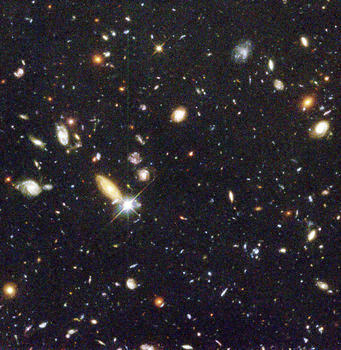
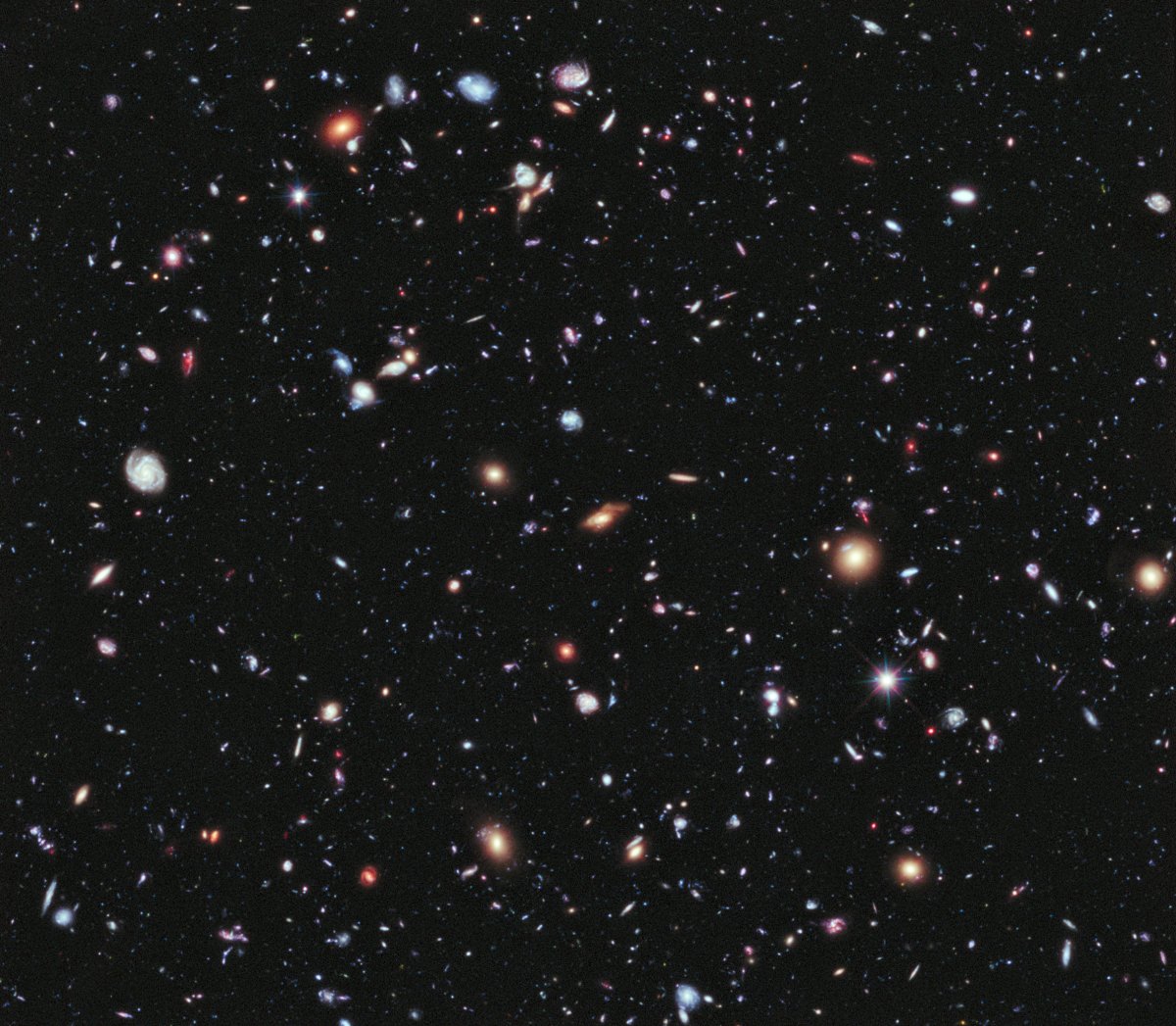
About 1,500 galaxies are visible in this deep view of the universe, taken by allowing the Hubble Space Telescope to stare at the same tiny patch of sky for 10 consecutive days in 1995. The image covers an area of sky only about the width of a dime viewed from 75 feet away.

“Who knows what is in the mind of God?”

People will tell us that “God knows all.

”The common conception of God is that of a divine being

that creates and governs the universe.

If God knows what everyone is thinking,

knows where everyone has been,

and knows what they all will be,

what a huge amount of information that would be.

We also must realize that the Earth

is a small speck of dust in a commonplace galaxy.

There are trillions of stars and billions of galaxies.

Try to imagine a mind that knows all this.What would it be like?

One thing is certain. It would not be like the human mind.

It would be more like universal consciousness.

But would God even have a self?

Is God self-aware?

What need would God have for self-awareness?

Self-awareness is a curse and a blessing.

It creates loneliness.

It creates unhappiness.

If God were self-aware, God would be lonely.

Does God get lonely?

The self can only be aware of its self by knowing

that something from the outside is not the self.

If God is everything, then what would exist outside God

for God to be self-aware?

If God isn’t everything then what is this thing outside

that is not God?

God does not need a brain.

If God is everything, then God is a brain.

An observer does not need to be self-aware.

A mouse observes the cheese with no sense of self.

The world existed before self-awareness.

So, as far as we can tell (and surely we know little),

the universe has only had self-awareness

for a minute fraction of an eternal epoch.

The universe has gotten along quite well

for billions of years without self-awareness.

Do we live in a fraction of an eon when the mud

stands up and sees that there are others?

Does that matter at all to the mind of God

that has no self and no need for a self?

After all, if God were present before anything existed,

then God will be present when everything has passed away.

19 October 2020, Arvada, Colorado

LISTEN TO ‘WHO OWNS THE SUN” AT BELOW LINK

http://www.soundclick.com/bands/page_songInfo.cfm…

WHAT IS THE ZERO DIMENSION?

Dimensions are mental constructs. A dimension is a measurement of something. These measurements are in the mental world of conscious awareness. We can only measure things with our conscious intellect. When we become aware of a dimension, it is a viewpoint.

This parade of dimensions begins with the zero-dimension, a non-dimensional viewpoint without material content. For dimensions to come into view, both awareness and information processing is required. That is why the zero-dimension is a mental world of awareness. It precedes the existence of being. This non-material zero-dimension is without time, without space and is eternally present everywhere at once. The zero dimension is the source of the awareness that projects the universe into being.  

This is where each of us came from before birth and possibly the same non-place that we dwell in when we die. We all remember this place. Since we have all experienced the place where our awareness of ourselves was united with everything before we began to exist in this time and space. Everyone has experienced an infinity of endlessness. 

Timelessness can be pictured as a sleeping form of awareness that—when  awakened—develops into the recognition of sensory touches and perceptions. In time, awareness births the subconsciousness and the self-consciousness. 

As the universe is born from infinity, we are as well. Infinity is that which was before this life experience. The world about us is similar to a continuous dream that is made real by our consciousness awareness.

Because the zero dimension is static and unchanging, the first and second dimensional structures are also timeless in that they are everywhere at once.

To see something in three dimensions, one has to view from outside and above the apparent dimensions. A circle on a plane—like a drawing on paper—does not appear as a sphere until viewed from above the plane. The added dimensions of height, width, length, and duration create a space that becomes visible in three dimensions while height, width, and length are being experienced. 

Duration is not only an element of time but it is also an element of length. “Length” commonly refers to physical size, as in the length, the width, and depth of an object. Duration measures the time period, but the term length  is also used to define a period of time as in: “How long have you been waiting?” 

When and space and time are molded into a common dimension, they become that fourth-dimensional viewpoint which Einstein called spacetime.

THE ROLE OF DIMENSIONS IN THE UNIVERSE

by Kenneth Harper Finton

UNIVERSE copy

    Something has to come into being within a dimension before it can exist. Otherwise, it would still be in the realm of dimensionless infinity.

At the very beginning of an idea, the universe has a point. This point has a purpose. It becomes the first-dimension. The point exists everywhere at once because that is all there is. The entire universe resides in it. The point exists even now in every corner of the universe. It is the eternal first-dimension. It is the foundation of experience from a timeless realm without a location. Space itself is unborn and appears in the second dimension. The point has the ability to be omnipresent by the simple fact that it is the only thing that exists.

Yet, our shared awareness cannot recognize or react to one thing alone because there is nothing to reference. At the very least, a singularity is unstable if not impossible.

A second-dimension only comes into being with the existence of at least two points—but the essential ingredient of awareness must present for observing, interpreting, and recording this information. This fact becomes even more obvious in the three-dimensional view where awareness is essential to separate the flat two-dimensional image of a circle from its background to envision a sphere with height, length, and width. In order to see a sphere, we have to see it from above and outside the image. It takes conscious awareness to do this. The second dimension requires dimensional awareness to exist. It exists upon a timeless plane with the entire universe and all its structure written in every part of space and every qubit of information by the first-dimensional point.

We have been taught to understand awareness as a product of evolutionary biology. Many think awareness is something that occurred from a chemical soup after molecules began to replicate and divide. Our ideas of awareness and consciousness are built around the idea of living beings, especially those with nervous systems. Some do not believe that plants have awareness, though they react to sunlight and propagate themselves. It takes subconscious mental powers to grow DNA into something that can be passed to offspring—and this does not necessarily mean the world is formed from intelligent design from a divine creator. Most awareness is subconscious. It is not necessarily produced from a self-reflective mind unless we consider the mid of nature itself is self-aware. Awareness comes before the mind.

Let us picture a mental universe that coexists with the physical universe. The physical universe is not a solid block of physical mass any more than the mental universe is a unified universal mind. Neither is true. The physical universe is composed of entities unique to themselves, just as the mental universe is made from separate levels of individual awareness each unique to themselves. Awareness is that which holds the knowledge of interactions and observations. As such, awareness precedes existence itself.

Yes, awareness comes first. For eons, this awareness may have held nothing at all because there was nothing of which to be aware. Each of us experiences the truth of this first hand. We come from a place that has no memories, no experience, and no existence until we are conceived, grow aware, and begin to form our identity. What we are before we are born is a field of awareness that has not come into identifiable form. Because awareness existed before we did, we were able to recognize, learn, and eventually become that which we are now. If our awareness did not exist before our birth, our birth would never have happened. So it is with all interactions and observations in nature and beyond. It takes awareness for anything to have physicality. That is why there are two states in existence, the mental and the physical. Both are separate aspects of the same reality.

To connect two points and form a line, information must pass between these points. Something or some non-thing must become aware of both points. Yet, this line is infinite because it has no length. We can see that there must be a form of knowing in the non-dimensional realm. It is not some void dimension that is without knowledge or thought of any kind. Left to itself, the vector of this line could go on forever or curve back upon itself to form an orbit. In the second dimension, there is no duration nor speed.

Because awareness is the one pre-existing condition essential for any form of energy to be perceived, awareness must be the original state of the universe. Awareness precedes essence. Awareness evolves into subconsciousness and consciousness.

A mental dimension for the positive point and a physical dimension for the negative point is part of the pairing of opposite states. These points are entangled. What happens to one happens to the other instantly because these points are still eternal and not in the dimension of time. Without time, no speed or duration exists. Each point, though duplicates of another, have different spins. Separate viewpoints evolve from that spin.

Awareness evolves into higher consciousness. This is confirmed by examination of the evolution of conscious life. This does not mean that awareness constantly knows everything in the universe, nor does it mean that there is a universal plan for advanced consciousness to inherit or evolve into a super-intelligence that is reserved for the attributes of a god. Self-awareness often rests. We sleep and we dream. We are not always consciously aware. We can conclude this is so by examining our awareness. Subconscious awareness is in charge of our autonomous systems that continue with or without self-awareness. The universe has evolved without self-consciousness for billions of years.

-Kenneth Harper Finton
Thursday, August 1, 2019, revised 8/29/2020