THE PRICE OF ADMISSION by F. Scott Fitzgerald

A LETTER FROM F. SCOTT FITZGERALD:
6184299387_262482da77_o

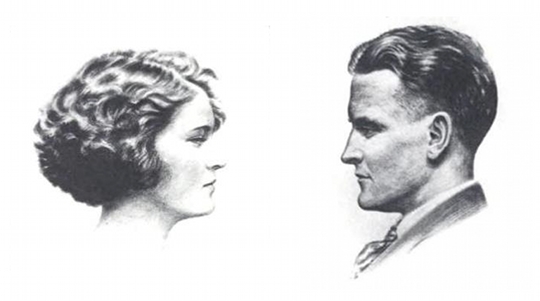
Left: Image of Zelda published in Metropolitan Magazine in June 1922, accompanying her piece “Eulogy of a Flapper”. Right: A study of F. Scott Fitzgerald by Gordon Bryant, published in Shadowland magazine in 1921. – See more at: http://publicdomainreview.org/2011/09/26/a-few-words-about-f-scott-fitzgerald/#sthash.BvnI9yhu.dpuf


(Source: F. Scott Fitzgerald: A Life in Letters; Image: F. Scott Fitzgerald.)


In 1938 the world was preparing for World War II. Fitzgerald lived in Culver City, California and was about to lose his very lucrative $1,250 per week contract with MGM as a screenwriter for the movies. On the 9th of November, 1938, a young woman named Frances Trumbell, sent the famous writer a story for review. That same night Germany looted and burned 7,500 Jewish businesses on “the night of broken class.” The young woman, a sophomore at Radcliffe University, wanted feedback from Fitzgerald. Fitsgerald was not impressed, though he said her writing was “smooth and agreeable and some of the pages are very apt and charming.”

History does not record how the young woman reacted to his letter. We can only imagine that she abandoned further attempt to become a writer when he said, “it doesn’t seem worthwhile to analyze why this story isn’t salable.”


November 9, 1938

Dear Frances:

I’ve read the story carefully and, Frances, I’m afraid the price for doing professional work is a good deal higher than you are prepared to pay at present. You’ve got to sell your heart, your strongest reactions, not the little minor things that only touch you lightly, the little experiences that you might tell at dinner. This is especially true when you begin to write, when you have not yet developed the tricks of interesting people on paper, when you have none of the technique which it takes time to learn. When, in short, you have only your emotions to sell.

This is the experience of all writers. It was necessary for Dickens to put into Oliver Twist the child’s passionate resentment at being abused and starved that had haunted his whole childhood. Ernest Hemingway’s first stories “In Our Time” went right down to the bottom of all that he had ever felt and known. In “This Side of Paradise” I wrote about a love affair that was still bleeding as fresh as the skin wound on a haemophile.

The amateur, seeing how the professional having learned all that he’ll ever learn about writing can take a trivial thing such as the most superficial reactions of three uncharacterized girls and make it witty and charming—the amateur thinks he or she can do the same. But the amateur can only realize his ability to transfer his emotions to another person by some such desperate and radical expedient as tearing your first tragic love story out of your heart and putting it on pages for people to see.

That, anyhow, is the price of admission. Whether you are prepared to pay it or, whether it coincides or conflicts with your attitude on what is “nice” is something for you to decide. But literature, even light literature, will accept nothing less from the neophyte. It is one of those professions that wants the “works.” You wouldn’t be interested in a soldier who was only a little brave.

In the light of this, it doesn’t seem worth while to analyze why this story isn’t saleable but I am too fond of you to kid you along about it, as one tends to do at my age. If you ever decide to tell your stories, no one would be more interested than,

Your old friend,

F. Scott Fitzgerald

P.S. I might say that the writing is smooth and agreeable and some of the pages very apt and charming. You have talent—which is the equivalent of a soldier having the right physical qualifications for entering West Point.



SUPPORTING WRITERS AND THEIR WORK

3b205f2a-2940-424b-aa9a-872a23e9f9a3


ANOTHER ONE BITES THE DUST

This month we lost another outlet for writers of short fiction and poetry. Pithy Pages has closed their doors. Writers, of course, need readers but unless readers support the writers by buying their works, contributing to their continued efforts, and commenting on their blog pages, then the accomplished writers will be driven to other ways of communication of will give up their efforts entirely. The publishers at Pithy Pages have gracefully allowed me to reprint their final comments on their short-lived project.


From the Publishers of Pithy Pages For Erudite Readers


This is our last issue  and quite frankly we think it is unfortunate. We have had a wonderful time reading the many, many stories submitted by a wide range of authors. One of the most difficult things any publisher must do is select a few stories for publication from the many received. The authors we have published have proven to be as gracious as they are talented, making our relationships with them both pleasurable and satisfying.

The fact that we have enjoyed our foray into the publishing world begs the question: Why are we ending our publication? The quick and easy answer is that our publishers and editors are talented writers and avid readers, but lousy business people. The longer answer is a bit more complicated.

In their role as authors, our staff members are constantly writing and submitting their works to a variety of venues for publication. When a publisher accepts their work, they would like to be paid a decent rate.

Unfortunately there are fewer and fewer publishers who will (or can) pay a good rate, making competition among authors fierce for the few spots available. Why is that so?

Publishers too, would like to be paid for their time and effort. To do this each publisher must decide to work as a profit or non-profit company. Pithy Pages chose the former because our publishers believe that the literary public, rather than government or some wealthy foundation, should support the publication of the short fiction they read or write. That being said, there are two ways to generate revenue from a publication: subscription fees and/or advertising. We tried both with dismal results. It turns out that there is more interest in writing short fiction than in reading it. It seems that the only people left to support the publication of short fiction are the authors working in the genre. Unfortunately, short fiction authors are under the incorrect assumption that people are lining up to read their work … They should be (it is really, really good) but they’re not, preferring the latest full-length novel (now showing as a movie).

Without direct and active intervention of the writers of short fiction the genre will continue to be a quaint, underpaid, and unappreciated art form. We, therefore, offer the following solution. Every author and aspiring author of short fiction should set aside ten dollars a week to support the publications of short fiction. When this is done, publishers will be able to sell enough subscriptions to stay in business and to continue to offer a decent payday for those authors selected. When those same authors encourage their friends and family to subscribe or advertise in short fiction publications, pay to authors will increase … as will the number of publications. Eventually, short fiction will rebound as a genre to everyone’s benefit.

One good thing has come out of our experience with publishing. Our staff has vowed to subscribe to the magazines they submit items to. … not because they think they will necessarily be published, but because they understand that the health of the short fiction publication market must be maintained or our genre will go the way of the dodo bird. We hope that you will consider taking the same pledge. Together we can keep short fiction alive and viable as a reading and writing choice.

The Publishers and Editors of Pithy Pages For Erudite Readers

DEPRESSION

med-1044-depression


Depression is a chemical change that originates in the brain. When depression arrives, a certain heaviness is felt in the head, almost like an invasion from a foreign substance. It is palpable, like the clouds flowing across the sun. The light is replaced with a much heavier shadow that blocks the warm rays of the sunlight.

I am not a chronic depressive, yet like most of us, the cloud comes over me when I feel exceptionally neglected or misunderstood. Most mild depressions are a simple case of getting the blues.

It helps to remember that we only feel emotionally good because we know about feeling emotionally bad.

Severe or mild, depression is caused by brain chemistry. When our chemical neurotransmitters are out of balance, we fall into depressive symptoms. Hormones, disease, inherited traits and life events all play a part in depression.

Some claim that women are more susceptible to depression than men, but that could be because women seek treatment for depression more than men do.

Severe depression often requires medical treatment. Because the causes are chemical changes, chemicals are often used for treatment. Some can have very serious consequences. Many people do not believe in chemical treatments, or feel the primary purpose of these treatments is to enrich pharmaceutical companies.

See http://www.mayoclinic.org/diseases-conditions/depression/basics/treatment/con-20032977

Medications

Many types of antidepressant medications are available to treat depression, including those below. Discuss possible major side effects with your doctor or pharmacist.

  • Selective serotonin reuptake inhibitors (SSRIs). Doctors often start by prescribing an SSRI. These medications are safer and generally cause fewer bothersome side effects than do other types of antidepressants. SSRIs include fluoxetine (Prozac), paroxetine (Paxil), sertraline (Zoloft), citalopram (Celexa) and escitalopram (Lexapro).
  • Serotonin and norepinephrine reuptake inhibitors (SNRIs). Examples of SNRI medications include duloxetine (Cymbalta), venlafaxine (Effexor XR) and desvenlafaxine (Pristiq).
  • Norepinephrine and dopamine reuptake inhibitors (NDRIs). Bupropion (Wellbutrin) falls into this category. It’s one of the few antidepressants not frequently associated with sexual side effects.
  • Atypical antidepressants. These medications don’t fit neatly into any of the other antidepressant categories. They include trazodone and mirtazapine (Remeron). Both are sedating and usually taken in the evening. A newer medication called vilazodone (Viibryd) is thought to have a low risk of sexual side effects.
  • Tricyclic antidepressants. Tricyclic antidepressants — such as imipramine (Tofranil) and nortriptyline (Pamelor) — tend to cause more severe side effects than do newer antidepressants. So tricyclics generally aren’t prescribed unless you’ve tried an SSRI first without improvement.
  • Monoamine oxidase inhibitors (MAOIs). MAOIs — such as tranylcypromine (Parnate) and phenelzine (Nardil) — may be prescribed, typically when other medications haven’t worked, because they can have serious side effects. Using MAOIs requires a strict diet because of dangerous (or even deadly) interactions with foods ― such as certain cheeses, pickles and wines ― and some medications including birth control pills, decongestants and certain herbal supplements. Selegiline (Emsam), a newer MAOI that you stick on your skin as a patch, may cause fewer side effects than other MAOIs do. These medications can’t be combined with SSRIs.
  • Other medications. Other medications may be added to an antidepressant to enhance antidepressant effects. Your doctor may recommend combining two antidepressants or medications such as mood stabilizers or antipsychotics. Anti-anxiety and stimulant medications might also be added for short-term use.

St. John’s wort is a popular means of treating depression in Europe, though it is not approved in the United States. This herbal remedy can interfere with quite a few medications, so a doctor’s advice is recommended to make certain that there is no interaction with other prescriptions.

Another European drug not approved in the US is called SAMe (pronounced ‘sam-E’) is the synthetic version of a naturally occurring chemical that the body manufactures.

Some people believe that diets high on Omega-3 fatty acids – found in cold water fish, walnuts, and flaxseed and oil – also helps to relieve mild depressions.

My depressions, I find, are most often caused by taking myself too seriously. I can often cure them by doing something else and not thinking about myself so much. Enlarging one’s self identification is always a good idea when the blues pay us a visit.

Helping others often rewards us as well. It is another method of bringing us out of ourselves and into a practical world where people can care about one another.

Taking our consciousness away from our limited definitions of ourselves and is a step toward expanding mental pictures of ourselves to include the rest of nature and humanity. For this we rely on many things, from mediation to music, exercise to entertainment.

Depression is a curse that falls on all of us. Looking from the top of the hill, we can see the valleys below, but from the valley itself, the mountain often looks insurmountable.

STORIES FOR GRANDKIDS #1


446px-Doris_Ulmann_-_Southern_mountaineer


Grandpa chewed on the butt end of his cigar as I read him my poem. His eyes rolled a bit beneath the thick wire rimmed glasses and the smoke from the cigar chaffed my nose.

“It’s a good one, son,” he told me, “but it ain’t much to my liking.”

“What do you mean?” I asked.

“Poems were good in my day,” he replied. “You heared a lot of poems back then, The folks who wrote them did not indulge in themselves the way they do now. They didn’t cry over their spilt feelings so much. Your little story is about what you lost out on. Everybody loses out on something or someone. You can’t get through your term on earth less’n you do.”

He placed his cigar on the ashtray that stood on a pedestal near his chair. It raised waves of smoke, then went out.

“They told stories back then,” he continued. “Sometimes they dressed their words up in fancy duds … least wise, they did if they went on for further schoolin’. They learn you to use big words at universities.”

“So you didn’t think it was good?” I asked. I felt disappointed. I thought it was good enough to show him. Becky had just told me she wanted to go steady with Fred. I wrote about it, telling how Fred was a homely bastard who has too many pimples. I could not understand what she saw in him and I wrote about it my poem.

“Love poems are fair to middling,” he said. “Everybody falls in love. It drives you crazy for a while … wanting this and wanting that. Get to your age and it’s passion and infatuation. It feels strong, but it ain’t a lasting thing. A good story is a lasting thing.”

“What makes a good story?” I asked.

“It ain’t so much what you say, but the way you say it,” he replied. “If you say it good, then people will understand it.”

He took a book from the table beside the ashtray.  “Now here’s one I always liked,” he said. He began to read.


images

The Ballad of William Sycamore’ was originally published by Stephen Vincent Benét in 1922.

THE BALLAD OF WILLIAM SYCAMORE 

by: Stephen Vincent Benét 

My father he was a mountaineer,

His fist was a knotty hammer;

He was quick on his feet as a running deer,

And he spoke with a Yankee stammer.

My mother, she was merry and brave,

And so she came to her labor,

With a tall green fir for her doctor grave

And a stream for her comforting neighbor.

And some are wrapped in the linen fine,

And some like a godling’s scion;

But I was cradled on twigs of pine

In the skin of a mountain lion.

And some remember a white, starched lap

And a ewer with silver handles;

But I remember a coonskin cap

And the smell of bayberry candles.

The cabin logs, with the bark still rough,

And my mother who laughed at trifles,

And the tall, lank visitors, brown as snuff,

With their long, straight squirrel-rifles.

I can hear them dance, like a foggy song,

Through the deepest one of my slumbers,

The fiddle squeaking the boots along

And my father calling the numbers.

The quick feet shaking the puncheon-floor,

And the fiddle squealing and squealing,

Till the dried herbs rattled above the door

And the dust went up to the ceiling.

There are children lucky from dawn till dusk,

But never a child so lucky!

For I cut my teeth on “Money Musk”

In the Bloody Ground of Kentucky!

When I grew as tall as the Indian corn,

My father had little to lend me,

But he gave me his great, old powder-horn

And his woodsman’s skill to befriend me.

With a leather shirt to cover my back,

And a redskin nose to unravel

Each forest sign, I carried my pack

As far as a scout could travel.

Till I lost my boyhood and found my wife,

A girl like a Salem clipper!

A woman straight as a hunting-knife

With eyes as bright as the Dipper!

We cleared our camp where the buffalo feed,

Unheard-of streams were our flagons;

And I sowed my sons like the apple-seed

On the trail of the Western wagons.

They were right, tight boys, never sulky or slow,

A fruitful, a goodly muster.

The eldest died at the Alamo.

The youngest fell with Custer.

The letter that told it burned my hand.

Yet we smiled and said, “So be it!”

But I could not live when they fenced the land,

For it broke my heart to see it.

I saddled a red, unbroken colt

And rode him into the day there;

And he threw me down like a thunderbolt

And rolled on me as I lay there.

The hunter’s whistle hummed in my ear

As the city-men tried to move me,

And I died in my boots like a pioneer

With the whole wide sky above me.

Now I lie in the heart of the fat, black soil,

Like the seed of the prairie-thistle;

It has washed my bones with honey and oil

And picked them clean as a whistle.

And my youth returns, like the rains of Spring,

And my sons, like the wild-geese flying;

And I lie and hear the meadow-lark sing

And have much content in my dying.

Go play with the towns you have built of blocks,

The towns where you would have bound me!

I sleep in my earth like a tired fox,

And my buffalo have found me.


Stephen Vincent Benét

From Wikipedia, the free encyclopedia

Stephen Vincent Benét (July 22, 1898 – March 13, 1943) was an American author, poet, short story writer and novelist. He is best known for his book-length narrative poem of the American Civil War, John Brown’s Body (1928), for which he won a Pulitzer Prize in 1929, and for two short stories, “The Devil and Daniel Webster” and “By the Waters of Babylon”.

Benet’s fantasy short story The Devil and Daniel Webster won an O. Henry Award, and he furnished the material for a one-act opera by Douglas Moore. The story was filmed in 1941 and shown originally under the title All That Money Can Buy.

Benét was born into an Army family in Fountain Hill, Pennsylvania, near Bethlehem in Pennsylvania’s Lehigh Valley. He spent most of his boyhood in Benicia, California. At the age of about ten, Benét was sent to the Hitchcock Military Academy. A graduate of The Albany Academy in Albany, New York and Yale University, where he was a member of Wolf’s Head Society and the power behind the Yale Lit, according to Thornton Wilder. He was awarded a posthumous Pulitzer Prize in 1944 for “Western Star”, an unfinished narrative poem on the settling of America.

It was a line of Benet’s poetry that gave the title to Dee Brown’s famous history of the destruction of Native American tribes by the United States: Bury My Heart at Wounded Knee.

He also adapted the Roman myth of the rape of the Sabine Women into the story The Sobbin’ Women, which in turn was adapted into the movie musical Seven Brides for Seven Brothers.

John Brown’s Body was staged on Broadway in 1953, in a three-person dramatic reading featuring Tyrone Power, Judith Anderson and Raymond Massey, and directed by Charles Laughton.

Benet’s brother, William Rose Benét (1886–1950), was a poet, anthologist and critic who is largely remembered for his desk reference, The Reader’s Cyclopedia (1948).

MISSED OPPORTUNITIES

MISSED OPPORTUNITY

MIssed Opportunies by Kenneth Harper Finton ©2014


“We often miss opportunity because it’s dressed in overalls and looks like work.” — Thomas A. Edison


OPPORTUNITY KNOCKS ONCE?

Does opportunity only knock once? Leon Spinks said it was so. He said that “opportunity knocks only once. You never know if you’ll get another opportunity.” Leon knows about knocking. He was the boxer that defeated Mohammad Ali in February of 1978 in a fifteen round decision fight.

Nonetheless, opportunity presents itself often. Opportunity is a set of circumstances that makes it possible to do something.  Hopefully, this action is a creative act, but it could just as easily be destructive.

Opportunities are time sensitive. We have all missed many opportunities. Sometimes they slide by unrecognized. Sometimes we are not ready for them. Sometimes we choose to ignore them.

Whatever your secret desires, there are always ways to make them ripen.


“MAKE IT SO”

“Make it so,” was the mantra of Captain Picard in Star Trek: the New Generation. Making it so is the secret to getting the task done.

We have opportunities today that people did not have in the past. We can develop relationships with brilliant and creative people all over the world through our new information technology. Highly creative people tend not only to recognize opportunity, but have placed themselves in a position to make something of it.

Almost every problem has a solution. It is creativity that solves these problems. We are all creative. Creativity is the hallmark of humanity.

The mind is constantly occupied and thoughts appear constantly, seemingly from nowhere. Since these ideas and observations are easily lost, it is wise to archive then in some fashion. Carry a notebook and write them down. Have a digital camera to document the out-of-the ordinary and use the video on your cell phone to make audio/visual notes that you can sort and transcribe at a later time.

It is that same mind that prevents us from taking advantage of opportunities. Exceptional creativity comes from an open mind that is not afraid of the unorthodox. Prejudice, uninformed religious beliefs and dogmas, political pressures and peer uniformity are all enemies of the open mind.

We need to be ready for opportunity. Rita Coolidge said, “Too often opportunity knocks, but by the time you push back the chain, push back the bolt, unhook the two locks and shut off the burglar alarm, it is too late.”

Being thankful for our limited talents and grateful in accepting our weaknesses helps us to clear our minds and look at things from different perspectives. Both resentment and complacency run amuck in today’s society. Dwelling on these things can put us in an unproductive mind set that can stymy our ability to recognize opportunity.

IS THERE VALUE TO PRAYER?

by Kenneth Harper Finton ©2014

41b1e853-cf63-4829-b0cc-c38b9e6632f9


Those who believe that a personal God has a special will – a will greater than our own – think that God can hear their prayers and possibly be made to care enough about the situation enough to give them an answer.

Those who see no evidence at all that prayers are answered say, “No, the only people who care are those in your individual circle. God, if there is such a thing, has nothing to do with it.”

Then there are those in the middle who are not positive deep within that there is a divine being with a will for humanity. Just in case there is, they subscribe to a moral code written by some religion of combination of religions.

Prayer is interpreted differently by all the above.

Some see prayer as kneeling down beside the bed or before some vivid image. They fold and clasp their hands and give thanks or asking for blessings. Some make a habit of holding hands around the table as reciting some rote blessing that passes through us like an ineffective TV commercial.

But it this really prayer?

prayer definition

prayer

pre(ə)r/

noun

noun: prayer; plural noun: prayers

  1. a solemn request for help or expression of thanks addressed to God or an object of worship.”I’ll say a prayer for him”
  1. synonyms:
  1. invocationintercessiondevotionarchaicorison “the priest’s murmured prayers”

2.

  • a religious service, especially a regular one, at which people gather in order to pray together.”500 people were detained as they attended Friday prayers”
  • an earnest hope or wish.”it is our prayer that the current progress on human rights will be sustained”


Of all those definitions, I like the third the best: an earnest hope or wish. There is something about hope that foretells and defines the future. There is something about thanks that defines and appreciates the present.

Appreciating the present is the key ingredient of happiness.

The way be can do this is to take a small break in our routine and consciously be thankful for those good things that brought us to this moment and respectful to the bad things that also brought us to this moment.

Our present contains all the good things that have happened as well as the bad. Nature provides the bad things to keep us moving and progressing. What matters is the nature of the movement forward. Focusing on the good we want to accomplish will keep us on a chipper and more productive path.

These efforts need not public, as they are in essence a private thing. Prayer does not even have to be called prayer to be effective. Call it meditation … call is a cigarette break … call it a pause to reflect … call it reevaluation. It is all the same thing if the objective is to bring good will and happiness into the future.


Thanks for reading. Follow me at:

www.kennethharperfinton.com

THE MARE’S NEST

1. Mare’s nest: a complex and difficult situation; a muddle

2. an illusory discovery such as “the mares next of perfect safety”

songs1

©2017 Kenneth Harper Finton

THE MARE’S NEST

When I’m good, I’m very good, but when I’m bad, I’m better.” -Mae West

   The child and the boy that Adam used to be was so foreign to him now. Looking over pages that he wrote years ago, Adam barely recognized his former self as the person who wrote them.

   Adam came from a conservative and opinionated small town in rural Ohio. Those who lived in his little town often claimed it was God’s country. Adam supposed that it might be good for the spirit to be content and proud of your community. God’s country seemed to be a stretch, though. So many wonderful spots in the world better fit that description.

   Life seemed to be so much more idyllic and simple then. Yet, it seems to Adam that this warmer view one has toward the past is never the case. Faded memories—the exclusive warm selections of chosen recollections—give the illusion that daily life was richer in the past than in the present. This is the mare’s nest. We are born in illusion and live most of our lives in a delusional fantasy with the blessings and approval of those who surround us.

II

   Religion and conservative politics were the mainstays of community belief when Adam was being raised. He was brought up to believe in things that were not real, but Adam had a problem with these beliefs. To suspend rational thought and dive into the unproven waters of belief was much easier when Adam was a child.

   Adam’s parents were good to him. They did everything they were supposed to do with a minimum of complaints and resentment. They were neither rich nor poor, neither too conservative nor too liberal.

   These were the days when a mother was expected to stay home and raise the children. The father was expected to bring in a paycheck and support the family. Yet, even then, the very ground of these expectations was trembling.World War II had shown women that they could manage without a man in charge. The experience of hundreds of thousands of years had proven to be false. The seeds of personal independence had taken root in even the most dependent of women. A new world was being born before Adam’s eyes. Only a very few seemed to realize that this was so.

III

Social taboos confuse men and women alike. A natural curiosity about the difference between men and women develops early in life. Adam remembered when he was four and took the train from Ohio to Colorado to visit his grandmother. He had little experience with the female sex. His curiosity got the best of him. His grandmother lived next to a family that had a daughter Adam’s age. She was deliciously blonde, wore a taffeta dress, and smelled of Ivory Soap. Adams’s play was often defined by guns and cowboys, trains, and fortifications. Society wanted him to grow up to be a good soldier. He was trained to defend his family and national interests while little Susie played with dolls and tea parties. It was the normal thing.

Adam had no idea who thought it up, but one warm afternoon they decided to explore one another’s bodies. Adam had no sister, so he was very curious to see what lay beneath that taffeta dress. “I’ll show you mine if you show me yours,” he said.

She was every bit as curious as Adam. They went behind the shade of a weeping willow and she pulled up her dress. She wore white panties that were different from Adam’s jockey shorts. She eagerly pulled her panties down and Adam saw a vagina for the first time in his young life. How wonderful it looked to him—almost puffy and so very different from what he possessed. She took her hands and pulled the labial folds apart so that Adam could see the inside. He could see little curds of a cheese-like substance.

“I get that, too,” he said.

“Let me see,” she replied.

His penis quickly grew stiffer and larger. He pulled down his pants and showed her what he meant. Adam had never been circumcised, so he pulled back the foreskin and exposed the same little white curds that she had proudly displayed. “Do you want to touch it?” she asked.

“Maybe.”

“Well, you either do or you don’t,” she said.

“Yeah, I guess I do,” he said.

“Then go ahead. Touch me. I like it when I rub it right here. You can try if you want.”

Adam took his index finger and rubbed her there. It felt very good and he had a tight feeling come into his groin, the same feeling he had when he climbed a rope.

“See,” she said. “This is fun. Do you want to kiss it?”

“Not really,” he said. “Boys don’t kiss girls.”

“Yes, they do,” she said, “my Daddy does that to my Mom.”

“Well—what if I just touch it.”

“That’s okay, but I want to know what it feels like to be kissed down there.”

“How do you know your Dad does that?”

“I’ve seen them do it when they don’t know I can see them.”

“Oh,” I said. “My Dad doesn’t do that.”

“How do you know?” she said. “I bet he does. Then he takes his thing and he puts it into her and they wrestle around on the bed.”

“Why?” Adam asked.

“I don’t know,” she replied.

A voice from the house could be heard calling her name. “That’s my mother,” she said. “I gotta go.”

She pulled up her panties and ran off to the house. Adam had the feeling that he was in deep trouble. Something told him that he was not supposed to do that with her. Suddenly, he felt panicked.

He crawled up an apple tree as far as his limbs and legs could take him, Sure enough, within ten minutes his mother’s voice could be heard in the distance. “Get in here this moment,” she said. “Susie’s mother told me what you did.”

“What did I do?” he asked, knowing full well that he was in deeper territory that he had never before explored.

“You damned well know what you did,” mother said. “You were bad.”

Adam was totally embarrassed. His head hung low. If he were a dog, he surely would have put his tail between his legs.

* * *

Though childhood lasted more than a dozen years, Adam’s recollections of it seemed to reduce it to a few weeks. Almost all of it was learning and play and Adam loved both equally.

He had the best of many worlds. He lived on a couple of acres in the country, but his family was still close enough to ride his bike to town. Adam attended the city schools. He could ride his bike to visit friends and he could explore the creeks and wooded lands that surrounded his home. He felt so very much alive and so very happy to be.

Later, he would versify these feelings:

The Veils of Time

How often down these gravel roads my bike and I would roam.
Downhill like the lightning flash, up with winded moans …
Mapping streams and woods about me, finding spots where no one came.
Africa could be no stranger than the place in my dreamscape.

Ghosts of dead forgotten Indians, birch canoes and forest game,
hidden in the brambles forest, there beside the fields of grain.
Tadpoles swam among the minnows, dragonflies would dart and play.
Water bugs and prickly nettles, part of each midsummer’s day.

As it was in the beginning, so remain these things today,
in the places man’s forsaken, wilderness, ten feet away.
From a child’s imagination, pterodactyl seeks his prey.
Ages past still live forever when the veil of time is raised.

IV

Adam was always in love. Girls were so pretty and different from the boys with whom he camped and hiked. Their skin was more clear, their hair so long and shining, their dresses rustling and clean smelling. Their grace seemed like music in motion.

Every day was a new adventure. Every person Adam met filled him with curiosity. Everything he learned about the land and customs around him filled with satisfaction. He has never experienced the like since.

In kindergarten, he met Mary with her striking long brown pigtails. Mary owned a pony. Even though she lived in town, she kept the pony in a shed back by the alley. Since cowboys and horses are inseparable and Adam was a young cowboy, she attracted him much as moths seek out the flame. Mary came to visit Adam often. When she could not come to see him, he rode to town on his bike to see her.

Mary and Adam never made experiments and explorations such as he had with his grandmother’s neighbor some years before. Neither the need, the desire or the curiosity ever arose. She made certain of that. Once when Adam had hitched a ride with her on the back of her bike, he reached up to hold onto the seat and she told him, “Watch where you put your hands.”

Her words, though, had the opposite effect. It called attention to her khaki-clad shorts that loosely held her shapely buttocks. Adam wanted to put his hands around her and hang on for life. To this day, Adam is left to wonder if that is what she wanted as well.

There was a television show in the afternoon in the 1950s that featured people being married before the camera. The bride, dressed in white and lovely as a sunrise, came slowly walking down the aisle to her betrothed. Mary and Adam would secretly watch it and play out the parts in front of the TV. He would spend many a lonesome night snuggled with his pillow and dreaming that the long length of her lay warm beside him.

Of her, Adam was later to write:

My love, she wore a gingham dress.
She wore her hair in braids.
Far too young for sweet caress,
our love was heaven made.

We spent a thousand idle hours
together in our dreams,
We wandered near the ancient oaks
and napped beside the stream.

I thought we might be married there,
and then, when time be lost,
side by side, eternally,
we’d rest beneath a cross.

But childhood washes from us all,
and dreams seek other fancies.
Soon she walked with someone else,
this lovely, freckled lassie.

Sure enough, I moved away
to seek some higher labor,
and to this day I’ve not returned
nor seen my long-lost neighbors.

When finally this childish love
grew up and found some others,
I know when I lay down to rest,
they’re one with one another.

Follow me at kennethharperfinton.com

IF I WERE A FLY

Unknown

If I were a fly, I’d land on the dung like all of my friends had already done.

If I were a fly, I’d crawl up a wall and carefully gather the secrets of all,

then publish my finds on an Internet site

– like my brothers and sisters that crawl through the night.


← Back

Thank you for your response. ✨

I LOST MY PENIS TODAY


k3906829

I lost my penis today. Somewhere in Penisylvania, I think.

I must have bent over and it fell out.

Frankly, I am lost without it.

I am a writer and I use it all the time.

It was a very special penis or I would simply go replace it.

I have tried using a peniscil instead, but I can’t keep it sharp like my fountain penis.

What to do? I could write on my laptop, I guess, but something is wrong with my spell check.
Every time I press a ‘p’, then an ‘e’, then an ‘n’ it adds an ‘is’.
This will not do. It is especially disconcerting when writing to my penis pal.
If I write much more, I might be sent to a penisal colony of a penisitentiary.
Further words from me will be penisding on solving this problem.

Thanks for reading.
Follow me at:

← Back

Thank you for your response. ✨

IN THIS I CAN FIND SOLACE


SUNSET


As sunset burns pink and red and orange

across a floating sky of sheepish clouds,

It heralds the darkness of the night itself.

The brilliance of the day has given me a joy of being

that slips away now with the setting sun.

Night comes and dimness falls upon the spirit.

Yet for a moment in that sunset,

the light becomes pure and magenta, so lovely.

It seems testimony enough that the day had value.

The Night gives birth to the blues.

The Night reminds us that all is changing,

How useless it seems to mourn this passing.

The bloom of youth fades.

The boundless energy of childhood play

becomes productive adult work.

So it is with autumn.

As the days grow shorter,

the winds blow colder.

The brilliant light of summer fades

and kindles the flames of burning colors

in the very leaves of time.

I cannot help but be struck by its beauty.

I leave until tomorrow that which is yet undone.

I gladly leave the planting to the Spring.

For Winter is now coming fast,

And Winter wants to kill us.

If Winter cannot kill us, it will slow us down.

We take the thrift of our days

And spend it getting through the night …

Getting through the Winter.

They are much the same, the Night and the Winter.

That same natural pattern of building and destruction

Is the theme of both.

It comes together in the Fall.

It comes together before the Night

To see it, I have only to look.

There is a balance in those autumn days.

There is a signal in those twilight moments.

Forget about the past and let the future be.

Let the now be incredible and lovely,

A laughing child is a bell to an undistracted mind,

I hear the music. I hear the bell. I feel the balance.

Tomorrow will carry joy for some and grief for others.

I know that well. The Winter will take us into Spring.

It is forever that way. In this I can find solace.

 FALL ASPENS

Photos by the author


Thanks for reading.  Follow me at:

          http://www.kennethharperfinton.com

← Back

Thank you for your response. ✨