JAMES WHITCOMB RILEY

The Hoosier Poet


VIDEO AUDIO
FALSE COVER OF POEMS OF CHILDHOOD  COVER OF POEMS OF CHILDHOOD
FALSE Pictures of Riley
FALSE TOMB STATUE
FALSE ILLUSTRATION OF STORY TELLING. An’  the Gobble-uns ‘ill git you. ef you don’t watch out.
FALSE These words from his famous poem about LIttle Orpant Annie framed the entire career of this famous Hoosier poet)
FALSE Pictures of Riley NARRATOR
FALSE
FALSE Log cabin and Greenfield footage James Whitcomb Riley, like Abe Lincoln,  was born in a log cabin. He was born in the heartland of the Indiana farmland near the town of Greenfield eleven years before the American Civil War began.
FALSE James was born on Oct 7, 1849, which was, by coincidence, the same day that Edgar Allan Poe died.
FALSE Video of Main Street today
FALSE
FALSE old Main street Main Street  in Greenfield was the National Road that wound through farms and forested lands on its way to California and points West
FALSE Reuben pix Riley’s father, Reuben, was a lawyer and politician.
FALSE RILEY PHOTOS
FALSE CAPITOL Greenfield was but a day’s ride from the capital city in Indianapolis.
FALSE
FALSE national road In 1848, the year before James was born, his father Reuben was elected as a Democrat to the Indiana House of Representatives. Reuben became good friends with James Whitcomb, the 8th governor of Indiana, so he named his second son after him.
FALSE
FALSE Pic of  Liz or gravestone and kitchen footage from house. His mother, Elizabeth, was a story teller who wrote poetry as well. She baked in a hearth oven and sometimes wrote her poetry at the kitchen table while and raising her growing bevy of children.
FALSE HOUSE IN GREENFIELD
FALSE When Riley was still quite young, his father began building another home for the family in Greenfield. This is the home where James grew up.
FALSE
FALSE GWEN BETOR SHOWING LIVING AREA It is now open as a museum and manned by historical society volunteers who take thousands of visitors on tours every year.
FALSE
FALSE James schooling was sporadic. He did not graduate the eighth grade  until he was twenty-one in 1869.

His mother taught him to read and write at home, but he eventually went to a local schoolhouse.

Riley was the first to admit that his schooling had suffered. He did not know much about mathematics, or science, as he was not interested in these things.

FALSE
FALSE His parents began to worry that James would never amount to much. He   simply would not learn history, science or mathematics.
FALSE
FALSE A teacher once asked him where Columbus sailed on his second voyage and Riley replied that he did not even know where he sailed on his first voyage,

Riley was fond of saying, “I don’t take no credit fer my ignorance – jest born that-a-way,.”

FALSE
FALSE LITTLE ORPHANT ANNIE WAS ONE OF RILEY’S FAMOUS CHILDREN POEMS. IT WAS WRITTEN ABOUT A HIRED GIRL NAMED MARY ALICE SMITH THAT CAME TO WORK FOR HIS PARENTS WHEN HE WAS YOUNG. WE HAVE AN OLD RECORDING OF RILEY READING THIS POEM:
FALSE CLIP OF FURNISHINGS … NO CHILDREN ALLOWED TO MESS IT UP
FALSE JAMES WAS FEARFUL OF THE SPACE IN THE ATTIC WHERE TWO EYES OF LIGHT SHOWED THROUGH FROM HOLES IN THE ROOFING.
FALSE
FALSE CLIP OF TOUR GUIDE TALKING ABOUT RILEY’S SCHOOLING GUIDE: James tried to please his father and study the law books but his mind just kept wandering.   Those poems just kept jumping in this head, and when he grew up Reuben couldn’t understand why he did not grow out of this phase. Poetry was a thing back then. Both His Mother and Dad did it, but then they grew up and they stopped.  James  didn’t like to work, he was a daydreamer, he liked to go outside and wander around. When James became big, what did those people see he him?  He’s a lazy guy.
FALSE
FALSE RILEY PHOTO AND PICTURES OF BOOKS FOR A LAZY GUY, JAMES WHITCOMB RILEY SURELY KEPT HIMSELF BUSY WRITING BOOKS AND COLLECTIONS OF POETRY.
TRUE  
TRUE When Riley was ten the first library was opened in Greenfield. He developed a real love for literature.
TRUE James and his friends  became friends with the librarian who told them stories and read them poems. One of James’ favorite authors was Charles Dickens . Some of his poems were inspired by Dickens, such as “CHRISTMAS SEASON’  and GOD BLESS US EVERY ONE.
TRUE MISC STILLS Poetry was not just an exotic taste in literature in Riley’s day.  It was read by the common men and women of the nation. Poetry offered the reader a form of self-reflection, an expression of  their personal hopes and aspirations. It was printed in of newspapers and read by public speakers.  Poetry served as entertainment for the masses. In Riley’s time, reading poetry was as common as watching television or clicking on Internet websites.
FALSE Fairbanks Tea Party photo Riley was known as a humorist and a prankster. One of his pranks may have had the effect of electing William Howard Taft to be President of the United States. President Roosevelt was a friend of Riley’s. A t a famous tea party in Indianapolis, Riley reportedly spiked the punch. The Hoosier Vice President, Charles Warren Fairbanks got tipsy at the party and gained the reputation of being a ‘lush’ during a time of prohibition sentiment. As a result, Fairbanks was passed over as Teddy Roosevelt’s pick for vice president and Taft was picked instead. Taft later succeeded Roosevelt to the Presidency.
FALSE Mark Twain ) said James Whitcomb Riley’s “Old Soldier’s Story”  was the funniest story he ever listened to and considered Riley America’s number one humorist.
FALSE “I heerd an awful funny thing the other day – Ha! Ha! I don’t know whether I kin git it off or not, but, anyhow, I’ll tell it to you. Well! – let’s see now how the fool thing goes.
FALSE Oh, yes! Why, there was a feller one time – it was during the army and this feller that I started in to tell you about was in the war and – Ha! Ha! – there was a big fight agoin’ one, and this feller was in the fight, and it was a big battle and bullets aflyin’ ever’ which way, and bombshells abustin’ and cannon balls aflyin’ ‘round promiscuous; and this feller right in the midst of it, you know, and all excited and heated up, and chargin’’ away; and the first thing you know along comes a cannon-ball and shot his head off – Ha! Ha! Ha!
FALSE Hold on here a minute! No, sir! I’m agettin’ ahead of my story.
FALSE No No! It didn’t shoot his head off. I’m gettin’ ahead of my story.
FALSE Shot his leg off. That was the way. Shot his leg off.
FALSE And down the poor feller dropped and of course in that condition was perfectly helpless, you know. But he did have the presence of mind enough to know that he was in a dangerous condition if something wasn’t done for him right away.

So he seen a comrade achargin’ by that he knowed, and he hollers to him and called him by name – I don’t remember now what the feller’s name was… Well, that’s got nothin’ to do with the story anyway.

FALSE He hollers at him, he did, and says, “Hello, there,” he says to him; “Here! I want you to come here and give me a lift. I got my leg shot off and I want you to pack me back to the rear of the battle.” That’s where the doctors is during a fight you know.
FALSE And he says, “I need attention or I’m a dead man for I got my leg shot off,” he says, “and I want you to pack me back there so’s the surgeons can take care of me.”

Well – the feller, as luck would have it, recognized him and run to him and throwed down his own musket so’s he could pick him up.

FALSE And he stooped down and picked him up and kind of half-way shouldered him and half-way held him between his arms like, and then he turned and started back with him – Ha! Ha!
FALSE Now, mind, the fight was still agoin’ on – and right at the hot of the fight, and the feller all excited you know like he was, and the soldier that had his leg shot off getting kinda fainty like, and his head kinda stuck back over the feller’s shoulder that was carryin’ him.
FALSE  
FALSE And the most curious thing about it was – Ha! Ha! – that the feller was apackin’ him didn’t know that he had been hit again at all, and back he went – still carryin’ the deceased back – Ha! Ha! Ha! – to where the doctors could take care of him – as he thought.
FALSE Well, his captain happened to see him, and he thought it was a rather curious proceedings – a solder carryin’ a dead body out of the fight – don’t you see?
And so the captain hollers at him, and he says to the soldier the captain did. He says, “Hello there. Where you goin’ with that thing?” That is what the captain said to the solder who was acarryin’ away the feller that had his leg shot off. Well, his head too, by that time.
FALSE “So he says, “Where you going with that thing?”
FALSE Well the soldier he stopped – kinda halted – you know like a private soldier will when his presidin’ officer speaks to him – and he says to him, “Why,” he says, “Cap. It’s a comrade of mine and the poor feller has got his leg shot off, and I’m a packin’ him back to where the doctors is . And there was nobody to help him, and the feller would have died in his tracks – or track rather – if it hadn’t been for me. I’m packin’ him back where the surgeons can take care of him, where he can get medical attendance or else his wife’s a widow for sure,” he says.
FALSE Then captain says, “You blame fool you. He’s got his head shot off.”

So then the feller slacked his grip on the body and let it slide down to the ground, and looked at it a minute, all puzzled, you know, and says, “Why he told me it was his leg!””

FALSE
FALSE One of the poems attributed to James Whitcomb Riley was never included in his published works.  It was called “The Passing of the Outhouse.”
FALSE      The older generations know what an outhouse is but perhaps the younger do not.  It is an outdoor toilet.  Every country home had an outhouse.
FALSE THE PASSING OF THE OUTHOUSE
FALSE James Whitcomb Riley
FALSE  
FALSE out house We had our posey garden
FALSE That the women loved so well.
FALSE I loved it too but better still
FALSE I loved the stronger smell
FALSE That filled the evening breezes
FALSE So full of homely cheer
FALSE And told the night-o’ertaken tramp
FALSE That human life was near.
FALSE On lazy August afternoons:
FALSE It made a little bower
FALSE passing 2 Delightful, where my grandsire sat
FALSE And whiled away an hour.
FALSE For there the summer morning
FALSE Its very cares entwined.
And berry bushes reddened
FALSE In the teeming soil behind.
FALSE All day fat spiders spun their webs
FALSE To catch the buzzing flies.
FALSE That flitted to and from the house
FALSE Where Ma was baking pies.
FALSE And once a swarm of hornets bold
FALSE Had built a palace there.
FALSE And stung my unsuspecting aunt –
FALSE I must not tell you where.
FALSE Then father took a flaming pole
FALSE That was a happy day –
FALSE He nearly burned the building up
FALSE But the hornets left to stay.
FALSE When summer bloom began to fade
FALSE And winter to carouse,
FALSE We banked the little building
FALSE With a heap of hemlock boughs.
FALSE But when the crust was on the snow
FALSE And the sullen skies were gray,
FALSE In sooth the building was no place
FALSE Where one could wish to stay.
FALSE We did our duties promptly;
FALSE There one purpose swayed the mind.
FALSE outhouse We tarried not nor lingered long
FALSE On what we left behind.
FALSE The torture of that icy seat
FALSE Would made a Spartan sob,
FALSE For needs must scrape the gooseflesh
FALSE With a lacerating cob.
FALSE That from a frost-encrusted nail
FALSE Was suspended by a string –
FALSE My father was a frugal man
FALSE And wasted not a thing.
FALSE When grandpa had to “go out back”
FALSE And make his morning call,
FALSE We’d bundled up the dear old man
FALSE With a muffler and a shawl.
FALSE I knew the hole on which he sat
FALSE Twas padded all around,
FALSE And once I dared to sit there;
FALSE Twas all too wide, I found.
FALSE passing 3 My loins were all too little
FALSE And I jack-knifed there to stay;
FALSE They had to come and get me out
FALSE Or I’d have passed away.
FALSE Then father said ambition
FALSE Was a thing small boys should shun,
FALSE And I must use the children’s hole
FALSE Till childhood days were done.
FALSE But still I marvel at the craft
FALSE That cut those holes so true;
FALSE The baby hole and the slender hole
FALSE That fitted Sister Sue.
FALSE That dear old country landmark!
FALSE I’ve tramped around a not
FALSE And in the lap of luxury
FALSE My lot has been to sit,
FALSE But ere I die I‘ll eat the fruit
FALSE Of trees I robbed of yore,
FALSE Then seek the shanty where my name
FALSE Is carved upon the door.
FALSE I ween the old familiar smell
FALSE Will soothe my jaded soul;
FALSE I’m now a man, but none the less
FALSE I’ll try the children’s hole.
FALSE The Old Swimmin’ Hole was a poem written by James Whitcomb Riley. H wrote it under the pen name “Benjamin F. Johnson of Boone County“. The poem was first published in 1883 as part of a book entitled The Old Swimmin’ Hole and ‘Leven More Poems. The poem is one of Riley’s most famous and perhaps the most  memorable. Riley reminisces about the Brandywine Creek where played with his friends during his boyhood. The poem has sold millions of copies.
FALSE Oh! the old swimmin’-hole! When I last saw the place,
FALSE The scenes was all changed, like the change in my face;
FALSE The bridge of the railroad now crosses the spot
FALSE Whare the old divin’-log lays sunk and fergot.
FALSE And I stray down the banks whare the trees ust to be—
FALSE But never again will theyr shade shelter me!
FALSE And I wish in my sorrow I could strip to the soul,
FALSE And dive off in my grave like the old swimmin’-hole.
FALSE James Whitcomb Riley loved children. Every year on Riley Day, the children from the Greenfield area have a parade and bring fresh cut flowers to the Riley statue, where they hand them to adults who decorate the statue with these cut flowers. So far as I know, this is a unique event.  What poet anywhere is revered and celebrated  with such enthusiasm and appreciation?

THE DOG POO BLUES

img_1721

Only about 60% of dog owners pick up after their pets, The 83 million dogs in the US generate more than 11 million tons of waste each year.

The real problem is that we view at the poop as waste rather that a resource that can be used and recycled for both compost and energy. Dog waste can be anaerobically digested to produce useful products.

The same biological process that makes compost of dog poo in used in Toronto, Ontario to produce a biogas that can be burned for energy. The residue can be used for compost for gardens, plants, and greenhouses. Toronto actually collects dog poop through a curbside bin program and makes a profit.

The dogs in the Denali National Park kennels produce around 50 pounds of poo each day. Alaska has had to deal with the problem for hundreds of years, as the natives have always had dog teams and the attendant problem of dog waste. Denali established a four-bin composting system where the nitrogen-rich waste is mixed with sawdust and/or leaves to provide the necessary carbon. This method—mixed with water, and rotated when it naturally heats up to 145 degrees—transforms the waste into a sweet smelling, earthy soil that is packed with nutrients. They use the soil to compost gardens and flowerbeds in the park.

When the microorganisms have broken down all the organic material, the compost pile is done “cooking”. This process can take anywhere from 4-8 weeks. The nutrient-rich material that is produced is called humus. It increases the nutrient content of soils and helps retain moisture.

San Francisco, with its 120,000 dogs produces 32 million pounds of poop per year. They began a program t divert dog waste into compost with biodegradable poop bags. The leader in that market is BioBags, who not only partnered with San Francisco but sells more than 19 million bags a year.

New York boasts the only dog park in the nation in which dog waste is processed right on the site. “This is the only one in the state and the city and possibly North America which has dog waste composting onsite completely handled by the people here at the park,” said Leslie Wright, the New York City regional director for the State Office of Parks, Recreation and Historic Preservation.

The park provides poop scoops and paper bags for people to pick up the waste and deposit into designated compost bins. Park staff takes it from there, mixing the waste with sawdust and transferring it to larger composting bins.

“The recipe for composting is to have a carbon source, a nitrogen source and mix them together,” Wright said. “The waste is then cooked and cured to kill microbes and pathogens. Eventually, it will be used as fertilizer for nearby gardens on Kent Avenue. But more importantly, it will keep waste and those ubiquitous plastic bags out of landfills.”

In Boulder, Colorado, Rose Seeman started up EnviroWagg and now process more than three tons of poop a year to make her product called “Doggone Good Compost”. They are planning to expand even further and partner with collectors such as Pet Scoop and Duty Calls.

There is also a booming market in biodegradable poop bags. BioBags sell more than 19 million bars each year. Regardless of the type of bag used, when dog poop degrades in a landfill, it produces the potent greenhouse gas methane that rises into the atmosphere and contributed to the problem of global warming.

Dog parks, doggie daycares, veterinarians, and shelters can recycle their dog waste for beneficial purposes. Doing the right thing always has its own reward.


ADDED BONUS:  AN UNRECORDED SONG LYRICS ABOUT THE SUBJECT. I WROTE IT LAST YEAR.  MAYBE I WILL TRY TO RECORD IT. -KHF


DOG POO BLUES ©2017 Kenneth Harper Finton

(TO THE MELODY OF “OLD SOFT SHOE”

G                                       A

Stepped in that old dog poo and got it on my shoe

C         D           C                               D

A one, a two, a dogetty-doodlely dew.

G                                         E          E7

Stepped in that old dog poo and got it on my shoe

C                                           D                          G

A  a dogetty-doodlely dew-dew-dew.


( LOOSELY BASED ON ‘DARKTOWN STRUTTER’S BALL” TUNE]

G

First you take your left foot and set it down.

A

Then you find your foot’s not touching the ground.

D                               D7

It has landed in a pile of poo …

G

Do-wha , do wha, do do de do.

G

Then you wipe your left foot in the grass

A

Twist it to the right, then to the left.

D D7

Shuffle all around and wipe it clean

G                   C               D

It’s so easy, see what I mean.

G                                      A

Stepped in that old dog poo and got it on my shoe

C         D           C                           D

A one, a two, a dogetty-doodlelly do.

G                                  E                       E7

Stepped in that old dog poo and got it on my shoe

C                       D                                 G

A  a dogetty-doodlely dew-dew-dew.

GOOD MORNING

©2017 KENNETH HARPER FINTON

GOOD MORNING ….. GOOD MORNING

2   Some be like the sun – some be like the moon.

Some they got the shine – some they got the gloom.

“Good morning.”

3    Some be like the day – some be like the night.

Some they like to  stay – some they cannot light.

“Take warning.”

4    I don’t need much from no one,

I don’t need much at all.

I like to spend my time with people I love,

and wake in the morning to say with love:

“Good morning.”   “Good morning.”

5    Some be like the grape, some be like the vine.

Some they hold you close, some they like to twine.

Good morning.   Good morning

6    Some be like the bee – some be like the hive

Some they come to sting – some they come to light.

“Take warning.”      “Good morning.”

7    “Night time love, never seems to be enough

Daytime cares,  see it ’round me everywhere.

“Good morning.”      “Good morning.”

8     I don’t need much from no one,

I don’t need much at all.

9   Some they like it hot – some they like it cold.

Some they can be bought  – some they can’t be sold.

“Take warning.”    “Good morning.”

10      I don’t need much from no one,

I don’t need much at all.

“Good morning.”   “Good morning.    “Good morning.”   “Good morning.”

WHAT TRUMP DOES NOT KNOW

img_3464

When Trump led the birther movement, he quickly learned how easy it was to gain a following from some of the most anti-intellectual and ignorant folks in the America. Unless he was truly fathered by an orangutan, as Bill Maher suggested, he also knew that what he was advocating was quite removed from the truth. More likely, he wanted to destroy Obama because of his race, as he had learned from his father about discrimination and prejudice and keeping the uppity Africans in their place.

Armed with the knowledge that Americans could be led and misled with the flimsiest of facts, he sailed that pirate ship to the presidency. Bully tactics, common to both authoritarian and insecure personalities, became his staple for knowing our his competition—”Little Marco”, “Lying Ted”, “Low Energy” George, “Crazy” Ben—all were impaled and fell before Trump’s vitriolic utterances.

He addressed ‘hot button’ issues like immigration, the danger of foreign terrorists, a woman’s right to choose her own life and destiny, gun control, black violence, and Mexican culpability for what he liked to call a disastrous American economy. Blacks lived in an inner city graveyard. Towns decimated from the loss of manufacturing jobs were living without hope and only he could add dignity to their undignified lives. He knew all this and, in his tiny heart, he thrived on it.

Not many educated people took Trump seriously. He was the clownish buffoon, the Lenny Bruce of the political world who mouthed his disjointed thoughts into something that occasionally resembled coherency. His orangish skin with white eye sockets was a strange new figure reminiscent of Batman’s Joker. His head, topped by a cultured comb-over of straw-like hair, begged us to question the nature of its reality.

He began his line of campaign promises with a pledge to build a wall between Mexico and the United States that would be paid for by Mexico. He would deport any Mexican illegally resident in the US. Some Mexicans, he mused, might be good people, but Mexico sent the criminals and the rapists to the United States to work the fields, drive the nails, mow the grass, plow the snow, build the pipelines, and make the beds.

He announced that he would ban Muslims from entering the United States. He would not accept immigrants from war-torn Mideast countries. He would be the Law and Order candidate and, most telling of all, he was the only one that would fix an America that was on a fast downward spiral into poverty and oblivion.

How could anyone take these policies seriously? Not even the opposing candidates questioned the legitimacy or possibility of these false promises. That most of his solutions were unconstitutional was not even considered. Hilary Clinton was, after all, ready to break the glass ceiling once and for all—until competition showed up in the urban scarecrow figure of Bernie Sanders. Bernie has a twenty-minute memorized speech that he delivered over and over, speaking about how the one-percent ruled the world, how Wall Street and the banks have ruined the economy while enriching themselves. He wanted health care for everyone as an American right, free college for the masses and called his program a political revolution.

The free college and Revolution grabbed the younger generation by the seat of the pant. All young people want a revolution. The older generation had lived through the revolution of the 70’s and had learned that revolutionaries are either destroyed of assimilated into the system. They never had a better answer that the imperfect system that we have now. By working inside, they found, they could profoundly change some things. The distribution of wealth was closely held by the well established rich. It seemed that nature itself had no qualms about severe inequality and chaos. One kid would eventually have most of the marbles.

Hillary Clinton, Trump realized, was not necessarily fated to be the ordained leader of the free world. If Bernie and a few minor party candidates could divide the vote, Trump could sail upstream with the wind at his back. All he needed was a string of bologna, some white bread with enough Russian dressing to make a palatable sandwich and he could force feed it down the throats of this who still refused to believe in him.

November 8, 2016, in the early hours of the evening, the world gasped as they learned that the United States had elected Clara Belle the Clown leader of the free world.

Trump’s bold-faced lies work for him now as much as they worked for him as a candidate. He consistently misleads the people. He will rationalize most anything.

No matter that there is no proof of voter fraud, millions of people voted illegally according to the new American Führer.

There are so many lies from his mouth, it is hard to remember them all. Instead of making America great, America is frightened that the country they have loved is about to become an alt-right wasteland. Trump’s cloddish footprints will soon be found all over the social landscape that we have worked so hard to create and protect all of our lives.

There is little doubt that Trump is the most unethical conman ever elected to the presidency. There is no doubt that his election was a huge error in judgment by some of the American people. They will learn to regret it as time progresses.

Americans have been politically divided for years, but the divide that separates us now are far more serious than any time since the Civil War. We live in dog time. Every day seems to be a month and every week a year. Liberties are being breached because no one had addressed the long term effects of such radically racist policies.

Courts are disrespected as the Executive Branch seeks to control all the government. Millions protest and march in the streets worldwide. The world is much less secure with Trump in power. This insecurity will surely erupt into violence in the future. Pent up emotions, like temperatures, can only be controlled so long before they come to a boil.

So far, demonstrations have been peaceful. People have listened to the words of John Lennon, who told us, “When it gets down to having to use violence, then you are playing the system’s game. The establishment will irritate you—pull your beard, flick your face—to make you fight! Because once they’ve got you violent, then they know how to handle you. The only thing they don’t know how to handle is non-violence and humor.”

Trump has failed to consider is the indomitable spirit of the majority or Americans. He has also underestimated the power if the courts to protect our democracy. If he thought could stack the deck with his power players and ride his whirlwind to world domination, he thought wrong.

Much is wrong with society, but it is our society, not his. We reserve the right to build is as we see fit. We will iron out the wrinkles in our social fabric. We will make technology work for all of us, not the wealthy few.

The golden age of civilization is still ahead of us, not behind us.

We will persist.

We will resist.

We will win.

MUSINGS OF A LYRICIST


It is said that writers “write to be read.”

Then painters paint to be seen, actors act to impress and singers sing to be heard.

If this is the case—and most often it is—the newer writers of the world are setting themselves up for great disappointment. They will not find the audience that they did in the past. They will not achieve the fame that others did in the past. They will quite likely not enjoy the riches that others have had In the past.

Technology and world Internet communications have obviously changed the world. Though it has democratized the ability to be read and seen and heard, by doing so it has practically eliminated the institutions that originally supported and brought culture to the world. Some vestiges of the old system remain, but they are losing ground with each passing year. They have been replaced by myriads of smaller, more democratized platforms that do not pay, do not develop and do not guide.

Moguls still control what is printed and sold in local stores. They chose the music that is allowed to be bought at box stores, the movies that are shown and the art that is displayed in museums and fine art shows. The competition for such space is fierce. The rewards to the artists have been drastically reduced from that it was just thirty years ago.

This leaves the would-be writer with a great dilemma. They feel that they have talent and should pursue an audience and readership, but the audience is slimmer and the finger of fate even more fickle than ever.

Only by applying a talent is the talent polished and sharpened. “Practice,” it is said, “makes perfect.” Perfection, though, is a subjective judgment that should be left out of that axiom. Practice makes us more exceptional. It is a fact, though, that natural talents of all kinds need to be performed and utilized to get beyond the level of the commonplace.

Writers now write blogs to keep their talents active and polished, but the readers of blogs are also a fickle lot. The individual blog does not really reach a substantial audience. Blogs and personal journals are worthy tools for a writer, as they can refer to them in the future, draw on them for ideas, and reference them for later promotion. There are few, if any, works that cannot be made better by multiple rewrites. So coming back to what you did before it quite valuable for the future.

Professional writing has not totally become extinct, but it is nearing that vanishing point. Professional writers are not free to write as their muse moves them, but are pressured to write what their superiors believe their readership wants to read.

Even with access to statistics that determine what people are choosing to read, the writer is often no longer free to follow their muse and write from the heart if they want to increase their following. Yet, writing from the heart and being true to your own voice is the only possible way to beat the odds. Only that will make you stand out in a crowd.

Even if you write from the heart, your heart and voice must be very special, very unique and quite original. Your perceived persona must be likable, strong and quite different from the masses. The vast majority of us will never be that person.

Chloe Thurlow recently spoke of  “the time before smartphones made the whole world a banal image and the photographer like the editor became a dinosaur.” https://www.facebook.com/chloe.thurlow.5?fref=ts

We have a changing dictum.

As writers, we must write for ourselves to be original. We will probably never make any financial profit from these efforts. Few in history ever have. We may not even achieve any large readership no matter how hard we try. Everyone has an opinion to share, a broken heart to express, a love that they feel they must share with the world about.

All lives are novels in the making.

The only thing we can do is persist or quit. Of course, if we quit, we never will have an audience. If we want an audience or a readership, our only alternative is to persist. To persist means to continue through depression and despair. It means we need to develop tools to combat and dispel our negative feelings. To persist means to struggle with the reality that we spend too much time doing things that we do not love in order to do what we do love.

It is easier to be a baker or a cook or a carpenter. All such work is creative, but the requirement of pleasing more than a few is not essential in many occupations.

Artists always had to pay their dues. The fees are even higher these days.

Inflation, you know.

THE PROBLEM WITH ENLIGHTENMENT

by Kenneth Harper Finton ©2017

meditating-dog

There is a problem with what people like to call ‘enlightenment’. No matter how much you think you might know the answers, you return to the familiar spot where you started. The world appears just as it did before. If you had a timeless experience through meditation or drugs or intellectual inquiry, then you begin to think that your timeless experience had no meaning at all and is perhaps just a function of your overtaxed nervous system. The universe and all its existential problems seem unchanged.

If you are like me with an abiding interest in cosmology and metaphysics, you check the TV shows and books about the newest particle colliders and listen closely to the latest theories that explain how the universe came into being. You check the Internet and find the links to The Standard Model [standard_model.html] You try to comprehend what physicist are saying. You realize that they are talking about theories that are backed up with mathematical equations that are difficult to understand and almost impossible to express. The essence of the world itself remains unknowable.

Scientists look for material reasons for the world’s existence and often ignore the non-material basis of being. Until non-material awareness is recognized as the primary building block of material existence, we will not understand how our world comes into being. We see evidence of this in quantum mechanics when we find that observation is interaction and produces changes the positioning of primary particles.

We are used to equating awareness and consciousness to what we term as living things.We are not used to it being a property of elemental reactions as well. Yet, it takes awareness to even make a point. Without an awareness that is processed through interactions, there is no point at all. A primal awareness without form or mass is essential to the very birthing of the world, just as it was in our personal beginnings. Gravity, weak forces, strong forces, and magnetism are essentially—like the sense of touch—that are brought into being by interactions that are perceived by awareness.

Nothingness does not exist in time and space. Even a void cannot be known without awareness. This awareness is not material, but it is eternally present and is especially evident everywhere that time and space have been formed. It dwells in an unknowable dimension of zero time and zero space.

If we are fortunate enough to be healthy, well-adjusted people, then we love our lives and the identities we have chiseled out of the elements. We feel sympathy and love. We desire to bask in understanding. We feel disgust and pain and rejection and either strike out against it or want to sleep through it. We are human and that is our lot. We live in a local universe of beginnings and endings. We muddle through change and aging, love and regret, sickness and health, joy and sorrow.

We find that there are many myths designed to help us cope with our lot in life. All of them are illusions created by others—sometimes out of real concern, sometimes for profit and power over us. All of them are fabricated answers.

We can only take reason and logic so far. We can probe our minds and find that something is conscious. That is quite evident. We cannot be sure that this conscious and aware entity is even ourselves. We spin around the vortex in the whirlpool of time. We discover that we will never have the real answer because there is no real answer.

There is a reason for that. Logic has not really abandoned us. If our own logic and observations cannot solve the problems of existence, then nothing can.

Our only and best recourse is to trust in the logical powers of our wisdom and minds. We know there appears to be an inside and an outside to everything. If we are the inside, then the world is the outside and we have to take that necessary leap of faith to believe in its actuality. We perceive the world around us with the same tools that we perceive ourselves.

When we delve deep inside we come to realize that there is a spirit in us that is beyond time and space. It does not matter what we call it. We can call it God, Soul, Void, or any other name we might devise. When we realize that time is truly relative and the now is an instant that always exists, we begin to get an idea of what our universe is about.

There is a way to wrap up the dichotomy of being and to solve the problem of why we exist. There is a real world about us. When we come to the realization that we are here for the experience of being and this experience is formed by interactions, we should get the bigger picture.

We know experience within ourselves. We need no outside proof of the fact that we are experiencing the world. That is our greatest gift and the way to a more peaceful life without nearly so much angst and sorrow. We can reach this understanding any time we wish to do so. When we sleep or enter into an unconscious state, the ultimate nature of the universe is revealed to us.

We are all made of the same stuff. That is obvious enough. Science tells us we are shaped from elements created by the explosions of ancient stars. We achieve uniqueness and variety by being in a place where we perceive space and time. It is a dimensional experience. It is all appearance. It appears to appear, so it exists. It is that simple.

Giant centrifuges are built to recreate conditions at the birth of the universe. This is not a useless thing. We might learn to harness physical forces and profit by this kind of research. After all, we profit from harnessing the energy released by converting matter to energy, not only in atomic energy but simple things like making fires, breathing and moving about. All life consumes and utilizes energy. Higher sciences are quite useful and can have many positive values that create warmth and comfort and ease of living.

In one sense, this understanding makes gods of us all. Not the father-mother-holy-and-divine God that almost all religions profess to believe, but an eternal—without beginning, without ending—awareness that brings experience into the world. Each one of us is a part of that experience. It is even possible that experience repeats itself in the infinity that we devise when we take our place in time and space. Information, some physicists tell  us, is stored digitally on the boundaries between the universe and that nothingness that is on the outside.  Consciousness of our persona can forget itself and beget itself again and again. We do this every night when we sleep. Awareness can perhaps take a symbolic breather and not be aware. When time and space itself is a product of dimensional viewpoints, there is no need to become emotionally upset with what is just an appearance. There is no need to take ourselves seriously if we are but bits of information like actors in a cosmic play.

We are now back where we started. Our lives are the same. The experience that we now experience continues and the problems we had yesterday continue today. The only good such understanding can do is help is to make better decisions, be more tolerant and less judgmental. It can change our hormonal balance and make us feel better in the now.

We the people of the world are the ones that place value and judgment on the valueless facts that appear in nature. We create a communal mind and a social structure that feeds and nourishes us. Perfecting that structure is what we do with our time. The universe leaves us with a billion unanswered questions. It gives us something useful to do with our limited time. Be kind. It is better than being cruel. We deem this to be so. Be proud of your spiritual awareness. Perfect the social aspect of your existence. Our time in this sector of space is short. Cherish it.

Be kind. It is better than being cruel. We deem this to be so. Be proud of your spiritual awareness. Perfect the social aspect of your existence. Our time in this sector of space is short. Cherish it.


FOR FURTHER READING:

https://heliosliterature.com/2014/12/10/whoarewe/

https://heliosliterature.com/2015/02/26/does-the-universe-have-a-brain/

https://heliosliterature.com/2015/11/13/channeling-our-world/

https://heliosliterature.com/2014/12/21/much-ado-about-nothing/

https://heliosliterature.com/2014/12/26/the-perpetua-lsearcyh-for-truth/

https://heliosliterature.com/2015/01/03/of-god-man-nature-and-zero-dimension/

https://heliosliterature.com/2015/01/05/metaphysics/

https://heliosliterature.com/2014/12/21/much-ado-about-nothing/

https://heliosliterature.com/2015/02/12/thought/

https://heliosliterature.com/2015/03/20/god-infinity-and-the-mobius-universe/

Ken Finton's avatarHELIOS

by Kenneth Harper Finton ©2017

meditating-dog

There is a problem with what people like to call ‘enlightenment’. No matter how much you think you might know the answers, you return to the familiar spot where you started. The world appears just as it did before. If you had a timeless experience through meditation or drugs or intellectual inquiry, then you begin to think that your timeless experience had no meaning at all and is perhaps just a function of your overtaxed nervous system. The universe and all its existential problems seem unchanged.

If you are like me with an abiding interest in cosmology and metaphysics, you check the TV shows and books about the newest particle colliders and listen closely to the latest theories that explain how the universe came into being. You check the Internet and find the links to The Standard Model [standard_model.html] You try to comprehend…

View original post 1,266 more words

HOW DOES THE UNIVERSE BEGIN?


sleep-paralysis-lucid-dream-e1297199806299


The hosting of awareness is something inherent in all things existent. This awareness of which I speak is the same awareness that you are using at this very moment. All awareness comes from and shares the same origin in the zero dimension. Awareness is the source of things, but awareness is not a thing. Neither is it nothing. It is what we might term the soul of the universe, not a material substance.

Awareness is invisible. It is not something that we can touch or measure, yet it is ever present even when we are not consciously aware of anything. Awareness is the observer that is awakened by reactions to objects from within and outside ourselves. These reactions to our inner and outer worlds create information that eventually organizes itself and becomes experience.

Awareness does not need the concept of time and space. It creates time and space when it awakens to stimulus from another. Awareness is all that is necessary for the building of a universe. Nature is the child of awareness.

I am aware of the existence of a universe around me. Other things that are not my being validly exist but I can never prove it unless the world outside me and my own conscious awareness are one and the same. If the universe outside me and my being are ultimately connected and the fundamental awareness that is present in both is one and the same, then both are logically substantiated. The per­ceptions I use to perceive my being are the same as those used to perceive the universe.

What we call the Now—this fleeting moment that seems to move through time and space—is the very embodiment of our human personal awareness. It is always present—a universal phenomenon that can be viewed from many points of reference.

Awareness is non-material. It is not a product of a nervous system any more than it is the product of the evolution of elemental interactions. That thing which makes you aware of yourself and the world around you is not unique to you personally, but the basic property that creates the geometry and form of all things existent. Awareness has evolved an unconscious network of differentiated components that build and project an actualized world into our locally personalized world and the universe about us. The business of physical sciences is showing how this happens in a physical manner.

When we examine the material world for evidence of its history, we discover things that are both previously unknown and surprising. These things exist independently of our perception, just as the world exists independently of our perception. Why is this so if we are all of the same elemental awareness?

Each of us has our own constantly changing version of that which we are aware. It is composed of what we have been taught and what we have learned both consciously and unconsciously.

Primal awareness is the precursor of consciousness. Interactions are observations and they create the world through interaction, which is the same as observation, materializing matter from a field of primal energy, forcing time into existence by slowing the speed of light.

(See https://en.wikipedia.org/wiki/Virtual_state /react-text )

In quantum physics, a virtual state is a very short-lived, unobservable quantum state. In many quantum processes a virtual state is an intermediate state, sometimes described as “imaginary” in a multi-step process that mediates otherwise forbidden transitions. Such is the state of the universe before the actualization of dimensional realities.

Whywecannotseegod0.png

The first step in actualizing an outside world is the creation of dimensional awareness. The first dimension has no time and space. It is simply a point that exists everywhere and nowhere simultaneously, as there is no time nor space nor observer with which to measure and define it. It cannot react until it is duplicated and reacts to movement and touch,

The second dimension records the point in motion. Movement creates spacetime, which until that movement took place, never existed. A line is composed of many clones of that individual point. All points are the same point. The prototype line also exists everywhere and nowhere simultaneously.  Space is defined by the measurement of duration. The entanglements of electrons are possible because they exist in the second dimension, everywhere at once without time’s duration. They materialize when observed and remain in a physical timeline,

It is through the ‘observation’ of itself, perhaps by touch, that a point becomes a line. This second dimension is the birth of the finite. It creates a process of a beginning and an ending. It creates an observed, closed system.

The only way a point can be influenced by itself is to clone itself into many points, all of which are the same point, and then move in a curved line that comes back to its beginning location. This creates a closed, circular system or orbit. Only at this moment is there an inside and an outside. What is inside is virtual energy and empty, unused fields of possibility. What is outside is the undifferentiated awareness of the zero dimension.

With the third dimension, we have the birth of the unconscious mind from the formless, undifferentiated primal awareness. This awareness unconsciously observes the two-dimensional closed circle from above and adds the dimension of height to the width and length of the two-dimensional circle, creating what appears to be a sphere by the act of awareness observing a circle from above in three dimensions.

Light itself, the photon, is one-dimensional and has no experience of time and duration. Light gets to its destination as soon as it leaves. We are in the 4th dimension. This dimension gives duration and time to light and we perceive light as traveling for many light years to reach us, but the photon does not experience time and duration. This is relativity. By the same process, electrons, being in the primary dimensions, can be many places at once and are not fixed until they interact and are observed. This is quantum mechanics.

The fourth dimension emerges as the duration of time is observed and merges with space as duration—and spacetime is added to the primordial soup. As we live in the 3rd and 4th dimensions, our awareness seems to be locked into these dimensions, though more elementary existences—such as waves and particles— exist in the many dimensions.

In 1993, the physicist Gerard ‘t Hooft put forward the holographic principle, which explains that the information about an extra dimension is visible as a curvature in a spacetime with one fewer dimension. For example, holograms are three-dimensional pictures placed on a two-dimensional surface, which gives the image a curvature when the observer moves. Similarly, in general relativity, the fourth dimension is manifested in observable three dimensions as the curvature path of a moving infinitesimal (test) particle. Hooft has speculated that the fifth dimension is really the spacetime fabric.

If this is so, then we may live in the 5th dimension as well, but we cannot perceive it with our senses, as we cannot perceive any of the larger dimensions by virtue of our physical senses.


penteract_projected

A perspective projection of a five-dimensional penteract


What Is Entanglement Anyway? Chris Fields


Entanglement or non-separability is the core idea of quantum theory. It is a simple idea: the universe is not a bunch of independent parts, but is rather one entity that evolves through time as one entity. That’s it. The problem is that this means there’s no such thing as causation. This is very hard to wrap your head around. Quantum theory is extraordinarily accurate, and our knowing quantum theory is why we have things like cell phones and computers. But what is quantum theory, really? Why is entanglement its primary prediction? This talk will explain what quantum theory is. It will show that quantum theory has nothing to do with tiny particles, wave-function collapse, or Schroedinger’s cat. Quantum theory is about how observers obtain information about the world. It is, in particular, about how observers who have memories and use language obtain information about the world. It is, in other words, about how you and I interact with perfectly ordinary things like tables and chairs and each other. You will leave this talk with a new understanding of quantum theory, and a new appreciation for entanglement. Chris Fields is an interdisciplinary information scientist interested in both the physics and the cognitive neuroscience underlying the human perception of objects as spatially and temporally bounded entities. His current research focuses on deriving quantum theory from classical information theory; he also works on cell-cell communication and cellular information processing, the role of the “unconscious mind” in creative problem solving, and early childhood development, particularly the etiology of autism-spectrum conditions. He and his wife, author and yoga teacher Alison Tinsley, recently published Meditation: If You’re Doing It, You’re Doing It Right, in which they explore the experience of meditation with meditators from many walks of life. Dr. Fields has also been a volunteer firefighter, a visual artist, and a travel writer. He currently divides his time between Sonoma, CA and Caunes Minervois, a village in southwestern France.

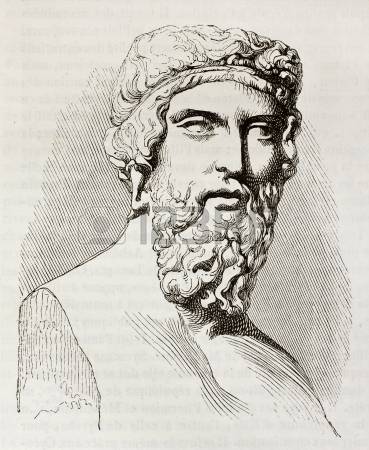
The Four Levels of Cognition in Plato

15270271-plato-the-famous-classical-greek-philosopher-bust-kept-in-louvre-museum-by-unidentified-author-publi

Plato’s bust in the Louvre by an unknown artist in Paris in 1842

The Four Levels of Cognition in Plato (From a paper written 
by Ken Finton in January 1967)

There has been much controversy in the interpretation of Plato’s allegory of the cave and the four systems or levels of cognition symbolized within this parable. This passage and the thoughts relating to it have done more than any other of Plato’s writings to establish him as working within a mystical understanding of the world process and have given rise to the transcendentalists and neo-platonists.

However, such controversy is only controversial to the non­-mystical minds that find that they themselves are caught in one or more of the under levels of cognition to which Plato refers and have to bring the highest level down to their own level of understanding in order to comprehend the whole, thus lowering the entire scale of Plato’s thought.

The mystic will implicitly understand Plato’s implications and will in­terpret them according to the prevailing understanding of his own time.

Plato first established that the Sun can be understood and symbolized as the Good. One will notice that there is no corresponding state of mind for this understanding. “You will agree,” Plato said, “that the Sun not only makes the things we see visible but also brings them into existence and gives them growth and nourishment; yet, he is not the same thing as existence.” (Chapter 23, p. 220, The Republic)

What reaches us from the sun is but light itself in its varying and dif­ferent forms? Elementary science shows us that the sun is responsible for all of the life energy processes on earth, directly and indirectly, from photosynthesis in plants to the completion of the life cycle in the animal kingdom. How then are we to understand that the Sun is, as Plato said, light, yet is not the same thing as existence?

A scientific understanding of this basic mystical intuition was not possible until Einstein made his tremendous discoveries about light and relativity. If we understand existence to be made of a material body and having a place in space and time, then we can understand how light itself hovers on the edge of existence, encompassing infinity, yet not being quite the same as existence itself because it has no place in space and time. A ray of light leaving the sun requires sixteen minutes to reach the earth from our observations; yet, would that ray of light have a conceptual mind it would have no consciousness that any time had elapsed but would think that it arrived at the moment it left. With Einstein the speed of light is absolute. [See, for example, a book on rel­ativity such as, “The ABC of Relativity” by Bertrand Russell.]

No material body can ever be pushed with the speed of light for as the speed increases the mass increases proportionately and could the speed of light be reached the mass would then become infinite.

Light itself, one can see, hovers on the edge of mystical unity and the mystical mind by directly experiencing light has understood what Plato meant by establishing the sun as a divinity. The ancients were more prone to give worship and credit to the basic energies than a modern man who takes their being for granted. The very term enlightenment signifies that one has directly experienced and understood the sacred power and qualities of light.

Light itself is a common denominator of all religious and mystical experiences. Christ said, “I am the light of the world!” By identifying himself with the light he said that he was the firstborn, the first cause, the original creation, and all things came into existence through him. Literary and religious symbolism throughout the world plays with the obvious connotations of light against darkness. Notice also that painters in representing spiritual transcendence play with the subtleties of light in its infinite variety of expressions. Plato identified light with The Good and in his levels of cognition noesis or intelligence appeals only after the understanding of the Sun and The Good.

Noesis is a Greek word referring to the perception of the mind, what the nous does. Dianoia (Greek: διάνοια) is a term used by Plato for a type of thinking, specifically about mathematical and technical subjects. It is the capacity for the process of, or the result of discursive thinking, in contrast with the immediate apprehension that is characteristic of noesis.]

Noesis is not “thought” but that understanding which is higher than thought, spontaneous rational intuition, an immediate act of vision that can only be grasped by the enlightened mind and is not to be confused with reasoning from premise to conclusion. The unenlightened attempt at this form of know­ledge is called rationalization, the sticky trap into which the majority of men fall. Rationalization is not so much in noesis as it is in the lowest state of cognition, eikasia, which we will refer to in a moment. The term eikasía (Ancient Greek: εἰκασία), meaning imagination in Greek, was used by Plato to refer to a human way of dealing with appearances. It is the inability to perceive whether a perception is an image of something else.

Below noesis, the spontaneous reaction to the vision of God is the level of dianoia or thinking. Dianoia is the conceptual mind within the subject-object relationship, aware of isolation, division, paradox, and seeming contradic­tion. This includes reasoning from premise to conclusion which always falls short of perfect knowledge and understanding.

Perfect knowledge cannot be communicated for to communicate is to bring it to another level of cognition. Dianoia or thinking recoils upon itself in a closed circle that can ap­proximate truth but never envelope or join it. A thought is countered by its opposing value or negative interpretation. A synthesis is formed between the two which is countered by another negative thought, thesis, and antithesis, until one looks up and finds that one synthesis puts him right back at his starting point and finds that thought has only brought him back to his beginnings once again. However, by going through the revolving circles of thought one comes nearer to the closer truth. A quick example would be in the abstract: A is +A. This is countered by +A is -A. This is synthesized by +A is both +A and -A. We ask then if +A is -A why talk about A? This is synthesized by the thought that this is so because +A is also -A.

The Greek word dianoia shows implicitly in its roots what happens with thought and why it is lower than enlightened intuition. Di– is a root word meaning “two” and ‘anoia’ is from a root word meaning mind. Dianoia is the process of viewing dually, the process of treating one’s own mind as though it is separate and distinct from the Divine Mind recognized by the mystic, the mind which is existence itself in all its past, present, and future possibilities, infinite and eternal in nature.

In Greek mythology, Pistis (Πίστις) was the personification of good faith, trust, and reliability. She is mentioned together with such other personifications as Elpis (Hope), Sophrosyne (Prudence), and the Charites, who were all associated with honesty and harmony among people.

Below the state of dianoia is the state of pistis which is similar to noesis in that it obtains the correct intuition, but the reason for that intuition and the understanding of it is not known. This is the state that assigns reality and existence blindly without attempting to define by thought (dianoia) the basic natures and reasons for actions and existence. Pistis is translated as belief, and as such, belief is insecure, destines to vacillate between its positive and negative state (doubt and belief) until the state of dianoia falls before noesis and liberation and mind control are brought about.

Plato calls the lower form of cognition eikasia. The difference between imagining and belief is one of degree. The lines between all states and levels are freely drawn and the human mind is free to pass through any or all at any given moment. The states themselves should not be viewed as constant, but shifting as man revolves around the circumstance of his being.

Imagining is an unsatisfactory translation of the Greek word eikasia. The root word is con­nected with eikon, image or likeness, reminding one of the English word ‘icon’, which has associations of blind, unquestioning acceptance of images, a worshipful idolatry that reveres the thing as it appears instead of the thing-in-itself that can be sought and clarified on the higher levels of cognition.

The historical unfolding of religious ideas I think best illustrates Plato’s objective ideas of knowledge. In the state of eikasia man’s worship is turned toward images and idols, not knowing that they are merely images and idols. In the state of pistis or belief man gives birth to definitions and concepts of a God and his faith swings back and forth between doubt and belief because he has made his concept so anthropomorphic that as his belief in himself ebbs, his belief in the mercy of a God goes through corresponding changes.

In the state of dianoia or thinking, man becomes aware of his isolation and the unfeeling process of the universe and the world-ground. Finally, denuding himself of conceptions, expanding his mind through thought, then vomiting the thought and standing naked in the presence of himself, man reached a state of enlightenment in which there is no mind-activity, a unity with light, and descending from this state into awareness of the outside world ho no longer marks off the world into rigid and separate categories and he is aware that he flows within the world-mind and is capable of entering into the highest state of human cognition, that of direct intuitive reason.

1.15.1967 Kenneth Harper Finton

REMEMBERING MAXINE

REMEMBERING MAXINE

DORIS MAXINE HARPER FINTON SACK
born October 18, 1919
died January 20, 2009

It occurs to me that when you are talking about the life of a person and the meaning of the time they spend on earth, you are entering a gray area—a scary place that not many people like to go. You are talking about the evolution of a spirit—the changes that a lifetime makes in a soul. At the same time, you are being judgmental, revealing your own values, beliefs, and patterns of thought in your words and praises— judging how the other person stood up to your own peculiar beliefs and evaluations.

Maxine was one of those rare species of human beings that took pleasure from being in the service of others. Not that she was totally selfless, as few of us are. Not that she was a saint, as none of us have perfect love, perfect lives, or perfect morals. Only the long-dead folks are made saints—and even then, it is only after the life they really lived has been selectively forgotten.

Born in Salem, Oregon, in October 1919 and living into January 2009 mathematically made Maxine 89 years old when she died, but the view outside the window of her person was truly remarkable. She never knew her father, Clinton Byron Harper. He died of Spanish Influenza before she saw the first light of day. She was raised by her mother, Cora Mae Gilmour, a descendant of European royal families that never had the slightest taste or knowledge of the diluted bluish blood that flowed in her veins. Cora took in washing and did people’s laundry during the Great Depression. She struggled hard to raise her three daughters, Florence, Ruth, and Maxine. Cora left Oregon shortly after Maxine’s birth to live in the middle of the Kansas prairie with her father, Hedron Walker Gilmour, a short, thin, and dapper man who loved the arts and entertainment. Hedron was an amateur magician and painter who became another big influence in Maxine’s early years.

After Maxine graduated from the Minneapolis Kansas High School, she moved to Denver, Colorado to live with her older sister Florence. She went to beauty school, though she rarely practiced the trade, just as her mother had gone through optometry school and never practiced that trade. Instead, Maxine waited tables on roller skates and went dancing with her friends as much as she could. It was at one of these dances that she met Ken Finton, an indisputably handsome man with Titian gold hair and a baritone voice to match those golden locks. He would become her husband of over 30 years and the father of her children: Kenny, Billy, and Jean Marie.

Ken would move her to Ohio where they would spend their life together near his family. They were married on November 15, 1941. Just a few short weeks later, Japan bombed Pearl Harbor. This act changed the lives of every American forever.

Maxine did not follow in the footsteps of Rosy the Riveter and go out into the workplace to replace the missing men in the American factories during the war. Instead, she had a baby —namely me—and sat out the war on the sidelines, staying sometimes in small apartments in Cleveland and Greenville, Ohio and sometimes with Ken’s parents. For a while in 1944 and 1945, she lived in Gainesville, Florida while Ken was stationed in Fort Blanding. They returned to Greenville where Ken first found work delivering fuel oil for the space heaters of Darke County’s many farmhouses. Afterward, Ken opened a small gas station with his Flying Red Horse Mobil Oil Company contacts.
Ken’s attempt at an independent life did not last very long. He was forced to take refuge in factory work when a new baby decided to come into the family. The money was not great, but the job was steady and not overly demanding. He worked in quality control inspecting taps and dies for a branch of the Detroit Tap and Tool company called Sater Products. This work lasted he until he retired at 64.

Around 1950, the schools in Darke County consolidated and left quite a few one-room brick schoolhouses vacant. Ken was able to buy one of these abandoned schools and had the idea that he could remodel it into an ideal two-story home with the help of his father and family. However, Ken was not a talented builder. The schoolhouse was divided into four 15×15 rooms with a bath and a hallway, but that is about as far as it went. This was much to Maxine’s dismay. She never liked the dwelling. It remains a schoolhouse on the exterior and a two-bedroom home on the interior to this very day.

Maxine spent the 50’s raising her two boys. There were plenty of instruction manuals on how to do this. Dr. Benjamin Spock had written his famous book that took the world by storm. In 1946, Spock was given the chance to publish his iconoclastic views in The Common Sense Book of Baby and Child Care. Along with everyone else, Maxine and Ken read it, of course.

In the 50s strange new gadgets appeared on the roofs of American houses as television became a household necessity. Leave it to Beaver, Father Knows Best, and The Nelson family’s The Adventures of Ozzie and Harriet did not hesitate to show how child-rearing in the 50s ought to be.

None of these shows were much like our own personal lives, but that did not matter much. With TV in most homes, everyone had a living model of the way things should be. A woman’s place was definitely in the home for everyone but school teachers and nurses. Thus, Maxine stayed home to raise the kids for most of the fifties, though she secretly would have preferred to be out in the workplace. Despite the social norm, Maxine did take temporary work as a cashier at some grocery stores and the five and ten cent store now and then. But in 1956, a new daughter that we named Jean Marie came as a complete surprise to everyone—fifteen years after the first baby—and once again life was changed for all.

As to religious views, the family was for the most part not serious about churches and religions. This changed a bit in the late fifties when Ken and Maxine started studying the Bible with John Timmons and his wife who were Jehovah’s Witnesses. I am not sure what swept them up into this strange, cultish group. It was probably the strong personality of John Timmons more than anything else, but I was young and impressionable and was swept up into this myself at the time. By the time I graduated high school, I had moved well beyond fundamentalist viewpoints, and developed interests in sciences, as well as philosophy, eastern religions, archeology, history, and music.

Ken died suddenly of a severe stroke in 1972. A few years later, Maxine sold off many of her Ohio possessions and moved to 1289 Clayton Street in Denver where she lived in a house that originally belonged to the Muckle family. Maxine’s sister Florence had married Paul Muckle. His parents had both passed away and the big old turn-of-the-century home sat empty at the time. Once again, like the time after Maxine’s graduation, her older sister Florence was there for her in her time of need and confusion. Florence had come to Ohio when my brother Billy was born and we had visited her several times in Colorado—once by train when I was around six and several times by auto when Ken took his vacation.

Maxine remarried briefly to a man named Robert Sack, thus getting another last name to append to the Harper-Finton appellation. Bob died of a heart attack within the first year of their marriage. Bob had moved into the Clayton Street house while Billy and I were in California. They did not get along well because Bob drank a lot and Maxine hardly ever has even a sip of wine. After his death, she remained in the house until Florence became ill with Alzheimer’s and had a serious stroke that left her with aphasia. Then Maxine moved in with Florence until Florence’s business affairs were settled and her many possessions were sold. They both retired to an assisted living facility until Florence became too incontinent for that kind of care. My wife Chaya and I bought a bigger home and moved everyone into that, but Florence only lasted about six more months.

Maxine was petite, 4’11” in her stocking feet. When she was young she looked a lot like Judy Garland. These are the facts and the statistics.

What is missing is the soul of the woman—and who am I to describe the soul of any woman, let alone my own mother?

This I can say: she loved word games and puzzles. She kept her mind extremely active and her brain exercised. She excelled at Scrabble and Word Puzzles.

She always looked on the bright side and hardly ever had a depressing day until the very last when she became ill with ovarian cancer and her pain and discomfort rose to epic proportions.

She easily excused the bad behavior of those around her and loved them anyway, a trait that often drove me to distraction and anger.

Her death came suddenly. In December 2008, she was not feeling well and went into the hospital. They found cancer on the ovaries and the seeds had spread throughout the abdomen. The doctors said she had a very short time to live.

She lasted one more hour after Barack Obama was sworn in as President of the United States.

Chaya and I spent as much time as we could with her. For years we had taken her to different places and vacationed with her from California to Ohio and Kentucky. After she broke her hip in 2002, she entered a nursing home. She came to like Allison Care very much, as there were people there of her age for and her days were filled with games and fun. We brought her back to our home almost every weekend. We took her to Yellowstone one year, Los Angeles and Yosemite another. We often went to Saratoga, Wyoming where we have a motel. Two of her grandchildren lived near the motel. We drove out to see the fall colors every year. We went to see the snow sculptures in Breckenridge every year. We watched the Broncos play football, went to movies, hung around the house, and took her to our musical shows. We saw the Nutcracker Suite ballet in 2007 and went to Garrison Keillor’s show at Red Rocks in 2008.

Those that knew her will surely miss her. She leaves a void that cannot be filled by any other person.

She leaves behind her son Kenny and his wife Chaya, her grandson Robert, her granddaughter Tasha and her great-grandson Zane, who loved to play games with her at every opportunity. She leaves behind her son Billy and her grandson, William Jr. She also leaves behind her daughter Jean Marie, who disappeared in 1998.

Maxine lives on now in our memories, our pictures, and our videos. She is well respected and loved in the minds of all who knew her.

DEARIE


Dearie” is a popular song written by David Mann; lyrics, by Bob Hilliard. The song was published in 1950. The Jo Stafford/Gordon MacRae record was recorded on January 14, 1950 and released by Capitol Records as catalog number 858. It first reached the Billboard magazine charts on March 3, 1950 and lasted 11 weeks on the chart, peaking at #12.[1]

The various versions of the song (combined, as was normal for Cash Box magazine reached #4 on the Cash Box Best-Selling Records chart.


Dearie, do you remember when we

Waltzed to the Sousa band

My wasn’t the music grand

Chowder parties down by the seashore

Every Fourth of July, test your memory

My Dearie

Do you recall when Henry Ford couldn’t even fix

The running board under a Chandler six

Dearie, life was cheery

In the good old days gone by

Do you remember?

Uh huh!

Well if you remember

Wonderful!

Well Dearie, you’re much older than I

What? Hey, wait a minute, Honey, I just got a long memory that’s all.

Dearie, do you remember when we

Stayed up all night to get

Pittsburgh on a crystal set

Keystone movies, Coogan and Chaplin

Made you laugh and then cry

Test your memory, my Dearie

Do you recall when Orville Wright flew at Kittyhawk

But take it from me I would rather walk

Dearie, life was cheery

In the good old days gone by

Do you remember

Uh huh!

Well if you remember

Well?

Well, Dearie, you’re much older than I

Ha Ha! I’ll kill you

Dearie, do you remember how they

Loved Harry Lauder’s act

My wasn’t the Palace packed

Jenny Lind presented by Barnum

Sang her sweet lullaby

Test your memory my Dearie,

Chicago all in flames

Sure caused a terrific row

They blamed it on Mrs. O’Leary’s cow

Dearie, life was cheery

In the good old days gone by

Do you remember? Well if you remember,

Well, Dearie, you’re much older than,

Quite a bit older than,

You’re older than I.