THIS LAND IS YOUR LAND

soundcloud.com/…/this-land-is-your-land-1

“This song is Copyrighted in U.S., under Seal of Copyright #154085, for a period of 28 years, and anybody caught singin’ it without our permission, will be mighty good friends of ourn, cause we don’t give a dern. Publish it. Write it. Sing it. Swing to it. Yodel it. We wrote it, that’s all we wanted to do.”

-Woody Guthrie


“WHEN WOODY GUTHRIE arrived in New York City he was known as “the Oklahoma cowboy.”

Guthrie was embraced by its leftist folk music community.  For a time, he slept on a couch in Will Geer‘s apartment. Guthrie made his first recordings—several hours of conversation and songs recorded by the folklorist Alan Lomax for the Library of Congress—as well as an album, Dust Bowl Ballads, for Victor Records in Camden, New Jersey.

Guthrie was tired of the radio overplaying Irving Berlin‘s “God Bless America.” He thought the lyrics were unrealistic and complacent. Partly inspired by his experiences during a cross-country trip and his distaste for “God Bless America,” he wrote his most famous song, “This Land Is Your Land“, in February 1940; it was subtitled: “God Blessed America for Me.” The melody is adapted from an old gospel song, “Oh My Loving Brother.” This was best known as “When The World’s On Fire,” sung by the country group The Carter Family. Guthrie signed the manuscript with the comment, “All you can write is what you see, Woody G., N.Y., N.Y., N.Y.”

He protested against class inequality in the fourth and sixth verses:

As I went walking, I saw a sign there,

And on the sign there, It said “no trespassing.” 

[In another version, the sign reads “Private Property”]

But on the other side, it didn’t say nothing!

That side was made for you and me.

In the squares of the city, In the shadow of a steeple;

By the relief office, I’d seen my people.

As they stood there hungry, I stood there asking,

Is this land made for you and me?

These verses were often omitted in subsequent recordings, sometimes by Guthrie. Although the song was written in 1940, it was four years before he recorded it for Moses Asch in April 1944. Sheet music was produced and given to schools by Howie Richmond sometime later.

EARLY LIFE:

Guthrie’s early life was no an easy road. His older sister, Clara, died in a coal oil fire from a heating stove when he was seven.  His mother, Nora Belle, was institutionalized after setting a fire that severely burned Guthrie’s father.

In 1920, oil was discovered in Okemah, which led to a boom for a few years. Then the oil dried up, and the people of Okemah were, Guthrie said, “busted, disgusted, and not to be trusted.” His father quit the town for Texas, leaving 14-year-old Guthrie to play harmonica for sandwiches and coins on the streets of Okemah. His older brother, Roy, became the struggling family’s main source of support.

Woody’s father ended up in Pampa, Texas, and sent for his son.

When he was 19, Guthrie met and married his first wife, Mary Jennings, with whom he had three children, GwendolynSue, and Bill.[

With the advent of the Dust Bowl era, Guthrie left Texas, leaving Mary behind, and joined the thousands of Okies who were migrating to California looking for work. Many of his songs are concerned with the conditions faced by these working-class people.

in 1931, formed the Corn Cob Trio, and enjoyed his first taste of public success before succumbing to the realities of the Great Depression. He hitchhiked and freight-trained his way across several states, soaking up the stories of “dustbowl refugees” and refining his songwriting skills. In Los Angeles, he joined up with a woman named “Lefty Lou” and became popular with the relocated Okies living in cardboard and tin shelters.

He wrote his most famous song, “This Land is Your Land,” in New York City while living in a building for transients called Hanover House, at the corner of 43rd Street and Sixth Avenue, one block east of where the ball now falls on New Year’s Eve in Times Square.

He’d seen enough during his travels to know that for many Americans, there was nothing blessed about their lives. He wrote the song in 1940 but didn’t record it until 1944. It was published in 1945 in a mimeographed booklet with 10 other songs and some of Guthrie’s drawings. The booklet cost 25 cents

Sources:    https://en.wikipedia.org/wiki/Woody_Guthrie, The Writer’s Almanac

THIS LAND IS YOUR LAND

(words and music by Woody Guthrie)

Chorus:

This land is your land, this land is my land

From California, to the New York Island

From the redwood forest, to the gulf stream waters

This land was made for you and me

As I was walking a ribbon of highway

I saw above me an endless skyway

I saw below me a golden valley

This land was made for you and me

Repeat Chorus

I’ve roamed and rambled and I’ve followed my footsteps

To the sparkling sands of her diamond deserts

And all around me a voice was sounding

This land was made for you and me

Repeat Chorus

The sun comes shining as I was strolling

The wheat fields waving and the dust clouds rolling

The fog was lifting a voice come chanting

This land was made for you and me

Repeat Chorus

As I was walkin’  –  I saw a sign there

And that sign said – no tress passin’

But on the other side  …. it didn’t say nothin!

Now that side was made for you and me!

Repeat Chorus

In the squares of the city – In the shadow of the steeple

Near the relief office – I see my people

And some are grumblin’ and some are wonderin’

If this land’s still made for you and me.

Repeat Chorus

©1956 (renewed 1984), 1958 (renewed 1986) and 1970 TRO-Ludlow Music, Inc. (BMI)
 

GERMANWINGS FLIGHT 9525

By Kenneth Harper Finton ©2015

An imaginary trip into the mind of Andreas Lubitz

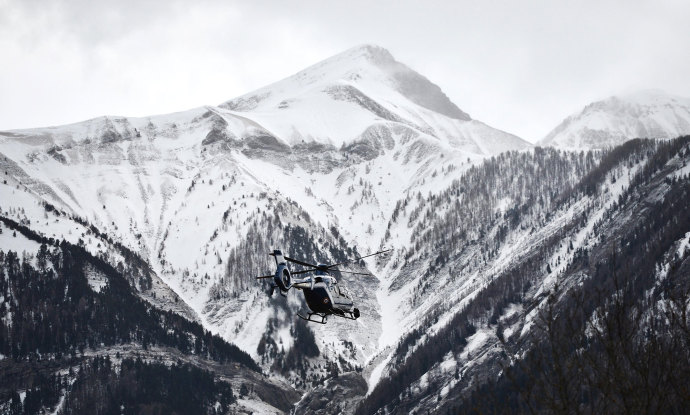
   A French helicopter departs for the site where Germanwings Flight 9525 crashed.                  CREDITPHOTOGRAPH BY MUSTAFA YALCIN/ANADOLU AGENCY/GETTY

A French helicopter departs for the site where Germanwings Flight 9525 crashed.              CREDITPHOTOGRAPH BY MUSTAFA YALCIN/ANADOLU AGENCY/GETTY

Tired of living, spurned in loving, deficit in compassion,

Andreas Lubitz and his crippled amygdala

Donned his smart uniform and climbed aboard the plane.

A pretty stewardess smiled at him,

Bid him a good morning as he passed.

She smelled of a musky perfume

That reminded him of the sex he often craved with her.

He found sex to be an animalistic and ludicrous practice.

Love had always been a dream that faded away to sorrow.

He returned to her a faceless smile without meaning.

He took his place in the cockpit beside Patrick, his pilot.

It was less that two hours to Dusseldorf from Barcelona.

Patrick was loquacious, almost collegiate in manner.

As they bantered back and forth, Patrick’s banal conversation

Bored Andreas to death. He could only fake a smile for reply.

Andreas thought about how he hated God for giving him life.

An aching desire for release from the prison of time

Had overcome him. A dull ache of depression swept over him

As he remembered all the hideous assaults he had endured.

It was as though he wore glasses that saw only

The evil of time and hid away the pleasant moments.

When Patrick left the cabin, Andreas pushed the button

To lock the door so that he would not have to bear him any longer.

Alone in the cabin, with only the sky in his eyes and the engine noise

In his ears, Andreas was at last alone with himself.

He hated his aloneness. “Everyone is suffering in their meaningless

Lives just like I am,” he thought. The future brings nothing

But more disappointment, times filled with melancholy,

Nights filled with helpless thoughts, days filled with foolish actions

That try to mitigate the absurdity of living a desperately miserable existence.

Dog eats dog, life eats life, panicked schools of fish swirling

In circles as the sharks attack the outer layers of their being.

The images consumed him. The irrelevance of his very being

And all those around him felt like the beating drum of a hated heartbeat.

Mushroom clouds raining death, pits with decapitated bodies killed

By fools who thought themselves righteous appeared in the gray sky

When he adjusted the course of the plane to fly at one hundred feet.

“It will soon be over,” he thought to himself. “I am finally on control.”

He heard a frantic knocking on the door as Patrick tried to gain the cabin

His gut tensed, his breath came hard and fast. He could hear

The hysterical screams of the passengers behind him.

No sympathy for their plight crossed Andreas mind.

“They are all going to die anyway,” he thought.

“Today is as good a day to die as any other. Today is better.

It will save them from through suffering their ignorant lives.”

Adrenaline rushed through Andreas veins as the mountain

Loomed before him. He felt like a soldier entering battle.

“It is a good day to die,” the voices around him exclaimed.

He remembered the stewardess with the sexy perfume

Who greeted him when he stepped onto the plane.

Her voice was among those screaming behind him.

“I will not fuck her,” he told himself. “She will not tempt

Anyone to fuck her now. I can make sure of that.”

There was power in the thought; power had always escaped him.

The remembered scent of her perfume hung in his nostrils.

His own breath came hard and deep as he thought about

Having sex with her. Death, he thought, would be like conception,

One timeless contracting orgasm would begin the journey

To another useless, meaningless and painful life.

Another contraction would snap the miserable body away from experience

And into the vast nothingness of the universe.

He could picture himself letting go after the shock of impact.

It would be his final orgasm, his final statement, his final action.

POSTMODERN MAN

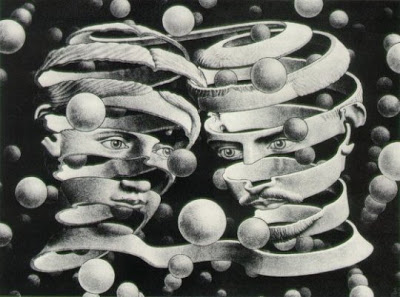
escher postmodern love relationship society free conversation

by KENNETH HARPER FINTON © 2015


While I was busy eating
My carrot spoke to me.
It said, “You simple, idle fool,
You cannot swallow me.”

“You grubby root,” I said to it,
“That’s not for you to say.
Your purpose, so they tell me.
Is to look the other way.”

 While I was busy reading
The author chastised me.
“These thoughts that you are thinking,”
He said, “are not of me.”

 While I was busy sleeping
The world went bust on me.
While I was busy drinking,
I snubbed reality.

 While I was  busy writing
My friends all disappeared.
When I was busy dreaming
Then some would reappear,

Half dead and resurrected
For allegiance can’t be bought.
Tortured and neglected,
They swam across my thoughts.

I realized the truth therein
And closed the book of dreams.
It seems that nothing ever was
Exactly what it seemed.
 

Postmodernism is a late-20th-century movement in the arts, architecture, and criticism that was a departure from modernism. Postmodernism includes skeptical interpretations of culture, literature, art, philosophy, history, economics, architecture, fiction, and literary criticism

THE MARE’S NEST

1. Mare’s nest: a complex and difficult situation; a muddle

2. an illusory discovery such as “the mares next of perfect safety”

songs1

©2017 Kenneth Harper Finton

THE MARE’S NEST

When I’m good, I’m very good, but when I’m bad, I’m better.” -Mae West

   The child and the boy that Adam used to be was so foreign to him now. Looking over pages that he wrote years ago, Adam barely recognized his former self as the person who wrote them.

   Adam came from a conservative and opinionated small town in rural Ohio. Those who lived in his little town often claimed it was God’s country. Adam supposed that it might be good for the spirit to be content and proud of your community. God’s country seemed to be a stretch, though. So many wonderful spots in the world better fit that description.

   Life seemed to be so much more idyllic and simple then. Yet, it seems to Adam that this warmer view one has toward the past is never the case. Faded memories—the exclusive warm selections of chosen recollections—give the illusion that daily life was richer in the past than in the present. This is the mare’s nest. We are born in illusion and live most of our lives in a delusional fantasy with the blessings and approval of those who surround us.

II

   Religion and conservative politics were the mainstays of community belief when Adam was being raised. He was brought up to believe in things that were not real, but Adam had a problem with these beliefs. To suspend rational thought and dive into the unproven waters of belief was much easier when Adam was a child.

   Adam’s parents were good to him. They did everything they were supposed to do with a minimum of complaints and resentment. They were neither rich nor poor, neither too conservative nor too liberal.

   These were the days when a mother was expected to stay home and raise the children. The father was expected to bring in a paycheck and support the family. Yet, even then, the very ground of these expectations was trembling.World War II had shown women that they could manage without a man in charge. The experience of hundreds of thousands of years had proven to be false. The seeds of personal independence had taken root in even the most dependent of women. A new world was being born before Adam’s eyes. Only a very few seemed to realize that this was so.

III

Social taboos confuse men and women alike. A natural curiosity about the difference between men and women develops early in life. Adam remembered when he was four and took the train from Ohio to Colorado to visit his grandmother. He had little experience with the female sex. His curiosity got the best of him. His grandmother lived next to a family that had a daughter Adam’s age. She was deliciously blonde, wore a taffeta dress, and smelled of Ivory Soap. Adams’s play was often defined by guns and cowboys, trains, and fortifications. Society wanted him to grow up to be a good soldier. He was trained to defend his family and national interests while little Susie played with dolls and tea parties. It was the normal thing.

Adam had no idea who thought it up, but one warm afternoon they decided to explore one another’s bodies. Adam had no sister, so he was very curious to see what lay beneath that taffeta dress. “I’ll show you mine if you show me yours,” he said.

She was every bit as curious as Adam. They went behind the shade of a weeping willow and she pulled up her dress. She wore white panties that were different from Adam’s jockey shorts. She eagerly pulled her panties down and Adam saw a vagina for the first time in his young life. How wonderful it looked to him—almost puffy and so very different from what he possessed. She took her hands and pulled the labial folds apart so that Adam could see the inside. He could see little curds of a cheese-like substance.

“I get that, too,” he said.

“Let me see,” she replied.

His penis quickly grew stiffer and larger. He pulled down his pants and showed her what he meant. Adam had never been circumcised, so he pulled back the foreskin and exposed the same little white curds that she had proudly displayed. “Do you want to touch it?” she asked.

“Maybe.”

“Well, you either do or you don’t,” she said.

“Yeah, I guess I do,” he said.

“Then go ahead. Touch me. I like it when I rub it right here. You can try if you want.”

Adam took his index finger and rubbed her there. It felt very good and he had a tight feeling come into his groin, the same feeling he had when he climbed a rope.

“See,” she said. “This is fun. Do you want to kiss it?”

“Not really,” he said. “Boys don’t kiss girls.”

“Yes, they do,” she said, “my Daddy does that to my Mom.”

“Well—what if I just touch it.”

“That’s okay, but I want to know what it feels like to be kissed down there.”

“How do you know your Dad does that?”

“I’ve seen them do it when they don’t know I can see them.”

“Oh,” I said. “My Dad doesn’t do that.”

“How do you know?” she said. “I bet he does. Then he takes his thing and he puts it into her and they wrestle around on the bed.”

“Why?” Adam asked.

“I don’t know,” she replied.

A voice from the house could be heard calling her name. “That’s my mother,” she said. “I gotta go.”

She pulled up her panties and ran off to the house. Adam had the feeling that he was in deep trouble. Something told him that he was not supposed to do that with her. Suddenly, he felt panicked.

He crawled up an apple tree as far as his limbs and legs could take him, Sure enough, within ten minutes his mother’s voice could be heard in the distance. “Get in here this moment,” she said. “Susie’s mother told me what you did.”

“What did I do?” he asked, knowing full well that he was in deeper territory that he had never before explored.

“You damned well know what you did,” mother said. “You were bad.”

Adam was totally embarrassed. His head hung low. If he were a dog, he surely would have put his tail between his legs.

* * *

Though childhood lasted more than a dozen years, Adam’s recollections of it seemed to reduce it to a few weeks. Almost all of it was learning and play and Adam loved both equally.

He had the best of many worlds. He lived on a couple of acres in the country, but his family was still close enough to ride his bike to town. Adam attended the city schools. He could ride his bike to visit friends and he could explore the creeks and wooded lands that surrounded his home. He felt so very much alive and so very happy to be.

Later, he would versify these feelings:

The Veils of Time

How often down these gravel roads my bike and I would roam.
Downhill like the lightning flash, up with winded moans …
Mapping streams and woods about me, finding spots where no one came.
Africa could be no stranger than the place in my dreamscape.

Ghosts of dead forgotten Indians, birch canoes and forest game,
hidden in the brambles forest, there beside the fields of grain.
Tadpoles swam among the minnows, dragonflies would dart and play.
Water bugs and prickly nettles, part of each midsummer’s day.

As it was in the beginning, so remain these things today,
in the places man’s forsaken, wilderness, ten feet away.
From a child’s imagination, pterodactyl seeks his prey.
Ages past still live forever when the veil of time is raised.

IV

Adam was always in love. Girls were so pretty and different from the boys with whom he camped and hiked. Their skin was more clear, their hair so long and shining, their dresses rustling and clean smelling. Their grace seemed like music in motion.

Every day was a new adventure. Every person Adam met filled him with curiosity. Everything he learned about the land and customs around him filled with satisfaction. He has never experienced the like since.

In kindergarten, he met Mary with her striking long brown pigtails. Mary owned a pony. Even though she lived in town, she kept the pony in a shed back by the alley. Since cowboys and horses are inseparable and Adam was a young cowboy, she attracted him much as moths seek out the flame. Mary came to visit Adam often. When she could not come to see him, he rode to town on his bike to see her.

Mary and Adam never made experiments and explorations such as he had with his grandmother’s neighbor some years before. Neither the need, the desire or the curiosity ever arose. She made certain of that. Once when Adam had hitched a ride with her on the back of her bike, he reached up to hold onto the seat and she told him, “Watch where you put your hands.”

Her words, though, had the opposite effect. It called attention to her khaki-clad shorts that loosely held her shapely buttocks. Adam wanted to put his hands around her and hang on for life. To this day, Adam is left to wonder if that is what she wanted as well.

There was a television show in the afternoon in the 1950s that featured people being married before the camera. The bride, dressed in white and lovely as a sunrise, came slowly walking down the aisle to her betrothed. Mary and Adam would secretly watch it and play out the parts in front of the TV. He would spend many a lonesome night snuggled with his pillow and dreaming that the long length of her lay warm beside him.

Of her, Adam was later to write:

My love, she wore a gingham dress.
She wore her hair in braids.
Far too young for sweet caress,
our love was heaven made.

We spent a thousand idle hours
together in our dreams,
We wandered near the ancient oaks
and napped beside the stream.

I thought we might be married there,
and then, when time be lost,
side by side, eternally,
we’d rest beneath a cross.

But childhood washes from us all,
and dreams seek other fancies.
Soon she walked with someone else,
this lovely, freckled lassie.

Sure enough, I moved away
to seek some higher labor,
and to this day I’ve not returned
nor seen my long-lost neighbors.

When finally this childish love
grew up and found some others,
I know when I lay down to rest,
they’re one with one another.

Follow me at kennethharperfinton.com