Time is a measurement. Because a measurement takes place only in the cognizant world, time is in the mind.
We who measure time create a timeline.
A line is simply a point that moves. Add time, and a moving point becomes a line. The same point is repeated over and over in the line’s appearance, the difference being the time and space. The same point is everywhere at one moment. To me, this is the secret of singularity.
Space-time exists in an eternal now, a pseudo moment that holds all that ever was and that which will ever be. Because time itself is relative to movement and speed, a photon begins and ends at the same moment, much as the Higgs boson does. We measured the duration of a moment differently because we measure it from our own viewpoints.
As humans, we have a past and a future because we live and operate in a time and space that travels at a particular speed, and we view ourselves as being in a specific region of space-time.
We can discern the artifacts and traces left by events that occurred in what we see as ‘then’, even though they take place in the eternal now. We are in different sections of space-time, experiencing some of the infinite number of experiences that can come into being in a world of endless possibilities.
We do not define space-time occurrences. What we define as individuals is infinitesimal. The part does not represent the whole. The whole defines the part.
While perception is observing and creating, what we see as being in the past – traces of particles and waves from the observed portion of time and space – can be seen in other sections of space and time that also exist in the eternity of now. Our perceptions create the world we live in, just as the perception of that world makes us.
Consciousness has no mass. It only needs awareness of another, and in that awareness, our entire personal universes are built. We exist in potentiality and come into existence in a space-time where we find ourselves materialized. Individually, we are but one small facet in the infinite number of potentialities that consciousness makes possible.
Because the now is an eternal moment, there is literally no such thing as a beginning and an ending. The eternal components of reality constantly change form. This change makes it appear that there are beginnings and endings, but what is changing is the conversion between matter and energy and between energy and matter. These are eternal processes. Even the information involved in these processes is preserved both physically and consciously, as in memory and relics, though both are sketchy representations of the past events.
Our universe can be viewed as a field of perceptive awareness that behaves in a quantum fashion. Its task is to experience and create new experiences. It is everywhere at once. It exists for us at this exact moment. That one moment is eternal. It never ends. Nothing came before it, and nothing comes after it. It is eternal. This very moment that we experience now is written in time and space in that eternal moment.
This process does not begin, but it has always been in the moment we call now. It was now, then, and it will be now in the future. That which changes is our viewpoints.
For much of my life, I have been trying to understand cosmic origins. I have tried to relay by words, music, and verse concepts of the many visions have come to me over the years. It is a most difficult task to bring together––atheists and theists, true believers and deists. We are a divided people in more that our politics and religions. We are segregated by custom, sex, national borders, local borders, economics, levels of education, genetic makeups, intellectual levels, personality types and race. Hope, essential as it is in social interactions, seems to be sinking when it needs to rise. Our world needs a release from the web of existential anxiety the modern world has created.
Scientists tell us that the universe was born about 13.8 billion years ago. Through the aeons that passed, our modern lives evolved from nothing into the complex situations that we find ourselves immersed in and call the present time. Everyone seems to have a theory of why this is so. Some ideas seem much better than others, yet all lead that same demise that our emotional states want desperately to reject, the cessation of being itself.
We try to contemplate the nature of the world—develop ideas about the building blocks of nature that create this world around us—by looking into the atoms that make our physical universe searching for the smallest particles.
Is there such thing as the smallest particles? How could there be? Something would always be smaller than the smallest until it disappeared into infinity—which is exactly what matter seems to do.
Matter seems to be made of vibrating wave frequencies. Electrons have different states of energy. We see solidity in our immediate world, but the micro world seems to be a sea of informational energy that creates the appearance of solidity, while most of the manifest universe is a vacuum in space. We do not live in the micro world. We know that if we crash into these solid mountains of elemental rocks, it will injure or destroy us.
Donald Hoffman—professor of cognitive science at the University of California, Irvine—wrote: “On the other side are quantum physicists, marveling at the strange fact that quantum systems don’t seem to be definite objects localized in space until we come along to observe them—whether we are conscious humans or inanimate measuring devices. Experiment after experiment has shown—defying common sense—that if we assume that the particles that make up ordinary objects have an objective, observer-independent existence, we get the wrong answers. The central lesson of quantum physics is clear: There are no public objects sitting out there in some preexisting space. As the physicist John Wheeler put it, “Useful as it is under ordinary circumstances to say that the world exists ‘out there’ independent of us, that view can no longer be upheld.”
Hoffman continues: “Not only are they ignoring the progress in fundamental physics, they are often explicit about it. They’ll say openly that quantum physics is not relevant to the aspects of brain function that are causally involved in consciousness. They are certain that it’s got to be classical properties of neural activity, which exist independent of any observers—spiking rates, connection strengths at synapses, perhaps dynamical properties as well. These are all very classical notions under Newtonian physics, where time is absolute and objects exist absolutely. And then [neuroscientists] are mystified as to why they don’t make progress. They don’t avail themselves of the incredible insights and breakthroughs that physics has made. Those insights are out there for us to use, and yet my field says, “We’ll stick with Newton, thank you. We’ll stay 300 years behind in our physics.”
In other words, Hoffman thinks that the universe itself if a mental conception composed of independent conscious agents with varying degrees of complexity, all of which are but informational viewpoints that communicate with one another. From the smallest to the largest, all is composed of the same non-material—awareness and consciousness. Communicating conscious agents can merge to form other conscious agents.
DOES IT MATTER?
Does it matter much if the universe is a mental conception or a physical reality? Are the results not the same? Both lead to the same questions and dilemmas either way. Can understanding of the cosmos as a mental conception be an emotional solace to existential anxiety?
Life becomes one riddle after another for the thinking person. Solving one riddle creates many more to take their place. Debunking one myth leads to another, as the world is both mystic and mythic.
We peer into the universe with our telescopes and our probes and find awe-inspiring beauty of all kinds. Who can object to the beauty of Saturn’s rings set in the blackness of the sky or the wonderful things that nature provides for our eyes and ears to hear and see? At the same time, we wonder why these things even exist for us to see. Why should the beauty of the world go unseen and unappreciated for billions of years while life on Earth evolves enough to care about it? Who or what experienced these wonders before the dawn of time or the emergence of living things? What was the observer that brought our universe into view?
This is where the idea of a mental conception of the world is most convincing. In order for there to have been an evolutionary past through the birthing of elements in stars, there had to be an observer.
Many believe that God is the creator of the universe and experienced the void of the universe alone long before the world came into being, but everyone has their own conception of what this God might be. The Abrahamic religions give God a male gender, a father figure—though giving birth to the universe seems to be a female attribute. Cultures create their own myths to explain their existence.
In the long run, does it matter whether God created the universe (as some religions claim) or physicality came into being and evolved into the present (as some scientists believe). Either point of view is obsolete with quantum mechanics. Yet, both views point to an event from an undefinable zero dimension. Whether we call it creation or the Big Bang, we refer to the same event that came from beyond time and space.
Some assume our universe came from the remnants of a previous universe. Some think it came from nothing at all, and some say something cannot come from nothing.
I, for one, find it much easier to visualize timelessness than to envision the beginnings and endings of time. I also find it easy to visualize timelessness as having no concept of duration, but focused on experience instead. The timelessness of the dimensions above our own experience seems to perfectly balance our mortal experiences with the immortal potential of our existence. Duration is a concept stamped upon experience by intellectual branders. Someone dreamed up the idea of measuring time, but did not really comprehend the nature of timelessness and pure experience. How long the experience is felt is not nearly as important as the experience itself.
Where did our consciousness reside before we came to be born? Is it possibly the same non-place in which we dwell when we die? We have all experienced the place where our awareness of ourselves was blank and united with everything. Before we began to exist in this time and space, we all experienced a blank infinity of time and memory. On a personal level, eternity is that which your consciousness was before this life experience. Eternity can be pictured as a sleeping form of awareness that—when awakened—develops sensory experience such as touch and perceptions. In time, the subconscious and the self-conscious carry out the business of life and survival. As the universe is born from infinity, we are as well. Infinity is that which was before this life experience. The world about us is similar to a continuous dream that is made real by our consciousness awareness.
Because the zero dimension is static and unchanging, the first and second dimensional structures are also timeless in that they are everywhere at once. That there is structure in the lower dimensions has some experimental evidence.
“So far, there may already be one piece of experimental evidence for the existence of a lower-dimensional structure at a higher energy scale. When observing families of cosmic ray particles in space, scientists found that, at energies higher than 1 TeV, the main energy fluxes appear to align in a two-dimensional plane. This means that, above a certain energy level, particles propagate in two dimensions rather than three dimensions.” (https://phys.org/news/2011-03-physicists-dimensions-universe.html#jCp)
The emergence of first and second dimensions begin the structure of our physical universe. Time is of no concern in these dimensions. The second dimension creates space where energies can move and react, physical fields can form universally in this dimension. The third dimension ads depth and height and the fourth expands space by creating the duration that we know as time.
Everything in the universe is projected in three dimensions from its zero dimensional source. It has been called the Void, God, Infinity, First Cause, The Great Spirit, Universal Mind, or many other such name devised to express the idea of an unknowable non-thing that is beyond existence, being and conception.
Infinity, since it contains all things and all events began from within it, must be the source of the physical laws that we discover in nature. The finite is contained within infinity.
INFINITY AND THE UNIVERSE
There are those who cannot accept that there is such a thing as infinity. They consider infinity a simple conception or a mathematical symbol. For some people, the dogmatic religious world hurt them emotionally when they came realize that that the dogma the world fed them is false.
But it is not that easy to dismiss infinity. If something is finite, then there must be something that is not finite. That would be the infinite.
1 a: the quality of being infinite. b: unlimited extent of time, space, or quantity: boundlessness. 2: an indefinitely great number or amount such as an infinity of stars.
When we think about how the world about us came to be, we have only two choices. It has a beginning or it is endless and has no beginning. Having no beginning leaves us in a quandary, as the universe should have run out of energy and depleted itself long, long ago. There would have to be a continual creation of new energy to replace that which was lost to the entropy of dissipation for a universe to be eternal.
If no universe existed before the Big Bang, then what was there? What was in its place when there was no place? Nothing? But nothing cannot exist because it has no being. The ‘it’ we seek cannot be anything but infinite and boundless nothingness which cannot have existence.
The world, it is said, cannot come from nothing. ‘Nothingness’ may not operate under the same laws of physics by which ‘somethingness’ operates. We cannot assume anything about the physics within nothingness. We cannot really say anything about what nothing is.
However, there are potentially satisfactory answers to the puzzle of eternity, infinity and first causes. These answers are simple to understand by any person that is able to shed his or her preconceptions that have been fostered by the cultural experience.
That answer is that physical reality is built in dimensional layers. The first dimension is infinite and eternal—no beginning nor endings—no particular spot in space nor place in time.
The first dimension is an infinite point that contains all that is possible to exist within it because it is all that exists. It is much like the singularity that the Big Bang theorists posit as the infinity dense point from which all came. The universe always exists within this eternal first-dimension, but not in physical form.
The second dimension is a flat plane which spreads in all directions from the infinite point. Being infinite as well, this dimension has no beginnings and endings. This second-dimension is without the perception of time, but originates all further dimensional experience. It is the foundation for the concept of space.
Ultimately, dimensions are viewpoints. Viewpoints are mental constructions. Each dimension contains all the information from the previous dimension while adding important new perceptions.
The two-dimensional line, for example, is the point replicating itself over and over, appearing to travel in a straight line, a vector from the original infinite point. The universal lines that form the universal field is the repetition of the infinite point throughout space. The point is endless and timelessly recurrent. By the expansion of its being, the point fuses with those primal copies of itself to form space and a second dimension. That fusion releases vast amounts of virtual energy that radiates from the original point to form myriads of universal fields. As this radiation spreads there is an expansion of space in the second-dimension.
It is the second dimension that contains the blueprint for the three-dimensional world we see with height, length and width. The two-dimensional universe is flat, like a blueprint. The beginning of the universe is easily comprehended if we hold the view that the physical laws which determine the mathematics, probabilities and shapes essential to universal existence exists in the second dimension. We do not create these laws and principles. We discover them.
As a picture of the natural world can be recorded on flat surfaces like paper and film from the artists perspective, the second dimension can hold our three-dimensional viewpoint in an encoded series of digital bits.
The third and fourth dimensions limit the space of the second, changing its physicality to a closed, temporal space where duration, height, volume, and depth become apparent. The process can be visualized as similar to the Japanese art of origami where three dimensional space is unfolded from the two dimensional patterns. By the folding of space, volume, height, and width emerge in a three-dimensional universe, but some space is lost in the process, the same way that some paper is lost on origamic folds. The three-dimensional universe is finite.
The step to physical reality comes through events in four-dimensional space.
Four-dimensional space combines time and duration with three dimensional space. It is the basis for the theory of relativity. Time and space are fused and effect one another as the fourth-dimension emerges and posits another aspect to the third dimensional viewpoint.
In this simple explanation of dimensions, there is a missing ingredient of vital importance to the universe—the mental component of the observation.
THE MENTAL UNIVERSE
Awareness precedes physical existence . Awareness is invisible. It cannot be touched or measured, yet it is ever present even when we are not conscious of it. Awareness builds consciousness through the fusion of random information into organized information.
The cosmos is projected into being from a non-dimensional and timeless zero dimension. Even if the remains of previous universes should form the present incarnation, those first universes have to start somewhere. That somewhere is beyond time. It has to come from the non-dimensional.
What we experience comes from our personal consciousness—our awareness of being in the moment. What is this awareness? Is it a sense that arises from our human brains and nervous systems? If so, then awareness dies when we die. Are plants are aware? Are microbes aware? If you think they are not, perhaps you have the wrong conception of what awareness is.
Many people think that awareness emerges late in evolutionary history. To some, it is unthinkable that awareness should precede evolutionary development. Consider an unthinking rock or an ignorant chemical reaction. Where is this awareness in primal nature? What causes awareness to rise in the first place? Is it inherent in the natural order? Are reactions awareness, or are we mincing words? Are interactions aware?
In quantum physics an observer and an interaction is the same thing. Only objects interact. Even a particle colliding with another particle is an interaction and therefore an observation as well. Observations and interactions do not need to have to have concepts to produce effects and events. They are the events.
Our awareness uses the tools of perception to identity itself and the outer world. Were dinosaurs unaware? Are single-celled life forms unaware? A better question is to ask if they have any form of perception. Obviously, if they react to stimuli they have some form of perception. If they have perception, they have awareness—not on the grand scale that mammals have developed, but their reaction to observation and touch shows that they have awareness built into their systems.
Quantum mechanics posits that the universe is a connected unit, each part having an effect upon another. Everything in space and time has a cause and an effect. If it has no cause and effect, it is not in space and time. Quantum mechanics also posits that events must have an observer/interaction to be an event. The event itself would not happen unless and until it is observed. The interaction itself is an observation.
This is another clue that the world might be a mental system with a physical component. Observers are generally thought of as being people, but they can also be a system. An observer is person or a system that observes. In other words, before we can have a world, we need events. To have events we need an observer. To have an observation we need awareness of an object or an event.
The essential quality for an observation or an interaction is to have awareness of an object. Mental awareness, then, is essential for the existence of time and space. All things are not only produced by mental awareness in its myriads of localized forms, but all things are formed from the eternal and non-material awareness which has always been present in the eternal now.
Something has to be a first cause for the parade of time and space to exist. This first cause cannot be material, yet the material world was produced from it. Our dreams are not material nor real, but the fields involved in neural synapses produce what appear as images in our minds. This is similar to the construction of the universe as well.
Awareness is invisible. It is not something that we can touch or measure, yet it is ever present even when we are not consciously aware of anything.
Awareness is the observer that is awakened by reactions to objects from within and outside ourselves. These reactions to our inner and outer worlds create information that eventually organizes itself and becomes experience.
Awareness does not need the concept of time and space. It creates time and space when it awakens to stimulus from another.
Awareness is essential for the building of a universe.
Eternal awareness may be the proper name for the concept of the mind of God.
Nature is the child of awareness.
Science does not know precisely what a mind is or from whence intelligence springs. Physical theories surmise that it emerged from physical-chemical reactions deep in the remote past. However, we cannot deny the intelligence manifested by nature that experiments with form after form and drives evolutionary change. We cannot deny the subconscious that regulates not only our personal physical systems but the intelligent patterns found in nature. If the mind were made only of nerves and synaptic systems alone, evolution would not have produced our unique world. Plants and chemical bondings have no nervous systems at all, but come up with intelligent and elegant solutions to problems and events. The mind is not a material thing. It is a primal force.
The universe is eternally present even though it may not always be manifest as it appears to be in our three-dimensional reality. Reality takes shape in all dimensions, but we are primarily concerned with the third and fourth-dimensions where our experiences are realized.
Our experience is also recorded in the second dimension in an eternal and timeless form. One unique property of awareness is that it does not have to be aware of anything at all. It can be empty—void of content of any kind—and still be awareness. Awareness needs no physical objects of which to be aware. It does not even need to be aware of itself.
Even our personal awareness rests and ceases to be aware temporarily. It happens daily. Why cannot these lapses of awareness last for eons or epochs, perhaps billions and billions of years. In these empty spaces, universes cease to be. When they exist, the blueprint for reality exists infinitely in the second dimension which holds all time and events, potential or actual.
Then how does the world come to be?
Consider the dimensional foundation of the universe. Assuming that awareness is non-material, massless and infinite, then a universe without dimension is the zero dimension, an immaterial zone beyond time and space where primal awareness sleeps and dreams. Only when awareness awakens does the first dimension come into being. That first dimension is a point that exists everywhere and contains everything that is possible to contain. It is much like the singularity envisioned in the original big bang theory. This point is infinite. Quadrillions of copies of itself exist at this point. All are infinite and massless as they take up no time and inhabit no space.
When these points move to form a second dimension, as awareness awakens from its slumber, infinite fields and lines are formed and space is born. This space has no place in time, as time has not yet emerged. It simply expands from the first dimension, pushed in all directions by the radiating energy from the point. This virtual energy radiated from the 1st-dimension is not vibratory because there is no vibrational dimension until time emerges in the third dimension. Instead, this radiation is a homogeneous mass of timeless energy. Vibrations have duration. Radiating lines only have motion. They are not in time because they have no duration.
These radiating lines create two-dimensional quantum fields throughout the universe, fields which trace patterns for the actualization of that which comes to be physical in the third-dimension. These fields include electromagnetic fields, weak gauge fields, strong gauge fields, and gravitational fields—all flat two-dimensional fields that occur everywhere in the universe and regulates how matter is born from infinite virtual energy.
As vibrations emerge in these waveforms the saga of time begins. Duration differentiates one form from another through vibrational frequency (duration).
Mass is added from passing through the second-dimensional fields (the Higgs field) which is a filter that further limits the virtual energy. Mass emerges as particles that eventually form elemental hydrogen, and helium—the basic elemental building blocks of our three-dimensional physical reality.
Eventually, a primal soup of extremely dense gases is built up. As the elements interact, they form pockets of different densities—material lumps that are no longer homogenous. The inequality of the mass in their combined states react to the second-dimensional gravitational fields that regulate the influence of unequal masses upon one another.
As the material lumps grow larger they revolve about one another before fusing themselves with the larger mass. These gravitational fields attract even more elemental gas and the first massive stars appear in the universe, using the principle of fusion to form heavier elements and radiant energy.
Fusion is the process or result of joining two or more things together to form a single entity. The entity formed is greater than the sum of its parts and the extra energy is released as radiation from stars.
Fusion is even more than a factory for heavier elements and radiated energy. It is a process of assimilation of two lesser parts into one which is greater than the parts themselves. It is the abstract process that fuels change and ignites evolution. Even reproduction uses an abstraction of the fusion process to propagate.
Definition\: fu’sion: the process or result of joining two or more things together to form a single entity.” 2) a fusion of an idea from anthropology and an idea from psychology”
HOFFMAN NOTES: “Over the years, we have written extensively about why QM seems to imply that the world is essentially mental (e.g. 1990, 1993, 1999, 2001, 2007, 2017a, 2017b). We are often misinterpreted—and misrepresented—as espousing solipsism or some form of “quantum mysticism,” so let us be clear: our argument for a mental world does not entail or imply that the world is merely one’s own personal hallucination or act of imagination. Our view is entirely naturalistic: the mind that underlies the world is a transpersonal mind behaving according to natural laws. It comprises but far transcends any individual psyche.”
Recall Max Planck’s position: “I regard consciousness as fundamental. I regard matter as derivative from consciousness. We cannot get behind consciousness.” (Emphasis added.
Our consciousness is formed from our awareness. Awareness is invisible. It is not something that we can touch or measure, yet it is ever present even when we are not consciously aware of anything. Awareness is the observer that is awakened by reactions to objects from within and outside ourselves. These reactions to our inner and outer worlds create information that eventually organizes itself and becomes experience.
Awareness does not need the concept of time and space. It creates time and space when it awakens to stimulus from another. That awareness precedes existence is essential for physical reality.
My friend Tim believes that the universe is infinite. If you could travel in a straight line forever, you would see nothing but stars and dust with galaxies, clusters, and planets so far beyond our sense’s ability to perceive that we could never find an end. It keeps on going forever. Even if matter is not present, Tim believes that space goes on forever. That is his picture of an infinite universe.
The problem with this image is that it is impossible to know. If energy cannot be newly created or destroyed (according to the 1st Law of Thermodynamics), then energy simply changes form. There would not be enough room in eternity to have infinite matter unless the universe is also infinite. Objects like the universe have a place in space and time. Therefore, both space and the universe must be finite. When the universe expands, everything is bigger and farther apart. In an eternity, the whole of finite matter that composes all objects would be so large as to be totally separated from one another.
So what is the universe expanding into?
That which is beyond the boundary of the universe is often called “voidness”. It is not anything. It is not in time and space. Voidness can be infinite because there is nothing there at all. You cannot travel there because it is not there. You cannot see it because it is invisible. Voidness is not simply the stillness of quantum fields without movement. Voidness is the infinity of nothingness, the original state of non-existence.
But is there something that can be eternally held in the nothingness of the void? Can the void hold potentiality? Potentiality is not something real––not something that exists. It has no definite time and occupies no space. In this case, potentiality is the invisible seed of something that can possibly exist.
If the void is capable of holding potentiality (as I assume must be the case), then it must have the ability to store both the potentiality of energy and the potentiality of alertness and awareness. Both are essential components of world formation. The Merriam-Webster Dictionary defines potential as “existing in possibility, capable of development into actuality.” See https://www.merriam-webster.com/dictionary/potential.
Potentiality is not actuality. It need not be in time and space. It can, like the void, be infinite. From the beginning, in order to start the unveiling of a universe, potential energy must exist within the void. This potentiality of the void would take up no time nor occupy any space because neither space nor time exists in the non-dimensional. Further, if the void can hold potential energy, then it can hold potential awareness and the potential intellect of the natural mind. The void’s potential information can serve as a two-dimensional blueprint for the unveiling of a universe.
We must then suspect that awareness and energy have their origin in the void. They do not exist there, but the potential to exist must be harbored in the void.
There are four fundamental necessities for the universe to exist––a space to exist within, energy in some form, and the systems with the ability to be aware of change and information. With these fundamentals, the void has the ability to bring the universe into existence. An excitation (perhaps a cosmic movement) in the potential eternal energy of the void creates the zero-dimension, a dimension similar to the void––in that it is outside space and time––but unlike the void in that the newly-released energy becomes kinetic instead of potential and is perceived by the potential for awareness in the void. Movement, like the released energy that creates a thought, creates a zero-dimension that is infinite and unique in that it sprang from the void by actuating the void’s potentiality.
Is it any wonder then, that this voidness would be interpreted as God by our ancestors, both remote and recent? The void has the property of holding the potential to activate nature itself with the potential energy and awareness that is somehow stored within it.
Tim’s wife also believes in an expanding universe that grows faster and faster as objects speed away from one another. If you ask her what the universe is expanding into, the answer is that “the universe is all there is. Nothing exists without it. It keeps getting bigger. It is not expanding into anything because there is nothing in which to expand.”
That is precisely my point… at the remote end of the universe is the void, just as in the remote beginning. Space expands and grows because there is nothing to enclose it. Our local space reflects he void in using emptiness as a carrier for existence. Without the void of the valley there would be no hill or mountains. Without the void in the pot, there is no container.
The good thing about the void is that it can be anything you want it to be. It can be God, Buddha, Allah, Jupiter, or Ra the Sun God. It can be the Tao, the heavens, Nirvana, or altered consciousness. What is created can be nature, reality, illusion, Maya, or something in between. All existence springs from the void of non-existence and the realized potential it has wrought.
At least three popular competing theories address the origin of the Universe. One is that God created the Universe from nothing for life to exist. The other theory eliminates God and claims that the Universe has always existed. Another is the Big Bang Theory, which is also a creation story.
Which myth, if any, is correct?
If God created the Universe, then who created God? That is the question even small tots ask. If God always existed, why did it take an eternity to create a Universe? That which predated existence has always been an unknown and intriguing mystery. Many books have been written on the subject. If the Universe itself is eternal and expands, then why has it not expanded completely beyond our view in the eternity that has already passed?
Current data points to an origin of the Universe more than 20 billion years ago. The current creation myth is the misnamed Big Bang Theory, misnamed because it is sound that causes a bang. Sound needs something through which to travel to be heard. There is no sound in the vacuum of space. Sound also needs a sense of hearing. Since none of these things were present for the Big Bang, we have to conclude that the Big Bang had no sound at all. It was neither a bang nor was it big.
The reason it was not big is simple. The Big Bang would have been everywhere because that is all that existed. The singularity from which it came was supposedly an infinitely dense single-dimensional point. Being unstable, we are told, it exploded violently. Newer versions of the same concept stress extreme density and inflation as the cause, not a singularity.
Despite the anthropic descriptions we hear about universal theories, the appearance of infinite energy instantly occurred, without a sense of time, without a sense of space. The place it occurred had to be everywhere as that was all there was. Before that, no universe existed.
Existence is a strange and heady subject. To exist means to have objective reality or being, It means being present in a particular situation or place. The word ‘exist’ was not even coined until the 17th-century and was likely an abbreviation of existence.
But if no universe existed before the Big Bang, then what was there? What was in its place when there was no place? Nothing? But nothing cannot exist because it has no being. The ‘it’ we seek cannot be anything physical.
Whatever we might think is was, it did not exist because without objects it had no objective reality. An observer and an object for the observer to perceive is essential to objective reality. No thing can be present in a particular space or time without an object and an observer. With no time or space into which a reality could be actuated, space would need to be created instantaneously for energy to have a place to go when it was released. The Big Bang explanation posits the expansion of the universe from a infinitely dense point. Space came into being as radiating energy found dimensions to inhabit. Time emerged and came into being as this energy expanded outward in all directions, creating virtual fields and bringing to the observer a sense of duration in time. The universe was born through the interaction of energies that became particles.
And what of this observer?
What is the observer? Observers are generally thought of as being people, but they can also be a system or an interaction. The property of perceptive awareness is essential for observation. Perceptive awareness must actually precede the observation as an awareness needs to be present for an observation to be recorded. The property of perceptive awareness comes before time, comes before space, and comes before the universe. Perception without objects is impossible. Objects without perception are impossible as well. The ability to perceive must be present before anything can perceived. In this case, that which perceived was the interaction itself. Interactions do not need brains or nerve systems in order to be perceived. The action itself contains perception. Perception and awareness ar essential elements of the universe.
Assuming the Big Bang occurred, that which was initially released by the Big Bang would be an unformed primal energy. Radiated energy is measured by the frequency of its vibrational waveforms. Primal energy has no vibrational components as there is no measure of time.The first step to physical actuality occurs with the emergence of time and space.
Realities are actuated when the infinite becomes finite. When a dimensional limitation is placed upon primal energy, vibrational fields emerge. These patterns repeat through eternity. They are precursors to the sense of time. The observing system can identify the frequency of these vibrations as an entity or substance.
Dimensions are points of view and require a mental component. This component is perceptive awareness that becomes consciousness as it seeks order and becomes aware of its own being. It awakens from its great sleep, dreams of its own experience, and posits its own being into conceptual existence. Only then can nature begin the evolutionary process of universe building.
Seen from an infinite point, there is no time nor space in the lower dimensions. Everything existent is a part of an eternal now.
Virtual radiation transforms into increasingly complex forms of light energy—like photons and cosmic rays—which vibrate in diverse patterns and frequencies as new dimensions are added to the primordial soup. The information experienced is encoded into what must be a cosmic imagination to become a physical actuality. The universe contains physical being and mental being as well. The two worlds are inseparable.
Before spin and mass comes to exist, bosons—which have no spin nor mass—crystalize into the elemental hydrogen and helium as they pass through a universal field which adds the spin and mass and begins the processes that form the great clouds of dense gases which fills the primitive universe. New senses evolve and come into existence. All the while, this new universe remains connected to the eternal source from which it was formed. Each new sense creates a different dimensional reality and adds additional limitations upon this eternal perceptive ability.
We know nothing of these natural processes at the time of our birth. Our personal selves are a very tiny part of the subconscious process that nature develops. Our growth as a person follows the hereditary patterns laid out in our DNA. We are not conscious of that which was behind our appearance in the universe. Perceptive awareness precedes consciousness and is locked in the misty visions of our personal identities. Our lives are similar to coming into the world in the middle of a motion picture we have never seen, except that we write the plot through our own free choices with the help and the hindrances of all the other playwrights that come to influence us.
We expand and extend our universe through consciousness. It is not that distant galaxies and black holes have no a priori existence of their own. They have an existence outside ourselves. The moon is present whether we see it or not. Our consciousness is like a moving snapshot of a moment in the now, different for everyone and every thing.
The hosting of awareness is something inherent in all things existent. This awareness of which I speak is the same awareness that you are using at this very moment. All awareness comes from and shares the same origin in the zero dimension. Awareness is the source of things, but awareness is not a thing. Neither is it nothing. It is what we might term the soul of the universe, not a material substance.
Awareness is invisible. It is not something that we can touch or measure, yet it is ever present even when we are not consciously aware of anything. Awareness is the observer that is awakened by reactions to objects from within and outside ourselves. These reactions to our inner and outer worlds create information that eventually organizes itself and becomes experience.
Awareness does not need the concept of time and space. It creates time and space when it awakens to stimulus from another. Awareness is all that is necessary for the building of a universe. Nature is the child of awareness.
I am aware of the existence of a universe around me. Other things that are not my being validly exist but I can never prove it unless the world outside me and my own conscious awareness are one and the same. If the universe outside me and my being are ultimately connected and the fundamental awareness that is present in both is one and the same, then both are logically substantiated. The perceptions I use to perceive my being are the same as those used to perceive the universe.
What we call the Now—this fleeting moment that seems to move through time and space—is the very embodiment of our human personal awareness. It is always present—a universal phenomenon that can be viewed from many points of reference.
Awareness is non-material. It is not a product of a nervous system any more than it is the product of the evolution of elemental interactions. That thing which makes you aware of yourself and the world around you is not unique to you personally, but the basic property that creates the geometry and form of all things existent. Awareness has evolved an unconscious network of differentiated components that build and project an actualized world into our locally personalized world and the universe about us. The business of physical sciences is showing how this happens in a physical manner.
When we examine the material world for evidence of its history, we discover things that are both previously unknown and surprising. These things exist independently of our perception, just as the world exists independently of our perception. Why is this so if we are all of the same elemental awareness?
Each of us has our own constantly changing version of that which we are aware. It is composed of what we have been taught and what we have learned both consciously and unconsciously.
Primal awareness is the precursor of consciousness. Interactions are observations and they create the world through interaction, which is the same as observation, materializing matter from a field of primal energy, forcing time into existence by slowing the speed of light.
In quantum physics, a virtual state is a very short-lived, unobservable quantum state. In many quantum processes a virtual state is an intermediate state, sometimes described as “imaginary” in a multi-step process that mediates otherwise forbidden transitions. Such is the state of the universe before the actualization of dimensional realities.
The first step in actualizing an outside world is the creation of dimensional awareness. The first dimension has no time and space. It is simply a point that exists everywhere and nowhere simultaneously, as there is no time nor space nor observer with which to measure and define it. It cannot react until it is duplicated and reacts to movement and touch,
The second dimension records the point in motion. Movement creates spacetime, which until that movement took place, never existed. A line is composed of many clones of that individual point. All points are the same point. The prototype line also exists everywhere and nowhere simultaneously. Space is defined by the measurement of duration. The entanglements of electrons are possible because they exist in the second dimension, everywhere at once without time’s duration. They materialize when observed and remain in a physical timeline,
It is through the ‘observation’ of itself, perhaps by touch, that a point becomes a line. This second dimension is the birth of the finite. It creates a process of a beginning and an ending. It creates an observed, closed system.
The only way a point can be influenced by itself is to clone itself into many points, all of which are the same point, and then move in a curved line that comes back to its beginning location. This creates a closed, circular system or orbit. Only at this moment is there an inside and an outside. What is inside is virtual energy and empty, unused fields of possibility. What is outside is the undifferentiated awareness of the zero dimension.
With the third dimension, we have the birth of the unconscious mind from the formless, undifferentiated primal awareness. This awareness unconsciously observes the two-dimensional closed circle from above and adds the dimension of height to the width and length of the two-dimensional circle, creating what appears to be a sphere by the act of awareness observing a circle from above in three dimensions.
Light itself, the photon, is one-dimensional and has no experience of time and duration. Light gets to its destination as soon as it leaves. We are in the 4th dimension. This dimension gives duration and time to light and we perceive light as traveling for many light years to reach us, but the photon does not experience time and duration. This is relativity. By the same process, electrons, being in the primary dimensions, can be many places at once and are not fixed until they interact and are observed. This is quantum mechanics.
The fourth dimension emerges as the duration of time is observed and merges with space as duration—and spacetime is added to the primordial soup. As we live in the 3rd and 4th dimensions, our awareness seems to be locked into these dimensions, though more elementary existences—such as waves and particles— exist in the many dimensions.
In 1993, the physicist Gerard ‘t Hooft put forward the holographic principle, which explains that the information about an extra dimension is visible as a curvature in a spacetime with one fewer dimension. For example, holograms are three-dimensional pictures placed on a two-dimensional surface, which gives the image a curvature when the observer moves. Similarly, in general relativity, the fourth dimension is manifested in observable three dimensions as the curvature path of a moving infinitesimal (test) particle. Hooft has speculated that the fifth dimension is really the spacetime fabric.
If this is so, then we may live in the 5th dimension as well, but we cannot perceive it with our senses, as we cannot perceive any of the larger dimensions by virtue of our physical senses.
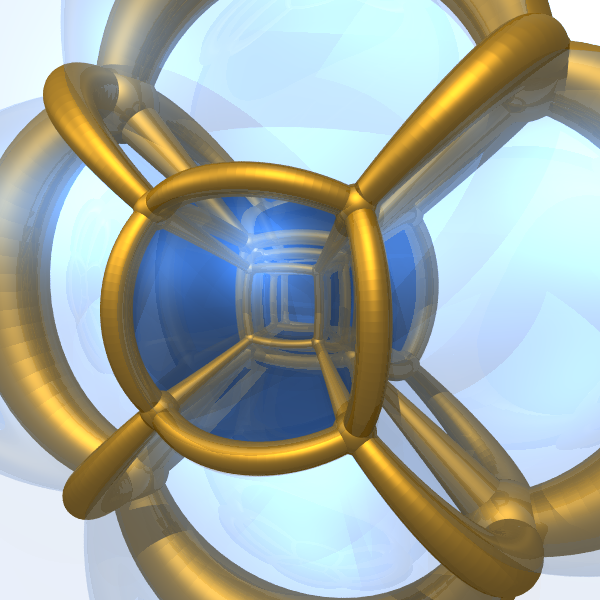
A perspective projection of a five-dimensional penteract
Entanglement or non-separability is the core idea of quantum theory. It is a simple idea: the universe is not a bunch of independent parts, but is rather one entity that evolves through time as one entity. That’s it. The problem is that this means there’s no such thing as causation. This is very hard to wrap your head around. Quantum theory is extraordinarily accurate, and our knowing quantum theory is why we have things like cell phones and computers. But what is quantum theory, really? Why is entanglement its primary prediction? This talk will explain what quantum theory is. It will show that quantum theory has nothing to do with tiny particles, wave-function collapse, or Schroedinger’s cat. Quantum theory is about how observers obtain information about the world. It is, in particular, about how observers who have memories and use language obtain information about the world. It is, in other words, about how you and I interact with perfectly ordinary things like tables and chairs and each other. You will leave this talk with a new understanding of quantum theory, and a new appreciation for entanglement. Chris Fields is an interdisciplinary information scientist interested in both the physics and the cognitive neuroscience underlying the human perception of objects as spatially and temporally bounded entities. His current research focuses on deriving quantum theory from classical information theory; he also works on cell-cell communication and cellular information processing, the role of the “unconscious mind” in creative problem solving, and early childhood development, particularly the etiology of autism-spectrum conditions. He and his wife, author and yoga teacher Alison Tinsley, recently published Meditation: If You’re Doing It, You’re Doing It Right, in which they explore the experience of meditation with meditators from many walks of life. Dr. Fields has also been a volunteer firefighter, a visual artist, and a travel writer. He currently divides his time between Sonoma, CA and Caunes Minervois, a village in southwestern France.




 Kenneth Harper Finton