FUN FACTS ABOUT NURSERY RHYMES

TWINKLE, TWINKLE LITTLE STAR

Unknown

The joint authors of Twinkle twinkle little star were two sisters called Ann Taylor (1782-1866) and Jane Taylor (1783-1824). The first publication date was 1806. How many of us know all the words?

Twinkle twinkle little star, how I wonder what you are?
Up above the world so high , like a diamond in the sky
When the blazing sun is gone, when he nothing shines upon,
Then you show your little light, twinkle, twinkle all the night.

Then the traveller in the dark, thanks you for your tiny spark,
He could not see which way to go, if you did not twinkle so.
In the dark blue sky you keep, and often through my curtains peep,
For you never shut your eye, ’till the sun is in the sky.
As your bright and tiny spark lights the traveller in the dark,
Though I know not what you are — twinkle, twinkle little star.


WHO KILLED COCK ROBIN?

Unknown-2

The origin of the “Who killed cock robin” poem: ‘Who killed cock robin?’ Not really a nursery rhyme, this is best described as an English folk song or poem. The words of “Who killed cock robin” are said to refer to the death of the legendary figure of Robin Hood and not that of a bird.

The legend of Robin Hood encompasses the theme that he stole from the rich to give to the poor. The words of “Who killed cock robin” describe how help was offered from all quarters following the death of cock robin thus reflecting the high esteem in which Robin was held by the common folk.

“Who killed Cock Robin?” “I,” said the Sparrow,
“With my bow and arrow, I killed Cock Robin.”
“Who saw him die?” “I,” said the Fly,
“With my little eye, I saw him die.”
“Who caught his blood?” “I,” said the Fish,
“With my little dish, I caught his blood.”
“Who’ll make the shroud?” “I,” said the Beetle,
“With my thread and needle, I’ll make the shroud.”
“Who’ll dig his grave?” “I,” said the Owl,
“With my pick and shovel, I’ll dig his grave.”
“Who’ll be the parson?” “I,” said the Rook,
“With my little book, I’ll be the parson.”
“Who’ll be the clerk?” “I,” said the Lark,
“If it’s not in the dark, I’ll be the clerk.”
“Who’ll carry the link?” “I,” said the Linnet,
“I’ll fetch it in a minute, I’ll carry the link.”
“Who’ll be chief mourner?” “I,” said the Dove,
“I mourn for my love, I’ll be chief mourner.”
“Who’ll carry the coffin?” “I,” said the Kite,
“If it’s not through the night, I’ll carry the coffin.”
“Who’ll bear the pall? “We,” said the Wren,
“Both the cock and the hen, we’ll bear the pall.”
“Who’ll sing a psalm?” “I,” said the Thrush,
“As she sat on a bush, I’ll sing a psalm.”
“Who’ll toll the bell?” “I,” said the bull,
“Because I can pull, I’ll toll the bell.”
All the birds of the air fell a-sighing and a-sobbing,
When they heard the bell toll for poor Cock Robin.


RAIN. RAIN, GO AWAY

Unknown-1

The origin of the lyrics to “Rain rain go away” dates back to the reign of Queen Elizabeth I (1533-1603). During this period in English history there was constant rivalry between Spain and England eventually leading to the launch of the Spanish Armada in 1588.

Once again, most of us know only part of the older poem. When rhe Spanish Armada was sent to invade England.  The attempt failed, not only because of the swifter nature of the smaller English ships but also by the stormy weather which scattered the Armada fleet. Hence the origin of the “Rain rain go away” Nursery rhyme!

Rain rain go away,
Come again another day.
Little Johnny wants to play;
Rain, rain, go to Spain,
Never show your face again!


BANBURY CROSS (RIDE A COCK HORSE)

 

037187_73abfc8c

Ride a cock horse to Banbury Cross
To see a fine lady upon a white horse
With rings on her fingers and bells on her toes
She shall have music wherever she goes.


Stallions were called ‘cock’ horses in old England. The reason is obvious to horse people. They say this rhyme is about Elizabeth I who went to Banbury to see the newly erected stone cross. The rings on her fingers anb bells on her toes refer to the Plantagenet dynasty custom of attaching bells to their pointed shoes. Banbury Cross was located at the top of a steep hill. The Queen’s carriage broke a wheel. so Elizabeth chose to get on the white cock horse to make the trip. The people celebrated her arrival with ribbons and hired minstrels to accompany her on her visit, so she had music wherever she went.


THE HOMEWRECKERS


110506.ajm_.demolition.3766

“They are tearing down my childhood home today,” he said, wishing instead he were already dead. “I should not watch. It is a sad thing to see,” he said, thinking softly of the past, wishing it could forever last.

images-1“I wish I could have done more to save it,” he mused, feeling the blues as it oozed from the news.

images

“I ate watermelon at the kitchen table, sweet as summer’s breath,” he said, tasting the juice that his mind reproduced.

Family-At-Table-1954-001

“We had many a memory in that house,” he understated,

110506.ajm_.demolition.37061

watching as his reality was castrated.

memory

“I wonder it I was happier back then than now,” he exclaimed, unashamed that he had no fame. “Probably not,” he said to himself, knowing he had not mastered laughter in the face of disaster.

Unknown

“Some folk’s homes become museums,” he pondered as his thoughts wandered. “I was never that important,” he concluded, as he brooded.


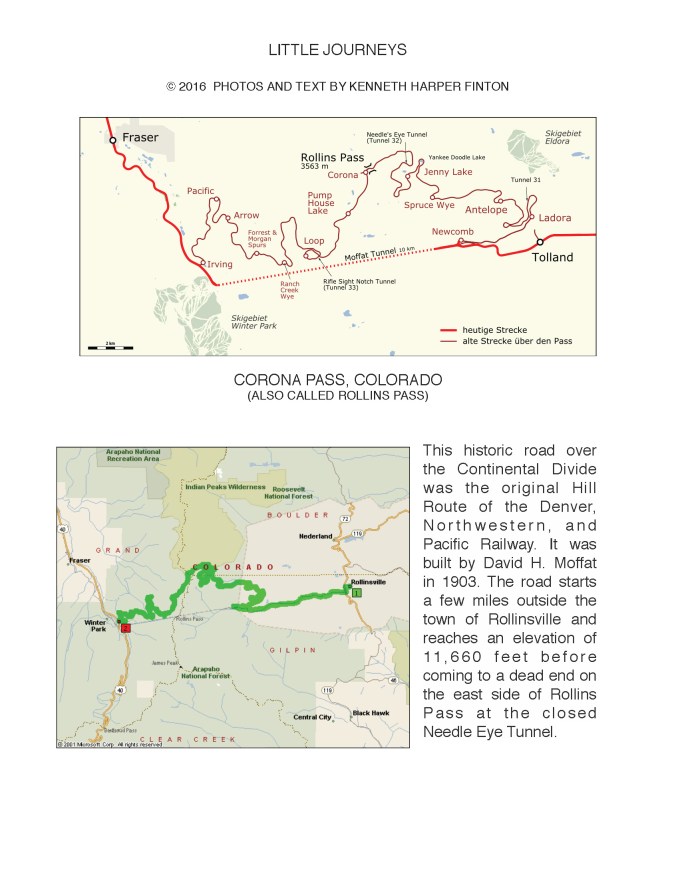
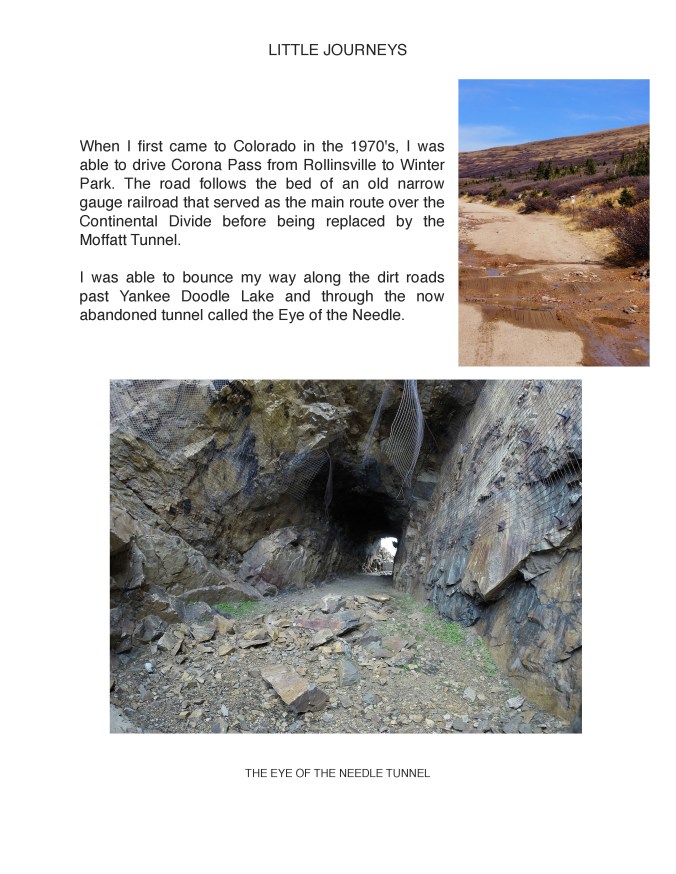
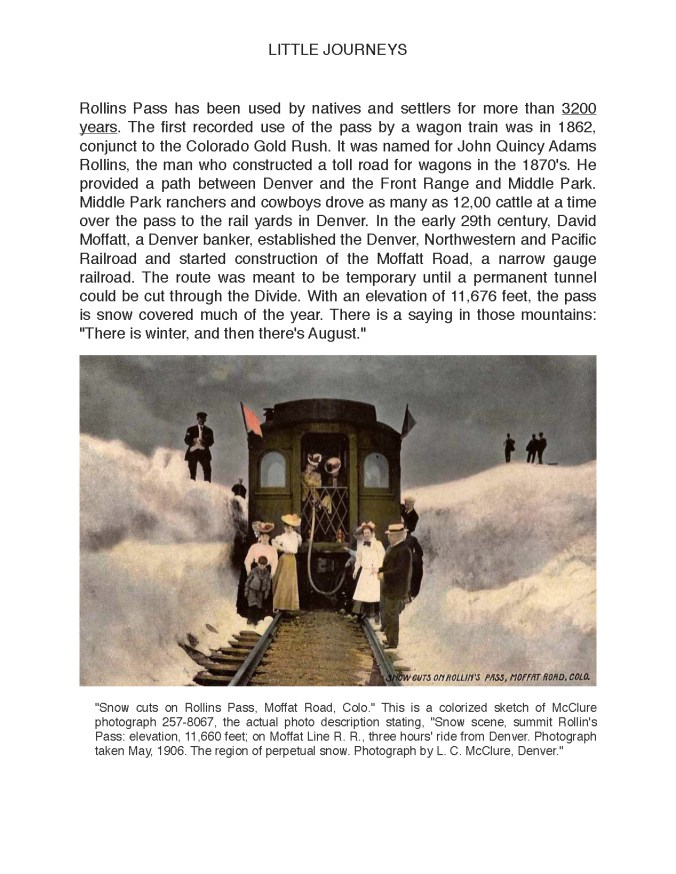
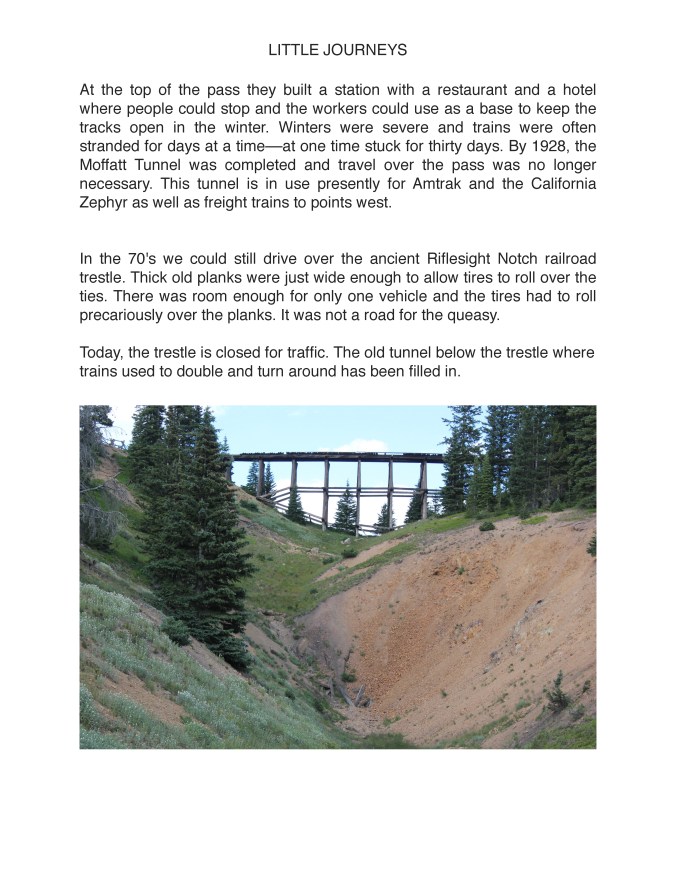
Little Journeys: Corona Pass

CORONA PASS_Page_1

CORONA PASS_Page_2

CORONA PASS_Page_3

CORONA PASS_Page_4

CORONA PASS_Page_5

CORONA PASS_Page_6

CORONA PASS_Page_7.jpg

NATURE WALKS


NATURE WALK copy _Page_1

NATURE WALK copy _Page_2


NATURE WALK copy _Page_3

NATURE WALK copy _Page_5

NATURE WALK copy _Page_6


NATURE WALK copy _Page_8

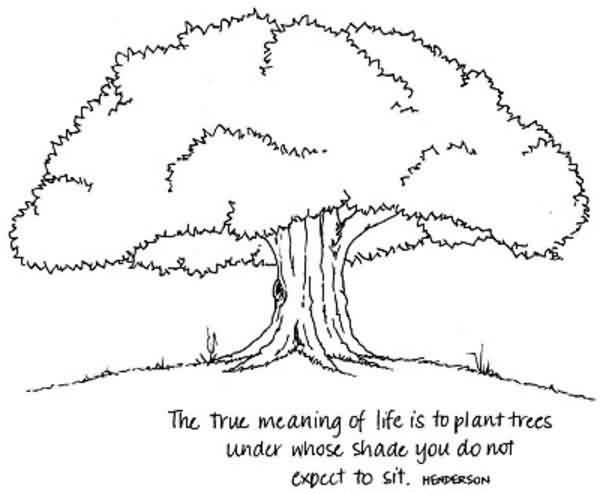
A SHADY SPOT WHERE I WILL NEVER SIT


13062182_10207232912513369_1626455923896667159_n


I did not write this caption, but I could have written it. 

I believe in planting trees in whose shade I will never sit.

We would all be happier if we all did this.

The artist within us strives to perfect for perpetuity.

The writer within us knows that most of their words are not read.

The caregivers within us know that their efforts will not be returned.

We know we cannot take our efforts and our concerns with us.

We plant seeds for tomorrow even if tomorrow does not come.

Likely, we would likely go mad if we did not do this.

A good parent is a parent that gives to the future.

The future is about the quality of life of the child and the grandchild.

Yet there are those of us who do not believe in the future.

There are among us those that believe the world is ending.

They believe that the end of time is the will of beings greater than themselves.

There is no factual evidence that their beliefs are correct.

Riches are better than poverty. Wealth provides comfort.

Health is better than illness. It maintains our being.

Contentment is better than depression.

To know something is much better than believing something.

To know is a personal fact. To believe is a personal wish.

And every word I write is a shady spot where I will never sit.

DOES THE PENIS SHRINK WITH AGE?

By Kenneth Harper Finton

n-PENIS-SIZE-628x314

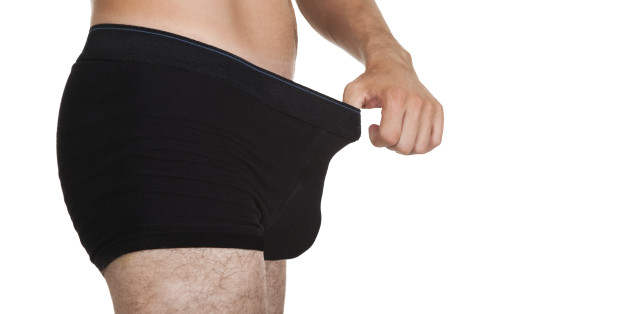
Man looking in his underwear

Does the penis shrink in size as it ages? The astounding answer is “yes, it does.” Nobody talks about it. Men fear it, women don’t really care, and young men have no idea what is coming (pun intended). Sexual dysfunction in men with age is no secret. Sometimes it seems that every other ad on TV tries to sell a pill for it. Newer comedy movies are not complete until the older male has a problem with his little blue pill that leads to hilarious consequences. The percentage of potent men falls from 60% to around 30% between the ages of 40 and 70.

Most men know little about their penis. It begins to change around age 30. The head gradually loses its purplish color that is created by healthy and youthful blood flow. The head becomes less sensitive and gradually shrinks in size and girth as a result of decreased testosterone and blood flow. By the time a man is 60 or 70 he loses around an inch or more in size.

“If a man’s erect penis is 6 inches long when he is in his 30s, it might be 5 or 5-and-a-half inches when he reaches his 60s or 70s,” Irwin Goldstein says. “As testosterone wanes, the penis gradually reverts to its prepubertal, mostly hairless, state.” Goldstein, MD, is director of sexual medicine at Alvarado Hospital in San Diego and editor-in-chief of The Journal of Sexual Medicine. So even men without a tendency for baldness should not be surprised that they also gradually lose pubic hair. It also turns gray as it thins. [If this fact is troublesome, one alternative would be to shave it off like  porno stars do and lengthen the apparent length of your penis as well.]

Age brings declines in semen volume and sperm quality. Also, the urine stream weakens as the bladder muscles become weaker and the prostate enlarges.

The beer belly adds to the apparent loss in size of the penis because “a large pre-pubic pad of fat makes the penile shaft look shorter,” says Ira Sharlip, MD, clinical professor of urology at the University of California, San Francisco.

“In some cases, abdominal fat all but buries the penis,” says Ronald Tamler, MD, Ph.D., co-director of the Men’s Health Program at Mount Sinai Hospital in New York City. “One way I motivate my overweight patients is by telling them that they can appear to gain up to an inch in size simply by losing weight.”

The penis shrinks from the same process that causes atherosclerosis. It is the same disease that contributes to blockages inside the coronary arteries and is a leading cause of heart attack. Fatty plaque is deposited by the blood in the small arteries and vessels in the penis, impairing the flow of blood and making erections softer and harder to achieve.

USE IT OR LOSE IT 

ThinkstockPhotos-474440822

overripe banana

You need to have erections regularly to keep your penis in shape. “It has to be essentially exercised,” says Tobias Kohler, MD, assistant professor of urology at Southern Illinois University School of Medicine.

The brain dreams and dreams help to set up an automatic penis maintenance function for exercising the penis. “Pulses from the brain cause erections during the dreaming phase of sleep called the REM phase.”

Whether by a remembered dream or not, the penis gets hard during that REM period of the sleep cycle. It doesn’t matter if you’re having a hot sex dream or an apocalyptic nightmare. Dreaming brings erections.

Some men such as those who’ve suffered trauma to the nerves involved or who have nerve or blood vessel damage caused by diabetes are physically unable to get erections.

Most men can get erections.

There is a lot of locker-room significance to the facts. You cannot assume that a man with a big, limp penis gets much bigger with an erection. The guy whose penis looks tiny might get a surprisingly big erection. Many women do not care about penis size, as enormous shafts can be quite painful. If a finger works for satisfaction, a smaller penis can also suffice as well. Technique is often more important than size. Half the total length of a penis is tucked away inside the body. It is invisible.

“It’s what he does with it and the rest of his body that matters,” says Lou Paget, a certified AASECT sex educator and author of “The Great Lover Playbook.”

SOURCES:

http://www.webmd.com/men/guide/life-cycle-of-a-penis

http://www.huffingtonpost.com/2015/01/15/penis-problems-aging-_n_6480920.html

http://www.webmd.com/men/guide/8-things-you-did-not-know-about-your-penis

http://www.menshealth.com/health/your-penis-when-you-age

THE HUNZA PEOPLE OF NORTH PAKISTAN

http://www.readgang.com/2016/03/they-never-get-sickthey-dont-know-about.html

fgr

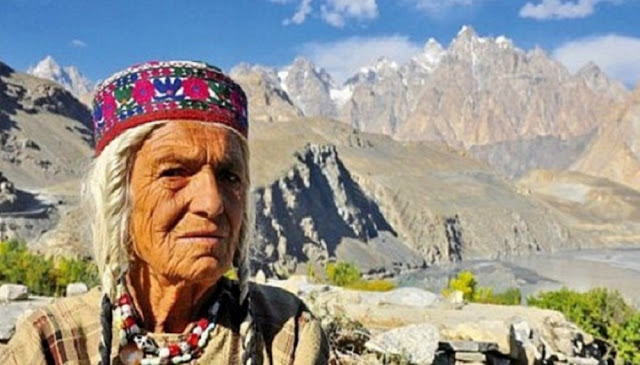
LEGEND HAS IT THAT THESE ARE THE PEOPLE OF SHANGRI-LA

Is living well past 100 years only a dream?  Not in Northern Pakistan.

They, like many in Northern Pakistan, claim to be descendants of the soldiers who came to the region with Alexander the Great‘s army in the 4th century BC.

Healthy living advocate J. I. Rodale wrote a book called The Healthy Hunzas in 1955 that asserted that the Hunzas, noted for their longevity and many centenarians, were long-lived because of their consumption of healthy organic foods such as dried apricots and almonds, as well as their getting plenty of fresh air and exercise.[21] He often mentioned them in his Prevention magazine as exemplary of the benefits of leading a healthy lifestyle.

Dr. John Clark stayed among the Hunza people for 20 months and in his book Hunza – Lost Kingdom of the Himalayas[22] writes: “I wish also to express my regrets to those travelers whose impressions have been contradicted by my experience. On my first trip through Hunza, I acquired almost all the misconceptions they did: The Healthy Hunzas, the Democratic Court, The Land Where There Are No Poor, and the rest—and only long-continued living in Hunza revealed the actual situations”. Regarding the misconception about Hunza people’s health, John Clark also writes that most of the patients had malaria, dysentery, worms, trachoma, and other things easily diagnosed and quickly treated; in his first two trips, he treated 5,684 patients.

Clark reports that the Hunza do not measure their age solely by the calendar––as he also said there were no calendars––but also by personal estimation of wisdom. This leads in turn to notions of typical lifespans of 120 or greater.

The October 1953 issue of National Geographic had an article on the Hunza River Valley that inspired Carl Barks’ story Tralla La.[23] Their standard of living is totally different from the others. Barks said,  “the healthy way of that kind of living should be an example to us.”

THE HUNZA LIFESTYLE

Hunza people are people who take a bath in cold water, and they can give birth to a baby at 65 years.

In summer, they eat only raw foods and in winter they use dry fruits, especially apricots, germinated seeds, and cheese from sheep.

”Hunger spring” is the name of the period when they are fasting. At that time, they do not eat anything, but they do drink clean water.

From 2 to 4 months they drink that water and consume the apricot seeds.

One of the Hunza people, known worldwide as Said Abdul Mobuda, totally confused the workers for immigration services when he pulled out his passport which stated that he has lived 160 years. They did not believe him until they checked that the man is really born 160 years ago and that in his village all the people have a long lifetime.

THEIR GENETIC LINE

A variety of Y-DNA haplogroups are seen among the Burusho. Most frequent among these are R1a1 and R2a, which probably originated in Central Asia during the Upper Paleolithic.[17][18] R2a, unlike its extremely rare parent R2, R1a1, and other clades of haplogroup R, is now virtually restricted to South Asia. Two other typically South Asian lineages, haplogroup H1 and haplogroup L3 (defined by SNP mutation M20) are also common among the Burusho.[19] [18]

Other Y-DNA haplogroups reaching considerable frequencies among the Burusho are haplogroup J2, associated with the spread of agriculture in, and from, the Neolithic Near East,[17][18] and haplogroup C3, of Siberian origin and possibly representing the patrilineage of Genghis Khan. Also present at lower frequency are haplogroups O3, an East Eurasian lineage, and QPF, and G.[18] DNA research groups the male ancestry of the Hunza with speakers of Pamir languages and the Sinti Romani (Gypsies), due primarily to the M124 marker (defining Y-DNA haplogroup R2a), which is present at high frequency in all three populations.[8] However, they have also an East Asian genetic contribution, suggesting that at least some of their ancestry originates north of the Himalayas.[20]

NATURE’S FLIGHT PATHS

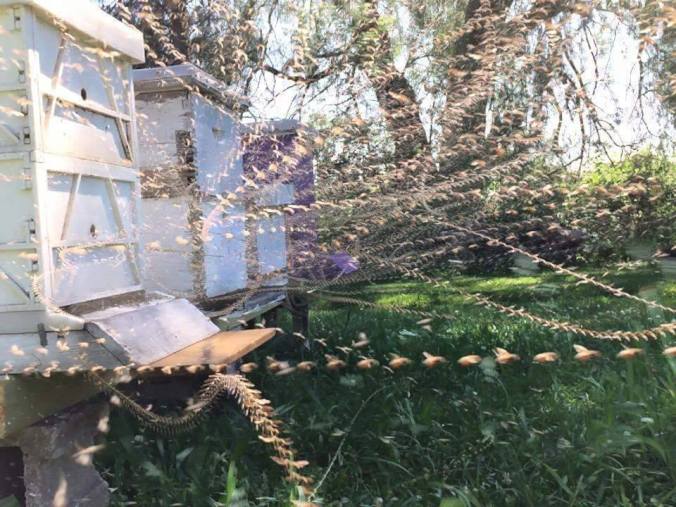
bees flight path

Time lapse of bees in flight.

CAPTURING THE RHYTHM  OF BIRD AND INSECT FLIGHT

 Source:

Dennis Hlynsky is a professor at Rhode Island School of Design. He began filming birds in 2005 on a Flip video camera. What began as a hobby turned into a remarkable study in bird behavior. Hlynsky’s videos capture the raw rhythm of life. They are filled with graceful geometric patterns.

BLACK VULTURES

By using a unique process known as extruded time, or layering frame sequences atop one another until the darkest pixels become “tracers”, we are able to see the birds careening across the sky, leaving a discernible trail behind them like ice skates do on ice. Hlynsky uses a Lumix GH2 to capture footage of the birds in flight before turning that into time lapses that are several minutes longer. Once he’s uploaded the footage to his computer, he uses the magic of After Effects to stack the sequence of shots closer together and after hours of editing, the flight paths are finally unveiled. Source:

STARLINGS AT SUNSET

CROWS

WE ARE ALL FLINT

WE ARE ALL FLINT

View at Medium.com

SEE ALSO: https://kennethharperfinton.me/2016/02/29/is-chloramine-in-your-tap-water/

Erin Brockovich

How America’s Moms Are Leading

the Battle for Clean Drinking Water

THIS IS AMERICA’S WATER


We saw Flint coming. In fact, I’ve seen this whole national water crisis coming for years. I see these issues happen, I know where they are. I know when they’re going to hit. And I know they’re going to come up, year after year after year.

I know because tens of thousands of people write to me each month. I started creating a map and I have more than 10,000 communities across the U.S. recording their plights. People come to me, saying, there’s too many children on our street with cancer, or we’ve had too many high school kids die of brain tumors, or we live next to a superfund site and we think our water is contaminated. After one comes forward, then five follow, then 20, 30, more. I read hundreds of these emails everyday, and sometimes you have to be able to read between the lines. I can sense the urgency. I know when what people are saying is just not right. Some emails clearly speak volumes, and I’m like, we need to jump on this now. It’s about being responsive: Last February, when my investigator Bob Bowcock and I heard about Flint, he was on a plane the next day.

What has always stuck me the most were the instances where people’s health was deteriorating. This has been true from the time I was a little girl to my work in Hinkley and beyond. What’s that common denominator? It’s usually the water. The one thing that sustains us all.

Communities across the country have been dealing with lead issues for years — but they’ve always fallen on a deaf ear. Flint is simply the perfect storm.

 
These horrifying images are sent to me every week from people all over the United States.

I didn’t discover Flint — the community wrote to me. We got out there and tried to sound the alarm. There’s almost always a community leader, and nine times out of 10, it’s going to be a mom. She starts gathering the community, setting up town meetings so we can inform people about what’s happening. We show folks how to protect themselves and their families. We try to work with the emergency contingency team that’s in place — we do that everywhere we go, and they usually don’t want to hear it. They want to run things their way, they think we’re just there to cause trouble, but that’s not the case at all.

Unfortunately, it takes a huge crisis like Flint for everybody else to wake up.


Right now, we’re in this special moment where people are paying attention and raising their voices. These chemicals, this problem, did not just arise yesterday. People have been drinking water that’s contaminated with PFOA or lead or TCE or other chemicals for too long. Towns in New Hampshire, Vermont, and New York are learning that their water is contaminated. Schools have turned off water fountains due to lead poisoning. Hannibal, Missouri and Tyler, Texas and Sebring, Ohio are all sounding the alarm.

These issues don’t see any boundaries of rich or poor, black or white, Republican or Democrat. All kinds of people everywhere are being taken advantage of. There’s this false sense of security that we’ve all been lulled into, and only now are people actually waking up to reality.

Eventually this moment will go away, when the attention wanes, and we will all forget that it ever happened — until the next crisis hits the news.


Look, there’s plenty of blame to go around. It’s here. It’s happening, it’s been going on for a very long time. It will continue to go on, and it’s going to get worse until we have a disaster situation that we cannot turn around. Agencies have not listened; they haven’t done the right thing, either out of fear or greed. This is morally wrong on a thousand different levels. And this is where we have to change.

The EPA is over burdened, understaffed, and broke. And this agency oversees our Safe Drinking Water Act. If we are going to have these federal agencies, we need to actually support them. Because, frankly, right now they’re not doing any good.

Sure, there are some good, well-intentioned, intellectual people in the EPA who want to make a difference. I don’t want everybody to go down when someone makes a bad decision, but unfortunately, bad decisions are happening everywhere.

We learned just this week that, in a memo, an EPA official stated that “Flint was not worth going out on a limb for.” The fact that someone from the governmental agency that is there to protect the health and the welfare of the people made such a disgusting comment will tell you where the problem is.

I’m so perplexed by Governor Rick Snyder’s thinking. He should be criminally prosecuted because he has done so much damage. That’s my opinion. To continue to waste millions of dollars of tax payers’ money to defend himself — Where is your decency? Where is your integrity as a human being, Governor? Please step down. Save that money, give it to those people who need it, get out of office, and let us begin the difficult task of repairing this problem.

These are real, legitimate, serious issues, and too often our government officials dismiss the affected community. Too often agencies fail to check on the health and welfare of people who live in a known contaminated zone. Too often they are dodging a bullet, hiding information, and doing it just to save a buck. Too often, the government is in denial.

Until we really start to listen — and I mean, until the municipalities, federal and state agencies start to listen to the people — instead of reacting to these disasters, we’re going to continue to create greater problems. Government officials and communities need to change their thinking in order to catch the crisis before it happens. And it starts with listening to the people. Right now, nobody is listening, so they come to me.


I’m a grandmother now, and I’m asking myself, what will be our legacy? What am I leaving? If I don’t continue to fight for this, what kind of world would I leave for my little grandchildren, Molly, Grace, and Charles?

My job isn’t to sit here and point fingers, my job is to care. We all do, about our health, our family’s health, our grandchildren’s health, and our neighbors health. I know we do.

Nothing is more important than water. It is connected to every single thing we do: our health and our welfare and our economy. And it should be up to the federal government, the state, every agency, right down to the local levels, to find a solution that provides safe water for all. The solution to pollution is not dilution. That is what we have used our water systems for in the past, and if we continue to do so, we are going to pay the ultimate price — many people already have.

If we could look back at history do something different, we would. We are at that moment right now. We can do something different. We don’t have to make history repeat itself. We are better than that.

We are living in a great country full of great people. We are now more connected then we have been before. We have easy access to information, we are more aware, more educated, more informed — and that’s helping us make different choices in how we live our lives. The millennials are starting a groundswell, which I think is fabulous. In the past our voices haven’t been heard — but now they are starting to rise.

When everyone uses their voice, that’s when we all get on that page — and I’m talking about our leaders. That’s how we change things. That’s how we set the tone and it’s how we move the world forward.

SEE ALSO:

https://kennethharperfinton.me/2016/02/29/is-chloramine-in-your-tap-water/

RUMP OR ASS?

What is your cut?

Sexist crap?

Sell meat by showing beef cut counterparts on a naked girl?

This ad uses a naked woman’s body in order to depict the certain types of meat cuts you can find on a cow.

Do we assume that people are buying their meat because they can then actually connect this diagram of a woman to a cow?

Are we deciding what meat cut we want from the cow diagram? Does the round rump of the woman seem more delicious and quite sexy?

Does the round and the rump of the woman make men nod in approval?  Does it seem  delicious and quite sexy?

Does this show us how society thinks of women, or is that reading too much into it a clever advertising ploy?

Is this simply another reference to the feminine and masculine properties where even foods have masculine and feminine articles to identify them.

One thing noticeably missing here is the breast, always tasty, always a favorite.